What it is
NebulaGraph is an open-source, distributed graph database written in C++ and released under the Apache-2.0 license. It lives in the graph database ecosystem and appears in the CNCF Database Landscape. The project describes itself as symmetrically distributed, with storage and computing separated into distinct layers, horizontal scalability across nodes, strong data consistency enforced through the RAFT protocol, an OpenCypher-compatible query language, role-based access control, and a set of graph analytics algorithms. It has been developed for roughly eight years and carries 12,387 stars, 1,330 forks, and 678 open issues on GitHub.
The concrete problem it solves is querying large volumes of highly connected data at low latency. Relational stores and simple key-value engines handle connected data poorly once traversal depth grows, because each hop becomes another join. NebulaGraph targets that case directly: it is built to hold large data volumes, answer queries in milliseconds, scale up quickly as the graph grows, and run fast graph analytics over the result. The README names social media, recommendation systems, knowledge graphs, security, capital flows, and AI as domains where it is already used.
Key capabilities
- Symmetrically distributed architecture, so no single component carries a structurally privileged role.
- Storage and computing separation, letting the two layers scale independently.
- Horizontal scalability for growth in data volume and query load.
- Strong data consistency provided by the RAFT protocol.
- OpenCypher-compatible query language, which keeps existing Cypher-style queries and skills usable.
- Role-based access control for higher-level security.
- Graph analytics algorithm support for analytical workloads beyond plain traversal.
Who uses it and how
- Social media platforms, where the graph encodes relationships between users and their interactions.
- Recommendation systems that follow user-item and item-item edges to select candidates.
- Knowledge graph and knowledge base construction, including the GraphRAG pattern named in the topic list.
- Security and capital flow analysis, where tracing paths through connected entities is the primary operation.
- Big-data and distributed-systems deployments that need a graph store alongside existing infrastructure.
Getting started
The README points to the getting started documentation for a quick start, and lists three routes: downloading a release, building from source, or running in the cloud on AWS. NebulaGraph is a distributed database with multiple components, so the source build covers the full set rather than a single binary.
When to use it — and when not to
Choose NebulaGraph when the workload is genuinely graph-shaped and needs distribution: deep traversals, analytics, and data volumes that must spread across machines. A self-hoster must operate a multi-component distributed system rather than a single
project readme (upstream, from github) — read inline
English | 中文
A distributed, scalable, lightning-fast graph database





NebulaGraph
Introduction
NebulaGraph is a popular open-source graph database that can handle large volumes of data with milliseconds of latency, scale up quickly, and have the ability to perform fast graph analytics. NebulaGraph has been widely used for social media, recommendation systems, knowledge graphs, security, capital flows, AI, etc. See our users.
The following lists some of NebulaGraph features:
- Symmetrically distributed
- Storage and computing separation
- Horizontal scalability
- Strong data consistency by RAFT protocol
- OpenCypher-compatible query language
- Role-based access control for higher-level security
- Different types of graph analytics algorithms
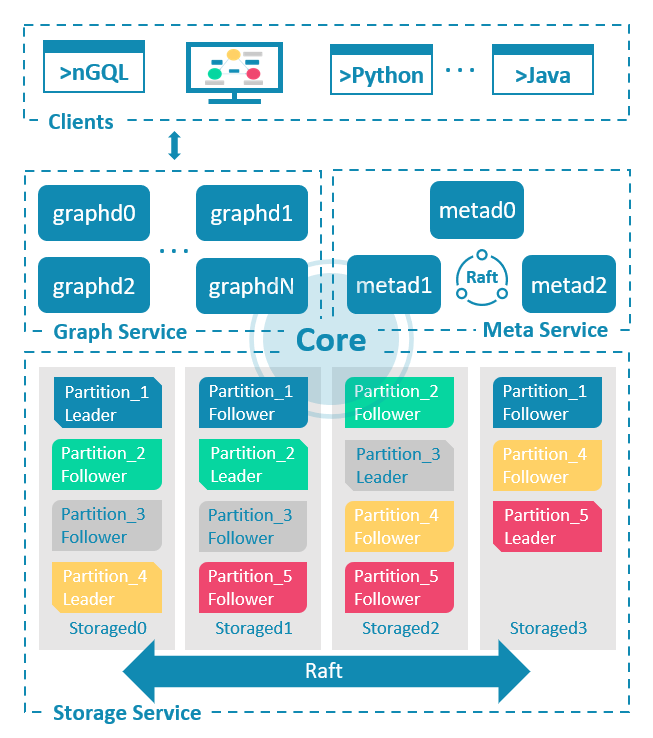
The following figure shows the architecture of the NebulaGraph core.
Learn more on NebulaGraph website.
Quick start
Read the getting started docs for a quick start.
Using NebulaGraph
NebulaGraph is a distributed graph database with multiple components. You can download or try in following ways:
Getting help
In case you encounter any problems playing around NebulaGraph, please reach out for help:
DevTools
NebulaGraph comes with a set of tools to help you manage and monitor your graph database. See Ecosystem.
Contributing
Contributions are warmly welcomed and greatly appreciated. And here are a few ways you can contribute:
Landscape

NebulaGraph enriches the CNCF Database Landscape.
Licensing
NebulaGraph is under Apache 2.0 license, so you can freely download, modify, and deploy the source code to meet your needs.
You can also freely deploy NebulaGraph as a back-end service to support your SaaS deployment.
Contact
Community
If you find NebulaGraph interesting, please ⭐️ Star it at the top of the GitHub page.