mycli


Rich MySQL terminal client with auto-completion, syntax highlighting, and dataframes.
Homepage: https://mycli.net
Documentation: https://mycli.net/docs
Mycli is known to be compatible with
Postgres equivalent
Release 2.x
Release 2.0.0 has breaking changes!
Quick Start
If you already know how to install Python packages, then you can install mycli
via pip. This package is always up to date.
You might need sudo on Linux.
pip install --upgrade 'mycli[all]'
or, on macOS (pygments is optional but recommended):
brew update && brew install mycli pygments
or, on Debian or Ubuntu (fzf and pygments are optional but recommended):
sudo apt-get install mycli fzf python3-pygments
Usage
See
mycli --help
Features
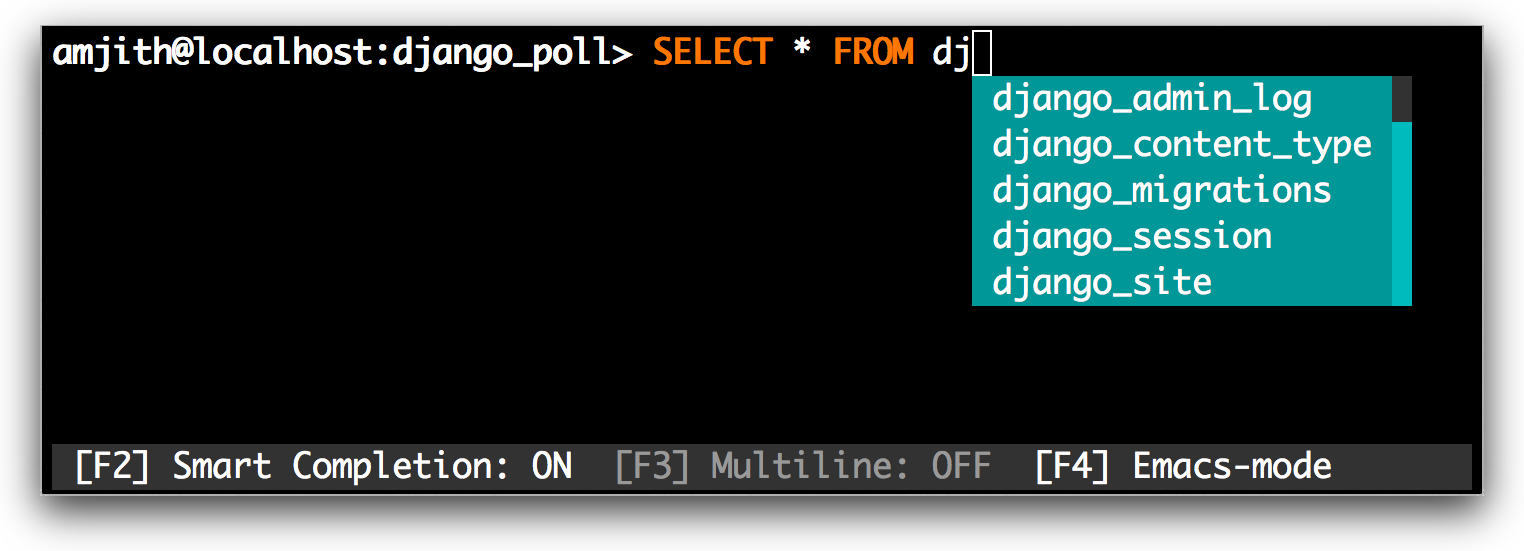
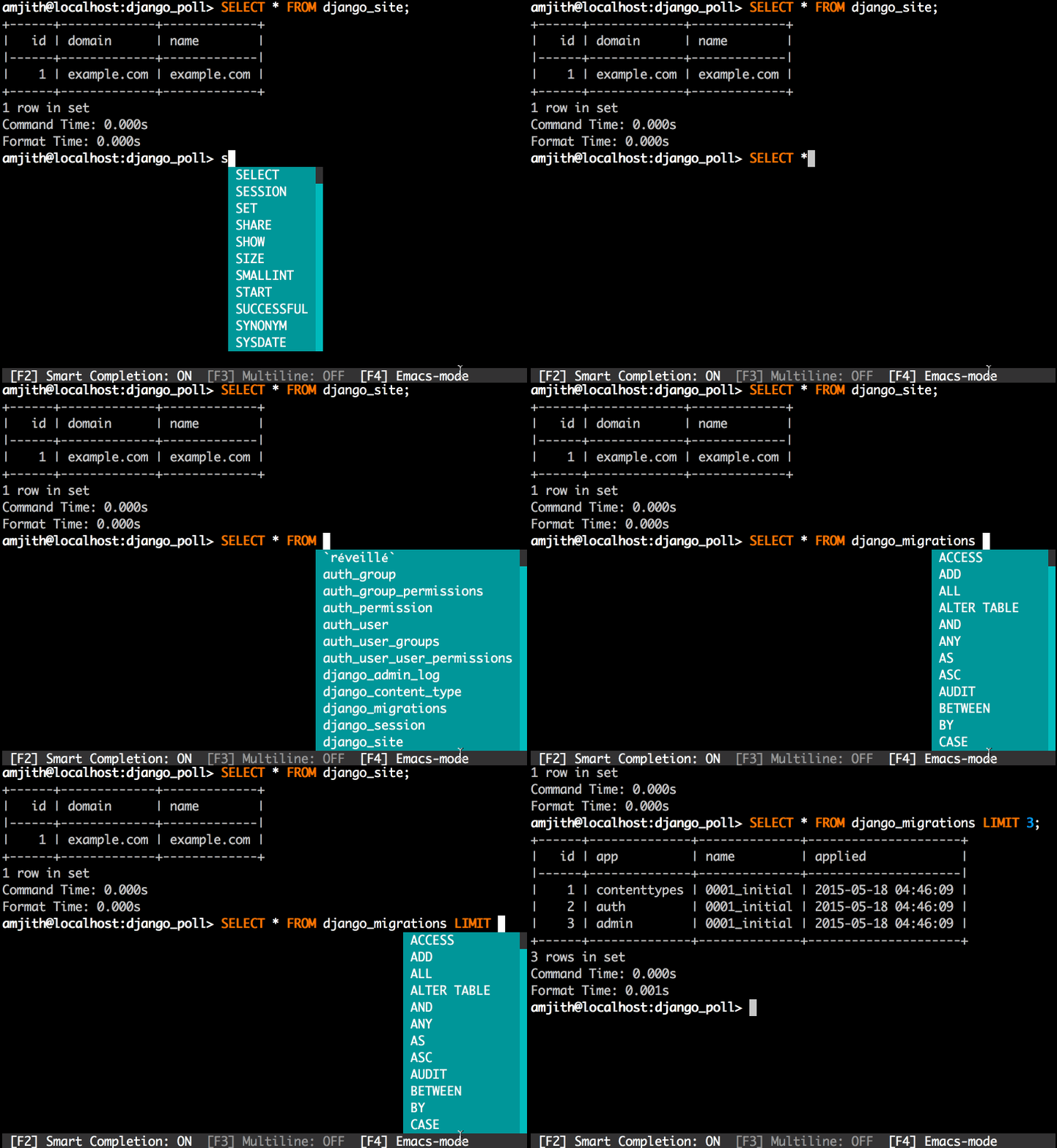
- Auto-completion as you type for SQL keywords as well as tables, views, columns, enums, and more!
- Fuzzy history search using fzf.
- Output explorer using fzf or other tools.
- Syntax highlighting using Pygments.
- Smart-completion suggests context-sensitive completion:
SELECT * FROMtab will only show table names.SELECT * FROM users WHEREtab will only show column names.
- Multiline queries.
- Favorite queries with positional or named parameters using Jinja. Save a query using
and execute it with/fs alias/f alias --key=value - Timing of SQL statements and table rendering.
- Logging of every query and its results to a file (off by default).
- Pretty printing of tabular data.
- Shell-style trailing redirects with
$>,$>>and$|operators. - Polars dataframe transforms and plots with
.|, and Parquet saves with.>. - Querying LLMs with context derived from your schema using
/llm. - Storing passwords in the system keyring.
- Modern defaults such as UTF-8 connection type and SSL.
- Integrations with: SSH, Kubernetes, Vault, and Boundary.
Mycli creates a config file ~/.myclirc on the first run; you can use the
options in that file to configure the above features, and more.
Some features are only exposed as key bindings.
Contributions
If you're interested in contributing to this project, first of all we would like to extend our heartfelt gratitude. We've written a small doc to describe how to get mycli running in a development setup.
https://github.com/dbcli/mycli/blob/main/CONTRIBUTING.md
Additional Install Instructions
Shell Completions
If installed via Homebrew, shell completions may already be configured.
Otherwise, to configure shell completions for the current session, execute a command like this:
eval "$(mycli --completions SHELL)"
replacing SHELL with bash, zsh, or fish, depending on your choice of
shell.
To permanently install shell completions, the above command may be added to your
~/.bashrc, ~/.zshrc, or ~/.config/fish/config.fish. To speed up login
time, the output of mycli --completions SHELL may be saved to a file and
loaded with source.
Alternative Install Methods
These are some alternative ways to install mycli that are not managed by our team but provided by OS package maintainers. OS packages could be considerably out of date.
If present, the fzf package can be used for fuzzy history search, and as an
output "explorer" with the \x special command. pygmentize can be used for
syntax highlighting within the fuzzy history search. The less package is
also expected, but almost always already installed.
Arch, Manjaro
You can install the mycli package available in the AUR. fzf and
python-pygments are optional but recommended:
yay -S mycli fzf python-pygments
Debian, Ubuntu
On Debian and Ubuntu distributions, you can easily install the mycli package
using apt. The fzf and python3-pygments packages are optional but
recommended:
sudo apt-get install mycli fzf python3-pygments
Fedora
Fedora has a package available for mycli; install it using dnf. The fzf and
python-pygments packages are optional but recommended:
sudo dnf install mycli fzf python-pygments
Docker
The images on Dockerhub are out of date. ghcr.io is preferred. Example:
docker run --pull=always -it ghcr.io/dbcli/mycli:latest
Windows
Option 1: Native Windows
Install the less pager, for example by scoop install less.
Install the fzf fuzzy finder, for example by scoop install fzf.
Follow the instructions on this blog post: https://web.archive.org/web/20221006045208/https://www.codewall.co.uk/installing-using-mycli-on-windows/
The libraries used in mycli are Windows-compatible, but there are known limitations according to the test suite. The basics work without any modifications, but this configuration isn't supported software at this time.
PRs to address shortcomings on Windows would be welcome!
Option 2: WSL
Mycli is more compatible with WSL than with native Windows, though still not 100% perfect. This is a good option for using mycli on Windows.
With WSL, you are probably using an Ubuntu distribution, in which case recommended dependencies can be installed by
sudo apt-get install fzf python3-pygments
and mycli can be installed by apt-get or by pip (recommended):
pip install --upgrade 'mycli[all]'
PRs to complete WSL support would be welcome!
Thanks
This project was funded through Kickstarter. Our thanks to the backers who supported the project.
A special thanks to Jonathan Slenders for creating Python Prompt Toolkit, which is quite literally the backbone library, that made this app possible. Jonathan has also provided valuable feedback and support during the development of this app.
Click is used for command line option parsing and printing error messages.
Thanks to PyMysql for a pure Python adapter to MySQL databases.
Compatibility
Mycli is tested on macOS (full), Linux (full), Windows (partial), and WSL (partial), and requires Python 3.10 or better.
To connect to MySQL versions earlier than 5.5, you may need to set the
following in ~/.myclirc:
[connection]
# character set for connections without --charset being set at the CLI
default_character_set = utf8
or use --charset=utf8 when invoking mycli.
Configuration and Usage
For more information on using and configuring mycli, check out our documentation.
Common topics include: