munder-difflin is a free, open source orchestration & scheduling project written in TypeScript and released under MIT. It has 7,514 GitHub stars, 982 forks and 172 open issues, and was last pushed 4 hours ago. On this registry it ranks #26 of 64 tracked projects in Orchestration & Scheduling, with 5 head-to-head comparisons available. It gained 306 stars over the last 3 tracked days.

What is munder-difflin?

Munder Difflin is a free, MIT-licensed Electron desktop application that wraps the terminal agent CLIs you already run — claude, agy, codex, grok, kimi, qwen, opencode, crush, pi, and copilot — into a self-coordinating office of agents with shared memory and a mailbox, built for developers who want autonomous coding agents working on their own machine while they are away.

What it is

Munder Difflin is a local multi-agent harness written in TypeScript and shipped as an Electron, React, and Pixi.js desktop application. Each supported command runs as a real process inside a pseudo-terminal through node-pty and is rendered with xterm.js, so a session is byte-for-byte the CLI you already use rather than a reimplementation. On top of those processes the project layers a shared hive: a long-term memory layer, a mailbox, a blackboard, and a task ledger. A single agent, referred to as the GOD agent and named Michael, acts as the orchestrator and supervisor, holding the roster, routing messages, adjudicating between agents, and escalating to you only when it needs a decision.

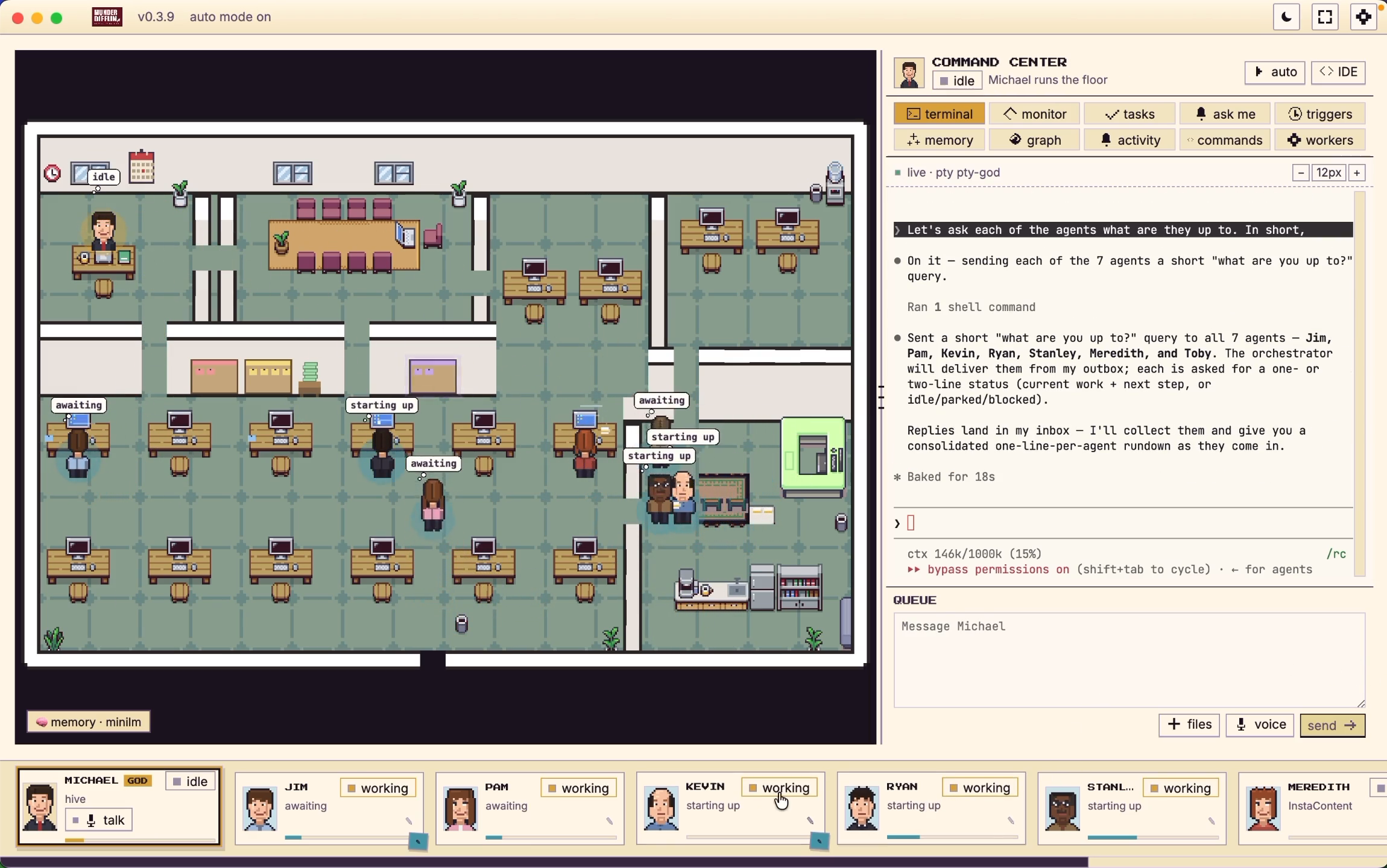
The concrete problem is coordination and amnesia across separate terminal sessions. Running one coding CLI at a time means each session starts cold, retains nothing from the previous one, and cannot hand work to another agent. Munder Difflin gives every agent a persistent markdown-first memory layer with a semantic recall index, so knowledge survives across sessions, plus a mailbox and router that move envelopes between agent inboxes. Agents appear as avatars on a Pixi.js office floor, walking to stations as they work, which makes the state of a hive of agents visible instead of buried in scrollback.

Key capabilities

  • Wraps eleven named agent CLIs — Claude Code, Antigravity (Gemini), OpenAI Codex, xAI Grok, Kimi Code, Gemini CLI, Qwen, OpenCode, Crush, pi.dev, and GitHub Copilot CLI, plus Cursor — and accepts any custom command.
  • Runs each session as an authentic process in its own pseudo-terminal via node-pty, rendered with xterm.js.
  • Provides a GOD agent orchestrator that maintains the roster, routes work, adjudicates between agents, and escalates to the user.
  • Supplies a markdown-first memory layer with a semantic recall index for cross-session recall.
  • Implements a mailbox and router so agents message each other, visualized as envelopes flying desk-to-desk.
  • Supports bring-your-own keys and local models through Ollama, LM Studio, or vLLM.
  • Ships signed and notarized builds for macOS, Windows, and Linux.

Who uses it and how

  • Developers who already pay for Claude Code, Codex, or similar subscriptions and want those hourly limits reused across many agents rather than a single session.
  • Solo developers running a hive of Claude Code agents on one workstation, watching the office floor to track which agent is doing what.
  • Users who want agents to keep working while they are away, with the orchestrator escalating only when a decision is required.
  • Mixed-provider setups that combine, for example, Gemini and Grok and Qwen sessions in one floor instead of one vendor's CLI.
  • Users without subscriptions, who supply their own API keys or point the harness at a local model server.

Getting started

Download the installer for macOS, Windows, or Linux from the latest GitHub release; the macOS builds are signed and notarized, and building from source is not required. The project homepage is at https://munderdiffl.in, and architecture details live in ./docs/ARCHITECTURE.md.

How it compares

No list of paid products that this project replaces is provided in the facts, and no comparable multi-agent harness is named. It therefore stands alone in this registry: the tools it names are agent CLIs it wraps and reuses, not alternatives it displaces.

When to use it — and when not to

A self-hoster must operate an Electron desktop application, at least one agent CLI with a valid subscription or API key, and optionally a local model server such as Ollama, LM Studio, or vLLM; the licence is MIT and the repository carries 172 open issues. Anyone wanting headless server-side or CI orchestration, or a host without a desktop environment, should look elsewhere, because this is a desktop app. The README is also lighter on deployment and storage detail than on positioning, with deeper material deferred to docs/ARCHITECTURE.md, and it documents a telemetry section that should be read before use.

project readme (upstream, from github) — read inline

Munder Difflin

Agent harness to run an office of your clones

Munder Difflin — #5 Product of the Day on Product Hunt

Free, open source and performant — a multi-agent harness that works with the subscriptions you already pay for, on their hourly limits. It turns the terminal coding CLI you already run into a clone of you, one that keeps working while you're away and coordinates a whole office of agents on your own machine.

Wraps Claude Code, Antigravity (Gemini), OpenAI Codex, xAI Grok, Kimi Code, Gemini CLI, Qwen, OpenCode, Crush, pi.dev, GitHub Copilot CLI, and Cursor — with bring-your-own keys and local LLMs. Agents that message, route, and remember, coordinated by your clone (Michael) and visualized as avatars at work on a shared office floor.

Electron · React · TypeScript · Pixi.js · xterm.js · node-pty

License: MIT Version: 0.4.6 Downloads across all releases Status: pre-release Platform: macOS | Windows | Linux PRs welcome Blog Discord


▶ Watch the floor — Munder Difflin running a hive of Claude Code agents


⬇ Download for macOS, Windows or Linux

macOS builds are signed and notarized. You do not need to build from source to use it.


[!NOTE] The world's best agents. The world's worst paper company. Munder Difflin takes the terminal-agent CLIs you already run — claude, agy, codex, grok, kimi, qwen, opencode, crush, pi, and copilot — and turns them into a self-coordinating team: each agent gets long-term memory, a mailbox, and a desk on a 2D office floor — and your clone (Michael) routes work between them while you watch. He's the boss of the floor; you're still the boss of him.

Contents

Supported agents

Bring the CLI you already pay for. Every one of these runs as a real process in its own terminal, with your existing subscription and its hourly limits. If it runs in a terminal, it can run here.

Claude Code Codex · GPT Grok · xAI Kimi Code Gemini CLI Antigravity · Gemini Qwen OpenCode Crush · Charm Pi GitHub Copilot Cursor + any custom command

Plus bring your own keys and local models through Ollama, LM Studio or vLLM.

What it is

Munder Difflin is a desktop app that wraps real terminal-agent CLIs as fully-capable agents, wires them into a hive mind, and puts your clone in charge — Michael, the one agent you talk to in order to get things done. Under the hood it runs the fastest memory layer in the world so every agent remembers what it learns and recalls it instantly.

  • Every terminal is an agent. Each claude, agy, codex, grok, kimi, qwen, opencode, crush, pi, copilot, or custom session runs as a real process in a pseudo-terminal (node-pty), byte-for-byte authentic, rendered with xterm.js.
  • Every agent is an avatar. Sessions appear as characters on a Pixi.js office floor — they walk to stations as they work, and envelopes fly desk-to-desk when they message each other.
  • The hive coordinates them. Agents read their memory and drain a mailbox; the router moves messages between inboxes; the GOD agent adjudicates, assigns, and escalates only when it needs you.
  • Memory that's instant. A markdown-first memory layer with a semantic recall index means agents remember across sessions and recall in milliseconds.

How it works

            you ── talk to ──►  ┌─────────────┐
                                │  GOD agent  │  orchestrator / supervisor
                                │ (Michael's  │  roster · routing · adjudication
                                │   office)   │  blackboard · task ledger
                                └──────┬──────┘
                                       │ assigns · routes · escalates
              ┌────────────────────────┼────────────────────────┐
              ▼                         ▼                         ▼
        ┌───────────┐            ┌───────────┐            ┌───────────┐
        │  agent A  │  message   │  agent B  │  message   │  agent C  │
        │ provider  │ ─────────► │ provider  │ ─────────► │ provider  │
        │  + memory │            │  + memory │            │  + memory │
        └───────────┘            └───────────┘            └───────────┘
              └──────── shared hive: memory · mailbox · blackboard · log ───────┘
  1. You spawn agents — each is a normal terminal process (claude, agy, codex, or custom) with its own working directory, identity, and provider-specific lifecycle.
  2. Agents collaborate through the hive — a local git repo of plain files. They write to their own outbox/; the harness's router delivers into recipients' inbox/. No agent ever touches git (single-committer design avoids index.lock corruption).
  3. The GOD agent runs the floor — it reads every request, resolves routine ones itself (keeping the system fully autonomous), and only escalates critical items (spend, destructive ops, scope changes) into an approvals queue you act on.
  4. Everything is visible — you watch avatars move, envelopes fly, and the live terminal stream; you can type back into any session, browse its files, and read it

readme truncated — read the full docs on github

Frequently asked questions

Is munder-difflin free to use?

munder-difflin is open source under the MIT licence. There is no licence fee and no seat count — you can self-host it or, where the project offers one, pay a vendor for a managed version instead.

What does munder-difflin do?

A local multi-agent harness that works with your existing Claude Code, Codex subscriptions, allows you to run an office of agents

What is munder-difflin written in?

munder-difflin is primarily written in TypeScript. Its source is publicly available at https://github.com/chaitanyagiri/munder-difflin, and it has 7,514 GitHub stars.