MROffice is a free, open source office suites project written in TypeScript and released under AGPL-3.0. It has 1,395 GitHub stars, 158 forks and 0 open issues, and was last pushed 18 hours ago. On this registry it ranks #16 of 21 tracked projects in Office Suites, with 5 head-to-head comparisons available.

What is MROffice?

MR Office is an AGPL-3.0, TypeScript codebase publishing six browser-based editors for documents, spreadsheets, presentations, PDF, handwriting and code as source that developers can build, run and embed in their own applications.

What it is

MR Office is the open-source editor layer of the MR Office workspace, a product whose desktop application is distributed free of charge. This repository publishes the source of the six editors, packaged as @mrnote/docs, @mrnote/sheets, @mrnote/slides, @mrnote/pdf, @mrnote/ink and @mrnote/code, all of which share a common @mrnote/core package and run together in a playground application included in the repository. A separate Electron shell in apps/desktop, named MR Office Editors, wraps the same editors as a desktop program. The README is explicit that these are open-source editors rather than a complete open-source office suite.

The concrete problem it solves is the gap between a full proprietary suite and a bare editing component. Teams that want paged word processing with tracked changes, a spreadsheet grid, a slide deck with a master and transitions, PDF annotation, pressure-sensitive ink, or a code editor with an in-browser runtime ordinarily have to license a suite or assemble unrelated libraries. MR Office supplies all six from one TypeScript codebase, each with its own file format (.mrdoc, .mrsheet, .mrslides, .mrink) plus import paths for HTML, Markdown, plain text, CSV and TSV. What it does not replace is Microsoft Office file handling: the repository states plainly that the reading and writing of Microsoft Office files stays in MR Office.

Key capabilities

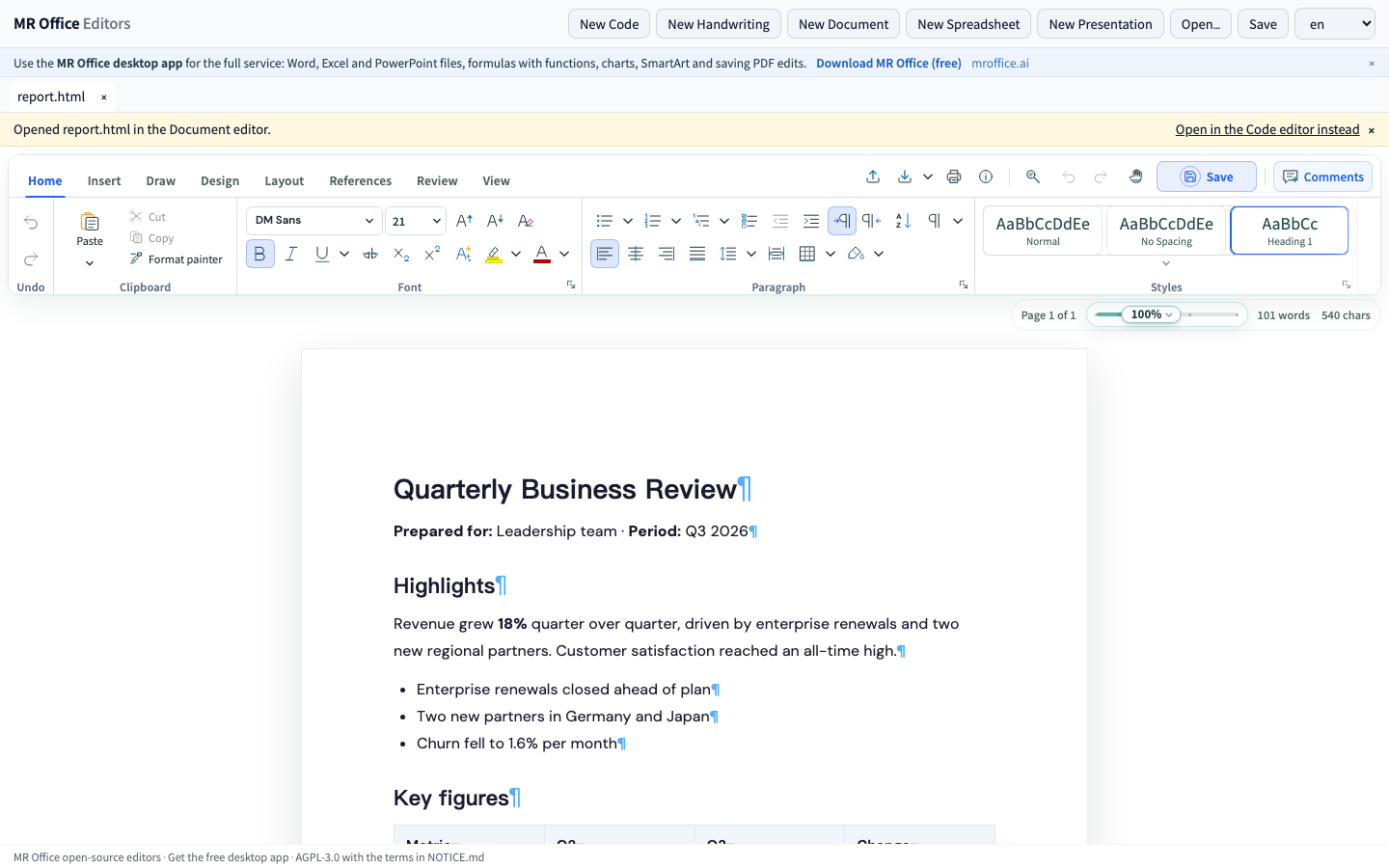
  • A documents editor with styles, fonts, lists, tables, headers and footers, sections and columns, shapes and equations, cover pages and tables of contents, comments and tracked changes, and pen ink on the page; it saves .mrdoc and opens HTML, Markdown and plain text.
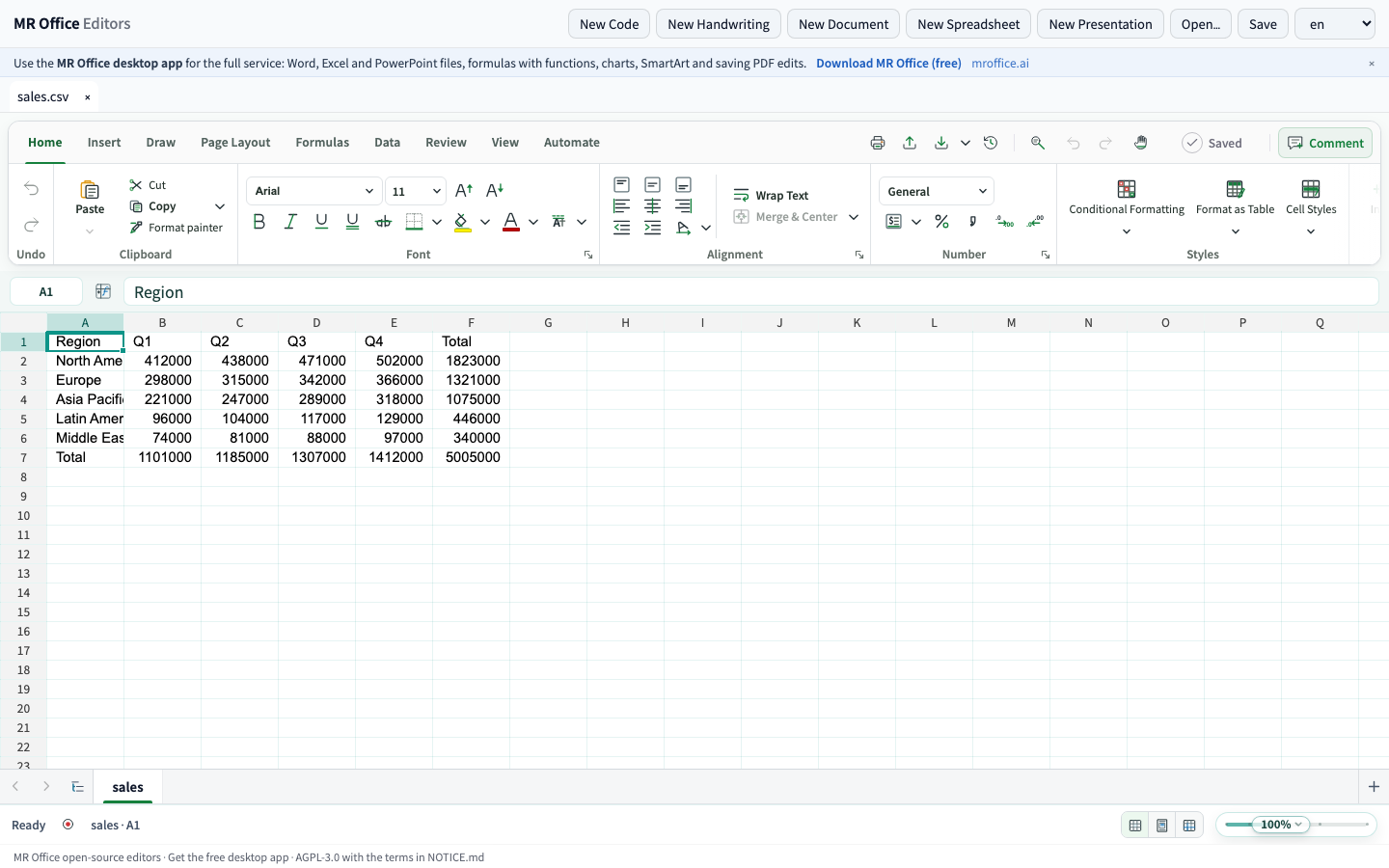
  • A spreadsheets editor in which arithmetic between cells such as =A1*B1+10 is calculated in the browser as you type, alongside number formats, conditional formatting, sorting and filtering, frozen panes and several sheets; it saves .mrsheet and opens and saves CSV and TSV.
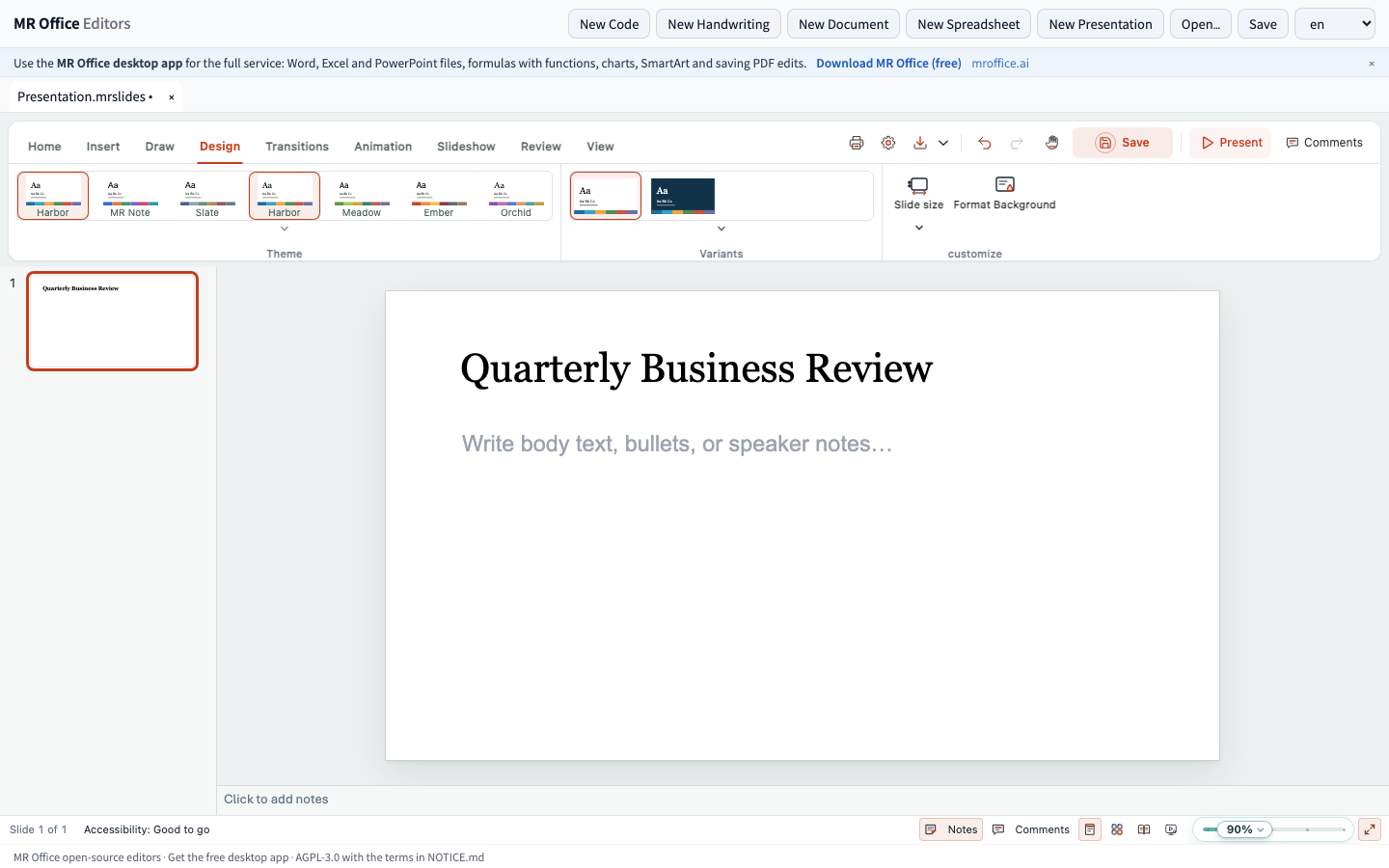
  • A presentations editor with eight themes of its own, layouts, slide master and layout views, tables, WordArt and equations, comments, sections, transitions and animations with preview, and a slide show; it saves .mrslides.
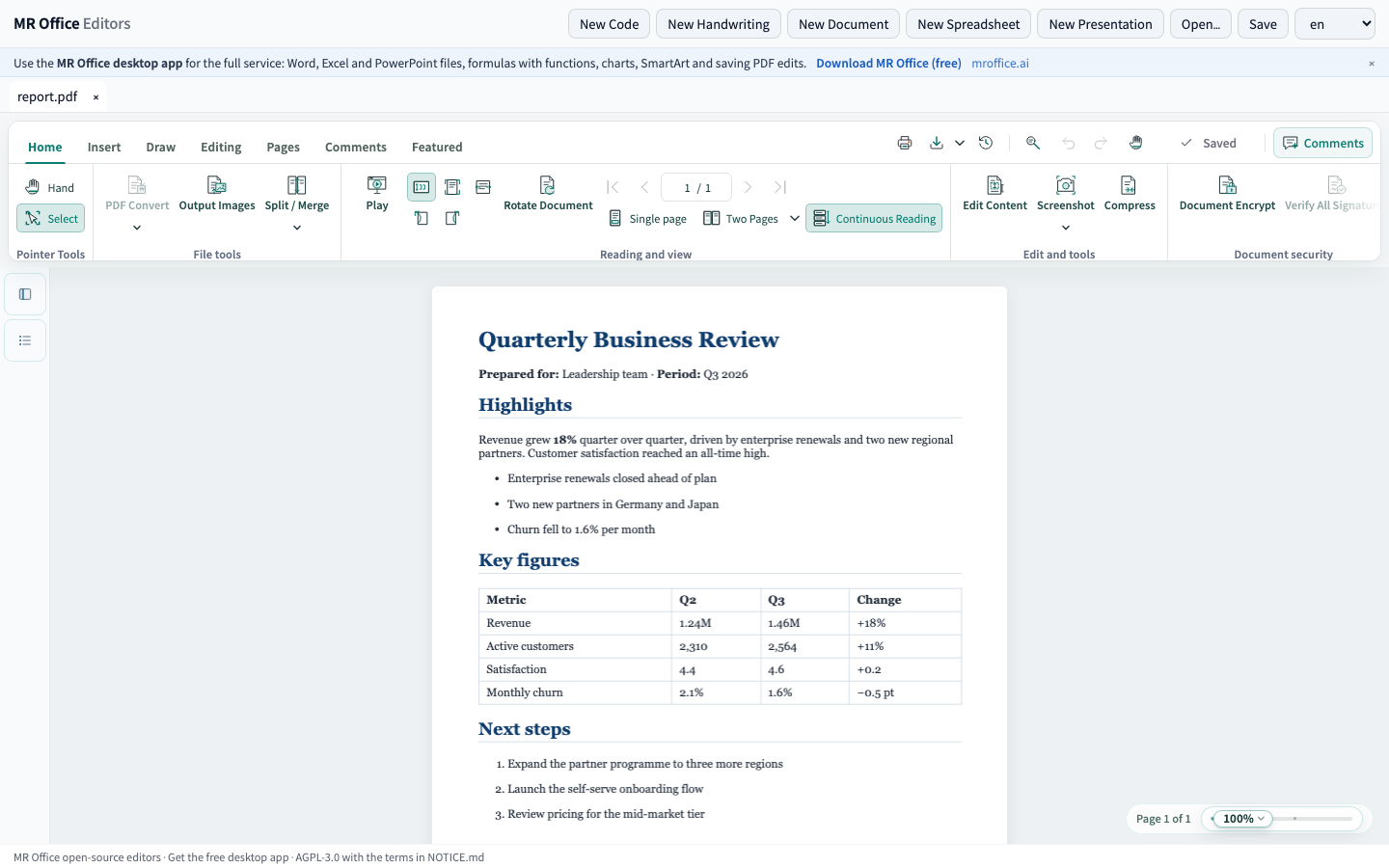
  • A PDF editor for reading, searching, presenting and printing files, copying and reading text aloud, and marking up selected text with highlight, underline, strikethrough and squiggly annotations plus notes in a comments panel, handing the file back as it was opened.
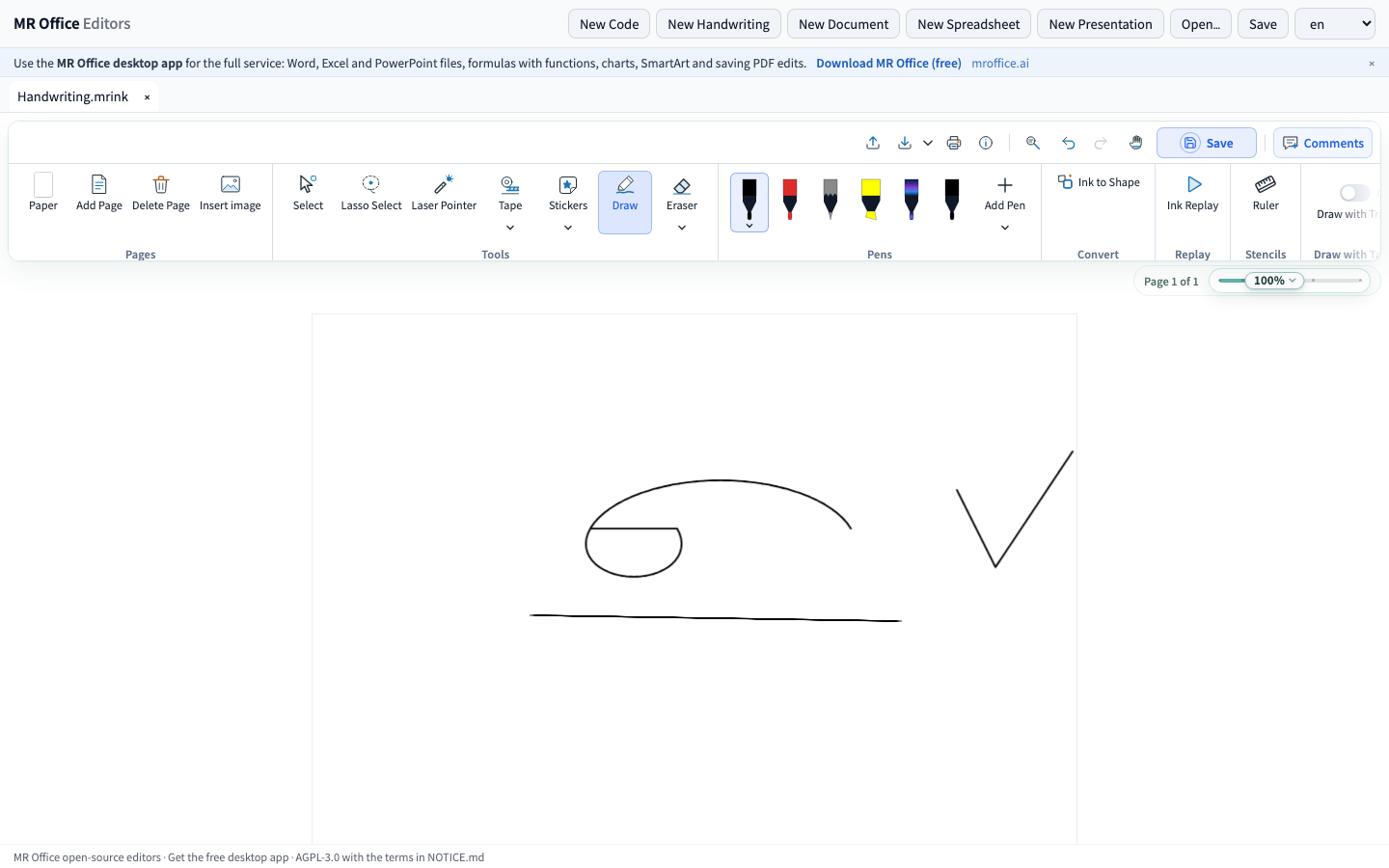
  • A handwriting editor with pressure-sensitive pens, highlighters, erasers, lasso and ruler, and ink turned into shapes; it saves .mrink.
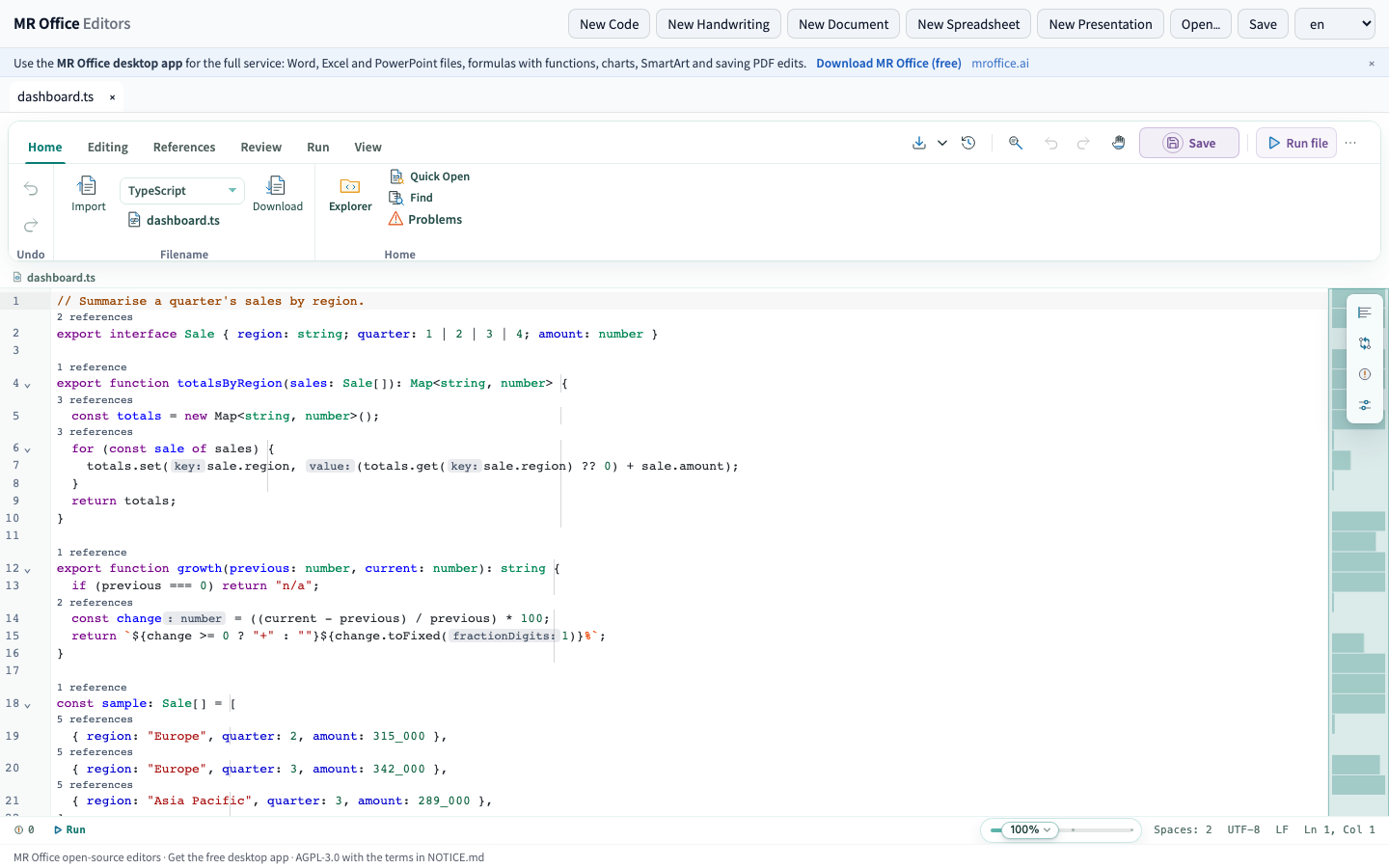
  • A code editor with syntax highlighting for many languages, an outline and find and replace, with JavaScript/TypeScript, Python, SQL, Lua and shell running in the browser.
  • A packaging layout of six npm packages under packages/ sharing @mrnote/core, a combined playground in apps/playground, and an Electron shell in apps/desktop.

Who uses it and how

  • Teams that want one editing surface rather than a suite can embed an individual package, such as @mrnote/docs, in an existing web application, since each package's README documents its behaviour and shows how to embed it.
  • Self-hosters who need an offline desktop build can run npm run build followed by npm run desktop to start the Electron shell, which opens .mrdoc, .mrsheet, .mrslides and .mrink files plus CSV, HTML, Markdown and PDF.
  • Organisations with review workflows can rely on tracked changes and comments in documents, comments and sections in presentations, and the annotations and comments panel in the PDF editor.
  • Users evaluating the editors without committing to a build can open the live demo at mroffice.ai, which requires no installation.
  • Multilingual teams are served by an interface offered in the twenty languages listed in the README, from English and Simplified Chinese to Thai and Vietnamese.

Getting started

The editors are built from source with npm install, npm run fonts for the open substitutes for Office's fonts, npm run build and npm run preview, which serves the playground at http://localhost:5178, while npm run dev starts a development server at the same address and npm run smoke checks a build. The live demo at mroffice.ai can be tried without any installation.

How it compares

The facts provide no list of paid products that this project replaces, and they name no directly comparable open-source suite, so MR Office stands alone in this registry. The only reference point in the material is Microsoft Office, which appears as the origin of the file formats and fonts the editors work alongside rather than as a product being substituted.

When to use it — and when not to

The project expects a Node toolchain and a build step, and the README presents no managed or hosted deployment beyond the live demo, so a self-hoster takes on building, serving and versioning the editors, though no database, object storage or SMTP service is mentioned as a requirement. It is a poor fit for anyone who needs .docx, .xlsx or .pptx interoperability inside an open-source build, because Microsoft Office reading and writing is deliberately left to the free but compiled, non-open-source MR Office component. Teams that need formulas with functions such as SUM, IF or VLOOKUP actually recalculated, or charts and SmartArt drawn, should also look elsewhere: the open editors keep those as written and render only what a file already holds.

project readme (upstream, from github) — read inline

MR Office

🌐 English · English (UK) · 简体中文 · 繁體中文 · 日本語 · 한국어 · Deutsch · Français · Español · Español (Latinoamérica) · Português (Brasil) · Italiano · Nederlands · Svenska · Dansk · Norsk · Suomi · Bahasa Indonesia · ไทย · Tiếng Việt

The open-source editors of MR Office — documents, spreadsheets, presentations, PDF, handwriting and code — running in the browser.

▶ Try the live demo — no install · ⬇ Download MR Office from Releases · 🌐 mroffice.ai

AGPL-3.0 release CI GitHub stars

🔊 Watch the 50-second tour with sound

Documents

Spreadsheets

Presentations

PDF

Handwriting

Code

MR Office is a workspace for notes, AI and real files. This repository publishes the source code of its editors: the same editors MR Office runs, which you can build, run and embed on your own. They are open-source editors, not a complete open-source office suite: the reading and writing of Microsoft Office files stays in MR Office (see below).

The editors

What each editor does in this repository:

  • Documents — a paged word processor: styles, fonts, lists, tables, headers and footers, sections and columns, shapes and equations, cover pages and tables of contents, comments and tracked changes, and pen ink on the page. Saves its own format (.mrdoc); opens HTML, Markdown and plain text.
  • Spreadsheets — cells and formulas, number formats, conditional formatting, sorting and filtering, frozen panes and several sheets, with sums and averages of the selection. Arithmetic between cells (=A1*B1+10) is calculated in the browser as you type; formulas with functions (SUM, IF, VLOOKUP …) are kept as written. Saves its own format (.mrsheet); opens and saves CSV and TSV.
  • Presentations — slides with eight themes of its own, layouts, slide master and layout views, text, shapes, text boxes, tables, WordArt and equations, comments, sections, transitions and animations with preview, and a slide show. Saves its own format (.mrslides).
  • PDF — read, search, present and print PDF files, copy and read aloud their text, and mark up selected text (highlight, underline, strikethrough, squiggly) with notes and a comments panel while a file is open; saving hands back the file as it was opened.
  • Handwriting — handwritten notes with pressure-sensitive pens, highlighters, erasers, lasso and ruler, and ink turned into shapes. Saves its own format (.mrink).
  • Code — a lightweight code editor with syntax highlighting for many languages, an outline, and find and replace; JavaScript/TypeScript, Python, SQL, Lua and shell run right in the browser.

Calculating formulas with functions, drawing charts and laying out SmartArt run in MR Office's own engine, in the MR Office desktop app: the open-source editors keep the formulas, charts and SmartArt a file holds, and show SmartArt as it was saved.

Run the editors

▶ Try the live demo — no install

The six editors are in packages/ (@mrnote/docs, sheets, slides, pdf, ink, code, sharing @mrnote/core) and run together in apps/playground:

npm install
npm run fonts     # the open substitutes for Office's fonts
npm run build
npm run preview   # http://localhost:5178

npm run dev starts a development server at the same address, and npm run smoke checks a build. Each package's README lists what it does in detail and shows how to embed it.

Desktop app

apps/desktop holds MR Office Editors: the source of the MR Office desktop app's shell (Electron), under an identity of its own. With the free MR Office component from Releases, it is the MR Office desktop app, with Word, Excel, PowerPoint and PDF files, sign-in and AI. Without the component, it runs the open-source editors on their own, which open .mrdoc, .mrsheet, .mrslides and .mrink files, CSV, HTML, Markdown and PDF. The shell and the editors are AGPL source code; the component is compiled, free to use and not open source. After npm run build, start it with:

npm run desktop

For the full experience, install the MR Office desktop app (free)

The MR Office desktop app is free, has these editors and the full service, and works offline on your own computer. It adds what the open-source editors leave out:

  • Opening and saving Word, Excel and PowerPoint files (.docx, .xlsx, .pptx)
  • Formulas with functions (SUM, IF, VLOOKUP …), calculated
  • Charts
  • SmartArt editing
  • Saving PDF edits back into the file

Download MR Office from Releases → · or from mroffice.ai

Word, Excel, PowerPoint and PDF files

Opening and saving Word, Excel and PowerPoint files (.docx, .xlsx, .pptx), and saving PDF edits back into the file, are provided by the MR Office desktop app (free), which has all of these editors and works offline on your own computer:

How the pieces fit

flowchart LR
  subgraph OSS["Open source · AGPL-3.0"]
    direction LR
    core["@mrnote/core"] --> E["The six editors<br/>Documents · Spreadsheets · Presentations · PDF · Handwriting · Code"]
    E --> PG["apps/playground<br/>Browser"]
    E --> DS["apps/desktop<br/>Desktop shell"]
    MCP["apps/mcp<br/>MCP server for AI apps"]
  end
  COMP["MR Office component: Word, Excel and PowerPoint files · free, not open source"] -.-> DS

License

Open source under the GNU Affero General Public License v3.0 (LICENSE), with the additional terms in NOTICE.md: keep the "MR Office" attribution and link to https://mroffice.ai, and no rights to the MR Office name or logo. A commercial license is available from support@mr-note.com. Third-party software and data are listed in THIRD_PARTY_NOTICES.md. Contributions: see CONTRIBUTING.md.

More

Website and the full product: https://mroffice.ai · Questions and feedback: support@mr-note.com

If MR Office is useful to you, a ⭐ on GitHub helps other people find it.

Frequently asked questions

Is MROffice free to use?

MROffice is open source under the AGPL-3.0 licence. There is no licence fee and no seat count — you can self-host it or, where the project offers one, pay a vendor for a managed version instead.

What does MROffice do?

MR Office: open-source document, spreadsheet, presentation, PDF, handwriting and code editors. https://mroffice.ai

What is MROffice written in?

MROffice is primarily written in TypeScript. Its source is publicly available at https://github.com/XinaTian/MROffice, and it has 1,395 GitHub stars.