

moosestack is a free, open source monitoring & observability project written in Rust and released under MIT. It has 591 GitHub stars, 32 forks and 1 open issues, and was last pushed 6 days ago. On this registry it ranks #259 of 270 tracked projects in Monitoring & Observability, with 5 head-to-head comparisons available.

What is moosestack?

MooseStack is an agent harness, distributed as the @514labs/moose-cli npm package under the MIT licence, that gives AI coding agents the interfaces, context, code and skills to build and ship applications on top of open-source realtime analytical infrastructure such as ClickHouse.

What it is

MooseStack is a developer framework and command-line tool that sits between a coding agent and a realtime analytical data stack. Built by Fiveonefour, it ships a dev framework, a CLI, a language server and a set of agent-readable rules, all written to let generalist coding agents handle the parts of analytical engineering that are specialized terrain.

The concrete problem it solves: generalist agents such as Claude Code, Cursor and Copilot work well on ordinary coding tasks, but ClickHouse and realtime analytical infrastructure are a different problem class. Optimizing data models and queries for OLAP, managing schema changes and migrations, building streaming ETL/ELT pipelines, and integrating analytics into a frontend application layer are all sticky work. MooseStack replaces hand-rolled wiring for that work by making everything code: tables, streams, workflows and APIs are declared in TypeScript or Python, and the framework wires them to ClickHouse (realtime OLAP), Redpanda (streaming), Temporal (workflow orchestration) and Redis (internal state).

Key capabilities

  • Code-first infrastructure: declare tables, streams, workflows and APIs in TS/Python and let MooseStack wire them up.
  • moose dev local dev server with hot-reloading infrastructure, giving a full mirror of the production environment on a laptop.
  • Typed schemas in application code with automated schema migration support, plus the separate Moose Migrate tool for migration management.
  • Moose Dev MCP, an AI agent interface to the local dev stack, so agents can inspect and drive the environment.
  • Moose Language Server (LSP) for in-editor diagnostics and autocomplete aimed at both agents and developers.
  • ClickHouse TS/Py Agent Skills, distributed as agent-readable rules covering ClickHouse, OLAP and data engineering best practices.
  • Modular design: each module is independent and can be adopted incrementally, with Git-native development providing version control, collaboration and governance.

Who uses it and how

  • Engineering teams adding product analytics to an existing application, using the frontend integration path to connect an analytics layer to their app.
  • Data engineering groups building realtime streaming ETL/ELT pipelines on Redpanda feeding ClickHouse.
  • Teams that want a local-first workflow, where moose dev mirrors production so development happens on a laptop before deployment.
  • AI-assisted development workflows where Claude Code, Cursor or Copilot drive the stack through Moose Dev MCP and the language server.
  • Organisations that need schema and migration governance, using typed schemas and Git-native version control to track changes to analytical workloads.

Getting started

Install the CLI from npm as @514labs/moose-cli, then start the local dev server with moose dev. The quickstart lives at docs.fiveonefour.com/moosestack/getting-started/quickstart, with community support on Slack at slack.moosestack.com.

How it compares

No list of commercial products is given here as a replacement target, but the facts place MooseStack specifically between generalist coding agents — Claude Code, Cursor and Copilot — and the open-source analytical stack of ClickHouse, Redpanda, Temporal and Redis. It does not replace those systems; it is a harness that sits on top of them and translates agent intent into code those systems can run.

When to use it — and when not to

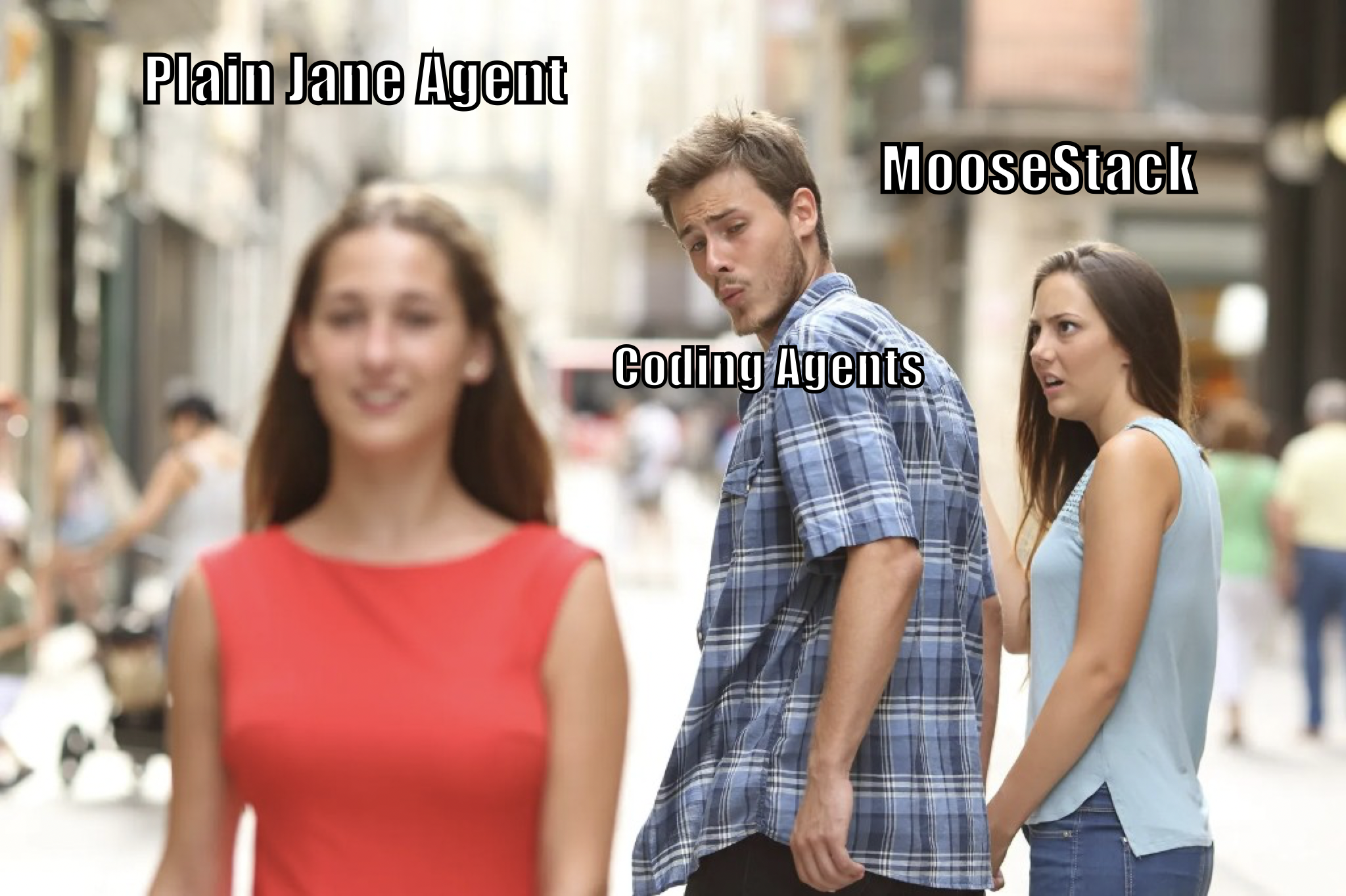
MooseStack has reached end of life and is no longer actively maintained, so new adopters should treat it as a frozen codebase rather than a project receiving fixes. A self-hoster must operate the full underlying stack — ClickHouse, Redpanda, Temporal and Redis — since MooseStack wires them together but does not supply them. The README records the reason for the shutdown: benchmarking through the Agent Experience Platform found agents preferred working directly on the underlying tools, scoring better and cheaper without the harness on the ingest-to-API and full OLAP pipeline scenarios.

project readme (upstream, from github) — read inline

moose logo

Made by Fiveonefour NPM Version MooseStack Community Docs MIT license

[!IMPORTANT] MooseStack has reached end of life and is no longer actively maintained.

As users, we loved the idea of the MooseStack harness. But as coding agents became our primary users over the last couple of years, results from the Agent Experience Platform (AXP) made it clear that they would rather free solo on the underlying tools than use our product. We cannot in good faith keep building tools that make their work harder. Thank you to everyone who supported MooseStack and helped us test the idea. You can learn more about AXP in the docs.
MooseStack EOL Image

Scenario AX without Moose AX with Moose
Create analytics table 1.00 score / 1m51s / $0.24 1.00 score / 2m32s / $0.35
CSV ingest 1.00 score / 2m03s / $0.45 1.00 score / 2m41s / $0.43
MV access patterns 0.53 score / 2m36s / $0.44 1.00 score / 5m09s / $0.94
Ingest to API 0.97 score / 3m08s / $0.62 0.23 score / 8m49s / $2.13
Full OLAP pipeline 1.00 score / 4m33s / $0.84 0.17 score / 11m31s / $2.12

MooseStack

The developer agent harness for ClickHouse — MooseStack gives your AI coding agents the interfaces, context, code, and skills to build and ship applications on popular OSS realtime analytical infrastructure: safely, efficiently, and effectively. Including:

Generalist coding agents like Claude Code, Cursor, and Copilot work well for most coding tasks. But ClickHouse and realtime analytical infrastructure are specialized terrain. MooseStack sits between your agent and your data stack, and enables your agent to handle the stickiest parts of building out applications on real time analytical infra. Think:

  • Optimizing data models & queries for OLAP
  • Managing schema changes and migrations
  • Building out realtime streaming ETL/ELT data pipelines
  • Integrating analytics into your frontend application layer

MooseStack agent harness diagram

How it works

In short, when everything is code, coding agents can thrive.

  • Dev framework & CLI: AI-friendly framework and CLI enable coding agents to iterate quickly and safely on your analytical workloads
  • Local-first experience: Full mirror of production environment on your laptop with moose dev
  • Schema & migration management: Typed schemas in your application code, with automated schema migration support
  • Code‑first infrastructure: Declare tables, streams, workflows, and APIs in TS/Python -> MooseStack wires it all up
  • Git-native development: Version control, collaboration, and governance built-in
  • Modular design: Only enable the modules you need. Each module is independent and can be adopted incrementally

Tooling:

Modules:

  • Moose OLAP: Manage ClickHouse tables, materialized views, and migrations in code.
  • Moose Streaming: Real‑time ingest buffers and streaming transformation functions with Kafka/Redpanda.
  • Moose Workflows: ETL pipelines and tasks with Temporal.
  • Moose APIs and Web apps: Type‑safe ingestion and query endpoints, code-first semantic layer, and bring your own API framework (Nextjs, Express, FastAPI, Fastify, etc.)

Get Started

Deploy to Production

Fiveonefour hosting

The fastest way to deploy your MooseStack application is with hosting from Fiveonefour, the creators of MooseStack. Fiveonefour provides automated preview branches, managed schema migrations, deep integration with GitHub and CI/CD, and an agentic harness for your realtime analytical infrastructure in the cloud.

Get started with Fiveonefour hosting →

Deploy Yourself

MooseStack is open source and can be self-hosted. If you're only using MooseOLAP, you can use the Moose library in your app for schema management, migrations, and typed queries on your ClickHouse database without deploying the Moose runtime. For detailed self-hosting instructions, see our deployment documentation.

Community

Join us on Slack

Contributing

We welcome contributions! See the contribution guidelines.

License

MooseStack is open source software and MIT licensed.

Frequently asked questions

Is moosestack free to use?

moosestack is open source under the MIT licence. There is no licence fee and no seat count — you can self-host it or, where the project offers one, pay a vendor for a managed version instead.

What does moosestack do?

The agent harness for building analytics into your app on top of ClickHouse, Redpanda and other high-performance analytical infrastructure

What is moosestack written in?

moosestack is primarily written in Rust. Its source is publicly available at https://github.com/514-labs/moosestack, and it has 591 GitHub stars.