minutes




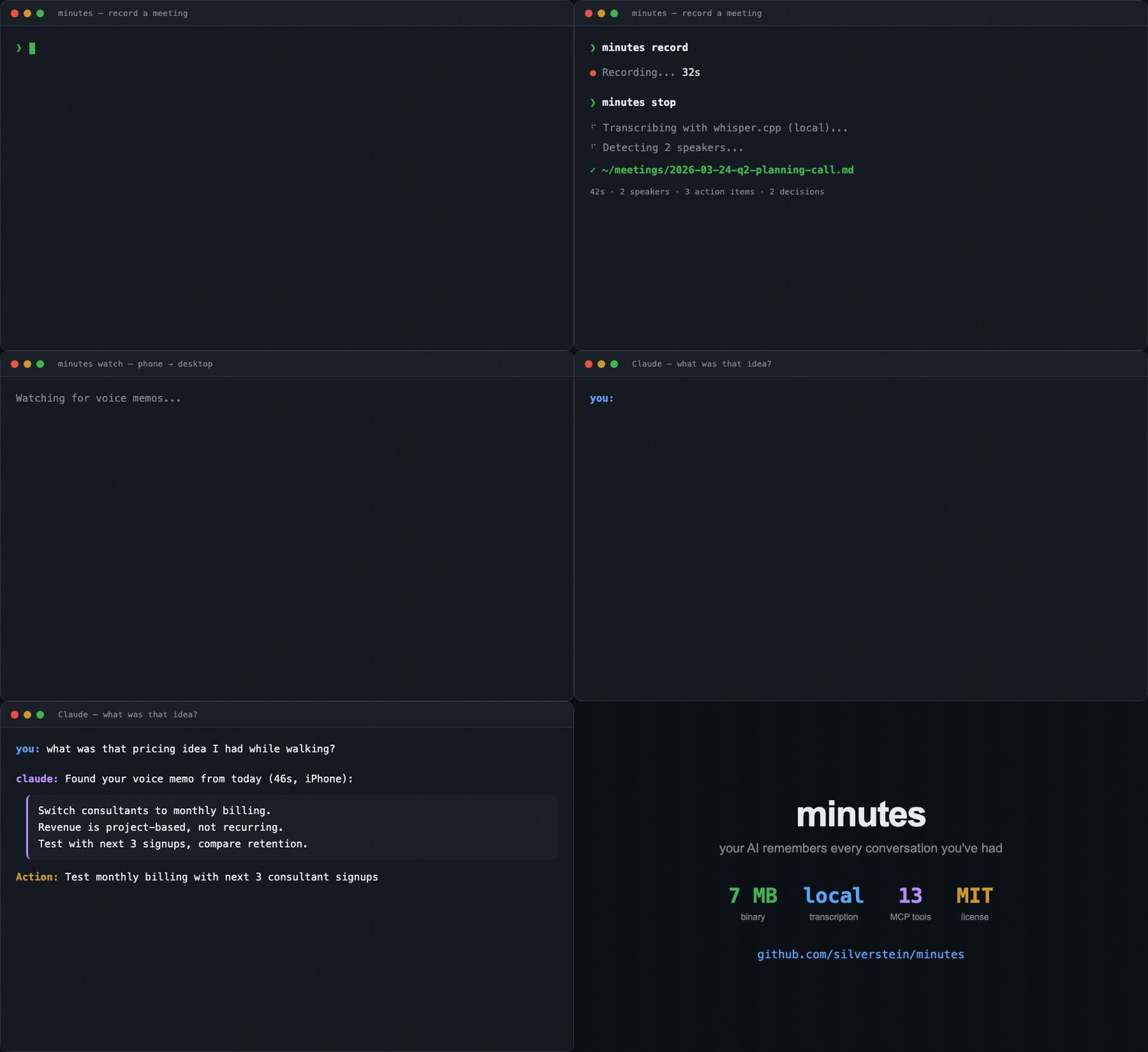
Minutes is a free, open-source conversation memory app for the AI you already use. Record and transcribe meetings, calls, voice memos, and dictation on your device, then let Claude Code, Codex, Cursor, or another MCP client search the history you choose to share. Your records are Markdown files you own in ~/meetings/.
Capture, transcription, and storage run locally. If you choose a cloud AI assistant or summarizer, the meeting context you authorize is sent to that provider.
Your conversations. Your memory. Ready for the AI you use.
Install
brew install --cask silverstein/tap/minutes
brew install silverstein/tap/minutes
cargo install minutes-cli
npx minutes-mcp  # or: claude mcp add minutes -- npx -y minutes-mcp
If Homebrew reports an untrusted tap, run brew trust silverstein/tap once.
Ask your agent
Add Minutes to your agent, seed five sample meetings (no mic needed), then ask about them:
claude mcp add minutes -- npx -y minutes-mcp
minutes demo --full
What did we decide about monthly billing, and did it stick?
The answer spans two meetings a month apart: launched on Feb 28, reversed on Mar 25.
A direct MCP call uses the same local meeting files:
search_meetings({"query":"monthly billing decision"})
Record a real one with minutes record, then minutes stop to transcribe. minutes demo --clean removes the samples.
Setup: Codex, Gemini CLI, and Claude Desktop,
Cursor,
OpenCode,
Pi,
Mistral Vibe, and
Cowork or Dispatch.
Works with
Claude Code · Codex · Cursor · OpenCode · Pi · Gemini CLI · Claude Desktop · Mistral Vibe · Cowork · Dispatch · Obsidian · Logseq · any MCP client
How it compares
| Workflow | Granola | Otter.ai | Anarlog (formerly Hyprnote) | Minutes |
|---|---|---|---|---|
| Product | Hosted meeting notepad | Hosted meeting assistant | Local meeting notepad | Local conversation memory |
| Agent access | Hosted MCP | Hosted integrations | CLI + MCP | Local files, MCP, CLI, SDK |
| Primary storage | Hosted workspace | Hosted workspace | Local SQLite + files | Local Markdown + YAML |
| Local AI | Cloud transcription | Cloud transcription | With local providers | Local transcription; AI provider of your choice |
Reviewed September 5, 2026 against Granola MCP, Otter privacy and security, and the Anarlog repository. Anarlog's community app is MIT; its enterprise components use a commercial license. See the detailed comparison and open-source alternatives for fit and limitations.
Who it's for
Agent-first users treat Minutes as the capture layer of a local second brain. They search meetings through Claude Code, Cursor, Codex, OpenCode, MCP, or the CLI, then fold useful context into a vault or wiki they own.
Desktop notetaker users record and read results in the app. They value reliable setup, clear processing and recovery, Recall, documents, Coach, and summary quality. See the full persona notes.
Surfaces
| Surface | What it provides | Docs |
|---|---|---|
| Desktop app | Menu bar capture, Recall, documents, and Coach. | Install |
| CLI (58 commands) | Local recording, processing, search, import, and automation. | Commands |
| MCP server (34 tools) | Local meeting tools and resources for any MCP client. | MCP reference |
| Claude Code plugin (23 skills) | Prep, capture, live help, debrief, and memory workflows. | Client setup |
| SDK | TypeScript access to meeting files without MCP. | Agent architecture |
Output format
Meetings are plain markdown with structured YAML frontmatter:
---
title: Q2 Pricing Discussion with Alex
type: meeting
date: 2026-03-17T14:00:00
duration: 42m
context: Discuss Q2 pricing
action_items:
  - assignee: mat
    task: Send pricing doc
    due: Friday
    status: open
decisions:
  - text: Test monthly billing with 10 advisors
---
See the frontmatter schema. Files work with Obsidian, grep, and any markdown tool.
Privacy & consent
- Transcription and speaker processing run on-device. Audio stays on your machine.
- Sensitive meetings save typed markers without audio and default to restricted.
- Consent reminders, acknowledgement, and provenance help you disclose recording.
- Text leaves the machine only when you send authorized context to a cloud agent or summarizer.
See the security documentation and consent enforcement design.
Docs
- Features and commands
- Install, setup, updating, and troubleshooting
- Agent and MCP client integrations
- Phone voice memo pipeline
- Summarization and automation
- Configuration
- Architecture and agent development
- Switching from Granola and importing archives
- Frontmatter schema
- Security
- Personas
- MCP tools
- Error reference
- Agent index
- Full agent index
Contributing
See CONTRIBUTING.md. Minutes is MIT licensed and staying that way: no relicensing, no paid tier for anything in this repo.
MIT. Built by Mat Silverstein, founder of X1 Wealth.