Meshery is an open source, cloud native manager — a Cloud Native Computing Foundation project released under the Apache-2.0 licence — that provides a self-service engineering platform for designing and managing Kubernetes-based infrastructure and applications across multiple clusters and multiple clouds, built for platform engineers, operators, and teams who manage Kubernetes at scale.
What it is
Meshery lives in the cloud native ecosystem and is hosted as a CNCF project. It describes itself as a self-service engineering platform and an extensible cloud native manager that enables the design and management of all Kubernetes-based infrastructure and applications, including multi-cloud deployments. Its approach is visual and collaborative GitOps, and its stated aim is to free users from managing Kubernetes multi-cluster deployments through hand-written YAML. The project is distributed through the repository tracked in this registry, which records 11,811 stars, 3,852 forks, and the Apache-2.0 licence, with recent activity recorded on 2026-09-17. Topics recorded for the project include cloud-native, cncf, control-plane, gitops, golang, kubernetes, kubernetes-operator, infrastructure-as-code, internal-developer-platform, and kanvas.
The concrete problem Meshery addresses is the operational gap between the configuration a team intends and what is actually running across several clusters. It supports 380+ integrations for cloud native infrastructure, so a single team can manage the configuration, deployment, and operation of cloud services and Kubernetes clusters rather than stitching together separate tools per provider. It replaces two specific manual practices: authoring and reconciling multi-cluster Kubernetes configuration by hand, and writing Open Policy Agent Rego queries by hand to enforce configuration policy. Through Context-Aware Policies, it lets teams enforce configuration best practices from code to Kubernetes without needing to know or write Rego.
Key capabilities
- Manages configuration, deployment, and operation of cloud services and Kubernetes clusters while supporting 380+ cloud native infrastructure integrations.
- Provides a single pane of glass for multiple Kubernetes clusters across any infrastructure, including multiple cloud providers, with consistent configuration, operation, and observability.
- Supports dry-run deployments by leveraging Kubernetes' built-in dry-run capability, validating YAML manifests, Helm charts, and Meshery Designs without applying changes to a live cluster.
- Fits dry-run into CI/CD pipelines as an automated pre-deployment check that catches invalid resource definitions, missing fields, and API version mismatches.
- Infers the manner in which each resource interrelates, supporting a broad variety of built-in relationships and allowing custom relationships.
- Enforces configuration best practices consistently from code to Kubernetes through Context-Aware Policies, without requiring Open Policy Agent Rego authoring.
- Organizes work through Workspaces as a collaboration and access-control point over Environments and their resources, and provides a catalog of curated design templates.
Who uses it and how
- Platform teams assembling an internal developer platform, for which the registry records the internal-developer-platform topic.
- Operators running multiple Kubernetes clusters across several cloud providers who need one control plane for configuration, operation, and observability.
- GitOps practitioners who connect Meshery to their GitHub repositories to preview deployments and view infrastructure snapshots inside pull requests, pull request to pull request.
- CI/CD owners who insert a dry-run validation step before deployment to prevent faulty releases.
- Teams that need to share collections of resources and credentials as a group through Environments, with Workspaces as the access-control boundary, instead of handling each connection individually.
Getting started
Meshery can be tried in a browser through the Cloud Native Playground, with the project homepage at meshery.io. Operational control across infrastructure is handled through mesheryctl.
How it compares
The facts provided list no paid products that Meshery replaces, and they name no comparable tools. On the evidence recorded here, it stands alone in this registry.
When to use it — and when not to
Meshery is Kubernetes-centric, so anyone without Kubernetes-based infrastructure, or without multi-cluster or multi-cloud requirements, gains little from adopting it. The registry records 1,983 open issues and a README excerpt that is itself truncated, so a prospective adopter should read the full documentation before committing rather than relying on the repository front page. The registry also lists the language as TypeScript while the topic list includes golang, which leaves the implementation surface unclear from these facts alone.
project readme (upstream, from github) — read inline














If you like Meshery, please ★ this repository to show your support! 🤩
MESHERY IS A CLOUD NATIVE COMPUTING FOUNDATION PROJECT


A self-service engineering platform, Meshery, is the open source, cloud native manager that enables the design and management of all Kubernetes-based infrastructure and applications (multi-cloud). As an extensible platform, Meshery offers visual and collaborative GitOps, freeing you from the chains of YAML while managing Kubernetes multi-cluster deployments.
Try Meshery in your browser using the Cloud Native Playground (teaser video)
Functionality
Infrastructure Lifecycle Management
Meshery manages the configuration, deployment, and operation of your Cloud services and Kubernetes clusters while supporting hundreds of different types of cloud native infrastructure integrations. Meshery supports 380+ integrations.
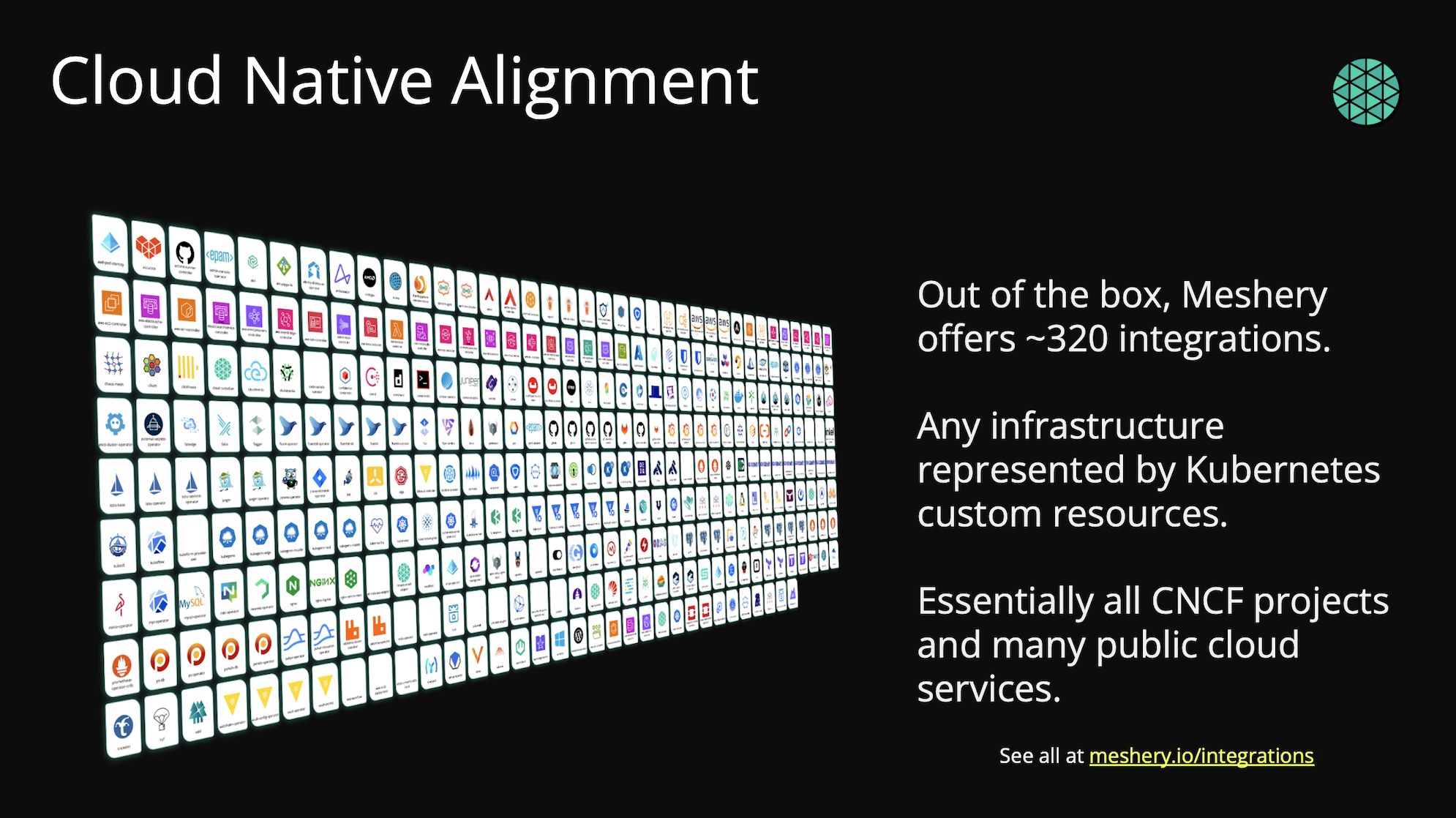
Find infrastructure configuration patterns in Meshery's catalog of curated design templates filled with configuration best practices.
Multiple Kubernetes Clusters and Multiple Clouds
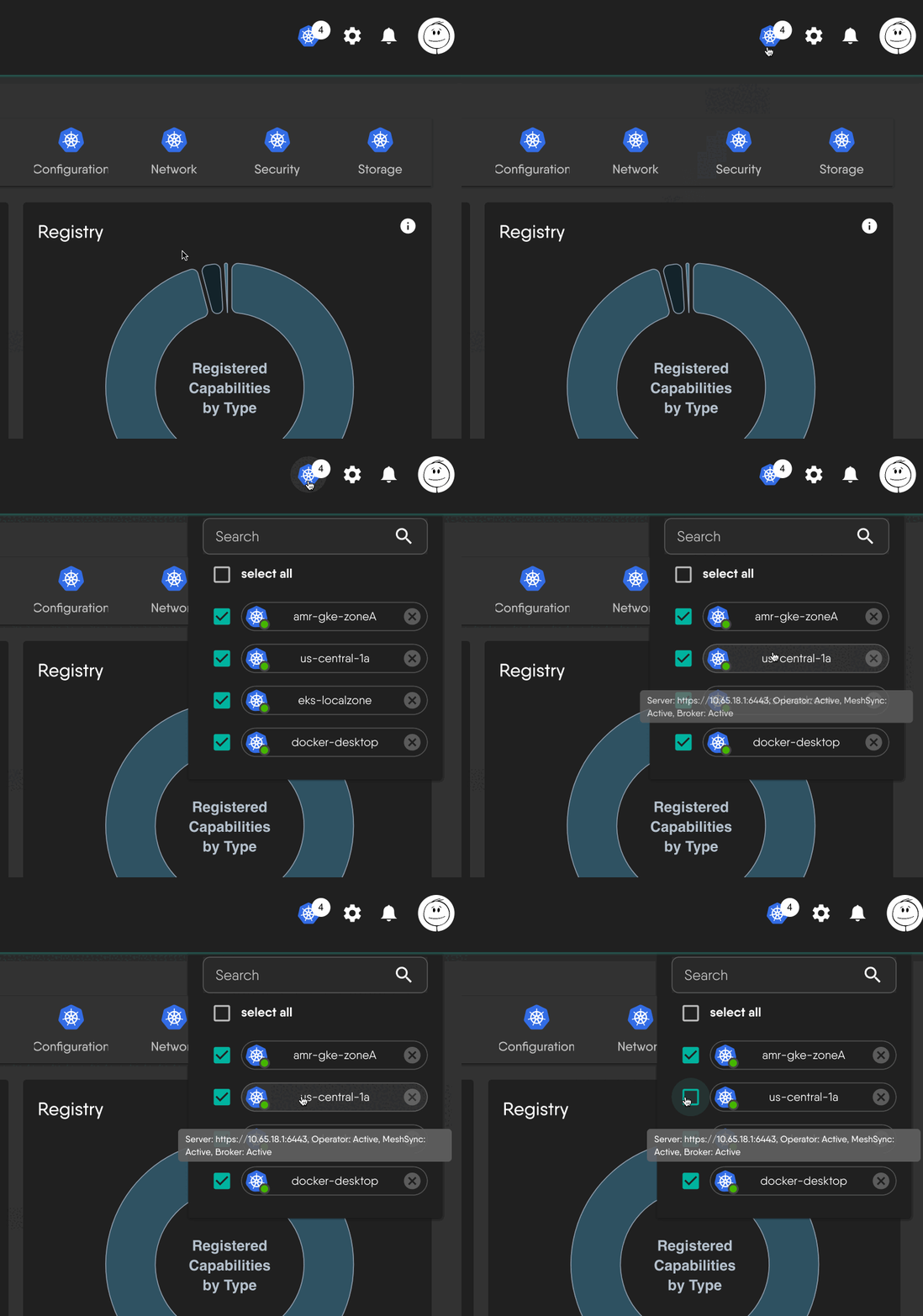
Meshery provides a single pane of glass to manage multiple Kubernetes clusters across any infrastructure, including various cloud providers. Meshery enables consistent configuration, operation, and observability across your entire Kubernetes landscape.
Dry-run your deployments
Meshery leverages Kubernetes' built-in dry-run capabilities to allow you to simulate deployments without actually applying the changes to your cluster. This enables you to:
- Validate configurations: Ensure your deployment specifications (e.g., YAML manifests, Helm charts, Meshery Designs) are syntactically correct and will be accepted by the Kubernetes API server.
- Identify potential issues: Detect errors in your configurations, such as invalid resource definitions, missing fields, or API version mismatches, before they impact your live environment.
- Preview changes: Understand the objects that Kubernetes would create or modify during a real deployment.
- Integrate with CI/CD: Incorporate dry-run as a step in your continuous integration and continuous delivery pipelines to automate pre-deployment checks and prevent faulty deployments.
By providing this dry-run functionality, Meshery helps you increase the reliability and stability of your Kubernetes deployments by catching potential problems early in the development and deployment process.
<!-
