MCP Toolbox for Databases








MCP Toolbox for Databases is an open source Model Context Protocol (MCP) server that connects your AI agents, IDEs, and applications directly to your enterprise databases.
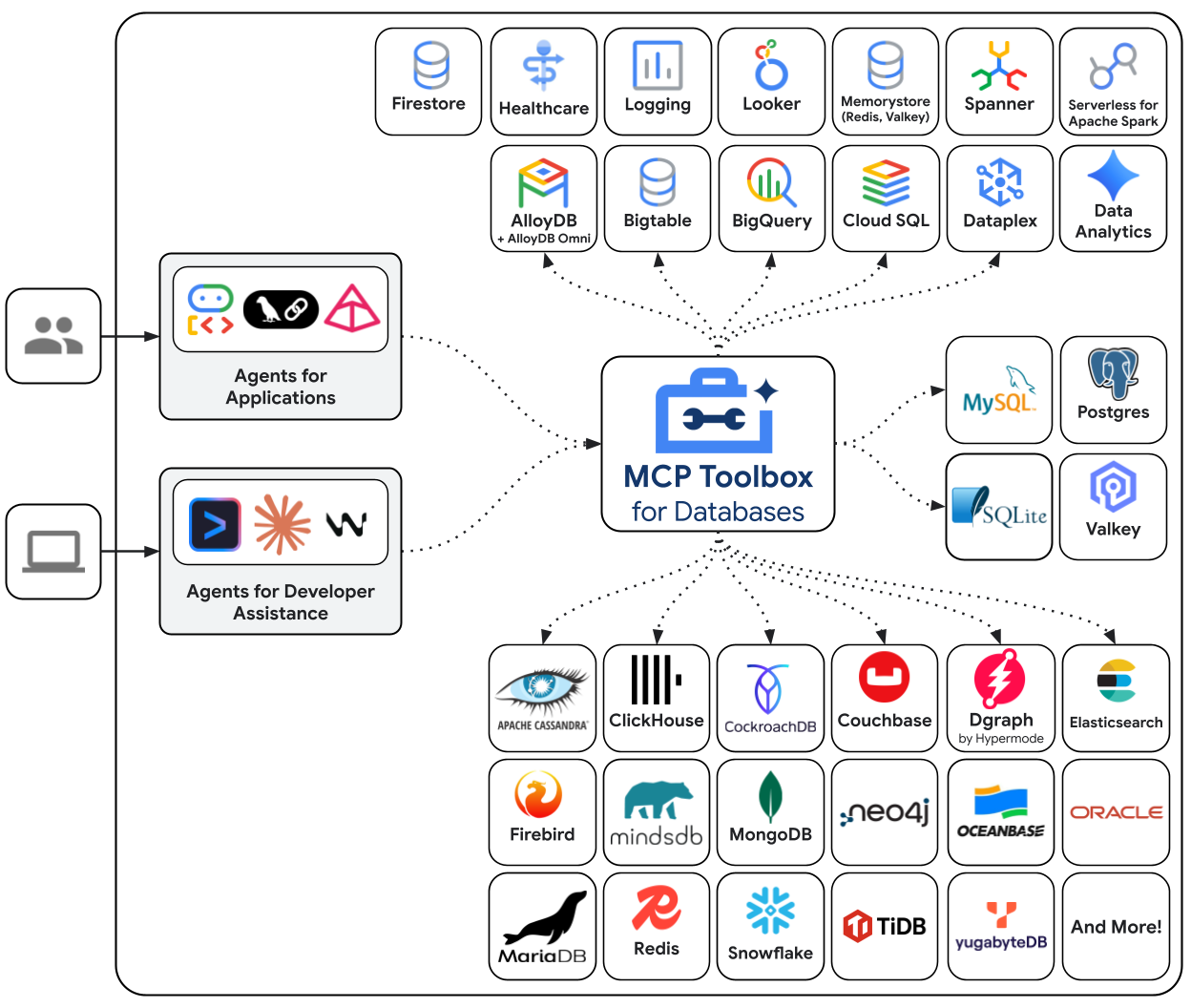
It serves a dual purpose:
- Ready-to-use MCP Server (Build-Time): Instantly connect Gemini CLI, Google Antigravity, Claude Code, Codex, or other MCP clients to your databases using our prebuilt generic tools. Talk to your data, explore schemas, and generate code without writing boilerplate.
- Custom Tools Framework (Run-Time): A robust framework to build specialized, highly secure AI tools for your production agents. Define structured queries, semantic search, and NL2SQL capabilities safely and easily.
This README provides a brief overview. For comprehensive details, see the full documentation.
[!IMPORTANT]
Repository Name Update: Thegenai-toolboxrepository has been officially renamed tomcp-toolbox. To ensure your local environment reflects the new name, you may update your remote:git remote set-url origin https://github.com/googleapis/mcp-toolbox.git
[!NOTE] This solution was originally named “Gen AI Toolbox for Databases” (github.com/googleapis/genai-toolbox) as its initial development predated MCP, but was renamed to align with the MCP compatibility.
Table of Contents
- Why MCP Toolbox?
- Quick Start: Prebuilt Tools
- Quick Start: Custom Tools
- Install & Run the Toolbox server
- Connect to Toolbox
- Additional Features
- Versioning
- Contributing
- Community
Why MCP Toolbox?
- Out-of-the-Box Database Access: Prebuilt generic tools for instant data exploration (e.g.,
list_tables,execute_sql) directly from your IDE or CLI. - Custom Tools Framework: Build production-ready tools with your own predefined logic, ensuring safety through Restricted Access, Structured Queries, and Semantic Search.
- Simplified Development: Integrate tools into your Agent Development Kit (ADK), LangChain, LlamaIndex, or custom agents in less than 10 lines of code.
- Better Performance: Handles connection pooling, integrated auth (IAM), and end-to-end observability (OpenTelemetry) out of the box.
- Enhanced Security: Integrated authentication for more secure access to your data.
- End-to-end Observability: Out of the box metrics and tracing with built-in support for OpenTelemetry.
Quick Start: Prebuilt Tools
Stop context-switching and let your AI assistant become a true co-developer. By connecting your IDE to your databases with MCP Toolbox, you can query your data in plain English, automate schema discovery and management, and generate database-aware code.
You can use the Toolbox in any MCP-compatible IDE or client (e.g., Gemini CLI, Google Antigravity, Claude Code, Codex, etc.) by configuring the MCP server.
Prebuilt tools are also conveniently available via the Google Antigravity MCP Store with a simple click-to-install experience.
Add the following to your client's MCP configuration file (usually
mcp.jsonorclaude_desktop_config.json):{ "mcpServers": { "toolbox-postgres": { "command": "npx", "args": [ "-y", "@toolbox-sdk/server", "--prebuilt=postgres", "--stdio" ] } } }Set the appropriate environment variables to connect, see the Prebuilt Tools Reference.
When you run Toolbox with a --prebuilt= flag, you instantly get access to standard tools to interact with that database. You can also specify a specific toolset using the --prebuilt=/ syntax (e.g., --prebuilt=postgres/data to only load SQL tools).
Supported databases currently include:
- Google Cloud: AlloyDB, BigQuery, Cloud SQL (PostgreSQL, MySQL, SQL Server), Spanner, Firestore, Knowledge Catalog (formerly known as Dataplex).
- Other Databases: PostgreSQL, MySQL, MariaDB, SQL Server, Oracle, MongoDB, Redis, Elasticsearch, CockroachDB, ClickHouse, Couchbase, Neo4j, Snowflake, Trino, and more.
For a full list of available tools and their capabilities across all supported databases, see the Prebuilt Tools Reference.
See the Install & Run the Toolbox server section for different execution methods like Docker or binaries.
[!TIP] For users looking for a managed solution, Google Cloud MCP Servers provide a managed MCP experience with prebuilt tools; you can learn more about the differences here.
Quick Start: Custom Tools
Toolbox can also be used as a framework for customized tools.
The primary way to configure Toolbox is through the tools.yaml file. If you
have multiple files, you can tell Toolbox which to load with the --config tools.yaml flag.
You can find more detailed reference documentation to all resource types in the Resources.
Sources
The sources section of your tools.yaml defines what data sources your
Toolbox should have access to. Most tools will have at least one source to
execute against.
kind: source
name: my-pg-source
type: postgres
host: 127.0.0.1
port: 5432
database: toolbox_db
user: toolbox_user
password: my-password
For more details on configuring different types of sources, see the Sources.
Tools
The tools section of a tools.yaml define the actions an agent can take: what
type of tool it is, which source(s) it affects, what parameters it uses, etc.
kind: tool
name: search-hotels-by-name
type: postgres-sql
source: my-pg-source
description: Search for hotels based on name.
parameters:
  - name: name
    type: string
    description: The name of the hotel.
statement: SELECT * FROM hotels WHERE name ILIKE '%' || $1 || '%';
For more details on configuring different types of tools, see the Tools.
Toolsets
The toolsets section of your tools.yaml allows you to define groups of tools
that you want to be able to load together. This can be useful for defining
different groups based on agent or application.
kind: toolset
name: my_first_toolset
tools:
    - my_first_tool
    - my_second_tool
---
kind: toolset
name: my_second_toolset
tools:
    - my_second_tool
    - my_third_tool
Prompts
The prompts section of a tools.yaml defines prompts that can be used for
interactions with LLMs.
kind: prompt
name: cod