Mastodon is a free, open source social networking project written in Ruby and released under AGPL-3.0. It has 50,299 GitHub stars, 7,498 forks and 4,525 open issues, and was last pushed 5 hours ago. On this registry it ranks #1 of 44 tracked projects in Social Networking, with 5 head-to-head comparisons available. It gained 1 stars over the last 6 tracked days.

Mastodon — Decentralized social networking in your control

What is Mastodon?

Mastodon is a free, open-source, self-hosted social network server built on ActivityPub that lets anyone run a microblogging community which interoperates with the wider Fediverse, and it is aimed at individuals, communities, and organisations that want to own their social graph instead of renting it from a platform.

What it is

Mastodon is a social network server written in Ruby on Rails under the AGPL-3.0 licence, first released in 2016 and maintained by Eugen Rochko together with the mastodon authors. It implements the ActivityPub protocol and WebFinger for discovery, so a server does not form an island: users on one instance follow and communicate with users on other instances, including software that is not Mastodon but still speaks ActivityPub. Users can publish links, pictures, text, and video, and every server on the network is interoperable as part of a federated whole known as the Fediverse.

The concrete problem it solves is vendor lock-in and the loss of control that comes with a centrally operated social account. Where a hosted microblogging service owns the account, the audience, and the data, Mastodon moves all three onto infrastructure the operator controls, with no vendor lock-in and no dependency on a single company's terms of service. The software itself replaces the closed, centrally hosted microblogging platform: the timeline, the follow graph, the media attachments, and the moderation decisions all live on a server that its own administrators run.

Key capabilities

  • ActivityPub federation, so users on one server can follow and interact with users on other servers, including non-Mastodon implementations of the same protocol.
  • WebFinger for account discovery across instances and ActivityStreams-style data exchange across the Fediverse.
  • Real-time, chronological timeline updates, where posts from followed accounts appear immediately in the user interface.
  • Media attachments for images and videos, with silent videos treated like animated GIFs and normal videos looping continuously.
  • Safety and moderation tooling including private posts, locked accounts, phrase filtering, muting, blocking, reporting, and a moderation system.
  • An OAuth2 provider role plus a straightforward REST API and a Streaming API, which support a broad third-party app ecosystem.
  • An official container image published as mastodon under the GitHub container registry, alongside Docker and docker-compose deployment configurations in the repository.

Who uses it and how

  • Community and organisational server operators who run their own instance so that their members' posts, follows, and media stay on their own infrastructure.
  • Administrators who deploy with the repository's Docker and docker-compose configurations, or with the provided configurations for Heroku and Scalingo, and who use the Helm charts from the mastodon/chart repository for Kubernetes.
  • Moderators who rely on the built-in reporting and moderation system, private posts, locked accounts, and phrase filtering to keep a server's local timeline in order.
  • Application developers who build third-party clients against the OAuth2, REST, and Streaming APIs rather than the web interface.
  • Federated users who follow and interact with accounts on other instances, including servers running different ActivityPub software.

Getting started

Deployment is handled either through the official container image at github.com/mastodon/mastodon/pkgs/container/mastodon, through the in-repository Docker and docker-compose configurations, or through the standalone installation guide in the project documentation at docs.joinmastodon.org/admin/install/.

How it compares

No list of paid products that this project replaces is provided in the facts, and no comparable projects are named by name there either, so Mastodon stands alone in this registry as the ActivityPub-based microblogging server it is. What the facts do establish is that its interoperability extends beyond itself, since any software implementing ActivityPub joins the same broader social network.

When to use it — and when not to

A self-hoster must operate the full stack, which means Ruby 3.3 or newer, PostgreSQL 14 or newer, Redis 7.0 or newer, Node.js 22 or newer, FFmpeg 5.1 or newer, and the Sidekiq queueing and caching layer that the streaming API depends on. Anyone who wants zero operational work, or who has no appetite for running a database and a queue in production, should not pick it; the same applies to groups unwilling to take on moderation duties. The visible weakness is maintenance load at the project level: 4525 open issues sit against 7498 forks and 50298 stars, which signals both a large contributor base and a backlog that self-hosters may end up resolving on their own.

project readme (upstream, from github) — read inline

[!NOTE] Want to learn more about Mastodon? Click below to find out more in a video.
Release Ruby Testing Crowdin

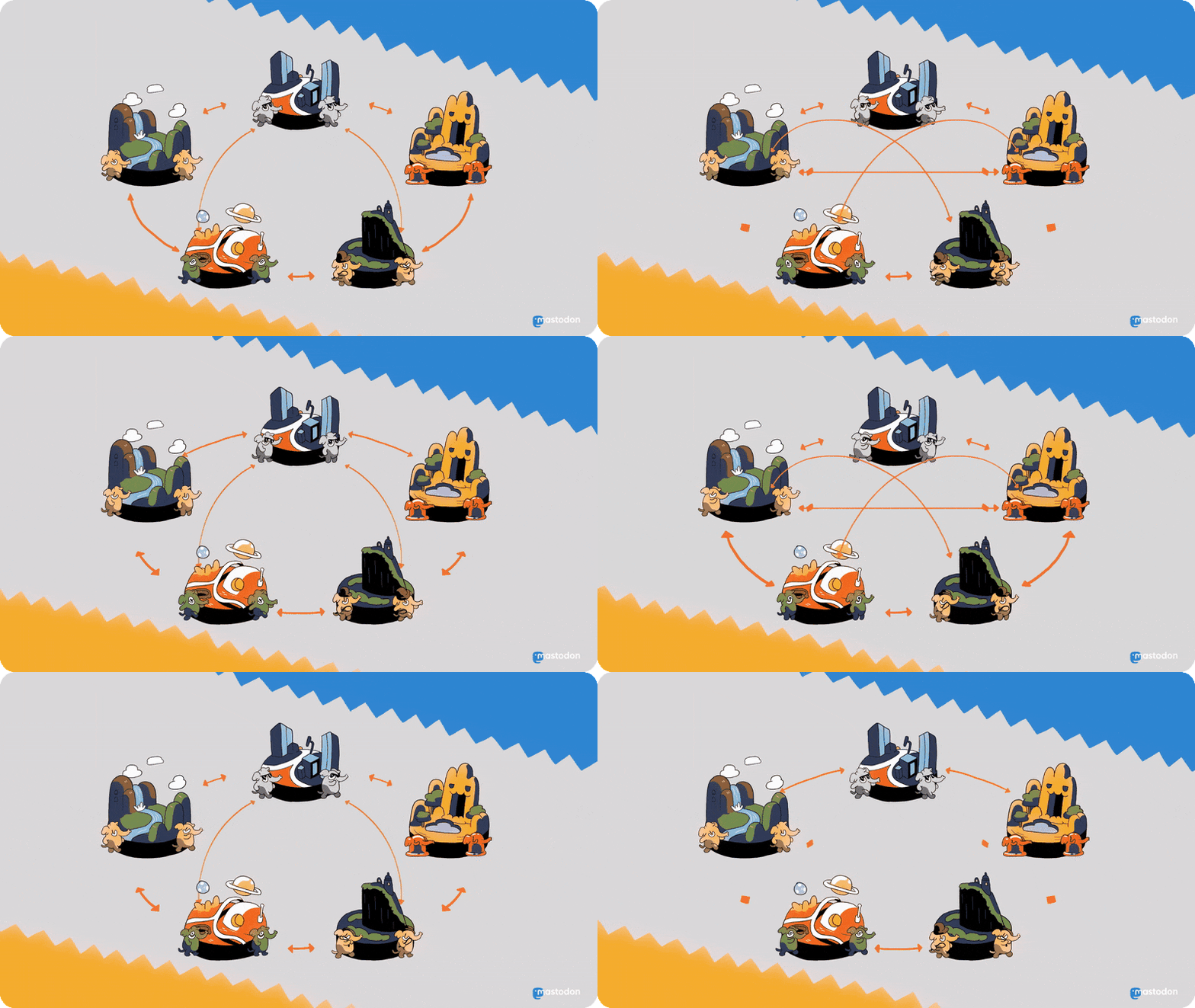
Mastodon is a free, open-source social network server based on ActivityPub where users can follow friends and discover new ones. On Mastodon, users can publish anything they want: links, pictures, text, and video. All Mastodon servers are interoperable as a federated network (users on one server can seamlessly communicate with users from another one, including non-Mastodon software that implements ActivityPub!)

Navigation

Features

Part of the Fediverse. Based on open standards, with no vendor lock-in. - the network goes beyond just Mastodon; anything that implements ActivityPub is part of a broader social network known as the Fediverse. You can follow and interact with users on other servers (including those running different software), and they can follow you back.

Real-time, chronological timeline updates - updates of people you're following appear in real-time in the UI.

Media attachments - upload and view images and videos attached to the updates. Videos with no audio track are treated like animated GIFs; normal videos loop continuously.

Safety and moderation tools - Mastodon includes private posts, locked accounts, phrase filtering, muting, blocking, and many other features, along with a reporting and moderation system.

OAuth2 and a straightforward REST API - Mastodon acts as an OAuth2 provider, and third party apps can use the REST and Streaming APIs. This results in a rich app ecosystem with a variety of choices!

Deployment

Tech stack

  • Ruby on Rails powers the REST API and other web pages.
  • PostgreSQL is the main database.
  • Redis and Sidekiq are used for caching and queueing.
  • Node.js powers the streaming API.
  • React.js and Redux are used for the dynamic parts of the interface.
  • BrowserStack supports testing on real devices and browsers. (This project is tested with BrowserStack)
  • Chromatic provides visual regression testing. (This project is tested with Chromatic)

Requirements

  • Ruby 3.3+
  • PostgreSQL 14+
  • Redis 7.0+
  • Node.js 22+
  • FFmpeg 5.1+

This repository includes deployment configurations for Docker and docker-compose, as well as for other environments like Heroku and Scalingo. For Helm charts, reference the mastodon/chart repository. A standalone installation guide is available in the main documentation.

Contributing

Mastodon is free, open-source software licensed under AGPLv3. We welcome contributions and help from anyone who wants to improve the project.

You should read the overall CONTRIBUTING guide, which covers our development processes.

You should also read and understand the CODE OF CONDUCT that enables us to maintain a welcoming and inclusive community. Collaboration begins with mutual respect and understanding.

You can learn about setting up a development environment in the DEVELOPMENT documentation.

If you would like to help with translations 🌐 you can do so on Crowdin.

LICENSE

Copyright (c) 2016-2026 Eugen Rochko (+ mastodon authors)

Licensed under GNU Affero General Public License as stated in the LICENSE:

Copyright (c) 2016-2026 Eugen Rochko & other Mastodon contributors

This program is free software: you can redistribute it and/or modify it under
the terms of the GNU Affero General Public License as published by the Free
Software Foundation, either version 3 of the License, or (at your option) any
later version.

This program is distributed in the hope that it will be useful, but WITHOUT
ANY WARRANTY; without even the implied warranty of MERCHANTABILITY or FITNESS
FOR A PARTICULAR PURPOSE. See the GNU Affero General Public License for more
details.

You should have received a copy of the GNU Affero General Public License along
with this program. If not, see https://www.gnu.org/licenses/

Frequently asked questions

Is Mastodon free to use?

Mastodon is open source under the AGPL-3.0 licence. There is no licence fee and no seat count — you can self-host it or, where the project offers one, pay a vendor for a managed version instead.

What does Mastodon do?

Decentralized social networking in your control

What is Mastodon written in?

Mastodon is primarily written in Ruby. Its source is publicly available at https://github.com/mastodon/mastodon, and it has 50,299 GitHub stars.