Maigret is an open-source Python OSINT tool that builds a dossier on a person from a username alone, checking for accounts across more than 3,000 sites without requiring API keys — it is aimed at OSINT analysts, pentesters, infosec teams, and investigators.
What it is
Maigret is a command-line information-gathering tool written in Python and released under the MIT licence. Given a single username, it queries a large built-in database of sites, detects which ones hold an account for that handle, and then scrapes each confirmed profile page and site API for whatever information the owner has left public. It lives in the Python OSINT and pentesting ecosystem, installs from PyPI, and is also importable as a library inside other Python projects. The project ships its own web interface for browsing results, and the companion extractor socid_extractor handles the parsing of profile data.
The concrete problem it solves is the manual, repetitive work of checking a handle site by site. Instead of opening hundreds of profile URLs by hand, an investigator runs one command and receives a consolidated view of where the username exists, what those profiles reveal, and which other accounts and identifiers are linked to them. A default run checks the 500 highest-ranked sites by traffic, and the -a flag widens the scan to the full set of 3,000-plus sites, so the tool scales from a quick triage pass to an exhaustive sweep.
Key capabilities
- Checks 3,000+ sites; default run covers the 500 highest-ranked by traffic,
-a scans everything, and --tags narrows by category or country.
- Extracts available account-owner information from profile pages and site APIs via the
socid_extractor component, including links to other accounts.
- Performs recursive search using discovered usernames and other identifiers found in earlier results.
- Detects and partially bypasses blocks, censorship, and CAPTCHA.
- Fetches an auto-updated site database from GitHub once per 24 hours, falling back to the built-in database when offline.
- Works with Tor and I2P sites, and can check domains.
- Ships a web interface for browsing results as a graph and downloading reports in every supported format from one page; optional
--ai mode summarizes findings through an OpenAI-compatible API.
- Embeddable in Python projects — import
maigret and run searches programmatically.
Who uses it and how
- OSINT analysts building a dossier on a handle, running the default 500-site pass for triage and
-a when the full 3,000-site sweep is warranted.
- Pentesters and infosec teams mapping an organization's or target's public footprint as part of an engagement.
- Developers embedding
maigret as a library inside larger social-media analysis or identification tooling.
- Users who want no local install at all, running the community Telegram bot, a Cloud Shell instance, or the Windows
maigret_standalone.exe from Releases.
- Investigations that need anonymity or reachability, using Tor and I2P support to route checks through those networks.
Getting started
Install with pip install maigret on Python 3.10 or higher, then run maigret YOUR_USERNAME. A web UI launch path, a community Telegram bot, Cloud Shell options, and the standalone Windows executable are available for anyone who does not want a local Python install.
How it compares
The facts provided name no paid products that Maigret replaces, and the topic list names no comparable tools. On the recorded evidence, Maigret stands alone in this registry.
When to use it — and when not
Choose Maigret when the task is username-based account discovery and profile extraction, when MIT licensing and self-hosting matter, and when Tor, I2P, or a scriptable Python interface is required. A self-hoster must supply Python 3.10 or higher, network access, and — for large or protected scans — proxy infrastructure, since the README's sponsor section centers on residential proxies for scraping workflows; the --ai mode additionally needs an OpenAI-compatible API endpoint and key. Anyone wanting a turnkey hosted service with no setup, or an operator unwilling to handle rate limits and partial CAPTCHA bypass, should look elsewhere. Note also that the README is truncated in the supplied facts and lists no release date, so packaging and versioning details cannot be confirmed from this page.
project readme (upstream, from github) — read inline
Maigret









English · 简体中文
Maigret collects a dossier on a person by username only, checking for accounts on a huge number of sites and gathering all the available information from web pages. No API keys required. AI profiling (demo).
Sponsors


RapidProxy provides high-performance residential proxies for Twitter scraping, Selenium automation, and web data extraction. 90M+ IPs • Smart rotation • Anti-block • Non-expiring traffic.
Special Offer: Try it free — Plans from $0.65/GB. Use code RAPID10 for 10% off.

MangoProxy is a Residential, ISP, Mobile and Datacenter proxy service designed for professional tasks where stability, speed, and anonymity matter.
Promo code: SOXOJ - 8% off Static ISP proxies

Thordata
provides reliable residential proxies for OSINT research, username lookup, and public data collection workflows.
Access 100M+ real residential IPs across 195+ countries unlimited concurrent connectionswith 99.99% uptime and stable connections, Rotating + Sticky Sessions, and high success rates.
Special Offer: Free 3-day trial + 10% OFF with code SOXOJ10.
Contents
In one minute
Ensure you have Python 3.10 or higher.
pip install maigret
maigret YOUR_USERNAME
No install? Try the community Telegram bot or a Cloud Shell.
Want a web UI? See how to launch it.
See also: Quick start.
Main features
- Supports 3,000+ sites (see full list). A default run checks the 500 highest-ranked sites by traffic; pass
-a to scan everything, or --tags to narrow by category/country.
- Embeddable in Python projects — import
maigret and run searches programmatically (see library usage).
- Extracts all available information about the account owner from profile pages and site APIs, including links to other accounts.
- Performs recursive search using discovered usernames and other IDs.
- Allows filtering by tags (site categories, countries).
- Detects and partially bypasses blocks, censorship, and CAPTCHA.
- Fetches an auto-updated site database from GitHub each run (once per 24 hours), and falls back to the built-in database if offline.
- Works with Tor and I2P websites; able to check domains.
- Ships with a web interface for browsing results as a graph and downloading reports in every format from a single page.
- Optional AI analysis mode (
--ai) that turns raw findings into a short investigation summary using an OpenAI-compatible API.
For the complete feature list, see the features documentation.
Used by
Professional OSINT and social-media analysis tools built on Maigret:


Demo
Video

Reports
PDF report, HTML report
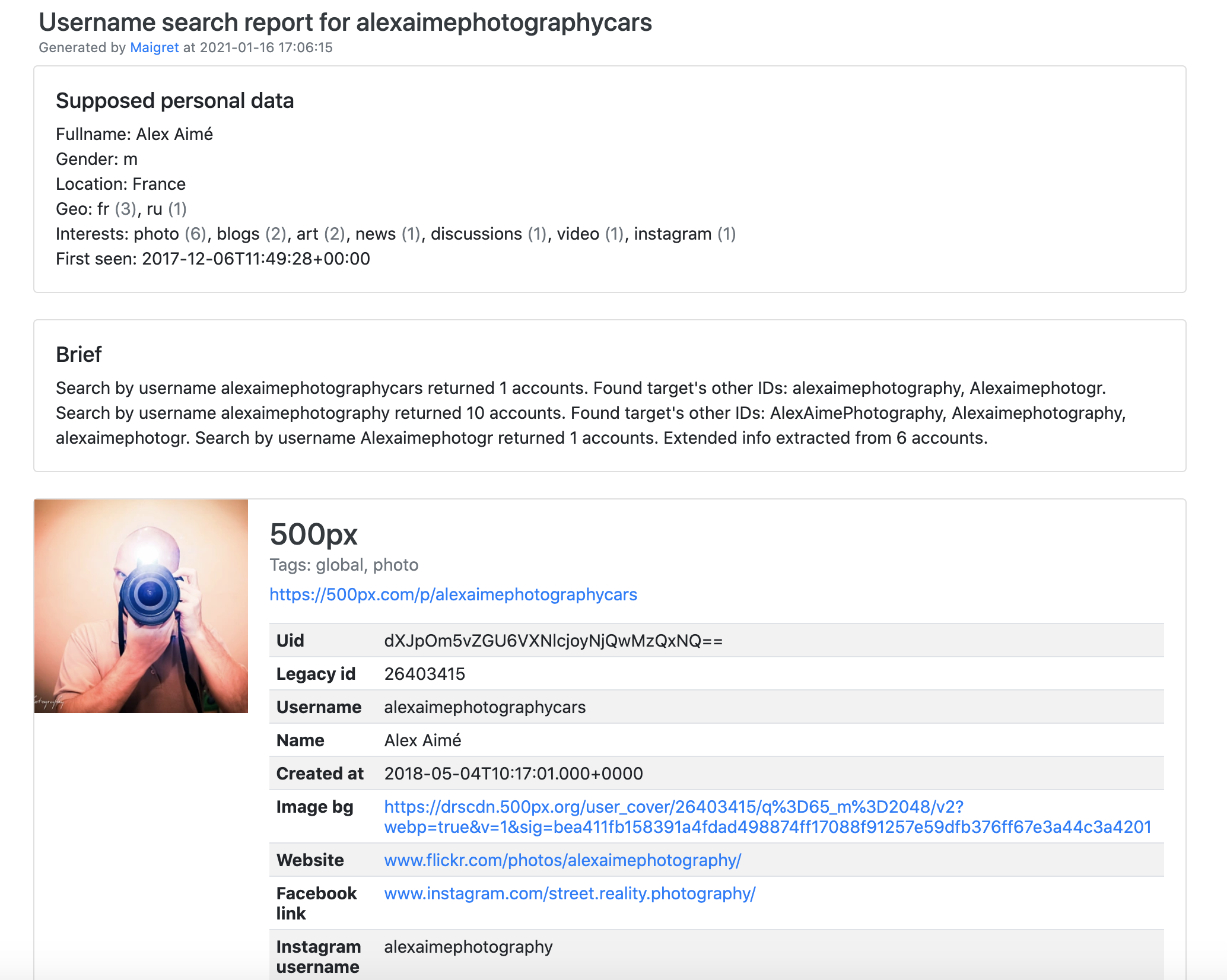
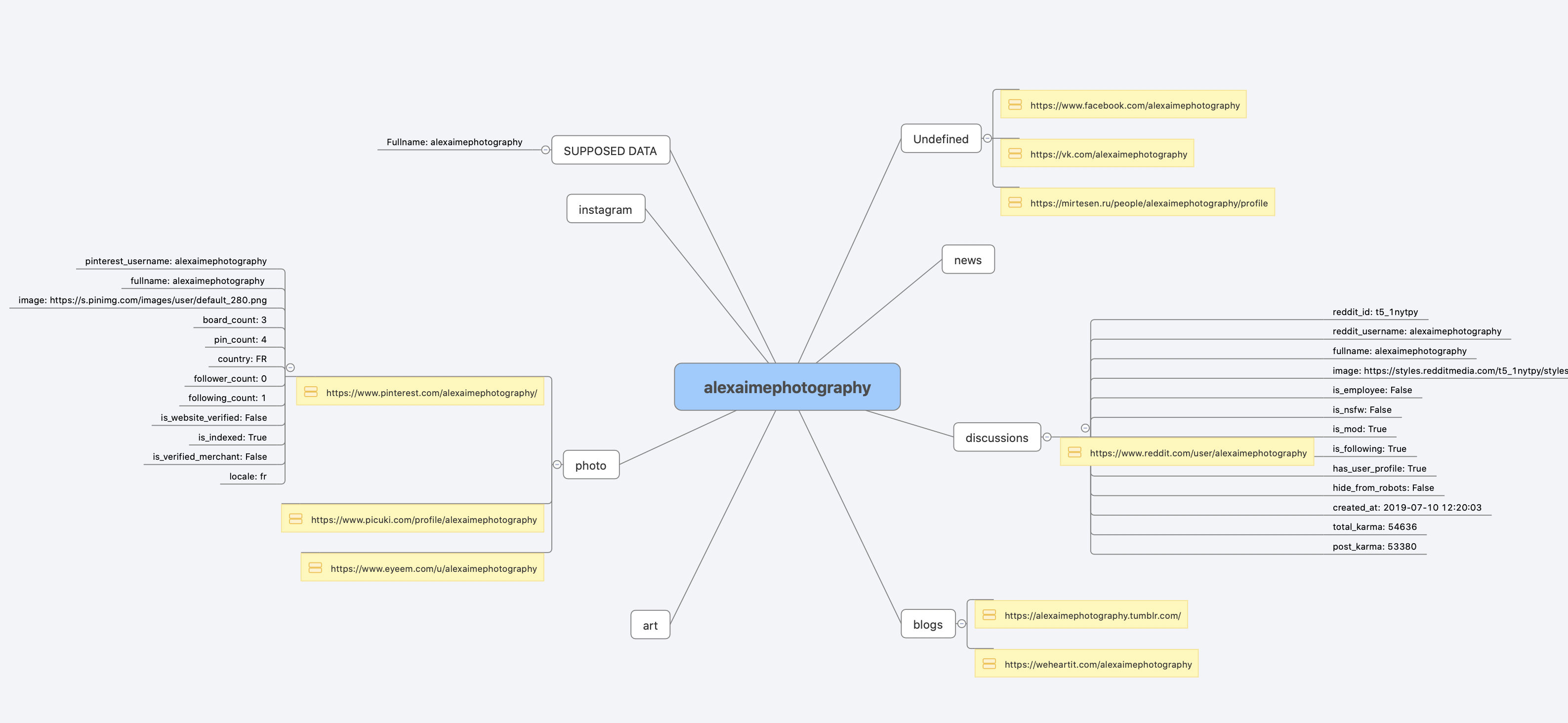
Full console output
Installation
Already ran the In one minute steps? You're set. Below are alternative methods.
Don't want to install anything? Use the community Telegram bot.
Windows
Download maigret_standalone.exe from Releases. You can launch it two ways:
- Double-click it — Maigret will ask for a username, run a default search, and wait at the end so the report links stay visible.
- Run it from a terminal — open Command Prompt (press
Win+R, type cmd, hit Enter) or PowerShell to pass extra options:
cd %USERPROFILE%\Downloads
maigret_standalone.exe USERNAME
maigret_standalone.exe USERNAME --html       :: also save an HTML report
maigret_standalone.exe --help                :: list all options
Video guide: https://youtu.be/qIgwTZOmMmM.
Cloud Shells
Run Maigret in the browser via cloud shells or Jupyter notebooks:


<a href="https://colab.research.google.com/gist/soxoj/879b51bc3b2f8b695ab