



Deutsch | Español | français | 日本語 | 한국어 | Português | Русский | 中文
LocalAI is the open-source AI engine. Run any model - LLMs, vision, voice, image, video - on any hardware. No GPU required.
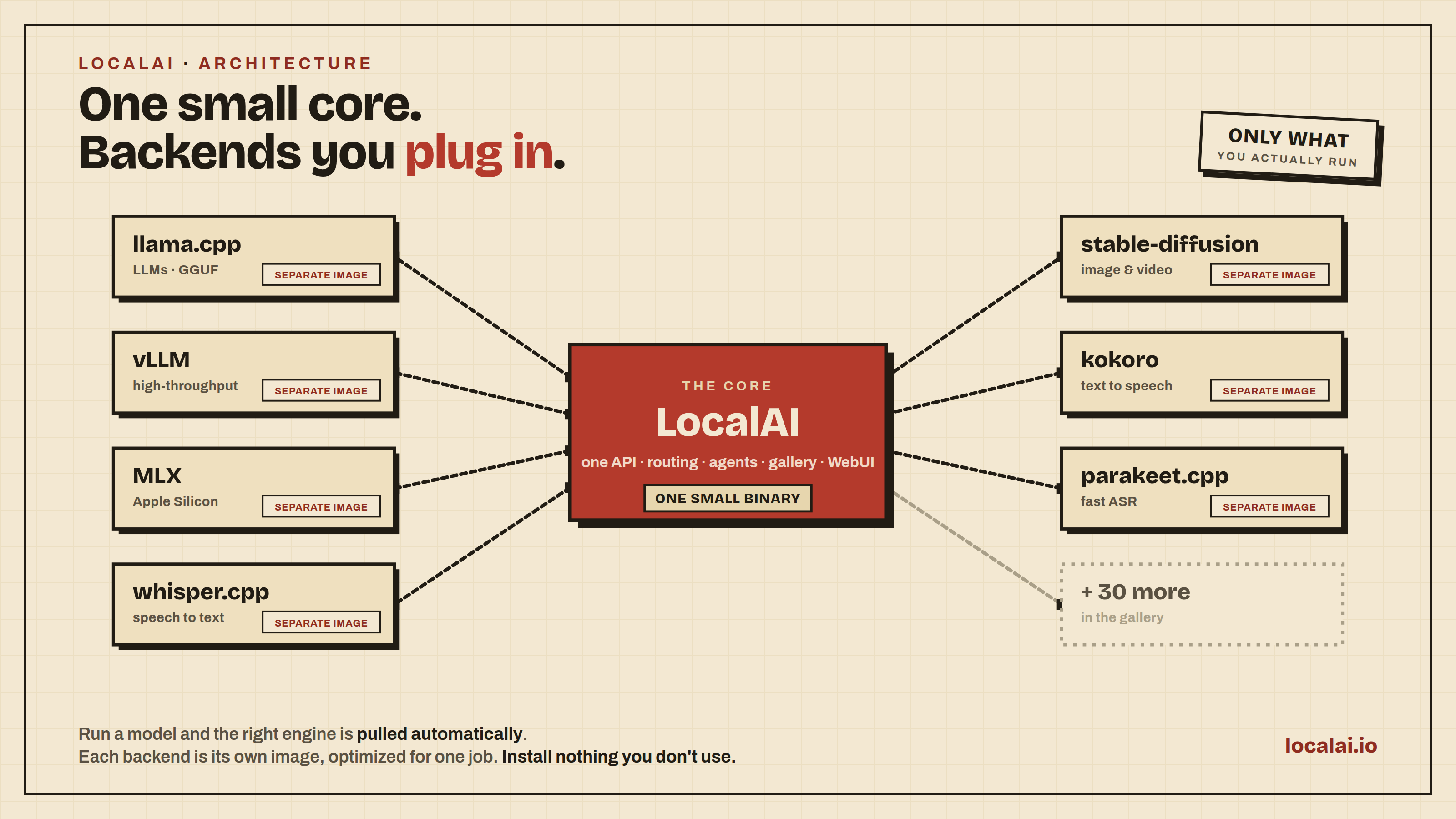
A small core, not a bundle. Each backend wraps a best-in-class engine (llama.cpp, vLLM, whisper.cpp, stable-diffusion, MLX...) in its own image, pulled only when a model needs it. You install nothing you don't use.
- Composable by design: backends are separate and pulled on demand, so you install only what your model needs
- Open and extensible: load any model, or build your own backend in any language against an open interface
- Drop-in API compatibility: OpenAI, Anthropic, and ElevenLabs APIs across every backend
- Any model, any modality: LLMs, vision, voice, image, and video behind one API
- Any hardware: NVIDIA, AMD, Intel, Apple Silicon, Vulkan, or CPU-only
- Multi-user ready: API key auth, user quotas, role-based access
- Built-in AI agents: autonomous agents with tool use, RAG, MCP, and skills
- Privacy-first: your data never leaves your infrastructure
Created by Ettore Di Giacinto and maintained by the LocalAI team.
:book: Documentation | :speech_balloon: Discord | 💻 Quickstart | 🖼️ Models | ❓FAQ
Guided tour
https://github.com/user-attachments/assets/08cbb692-57da-48f7-963d-2e7b43883c18
Click to see more!
User and auth
https://github.com/user-attachments/assets/228fa9ad-81a3-4d43-bfb9-31557e14a36c
Agents
https://github.com/user-attachments/assets/6270b331-e21d-4087-a540-6290006b381a
Usage metrics per user
https://github.com/user-attachments/assets/cbb03379-23b4-4e3d-bd26-d152f057007f
Fine-tuning and Quantization
https://github.com/user-attachments/assets/5ba4ace9-d3df-4795-b7d4-b0b404ea71ee
WebRTC
https://github.com/user-attachments/assets/ed88e34c-fed3-4b83-8a67-4716a9feeb7b
Quickstart
macOS

Note: The DMG is not signed by Apple. After installing, run:
sudo xattr -d com.apple.quarantine /Applications/LocalAI.app. See #6268 for details.
Containers (Docker, podman, ...)
Already ran LocalAI before? Use
docker start -i local-aito restart an existing container.
CPU only:
docker run -ti --name local-ai -p 8080:8080 localai/localai:latest
NVIDIA GPU:
# CUDA 13
docker run -ti --name local-ai -p 8080:8080 --gpus all localai/localai:latest-gpu-nvidia-cuda-13

# CUDA 12
docker run -ti --name local-ai -p 8080:8080 --gpus all localai/localai:latest-gpu-nvidia-cuda-12

# NVIDIA Jetson ARM64 (CUDA 12, for AGX Orin and similar)
docker run -ti --name local-ai -p 8080:8080 --gpus all localai/localai:latest-nvidia-l4t-arm64

# NVIDIA Jetson ARM64 (CUDA 13, for DGX Spark)
docker run -ti --name local-ai -p 8080:8080 --gpus all localai/localai:latest-nvidia-l4t-arm64-cuda-13
AMD GPU (ROCm):
docker run -ti --name local-ai -p 8080:8080 --device=/dev/kfd --device=/dev/dri --group-add=video localai/localai:latest-gpu-hipblas
Intel GPU (oneAPI):
docker run -ti --name local-ai -p 8080:8080 --device=/dev/dri/card1 --device=/dev/dri/renderD128 localai/localai:latest-gpu-intel
Vulkan GPU:
docker run -ti --name local-ai -p 8080:8080 localai/localai:latest-gpu-vulkan
Loading models
# From the model gallery (see available models with `local-ai models list` or at https://models.localai.io)
local-ai run llama-3.2-1b-instruct:q4_k_m
# From Huggingface
local-ai run huggingface://TheBloke/phi-2-GGUF/phi-2.Q8_0.gguf
# From the Ollama OCI registry
local-ai run ollama://gemma:2b
# From a YAML config
local-ai run https://gist.githubusercontent.com/.../phi-2.yaml
# From a standard OCI registry (e.g., Docker Hub)
local-ai run oci://localai/phi-2:latest
To work with a running LocalAI server from the terminal, start the built-in agent from another shell. It answers questions, reads your files and runs commands on your machine, asking you to approve anything that changes state. Inside a session, /models lists installed models and /model switches between them. See the Terminal agent docs.
# Terminal 1
local-ai run llama-3.2-1b-instruct:q4_k_m

# Terminal 2
local-ai chat --model llama-3.2-1b-instruct:q4_k_m
Automatic Backend Detection: LocalAI automatically detects your GPU capabilities and downloads the appropriate backend. For advanced options, see GPU Acceleration.
For more details, see the Getting Started guide.
Latest News
- June 2026: New native biometric backends from the LocalAI team: voice-detect.cpp for speaker recognition and voice analysis (ECAPA-TDNN, WeSpeaker, ERes2Net, CAM++, wav2vec2 age/gender/emotion) and face-detect.cpp for face detection, recognition, demographics and anti-spoofing (SCRFD/ArcFace, YuNet/SFace). Both are from-scratch C++/ggml engines with no Python or onnxruntime at inference, self-contained GGUF weights, bit-exact parity with the reference, and GPU cuDNN parity, replacing the heavier Python
insightfaceandspeaker-recognitionbackends (PR #10441). - June 2026: New realtime voice assistant demo (a tiny Go client for the Realtime API with a full talk-back voice loop and tool calling), plus streaming of the realtime LLM / TTS / transcription pipeline stages and configurable WebRTC ICE candidates.
- June 2026: Big speech push: the parakeet.cpp ASR engine gains NeMo-faithful segment timestamps, a multilingual streaming Nemotron-3.5 model, dynamic batching for concurrent transcription and CUDA graphs; the new CrispASR backend adds multi-architecture ASR + TTS, and 60 Piper TTS voices across 42 languages land in the gallery (plus per-request TTS instructions and params)