
LobsterAI is a free, open source ai interaction & interfaces project written in TypeScript and released under MIT. It has 6,046 GitHub stars, 968 forks and 601 open issues, and was last pushed 9 hours ago. On this registry it ranks #45 of 76 tracked projects in AI Interaction & Interfaces, with 5 head-to-head comparisons available. It gained 12 stars over the last 3 tracked days.

What is LobsterAI?

LobsterAI is an MIT-licensed, Electron-based desktop AI agent from NetEase Youdao that runs tools against your real local files, terminal, and browser and accepts commands from your phone through messaging apps — built for developers, analysts, and office teams who want agent automation to stay on their own machine.

What it is

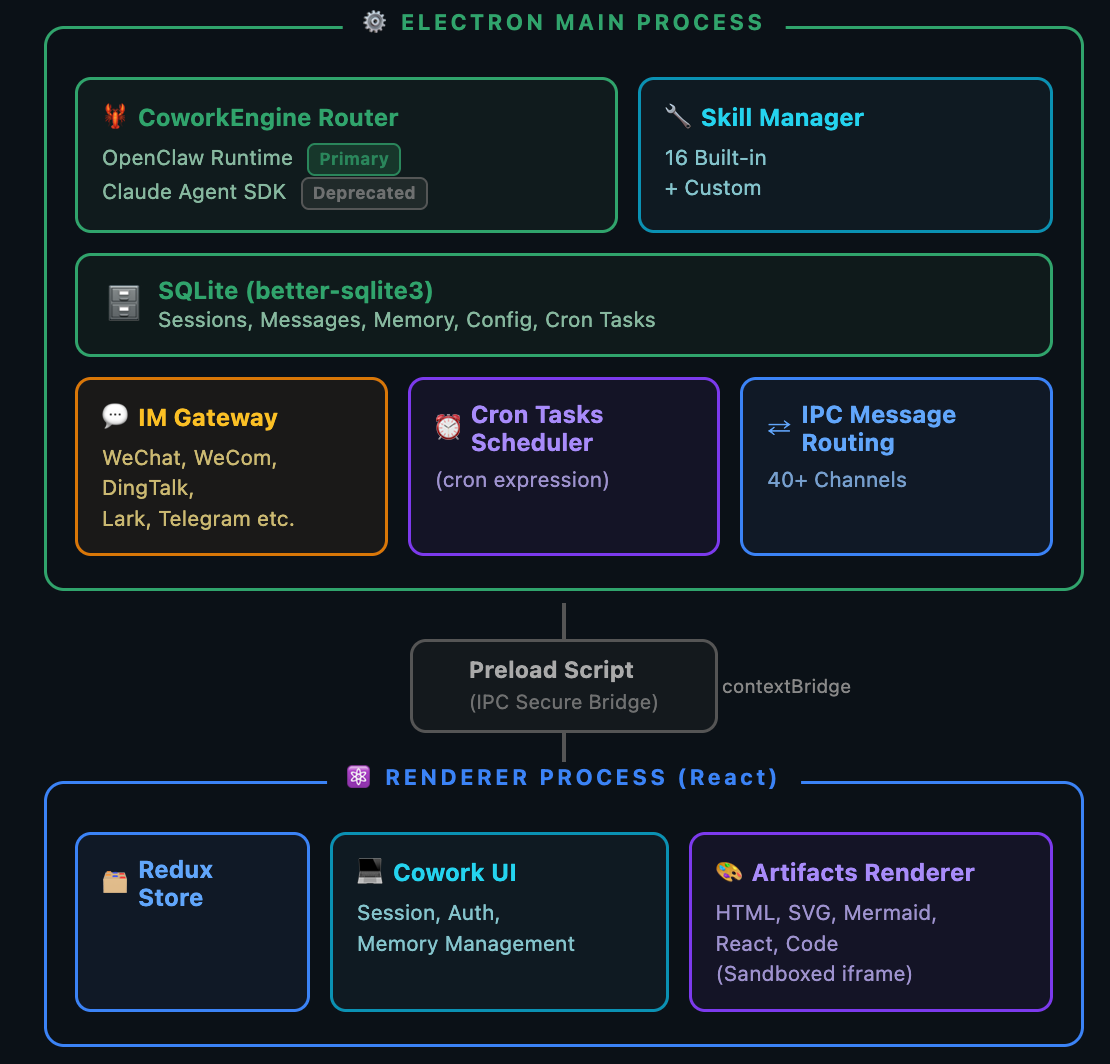
LobsterAI is an open-source desktop Agent built by NetEase Youdao, written in TypeScript and shipped as an Electron application. It splits into two layers: Cowork is the product and session layer inside the desktop app, and OpenClaw is the runtime and gateway underneath it. That split lets LobsterAI keep local persistence, permissions, UI state, artifacts, agents, memory, and IM bindings in the desktop client while OpenClaw handles agent execution.

The concrete problem it solves is the gap between a chat assistant that describes work and an agent that actually performs it in your working environment. Instead of relaying instructions by hand between an LLM conversation and a local toolchain, LobsterAI operates directly on local files, terminal commands, browser workflows, documents, spreadsheets, slides, IM channels, scheduled jobs, and project workspaces. It replaces that manual relay, and it asks for approval before sensitive actions such as file operations, terminal commands, or network access.

Key capabilities

  • Desktop Cowork sessions that run long-form Agent tasks against local projects, stream progress, keep session history, render tool output, and gate sensitive actions behind approvals.
  • 28 built-in skills configured in SKILLs/skills.config.json, including web search, Word documents, spreadsheets, PowerPoint, PDF processing, Remotion video generation, browser automation, image/video generation, stock research, content writing, email, weather, and skill creation.
  • Multi-Agent workflows with per-agent identity, model choice, skills, working directory, enabled state, and IM bindings, keeping a Main Agent for general work and specialized Agents for repeatable roles.
  • Expert Kits that package capability selections and references for common workflows, selectable independently from direct skills so a workflow can combine curated kits with individual tools.
  • MCP server connections that store user-configured servers locally and sync enabled servers into OpenClaw.
  • Scheduled tasks created either by conversation or through the scheduled task UI, for daily news digests, inbox summaries, website monitoring, weekly reports, and other repeatable work.
  • IM remote control from WeChat, WeCom, DingTalk, Feishu/Lark, QQ, Telegram, Discord, NetEase IM, NetEase Bee, POPO, and email, plus rich artifact preview for HTML, SVG, images, video, Mermaid diagrams, code, Markdown, text, documents, and local service artifacts.

Who uses it and how

  • Individual analysts working from local spreadsheets point it at a file such as product-growth.xlsx to build a visual dashboard and summarize growth drivers.
  • Operations staff automate recurring browser checks, opening an ads dashboard every morning to review spend and conversion anomalies and summarize likely causes.
  • Recruiters and hiring teams turn a folder of resumes into a screening sheet and shortlist candidates against a job description.
  • Teams standardized on Chinese IM stacks bind different accounts or channels to different Agents and drive those Agents from a phone over WeChat, WeCom, DingTalk, or Feishu/Lark.
  • Builders who need small local tools generate systems, such as a local inventory system that records purchases and sales, calculates stock and profit, and opens in the browser.
  • Anyone with repeatable reporting needs schedules work conversationally, for example collecting yesterday's AI news every weekday at 9 AM and sending a concise digest.

Getting started

The README points to downloading LobsterAI from the project homepage at https://lobsterai.youdao.com, which is the documented way to obtain the desktop application. From there the app starts the OpenClaw runtime and syncs enabled skills, MCP servers, and IM gateways itself.

How it compares

LobsterAI builds on OpenClaw rather than competing with it: OpenClaw is the execution runtime and gateway, and LobsterAI is the desktop product and session layer on top. The provided facts name no other comparable desktop-grade agent for positioning, so on this registry it stands on its own.

When to use it — and when not to

A self-hoster must operate an Electron desktop application with local SQLite persistence and the OpenClaw runtime the app starts and repairs, so this is not a headless server or CI-oriented tool, and teams wanting a managed hosted service or browser-only access should look elsewhere. The project carries 601 open issues against 6,047 stars and 968 forks, which indicates an active but still rough surface with a large bug backlog. The README excerpt is also thin on installation specifics beyond the homepage download, so anyone evaluating it should expect to learn the setup from the app and the repository rather than from a detailed operations guide.

project readme (upstream, from github) — read inline


LobsterAI

GitHub stars License Follow LobsterAI on X Follow LobsterAI on X
Supported platforms: macOS and Windows Electron 43 React 18

English · 中文

All-scenario office assistant Agent.
The first open-source desktop-grade Agent among major Chinese tech companies, built by NetEase Youdao.

Features  ·  Developing  ·  Community

Download LobsterAI
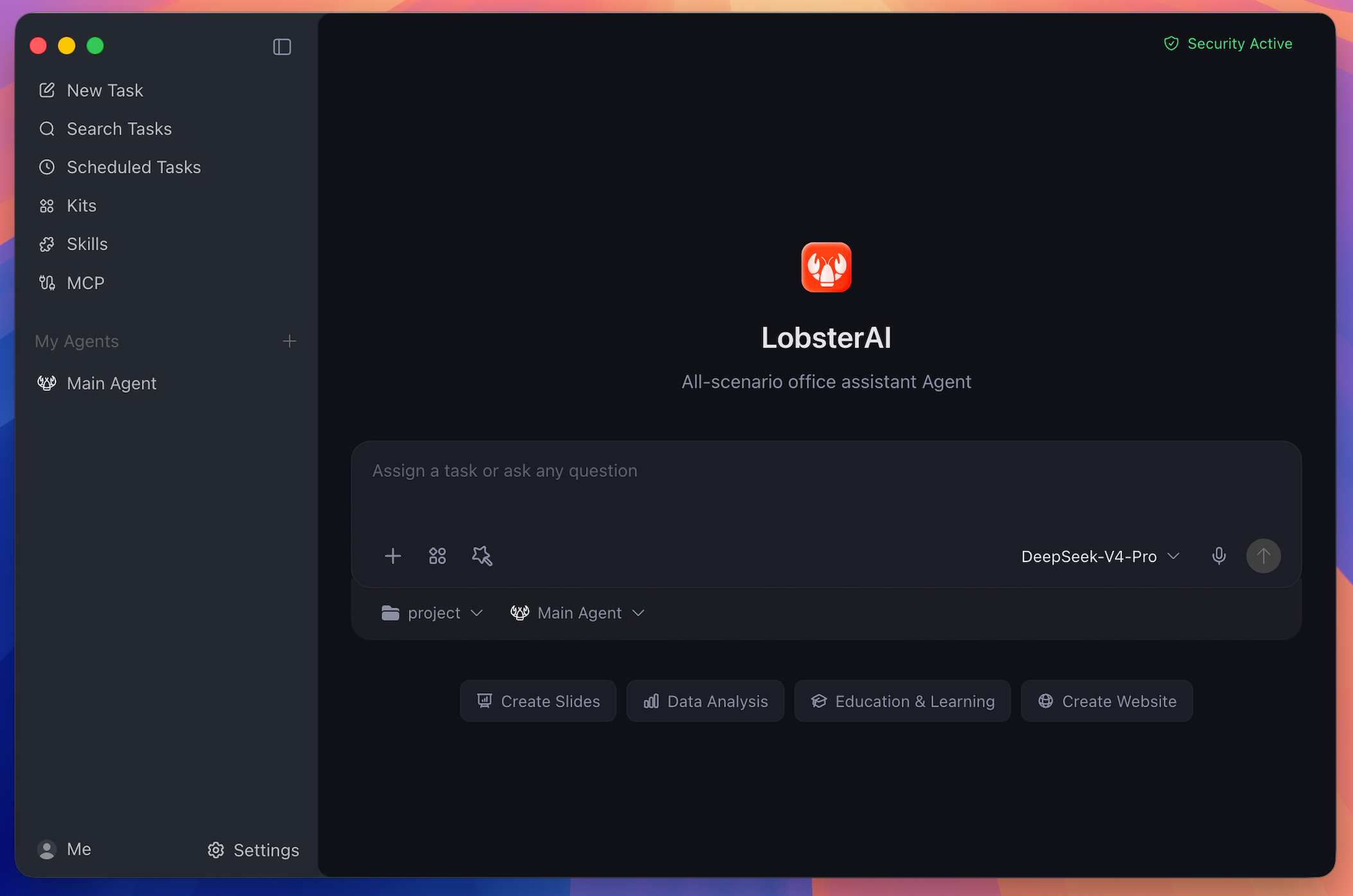
LobsterAI is a desktop Agent that can operate in your real working environment: local files, terminal commands, browser workflows, documents, spreadsheets, slides, IM channels, scheduled jobs, and project workspaces.

Cowork is the LobsterAI product/session layer. OpenClaw is the runtime and gateway underneath it. That split lets LobsterAI keep local persistence, permissions, UI state, artifacts, agents, memory, and IM bindings in the desktop app while using OpenClaw for agent execution.

Features

Desktop Cowork Sessions

Run long-form Agent tasks against local projects and files. LobsterAI streams progress, keeps session history, renders tool output, and asks for approval before sensitive actions such as file operations, terminal commands, or network access.

Multi-Agent Workflows

Create custom Agents with their own identity, model choice, skills, working directory, enabled state, and IM bindings. Keep the Main Agent for general work and use specialized Agents for repeatable roles.

Expert Kits

Install scenario-oriented Expert Kits that package capability selections and references for common workflows. Kits are selected independently from direct skills, so a workflow can combine curated kits with individual tools.

Skills

LobsterAI ships with 28 built-in skills configured in SKILLs/skills.config.json, including web search, Word documents, spreadsheets, PowerPoint, PDF processing, Remotion video generation, browser automation, image/video generation, stock research, content writing, email, weather, and skill creation.

MCP Servers

Connect external tools and data sources through Model Context Protocol servers. LobsterAI stores user-configured servers locally and syncs enabled servers into OpenClaw.

Scheduled Tasks

Create recurring work either by conversation or through the scheduled task UI. Use it for daily news digests, inbox summaries, website monitoring, weekly reports, and other repeatable work.

IM Remote Control

Reach your desktop Agent from WeChat, WeCom, DingTalk, Feishu/Lark, QQ, Telegram, Discord, NetEase IM, NetEase Bee, POPO, and email. Multi-instance platforms can bind different accounts or channels to different Agents.

Rich Artifacts

Preview and manage generated HTML, SVG, images, video, Mermaid diagrams, code, Markdown, text, documents, and local service artifacts inside the desktop app.

Local Memory And Data

Sessions and app data live locally in SQLite. OpenClaw workspace memory uses files such as MEMORY.md, USER.md, SOUL.md, and daily notes, so durable preferences and project context can carry across sessions.

Real-World Prompts

Scenario Example prompt
Build a local system "I still track inventory and sales in Excel. Build a local inventory system that records purchases and sales, calculates stock and profit, and opens in my browser."
Analyze local data "Use product-growth.xlsx to build a visual dashboard and summarize the main growth drivers."
Generate a deck "Research the AI Agent market and turn the findings into a presentation."
Automate browser checks "Open the ads dashboard every morning, check spend and conversion anomalies, and summarize likely causes."
Screen documents "Turn the resumes in this folder into a screening sheet and shortlist the strongest candidates against the JD."
Run scheduled work "Every weekday at 9 AM, collect yesterday's AI news and send me a concise digest."

How It Works

  • Renderer: React, Redux Toolkit, Tailwind, artifact renderers, settings, agent/session UI, skills, MCP, scheduled tasks, and IM configuration.
  • Main process: Electron lifecycle, IPC, SQLite persistence, auth, logging, OpenClaw startup, runtime repair, skill sync, IM gateways, and artifact services.
  • OpenClaw integration: openclawEngineManager, openclawConfigSync, openclawRuntimeAdapter, and coworkEngineRouter translate LobsterAI state into OpenClaw runtime behavior.

Install

Desktop

Download the latest macOS and Windows installers from Official Website or GitHub Releases.

Run From Source

Requirements:

  • Node.js `>=24.15.0 =11.17.0
Publish a runtime archive (per platform)

Each target must be built on a matching machine: native dependencies install for the host, so a cross-architecture build produces an archive that packs cleanly and only fails on users' machines. The build refuses to run on a mismatched host.

Target Build on
mac-arm64 Apple Silicon mac
mac-x64 Intel mac
win-x64 Windows 10 1803+ (ships `ta

readme truncated — read the full docs on github

Frequently asked questions

Is LobsterAI free to use?

LobsterAI is open source under the MIT licence. There is no licence fee and no seat count — you can self-host it or, where the project offers one, pay a vendor for a managed version instead.

What does LobsterAI do?

Open-source, desktop-grade AI agent that gets real work done — data analysis, slides, docs, video & web research. Built on OpenClaw; runs tools on your real des

What is LobsterAI written in?

LobsterAI is primarily written in TypeScript. Its source is publicly available at https://github.com/netease-youdao/LobsterAI, and it has 6,046 GitHub stars.