LLM Workflow Engine (LWE) is an MIT-licensed Python CLI and workflow manager that lets developers and operators drive ChatGPT, GPT-4 and other large language models from the terminal, embed those calls in scripts and Ansible Playbook workflows, and extend the whole thing through a plugin architecture.
What it is
LLM Workflow Engine is a power command-line interface and workflow manager for large language models. It runs in a shell, so a user can call and interact with ChatGPT or GPT-4 directly in the terminal rather than through a browser tab or a bespoke script. It talks to the official ChatGPT API, which means every model available to an OpenAI account is reachable, and it also ships a Python library that exposes the same capability inside ordinary Python programs. The project sits in the Python and OpenAI ecosystem and identifies itself with topics such as chatbot, chatgpt, gpt-3, gpt3, gpt4, llm, openai and python.
The concrete problem it solves is fragmentation of ad-hoc LLM usage. Instead of scattering one-off API calls across scripts, notebooks and shell aliases, LWE centralises prompt interaction, provider access, tool use and multi-step automation in one configurable tool. It is the successor to the original ChatGPT Wrapper project, whose codebase it grew from, and it replaces that predecessor with a broader engine that supports multiple LLM providers through provider plugins, including GPT-3, Cohere and Huggingface alongside OpenAI models.
Key capabilities
- Command-line chat: interact with ChatGPT and GPT-4 straight from the shell, with no separate client application.
- Official OpenAI API access: direct API calls to the ChatGPT endpoint, covering all supported models reachable by the user's OpenAI account.
- Plugin architecture: extend LWE with custom functionality through documented core plugins.
- Multiple LLM providers: provider plugins allow interaction with models beyond OpenAI, such as GPT-3, Cohere and Huggingface.
- Workflow building: integrate LLM calls into larger workflows via Ansible Playbooks.
- Tool use: supported providers can invoke tools as part of a conversation.
- Docker image: LWE is also distributed as a Docker image, marked experimental in the README.
- Python API: use ChatGPT and GPT-4 from Python scripts through the bundled library.
Who uses it and how
- Developers who live in the terminal and want prompt-and-response loops without leaving the shell.
- Automation authors who need LLM calls embedded as steps inside Ansible Playbooks.
- Python developers who want the same engine available as a library inside existing scripts.
- Teams routing traffic across providers, using provider plugins to switch between OpenAI, Cohere and Huggingface models.
- Users of the original ChatGPT Wrapper ecosystem; downstream projects built on that predecessor include ChatGPT.el for Emacs, ChatGPT Reddit Bot, ChatGPTify, bookast and selection-to-chatgpt.
Getting started
LWE is installed by following the installation guide in the official documentation at llm-workflow-engine.readthedocs.io, and it is also available as a Docker image, which the README labels experimental.
How it compares
No comparable tools or paid alternatives are named in the material supplied for this entry, so no direct contrast on licence, self-hosting or cost model can honestly be drawn. On the evidence here, LLM Workflow Engine stands alone in this registry.
When to use it — and when not to
Choose LWE when a terminal-first, scriptable LLM engine with provider plugins and Ansible-based workflow integration is what is needed, and when the operating environment can supply OpenAI or other provider credentials. Avoid it if a graphical client or a hosted, managed experience is required, if depending on Ansible Playbooks for workflows is unwelcome, or if the experimental Docker image cannot be accepted in production. Note also that the README is largely a set of links to external documentation, so prospective adopters should read that documentation before committing, and that the project carries a small open-issue count but no release cadence information in the facts provided.
project readme (upstream, from github) — read inline


LLM Workflow Engine
LLM Workflow Engine (LWE) is a Power CLI and Workflow manager for LLMs.
Welcome!
What would you like to do?
What happend to the original ChatGPT Wrapper project?
See CHATGPT_WRAPPER.md
ChatGPT Wrapper was an amazing tool for its time, thank you to its original creator mmabrouk for all your hard work, it lives on in a new form :)
Highlights
🤖 LWE lets you use the powerful ChatGPT/GPT4 bot from the command line.
💬 Runs in Shell. You can call and interact with ChatGPT/GPT4 in the terminal.
💻 Supports official ChatGPT API. Make API calls directly to the OpenAI ChatGPT endpoint (all supported models accessible by your OpenAI account)
🔌 Simple plugin architecture. Extend LWE with custom functionality
🗣 Supports multiple LLM providers. Provider plugins allow interacting with other LLMs (GPT-3, Cohere, Huggingface, etc.)
🔄Build workflows. Easily integrate calls to an LLM into larger workflows via Ansible Playbooks
🔧 Tool use. (for supported providers)
🐳 Docker image. LWE is also available as a docker image. (experimental)
🐍Python API. LWE also has a Python library that lets you use ChatGPT/GPT4 in your Python scripts.
Projects built with the original ChatGPT Wrapper
Contributing
We welcome contributions to LWE! If you have an idea for a new feature or have found a bug, please open an issue on the GitHub repository.
License
This project is licensed under the MIT License - see the LICENSE file for details.
Acknowledgments
- The original ChatGPT Wrapper project (which LWE grew from) was created and maintained by mmabrouk
- The original ChatGPT Wrapper project is a modification from Taranjeet code which is a modification of Daniel Gross code.
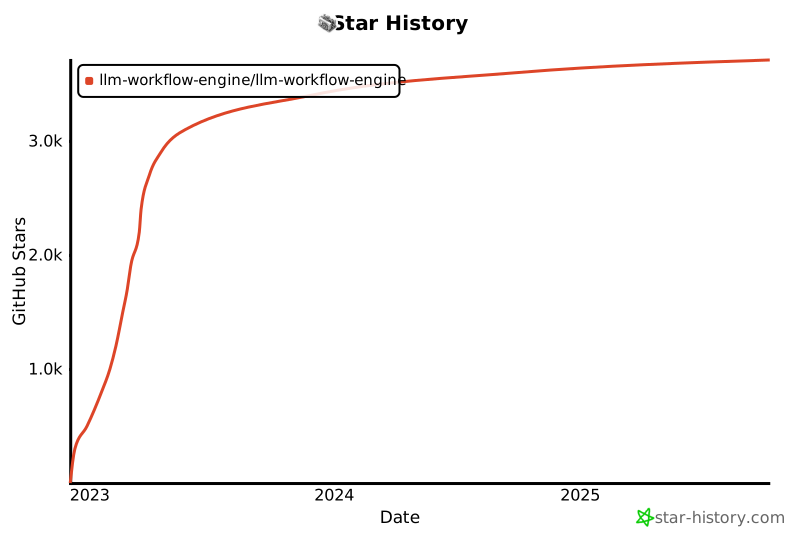
Star History