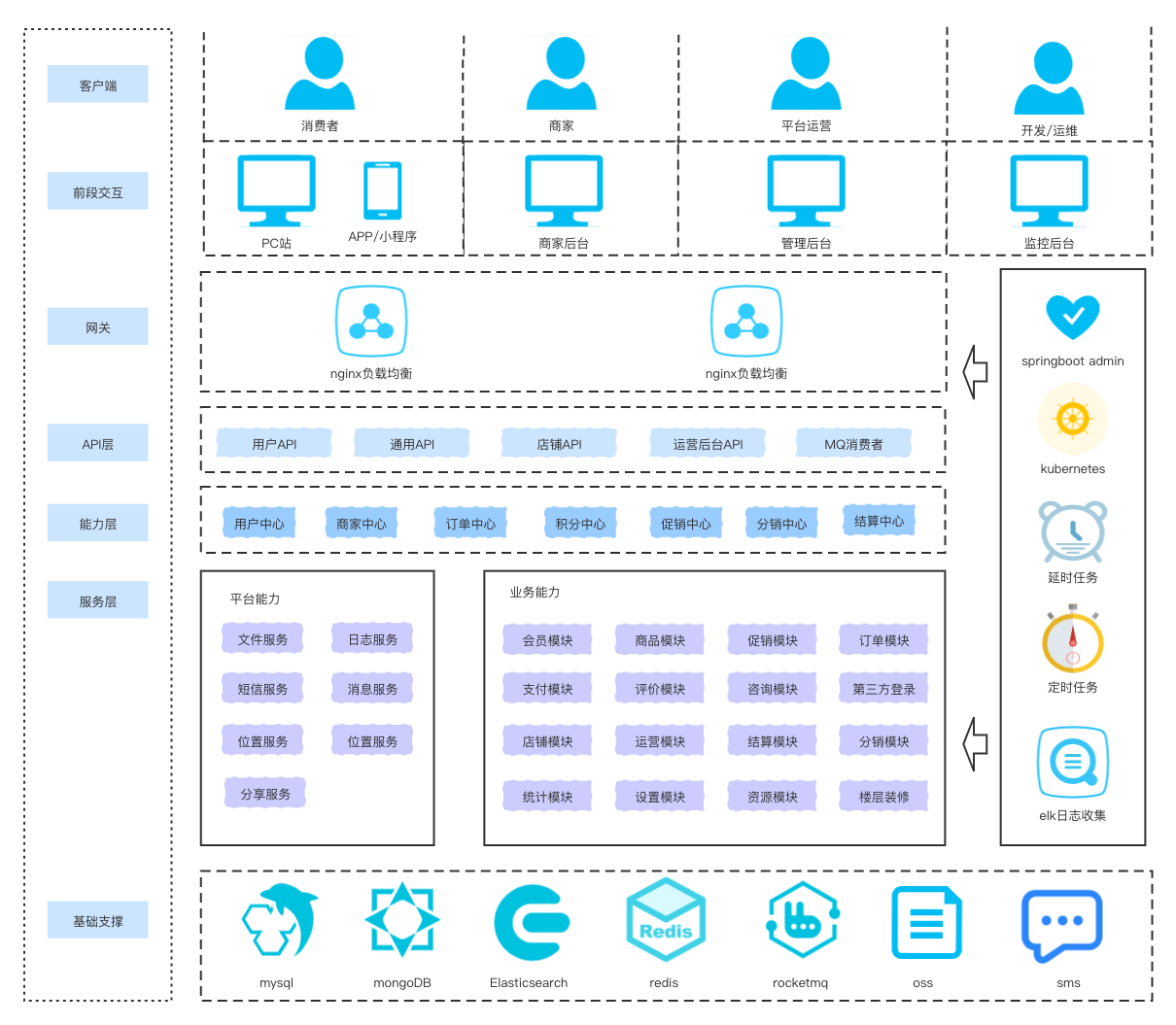
Lilishop (also published as PickMall) is an open-source Java B2B2C multi-merchant mall system built on Spring Boot, Spring Cloud, Vue and uni-app, aimed at enterprises and development teams that want to self-host an online marketplace serving PC, H5, mini program and APP storefronts from a single codebase.
What it is
Lilishop is a full-stack e-commerce platform source release written in Java and living in the Spring ecosystem. The back end is built on Spring Boot 3 and Spring Cloud, with a front-end/back-end separated architecture that supports distributed deployment; the front end covers PC, H5, WeChat mini program and APP using Vue and uni-app. The repository carries 4,306 stars and 1,043 forks, with 15 open issues, and was last pushed in June 2026. The source is released under AGPL-3.0, and the project is registered in this registry under Infrastructure & Operations / Databases. An official website and documentation site are published at pickmall.cn and docs.pickmall.cn.
The concrete problem it solves is the cost of assembling a multi-merchant marketplace from nothing. Instead of writing merchant onboarding, goods, order, promotion, shop, operation and statistics modules by hand, and instead of maintaining a separate codebase for each client channel, Lilishop ships those modules and a shared uni-app front end out of the box. It also replaces manual provisioning of the backing services: the recommended deployment path is a docker-compose configuration that deploys and initializes MySQL, Redis and Elasticsearch automatically, rather than requiring an operator to stand up each dependency and load SQL by hand.
Key capabilities
- B2B2C multi-merchant model with merchant onboarding (商家入驻) and separate platform and shop administration consoles.
- Docker images and docker-compose configuration for one-click deployment that initializes MySQL, Redis and Elasticsearch automatically.
- Manual database initialization path: SQL scripts published in the Gitee docker repository under
init/mysql, matched to the code version.
- Back-end stack including Spring Boot 3.5.6, MyBatis-Plus 3.5.8, MySQL 8.3.0, RocketMQ 2.3.4, Redis, Elasticsearch, Spring Security, ShardingSphere 4.0.0, XXL-Job 2.3.0 and JWT authentication.
- Admin front end built on Vue with iView, Vuex, Vue Router and axios.
- Mobile front end built on uni-app with uViewUI and SCSS, covering H5, mini program and APP.
- Business coverage spanning customer, order, goods, promotion, shop, operation and statistics modules, plus live commerce, distribution commission, flash sale and multi-language support.
Who uses it and how
- Enterprises deploying a private, self-hosted marketplace where the storefront and data stay on their own infrastructure.
- Marketplace operators running two distinct consoles: a platform administration endpoint and a shop administration endpoint, with separate credentials for each.
- Teams performing secondary development on Java and Spring source, extending the module set rather than starting from an empty project.
- Product teams that need PC, H5, WeChat mini program and APP storefronts delivered from one uni-app codebase.
- Developers evaluating the system through the hosted demo, which runs on the
master branch with a fixed SMS verification code.
Getting started
The recommended route is the project's docker-compose configuration, which deploys and initializes the database services automatically; the deployment guide lives at docs.pickmall.cn/deply/deply.html, and a manual install requires loading the version-matched SQL scripts from the Gitee docker repository. A hosted demo is available at pickmall.cn.
How it compares
No list of paid products this project replaces is provided in the available facts, and no directly comparable open-source mall systems are named. On the facts given, it stands alone in this registry.
When to use it — and when not to
A self-hoster must operate a real service footprint: MySQL, Redis, Elasticsearch, RocketMQ and XXL-Job all appear in the back-end stack, so the deployment is not a single binary. The licence deserves attention before commitment — the repository states AGPL-3.0 while also restricting use to personal learning, research and non-commercial purposes, with commercial use requiring a separate one-time perpetual licence from the vendor, so commercial adopters should resolve licensing before building on the code. The project is also a poor fit for teams that want a permissive licence or a hosted SaaS with no operational burden, and the documentation and demonstration material are primarily Chinese-language.