LightRAG is a free, open source ai development platforms project written in Python and released under MIT. It has 39,726 GitHub stars, 5,591 forks and 222 open issues, and was last pushed 5 hours ago. On this registry it ranks #22 of 61 tracked projects in AI Development Platforms, with 5 head-to-head comparisons available. It gained 54 stars over the last 3 tracked days.

What is LightRAG?

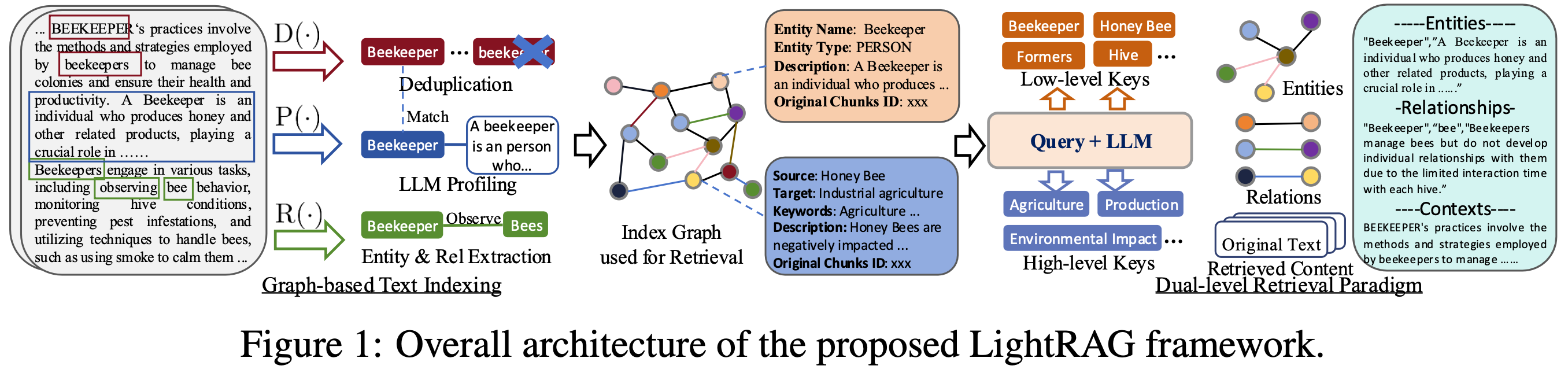
LightRAG is a Python retrieval-augmented generation framework, released under the MIT licence and presented in an EMNLP 2025 paper, that builds a knowledge graph over documents so that queries can be answered from both graph structure and vector similarity.

What it is

LightRAG sits in the Python LLM tooling ecosystem, alongside projects such as GraphRAG, and it targets the RAG layer that most applications otherwise assemble by hand. It indexes documents into a knowledge graph, stores that graph and its embeddings across configurable backends, then serves retrieval at query time. Storage is not fixed: the project supports PostgreSQL, MongoDB, Neo4J and OpenSearch as backends, with MongoDB and PostgreSQL usable as all-in-one storage solutions and OpenSearch integrated as a unified backend covering all four LightRAG storage types.

The concrete problem it solves is the cost and fragility of graph-based RAG pipelines. Graph-indexed retrieval traditionally means slow indexing and a hard choice between graph traversal and vector search; LightRAG combines the two and exposes the result through a single API, a WebUI, and a Docker-based setup wizard. Recent work removed processing bottlenecks to support large-scale datasets efficiently, and document deletion now triggers automatic knowledge graph regeneration so that removing a source does not silently degrade query quality. It replaces the custom glue code that teams write to stitch together an extractor, a graph store, a vector store, and a query rewriter.

Key capabilities

  • Knowledge graph extraction with accuracy improvements targeted at open-sourced LLMs such as Qwen3-30B-A3B.
  • Role-specific LLM configuration across four distinct roles: EXTRACT, QUERY, KEYWORDS, and VLM, each with independent model settings.
  • Four selectable text chunking strategies: Fix, Recursive, Vector, and Paragraph.
  • Multimodal parsing through the merged RagAnything work, using MinerU or Docling services for text, images, tables, and equations.
  • OpenSearch as a unified storage backend, plus Neo4J graph support and MongoDB or PostgreSQL as all-in-one storage solutions.
  • RAGAS for evaluation and Langfuse for tracing, with the API returning retrieved contexts alongside query results to support context precision metrics.
  • Reranker support, enabled as the default query mode, and citation functionality for source attribution and document traceability.

Who uses it and how

  • Teams running private document search who need a web-facing entry point can use the LightRAG WebUI to insert, query, and visualize knowledge through a dashboard.
  • Applications that already run PostgreSQL or MongoDB can point LightRAG at the existing database instead of operating a separate store, since both are supported as all-in-one storage.
  • Installations with existing Neo4J graph infrastructure can reuse it for storage rather than adopting a new graph database.
  • Deployments that require local model execution can run embedding, reranking, and storage backends locally via Docker, keeping the retrieval stack on their own hardware.
  • Projects evaluating retrieval quality can wire in RAGAS and Langfuse to measure and trace query performance over time.
  • Multilingual and multimodal pipelines can route PDFs, images, Office documents, tables, and formulas through MinerU or Docling before indexing.

Getting started

The README describes an interactive setup wizard plus Docker support for local deployment of the embedding, reranking, and storage backends; running it deploys the retrieval stack and its dependencies together.

How it compares

No list of commercial products that LightRAG replaces is supplied, and the only comparable retrieval systems named in the facts are the same research group's sibling projects: RAG-Anything for all-in-one multimodal RAG, MiniRAG for simplification with small models, and VideoRAG for extremely long-context video understanding. GraphRAG appears in the project's topic list as the closest named reference point, so LightRAG's differentiation rests on its storage-backend flexibility and its Python package rather than on a documented feature-by-feature comparison.

When to use it — and when not to

A self-hoster must operate real infrastructure: a storage backend such as PostgreSQL, MongoDB, Neo4J, or OpenSearch, plus locally deployed embedding and reranking services if Docker is used, and credentials for up to four separate LLM roles. Anyone wanting a drop-in hosted service with no operational surface should look elsewhere, and the project carries 222 open issues, which is a meaningful support signal for teams without capacity to debug their own deployment. The MIT licence is clear and permissive, so the trade-off is operational effort, not legal risk.

project readme (upstream, from github) — read inline

🚀 LightRAG: Simple and Fast Retrieval-Augmented Generation


HKUDS%2FLightRAG | Trendshift


🎉 News

  • [2026.07]🎯[New Feature]: Add Smart Heading recognition feature for word documents.
  • [2026.05]🎯[New Feature]: Merge RagAnything into LightRAG🎉. Multimodal content parsing and extraction via MinerU / Docling services.
  • [2026.05]🎯[New Feature]: Introducing four selectable text chunking strategies: Fix, Recursive, Vector, and Paragraph.
  • [2026.05]🎯[New Feature]: Role-specific LLM configuration support, 4 distinct roles: EXTRACT, QUERY, KEYWORDS, and VLM, with independent LLM settings.
  • [2026.03]🎯[New Feature]: Integrated OpenSearch as a unified storage backend, providing comprehensive support for all four LightRAG storage.
  • [2026.03]🎯[New Feature]: Introduced a setup wizard. Support for local deployment of embedding, reranking, and storage backends via Docker.
  • [2025.11]🎯[New Feature]: Integrated RAGAS for Evaluation and Langfuse for Tracing. Updated the API to return retrieved contexts alongside query results to support context precision metrics.
  • [2025.10]🎯[Scalability Enhancement]: Eliminated processing bottlenecks to support Large-Scale Datasets Efficiently.
  • [2025.09]🎯[New Feature] Enhances knowledge graph extraction accuracy for Open-Sourced LLMs such as Qwen3-30B-A3B.
  • [2025.08]🎯[New Feature] Reranker is now supported, significantly boosting performance for mixed queries (set as default query mode).
  • [2025.08]🎯[New Feature] Added Document Deletion with automatic KG regeneration to ensure optimal query performance.
  • [2025.06]🎯[New Release] Our team has released RAG-Anything — an All-in-One Multimodal RAG system for seamless processing of text, images, tables, and equations.
  • [2025.06]🎯[New Feature] LightRAG now supports comprehensive multimodal data handling through RAG-Anything integration, enabling seamless document parsing and RAG capabilities across diverse formats including PDFs, images, Office documents, tables, and formulas. Please refer to the new multimodal section for details.
  • [2025.03]🎯[New Feature] LightRAG now supports citation functionality, enabling proper source attribution and enhanced document traceability.
  • [2025.02]🎯[New Feature] You can now use MongoDB as an all-in-one storage solution for unified data management.
  • [2025.02]🎯[New Release] Our team has released VideoRAG-a RAG system for understanding extremely long-context videos
  • [2025.01]🎯[New Release] Our team has released MiniRAG making RAG simpler with small models.
  • [2025.01]🎯You can now use PostgreSQL as an all-in-one storage solution for data management.
  • [2024.11]🎯[New Resource] A comprehensive guide to LightRAG is now available on LearnOpenCV. — explore in-depth tutorials and best practices. Many thanks to the blog author for this excellent contribution!
  • [2024.11]🎯[New Feature] Introducing the LightRAG WebUI — an interface that allows you to insert, query, and visualize LightRAG knowledge through an intuitive web-based dashboard.
  • [2024.11]🎯[New Feature] You can now use Neo4J for Storage-enabling graph database support.
  • [2024.10]🎯[New Feature] We've added a link to a LightRAG Introduction Video. — a walkthrough of LightRAG's capabilities. Thanks to the author for this excellent contribution!
  • [2024.10]🎯[New Channel] We have created a Discord channel!💬 Welcome to join our community for sharing, discussions, and collaboration! 🎉🎉
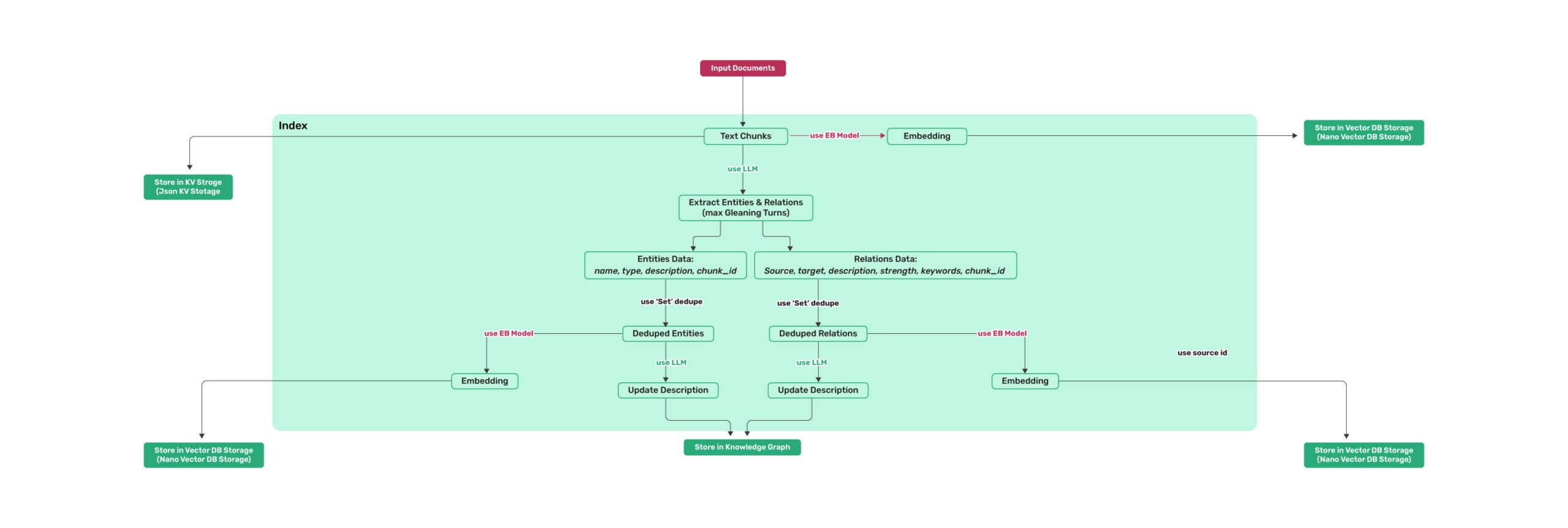
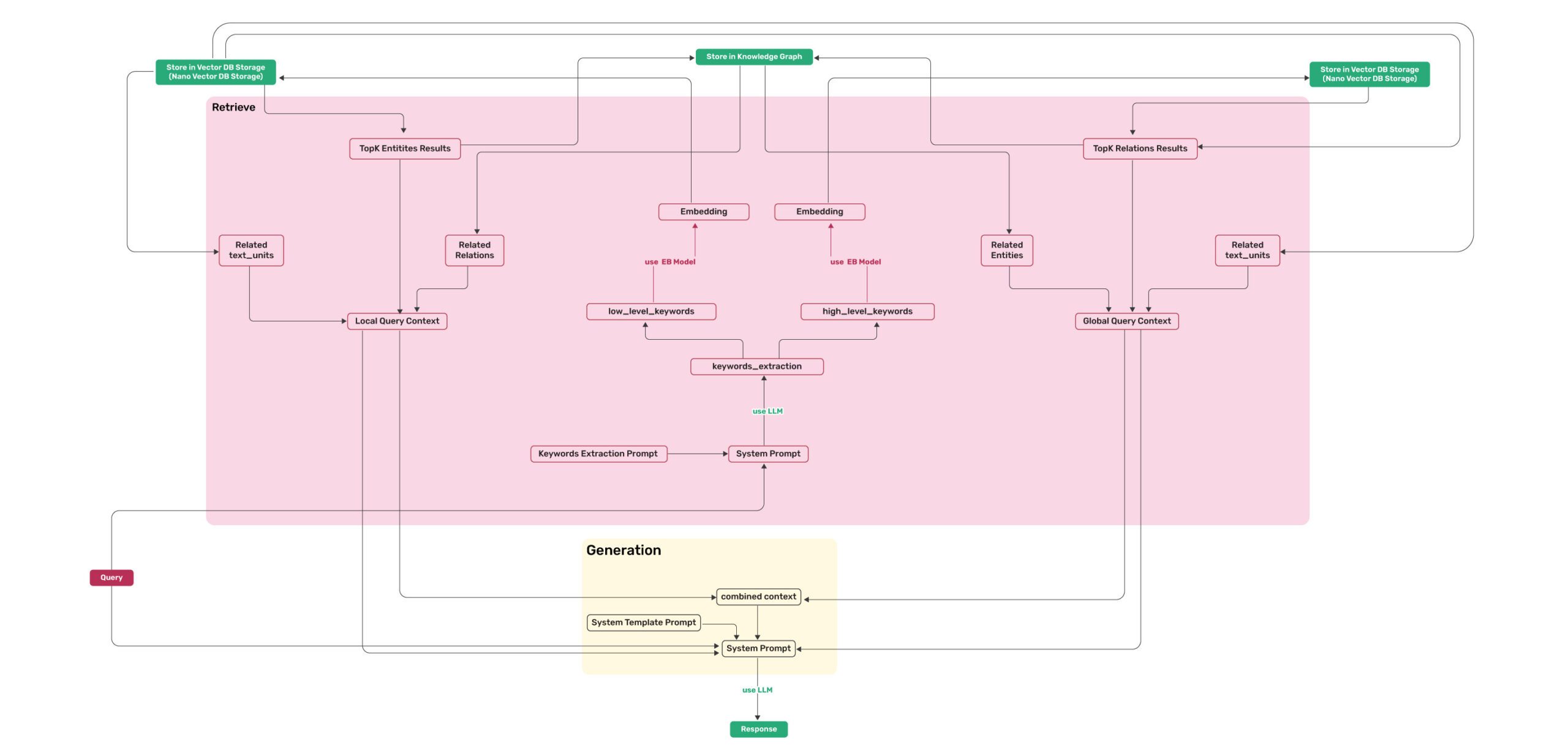
Algorithm Flowchart

LightRAG Indexing Flowchart Figure 1: LightRAG Indexing Flowchart - Img Caption : Source LightRAG Retrieval and Querying Flowchart Figure 2: LightRAG Retrieval and Querying Flowchart - Img Caption : Source

Installation

💡 Using uv for Package Management: This project uses uv for fast and reliable Python package management. Install uv first: curl -LsSf https://astral.sh/uv/install.sh | sh (Unix/macOS) or powershell -c "irm https://astral.sh/uv/install.ps1 | iex" (Windows)

Note: You can also use pip if you prefer, but uv is recommended for better performance and more reliable dependency management.

📦 Offline Deployment: For offline

readme truncated — read the full docs on github

Frequently asked questions

Is LightRAG free to use?

LightRAG is open source under the MIT licence. There is no licence fee and no seat count — you can self-host it or, where the project offers one, pay a vendor for a managed version instead.

What does LightRAG do?

[EMNLP2025] LightRAG: Simple and Fast Retrieval-Augmented Generation

What is LightRAG written in?

LightRAG is primarily written in Python. Its source is publicly available at https://github.com/HKUDS/LightRAG, and it has 39,726 GitHub stars.