Learn Agentic AI using Dapr Agentic Cloud Ascent (DACA) Design Pattern: From Start to Scale
This repo is part of the Panaversity Certified Agentic & Robotic AI Engineer program. You can also review the certification and course details in the program guide. This repo provides learning material for Agentic AI and Cloud courses.
Here’s a polished, professional rewrite you can use as a one-pager or slide—tight on wording, clear on stakes, and just a touch playful so it doesn’t read like it was written by a committee (no offense to committees 😄).
Our Agentic Strategy for Pakistan: Four Working Hypotheses
Pakistan must place smart, early bets on the technologies and talent that will define the agentic AI era—because we intend to train millions of agentic-AI developers across the country and abroad, and launch startups at scale (ambitious, yes—but coffee is cheaper than regret).
Hypothesis 1 — Agentic AI is the trajectory
We believe the future of AI is agentic: systems that plan, coordinate tools, and take actions to deliver outcomes, not just answers (aka “from chat to getting things done”—and ideally without breaking anything valuable). This hypothesis guides our curriculum design, tooling choices, and venture focus.
Hypothesis 2 — Cloud-native rails: Kubernetes × Dapr × Ray
Our bet for large-scale agentic systems is a cloud-native stack: Kubernetes for orchestration, Dapr (Actors, Workflows, and Agents) for reliable micro-primitives, and Ray for elastic distributed compute. Together, these provide the building blocks for durable, observable, horizontally scalable agent swarms.
Hypothesis 3 — The real blocker is the learning gap
Most AI pilots fail not because the models are incapable, but because teams don’t know how to integrate AI into workflows, controls, and economics. Recent coverage of an MIT study reports that ~95% of enterprise gen-AI implementations show no measurable P&L impact—largely due to poor problem selection and integration practices, not model quality. Our program is designed to close this gap with workflow design, safety guardrails, and ROI-first delivery. An MIT report that 95% of AI pilots fail spooked investors. But it’s the reason why those pilots failed that should make the C-suite anxious
Hypothesis 4 — The web is becoming agentic and interoperable
The next web is a fabric of interoperable agents coordinating via open protocols—MCP for standardized tool/context access, A2A for authenticated agent-to-agent collaboration, and NANDA for identity, authorization, and verifiable audit. These emerging standards enable composable automation across apps, devices, and clouds—shifting the browser from a tab list to an outcome orchestrator with trust and consent built in (finally, fewer tabs, more results).
What this means for execution
- Talent engine: hands-on training in agentic patterns (planning, tools, memory, evaluation), workflow design, and safety—tied to real industry use-cases (because “Hello, World” doesn’t move P&L).
- Reference stack: Kubernetes + Dapr + Ray blueprints with observability, guardrails, and cost controls—shippable by small teams (and auditable by large ones).
- Protocol readiness: MCP/A2A/NANDA-aware agent designs to ensure our solutions interoperate as the standards mature (future-proof beats future-guess).
If any hypothesis is wrong, we’ll measure, publish, and pivot fast—because the only unforgivable error is not learning.
This Panaversity Initiative Tackles the Critical Challenge:
“How do we design AI Agents that can handle 10 million concurrent AI Agents without failing?”
Note: The challenge is intensified as we must guide our students to solve this issue with minimal financial resources available during training.
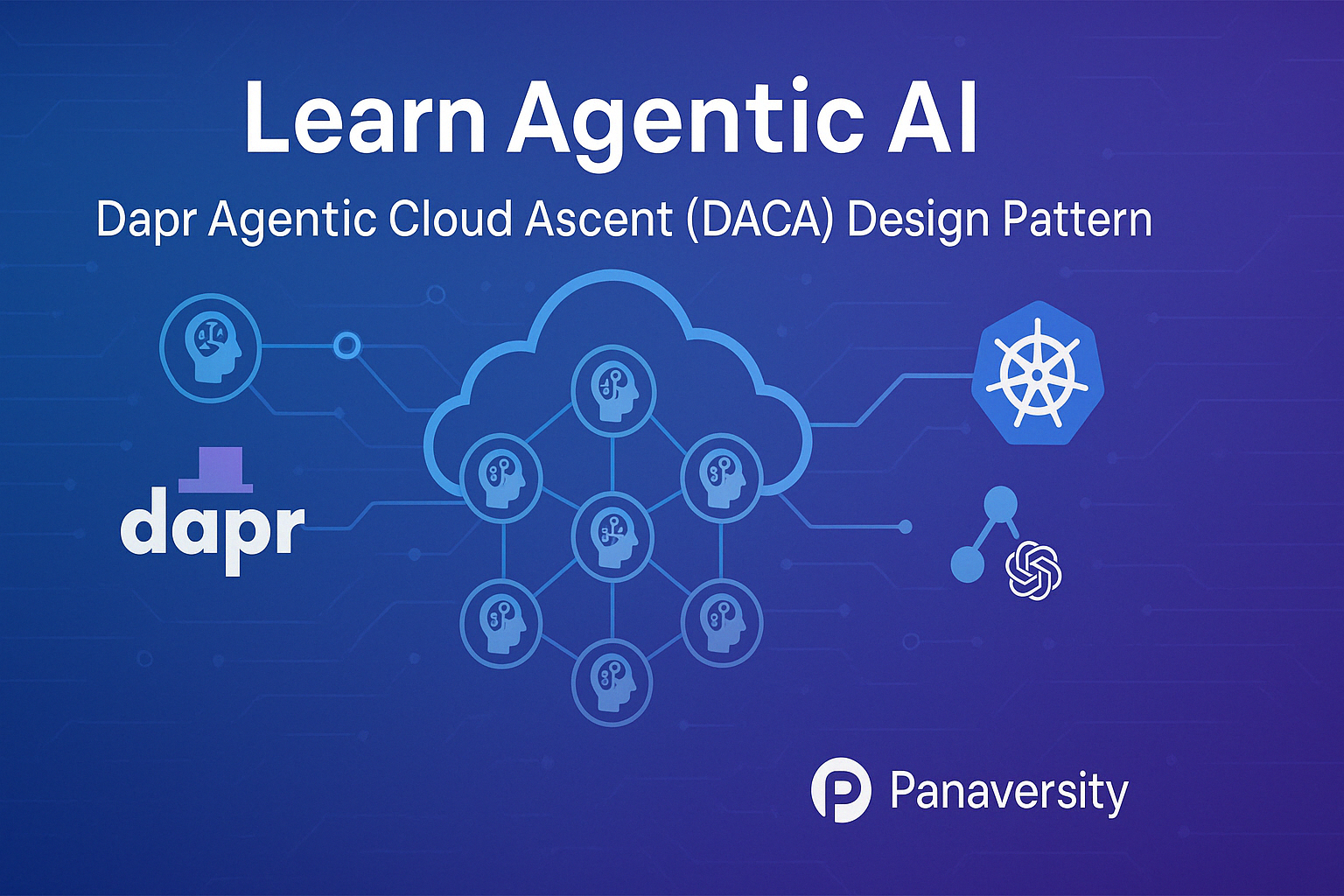
Kubernetes with Dapr can theoretically handle 10 million concurrent agents in an agentic AI system without failing, but achieving this requires extensive optimization, significant infrastructure, and careful engineering. While direct evidence at this scale is limited, logical extrapolation from existing benchmarks, Kubernetes’ scalability, and Dapr’s actor model supports feasibility, especially with rigorous tuning and resource allocation.
Condensed Argument with Proof and Logic:
Kubernetes Scalability:
- Evidence: Kubernetes supports up to 5,000 nodes and 150,000 pods per cluster (Kubernetes docs), with real-world examples like PayPal scaling to 4,000 nodes and 200,000 pods (InfoQ, 2023) and KubeEdge managing 100,000 edge nodes and 1 million pods (KubeEdge case studies). OpenAI’s 2,500-node cluster for AI workloads (OpenAI blog, 2022) shows Kubernetes can handle compute-intensive tasks.
- Logic: For 10 million users, a cluster of 5,000–10,000 nodes (e.g., AWS g5 instances with GPUs) can distribute workloads. Each node can run hundreds of pods, and Kubernetes’ horizontal pod autoscaling (HPA) dynamically adjusts to demand. Bottlenecks (e.g., API server, networking) can be mitigated by tuning etcd, using high-performance CNIs like Cilium, and optimizing DNS.
Dapr’s Efficiency for Agentic AI:
- Evidence: Dapr’s actor model supports thousands of virtual actors per CPU core with double-digit millisecond latency (Dapr docs, 2024). Case studies show Dapr handling millions of events, e.g., Tempestive’s IoT platform processing billions of messages (Dapr blog, 2023) and DeFacto’s system managing 3,700 events/second (320 million daily) on Kubernetes with Kafka (Microsoft case study, 2022).
- Logic: Agentic AI relies on stateful, low-latency agents. Dapr Agents, built on the actor model, can represent 10 million users as actors, distributed across a Kubernetes cluster. Dapr’s state management (e.g., Redis) and pub/sub messaging (e.g., Kafka) ensure efficient coordination and resilience, with automatic retries preventing failures. Sharding state stores and message brokers scales to millions of operations/second.
Handling AI Workloads:
- Evidence: LLM inference frameworks like vLLM and TGI serve thousands of requests/second per GPU (vLLM benchmarks, 2024). Kubernetes orchestrates GPU workloads effectively, as seen Kubernetes manages GPU workloads, as seen in NVIDIA’s AI platform scaling to thousands of GPUs (NVIDIA case study, 2023).
- Logic: Assuming each user generates 1 request/second requiring 0.01 GPU, 10 million users need ~100,000 GPUs. Batching, caching, and model parallelism reduce this to a feasible ~10,000–20,000 GPUs, achievable in hyperscale clouds (e.g., AWS). Kubernetes’ resource scheduling ensures optimal GPU utilization.
Networking and Storage:
- Evidence: EMQX on Kubernetes handled 1 million concurrent connections with tuning (EMQX blog, 2024). C10M benchmarks (2013) achieved 10 million connections using optimized stacks. Dapr’s state stores (e.g., Redis) support millions of operations/second (Redis benchmarks, 2024).
- Logic: 10 million connections require ~100–1,000 Gbps bandwidth, supported by modern clouds. High-throughput databases (e.g., CockroachDB) and caching (e.g., Redis Cluster) handle 10 TB of state data for 10 million users (1 KB/user). Kernel bypass (e.g., DPDK) and eBPF-based CNIs (e.g., Cilium) minimize networking latency.
Resilience and Monitoring:
- Evidence: Dapr’s resiliency policies (retries, circuit breakers) and Kubernetes’ self-healing (pod restarts) ensure reliability (Dapr docs, 2024). Dapr’s OpenTelemetry integration scales monitoring for millions of agents (Prometheus case studies, 2023).
- Logic: Real-time metrics (e.g., latency, error rates) and distributed tracing prevent cascading failures. Kubernetes’ liveness probes and Dapr’s workflow engine recover from crashes, ensuring 99.999% uptime.
Feasibility with Constraints:
- Challenge: No direct benchmark exists for 10 million concurrent users with Dapr/Kubernetes in an agentic AI context. Infrastructure costs (e.g., $10M–$100M for 10,000 nodes) are prohibitive for low-budget scenarios.
- Solution: Use open-source tools (e.g., Minikube, kind) for local testing and cloud credits (e.g., AWS Educate) for students. Simulate 10 million users with tools like Locust on smaller clusters (e.g., 100 nodes), extrapolating results. Optimize Dapr’s actor placement and Kubernetes’ resource quotas to maximize efficiency on limited hardware. Leverage free-tier databases (e.g., MongoDB Atlas) and message brokers (e.g., RabbitMQ).
Conclusion: Kubernetes with Dapr can handle 10 million concurrent users