🌿 LeafWiki




Self-hosted wiki. Single Go binary. SQLite + Markdown stored on disk.
For engineers and self-hosters who want structured, long-lived documentation. No Node.js, no Redis, no Postgres — just a binary and a data directory.
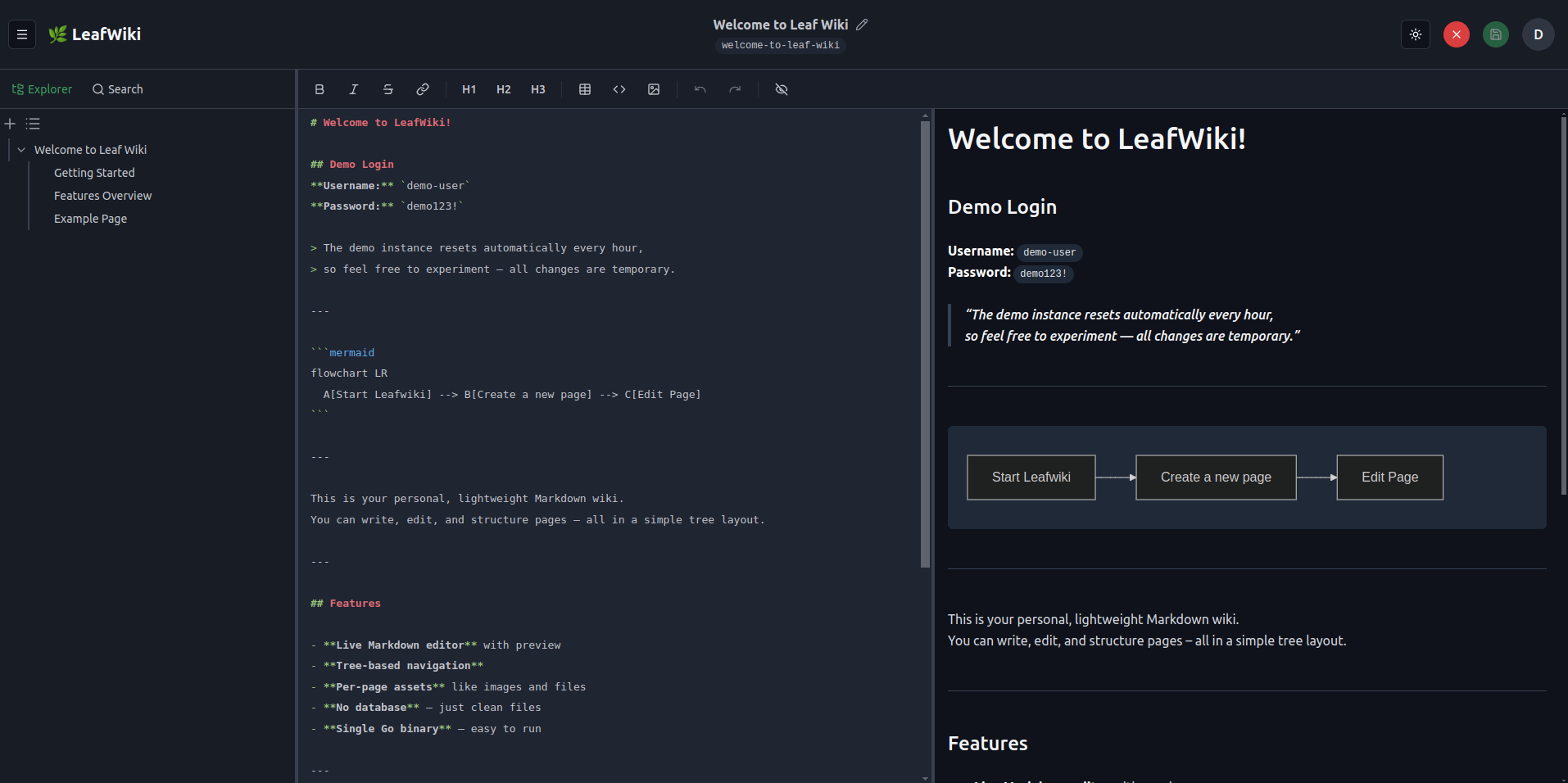
If you've looked at Wiki.js or Outline and thought "this is too much to operate for what I need" — this could fit for you.
→ Try it without installing: demo.leafwiki.com · Ctrl+E edit · Ctrl+S save · resets hourly
→ If it fits, a star helps others find it.
docker run -p 8080:8080 -v ~/leafwiki-data:/app/data \
  ghcr.io/perber/leafwiki:latest \
  --jwt-secret=yoursecret --admin-password=yourpassword --allow-insecure=true
→ All install options (Docker Compose, Linux installer, binary)
Table of Contents
- Features
- Good fit / not a fit
- Install
- Operating Modes
- Dev Setup
- Configuration
- Keyboard Shortcuts
- External Edits & Resync
- Sorting Pages
- Support this project
- Contributing
Features
Operations:
- Single Go binary — no external database, no runtime dependencies
- Markdown on disk — page content is readable outside the app, backup is
cp -r(stop the app first) - Runs on Linux, macOS, Windows, Raspberry Pi (x86_64 and ARM64)
- Reverse-proxy friendly with
--base-path - Reverse-proxy authentication via trusted HTTP header (v0.10+)
- API keys for programmatic and agent access, admin-managed, read-only — in development, not yet ready for use
- Three access modes: fully internal, public read with login-only editing, or open editing without login (see Operating Modes)
- Roles: admin, editor, viewer
Core functionality:
- Tree navigation — explicit hierarchy, not flat note feeds
- Manual page ordering — sort order is explicit, not driven by filename (see Sorting Pages)
- Full-text search across titles and content, with tag-based filtering
- Tags on pages — searchable and filterable across the wiki
- Backlinks and link status per page (incoming, outgoing, broken links), with a dedicated admin view for auditing broken links
- Built-in Markdown editor with live preview, keyboard shortcuts, and autocomplete for internal page links
- Optimistic locking for concurrent edits
- Markdown: tables, task lists, footnotes, callouts (
:::info/:::warning), collapsible blocks (:::collapsible/:::collapsed), Mermaid diagrams, KaTeX math blocks ($$...$$, inline$...$not supported), sanitized inline HTML
Customization:
- Custom stylesheet (
--custom-stylesheet, v0.8.5+) - Inject HTML/JS into `` for analytics or custom CSS
- Branding: logo, favicon, site name
- Dark mode and mobile-friendly UI
- Translated UI — ships in English, German, and Spanish;
--default-languagepicks the default. Contributions of other languages are very welcome — see docs/i18n.md
Opt-in via feature flags:
- Revision history (
--enable-revision) - Automatic link rewriting when pages are renamed or moved (
--enable-link-refactor) - Email via SMTP for password reset and user invitations (
--smtp-host, v0.13.0) - Git backup — push wiki content to a remote Git repository via SSH or HTTP(S) (
--git-backup, v0.11.3, experimental)
Markdown import:
- ZIP-based importer for editors and admins
- Supports Obsidian-style wiki link rewriting on import
- Best results with a reasonably clean folder structure; not a fully automatic converter for all source formats
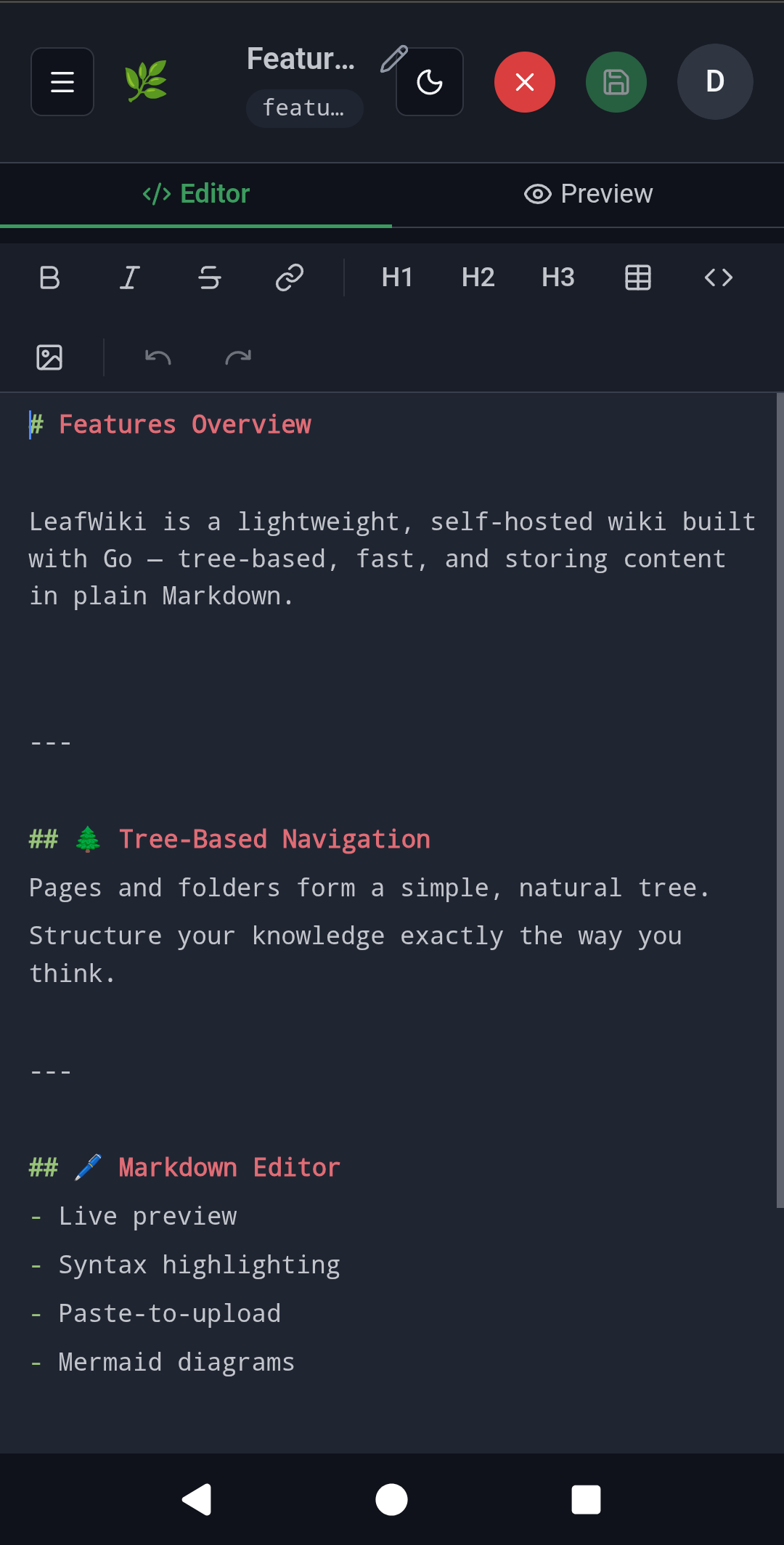
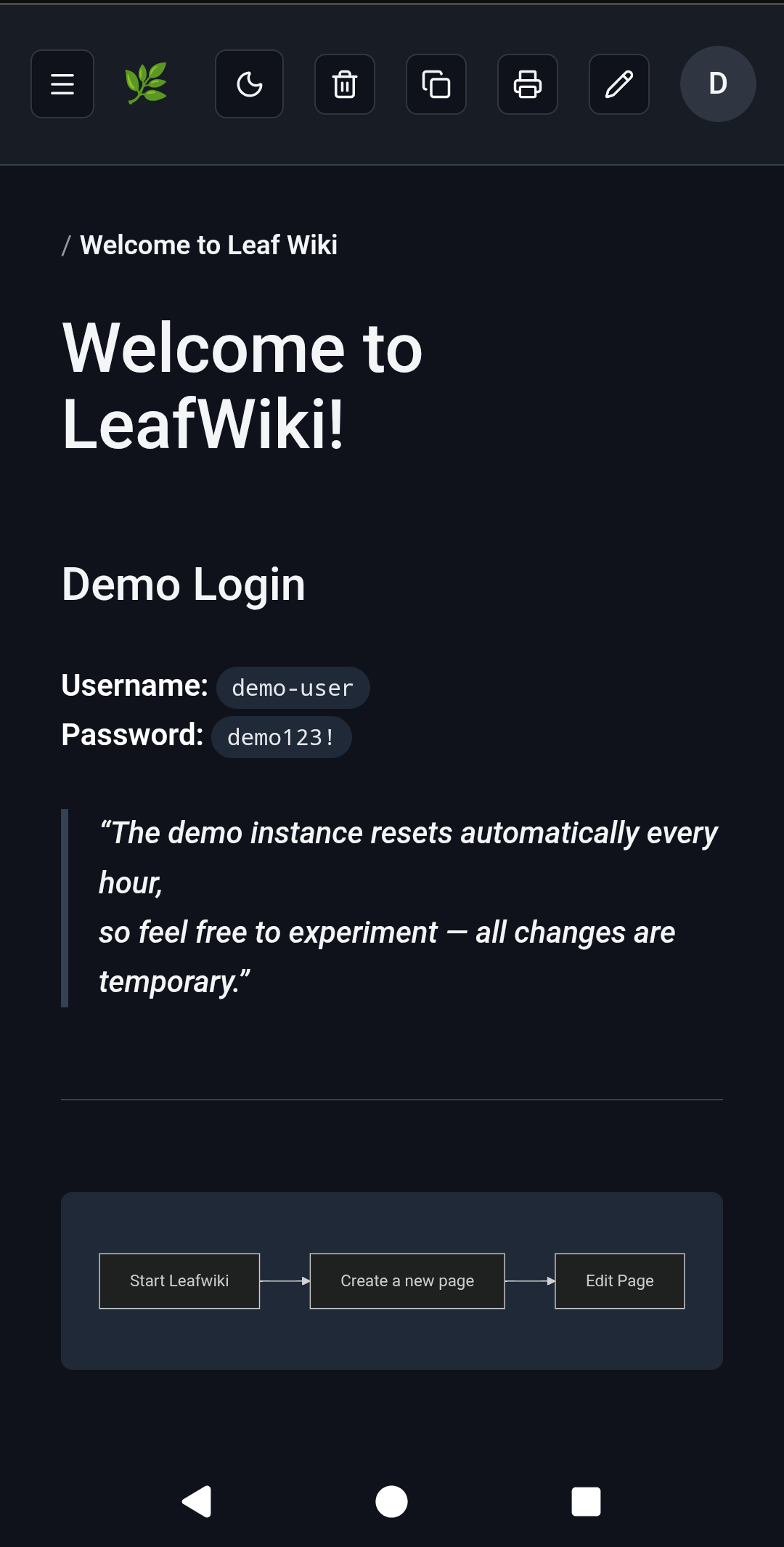
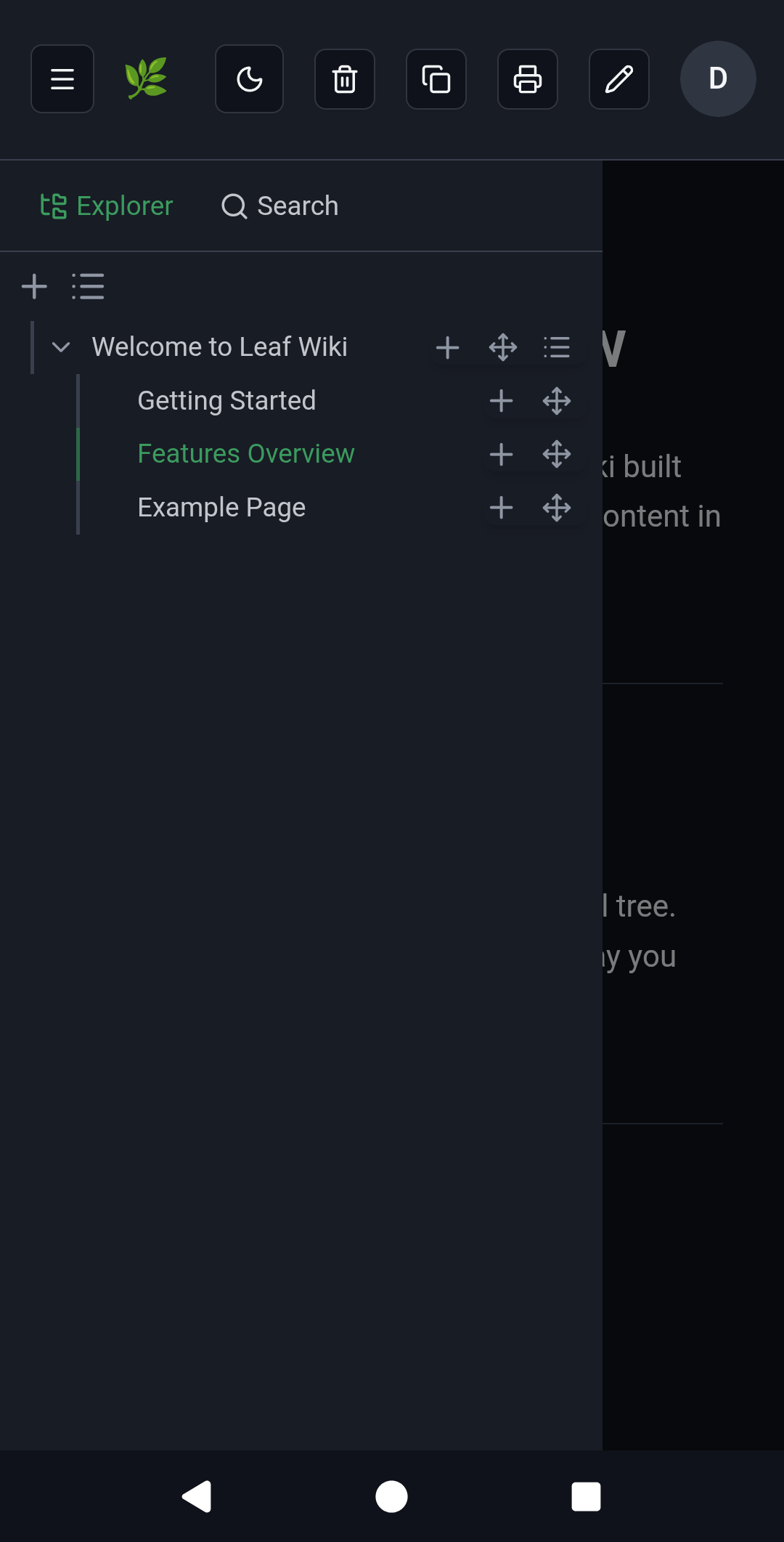
Mobile:
Good fit / not a fit
Good fit:
- Personal wikis, engineering notebooks, and runbooks
- Internal team or homelab documentation
- Existing Markdown or Obsidian vaults that need a structured wiki UI
- Small teams that want tree navigation over flat note feeds
- Self-hosted environments with low operational overhead
Probably not a fit:
- Organizations needing complex enterprise permissions or approval workflows
- Real-time collaborative editing
- Teams looking for a Confluence or Notion replacement
LeafWiki is intentionally narrower than those systems. That focus is part of the value.
Prefer not to run your own server? Free hosted beta — 10 spots, starting September 2026. Get a beta spot → and help shape the hosted version.
Install
Docker
docker run -p 8080:8080 \
    -v ~/leafwiki-data:/app/data \
    ghcr.io/perber/leafwiki:latest \
    --jwt-secret=yoursecret \
    --admin-password=yourpassword \
    --allow-insecure=true
--allow-insecure=true is required for plain HTTP. Omit it when serving over HTTPS (make sure your reverse proxy forwards X-Forwarded-Proto: https).
Non-root:
docker run -p 8080:8080 \
    -u 1000:1000 \
    -v ~/leafwiki-data:/app/data \
    ghcr.io/perber/leafwiki:latest \
    --jwt-secret=yoursecret \
    --admin-password=yourpassword \
    --allow-insecure=true
The data directory must be writable by the specified user.
Docker Compose
services:
  leafwiki:
    image: ghcr.io/perber/leafwiki:latest
    container_name: leafwiki
    user: 1000:1000
    ports:
      - "8080:8080"
    environment:
      - LEAFWIKI_JWT_SECRET=yourSecret
      - LEAFWIKI_ADMIN_PASSWORD=yourPassword
      - LEAFWIKI_ALLOW_INSECURE=true  # Required for plain HTTP. Omit for HTTPS (ensure `X-Forwarded-Proto: https` is forwarded).
    volumes:
      - ${HOME}/leafwiki-data:/app/data
    restart: unless-stopped
Linux installer
sudo /bin/bash -c "$(curl -fsSL https://raw.githubusercontent.com/perber/leafwiki/main/install.sh)"
Installs LeafWiki as a system service. Tested on Ubuntu, Debian, and Raspbian.
Update:
sudo /bin/bash -c "$(curl -fsSL https://raw.githubusercontent.com/perber/leafwiki/main/update.sh)"
Only works if you installed with the script above. Not compatible with Docker or binary installs.
Non-interactive mode:
cp .env.example .env
# Edit .env with your configuration
sudo ./install.sh --non-interactive --env-file ./.env
Security: in interactive mode, environment variables are written in plain text to
/etc/leafwiki/.env. Restrict access to that file.
Deployment examples:
Binary
chmod +x leafwiki
./leafwiki --jwt-secret=yoursecret --admin-password=yourpassword --allow-insecure=true
The server binds to 127.0.0.1:8080 by default. To expose it on the network:
./leafwiki --jwt-secret=yoursecret --admin-password=yourpassword --host=0.0.0.0 --allow-insecure=true
Default data directory is ./data. Change with --data-dir.
Build from source
Requires Go and Node.js. make build compiles the UI, embeds it, and produces a self-contained leafwiki binary (same as release/Docker builds). Use HTTP (http://localhost:8080/), not HTTPS, unless you terminate TLS in front of LeafWiki.
git clone https://github.com/perber/leafwiki.git
cd leafwiki
git switch --detach v0.13.0   # or any tag / main
make build
./leafwiki --disable-auth --host=127.0.0.1 --data-dir ./data --allow-insecure=true
For API-only local development with Vite, use make build-api (or make run) ins