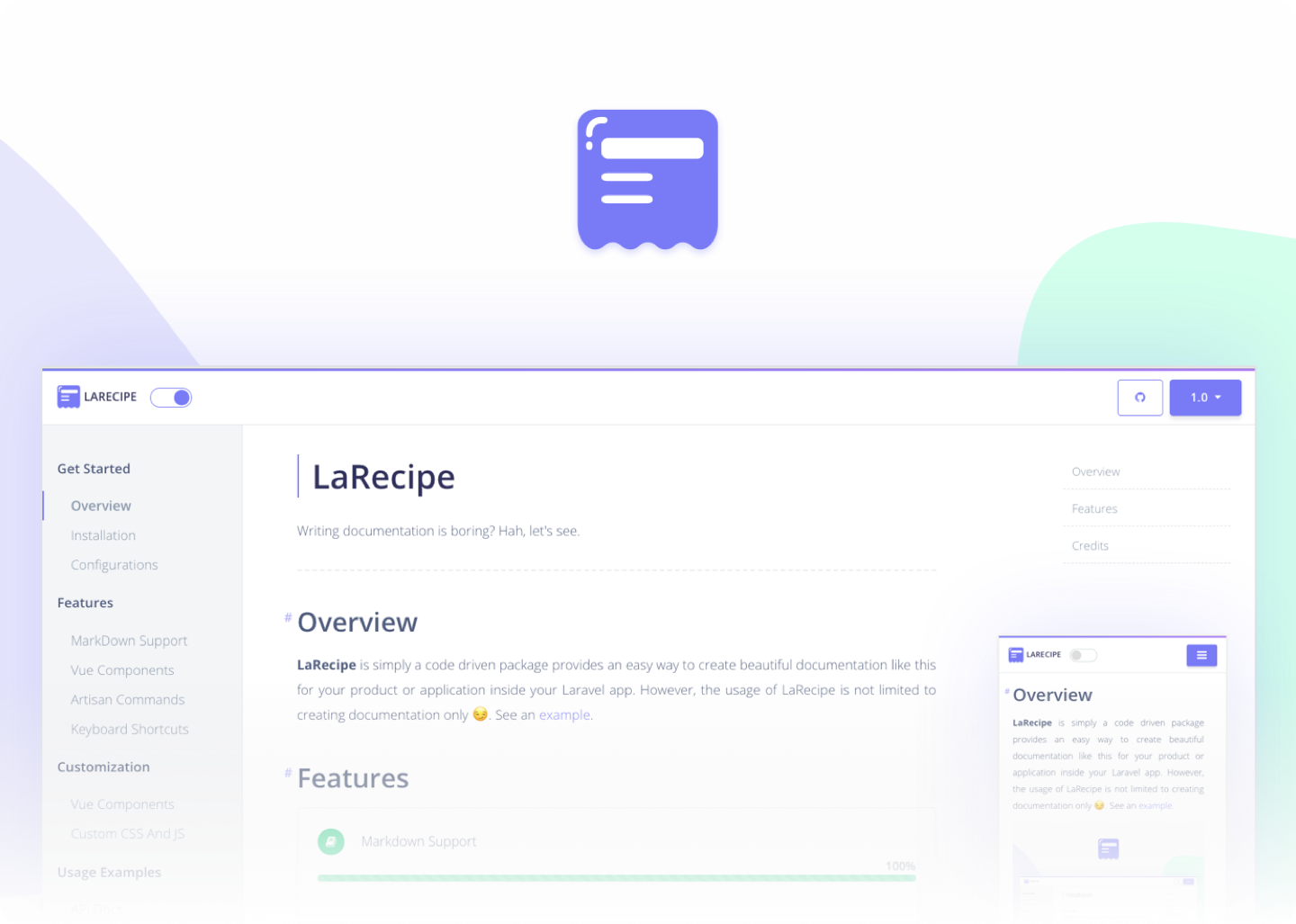
LaRecipe is a code-driven Laravel package that lets a team write Markdown documentation for a product or application and serve it from inside the Laravel app itself, aimed at Laravel developers and product teams who want documentation to live and ship with the code it describes.
What it is
LaRecipe is a documentation package for PHP, published under the MIT licence and installed through Composer as binarytorch/larecipe. It lives in the Laravel ecosystem and renders documentation from within a Laravel application rather than from a separate site, so the documentation is deployed as part of the product it documents. The repository carries 2,512 stars, 266 forks and 26 open issues, is tagged with laravel, laravel-docs, api-docs, docs, documentation and larecipe, and its last push was on 2026-09-02.
The concrete problem it solves is the second deployment. A team that wants Markdown documentation normally has to build, host and maintain a separate documentation site, or pay for a hosted documentation service, and then keep that site in step with the application. LaRecipe replaces that standalone documentation site: the Markdown files stay inside the Laravel application, and the package serves them from the /docs endpoint on the application's own domain, so there is no second codebase, no separate hosting arrangement and no separate release process for the docs.
Key capabilities
- Documentation is authored in Markdown and rendered from inside the Laravel application rather than from a separate site.
- Installation uses the Composer package
binarytorch/larecipe via composer require binarytorch/larecipe.
- Scaffolding is performed by the Artisan command
php artisan larecipe:install.
- The rendered documentation is reachable on the application domain at the
/docs endpoint.
- An official dark theme is available as
binarytorch/larecipe-dark-theme.
- Right-to-left layout support is available as
binarytorch/larecipe-rtl, and reader feedback is available as binarytorch/larecipe-feedback.
- OpenAPI style reference documentation is supported through the companion package
binarytorch/larecipe-swagger.
- The library is licensed under the MIT License, with the terms recorded in the
LICENSE.md file.
Who uses it and how
- Laravel product teams that want end-user or product documentation to be versioned and deployed together with the application, rather than in a separate repository.
- Teams publishing API reference material, which the README addresses through the official
binarytorch/larecipe-swagger package.
- Teams documenting products for right-to-left language audiences, covered by
binarytorch/larecipe-rtl.
- Teams that want to collect reader responses on documentation pages, covered by
binarytorch/larecipe-feedback.
- Teams that prefer a dark reading interface, covered by
binarytorch/larecipe-dark-theme; the same author also maintains a .NET counterpart, LaRecipe Dotnet, for teams outside the PHP ecosystem.
Getting started
Install the package with composer require binarytorch/larecipe, run the installer with php artisan larecipe:install, then visit the application domain at the /docs endpoint. Full documentation is published at https://larecipe.saleem.dev/.
How it compares
The facts provided list no paid products that LaRecipe replaces, so no licence, cost-model or data-ownership comparison can honestly be drawn. The only peer named is LaRecipe Dotnet, a .NET version of the same project from the same organisation, which shows the author intends the code-driven approach to extend beyond PHP rather than to compete with an established commercial documentation suite.
When to use it — and when not to
Choose LaRecipe when the product is already a Laravel application and the team is content to run its documentation as part of that application, accepting responsibility for the Laravel runtime and the Composer install that the package requires. Do not choose it if the documentation must be served as a standalone static site outside the application, or if the stack is not PHP, since the README offers no other deployment path. The honest weakness is thinness of the README: it documents three steps and defers everything else to the external site at larecipe.saleem.dev, it does not describe any database, file storage or SMTP requirements, and the repository carries 26 open issues that a prospective self-hoster should review before adopting it.