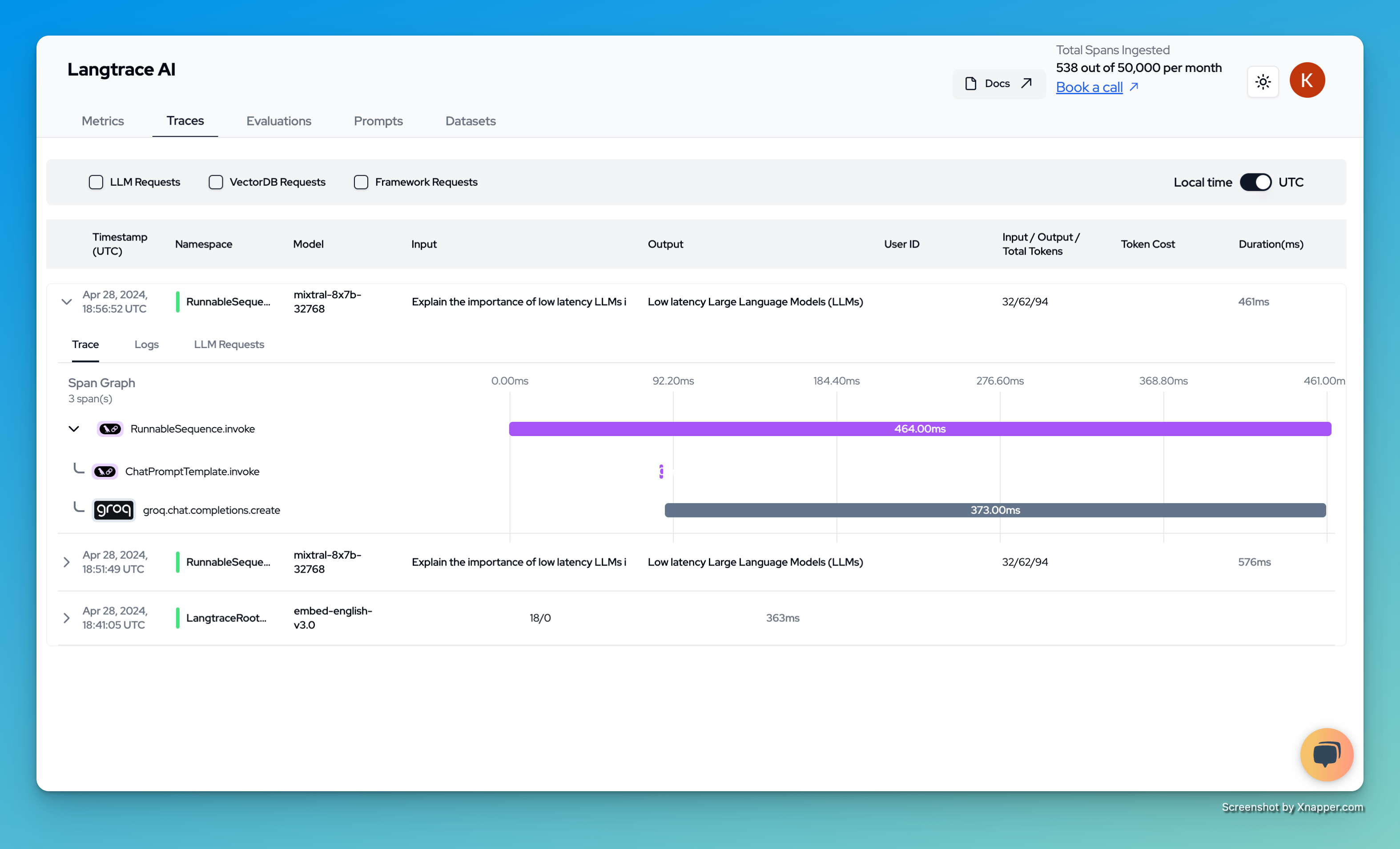
langtrace is a free, open source ai development platforms project written in TypeScript and released under AGPL-3.0. It has 1,231 GitHub stars, 127 forks and 2 open issues, and was last pushed 10 months ago. On this registry it ranks #58 of 61 tracked projects in AI Development Platforms, with 5 head-to-head comparisons available.

What is langtrace?

Langtrace is an open-source, OpenTelemetry-based end-to-end observability tool for LLM applications that captures and analyzes real-time traces, evaluations and metrics across LLM APIs, vector databases and LLM frameworks, and it is aimed at developers and LLMOps teams who need to see what their LLM-backed applications are actually doing in production.

What it is

Langtrace is an open-source observability software that captures, debugs and analyzes traces and metrics from applications that leverage LLM APIs, vector databases and LLM based frameworks. Its traces adhere to OpenTelemetry (OTEL) standards, and the project is developing semantic conventions for the span attributes it emits, with current definitions published in the langtrace-trace-attributes repository. Client libraries ship for two ecosystems: a TypeScript SDK (@langtrase/typescript-sdk) and a Python SDK (langtrace-python-sdk). A managed SaaS version runs at langtrace.ai, and the same software can be self-hosted on the user's own infrastructure.

The concrete problem it addresses is fragmentation: a single user request through an LLM framework fans out into many provider calls, vector operations and retrieval steps, each emitting output in a different place with its own format and its own delay. Langtrace pulls those events into one trace-oriented view where latency, cost and usage patterns are analyzed together, so a slow or expensive response can be followed step by step instead of reconstructed from scattered provider dashboards and framework logs. Evaluations and datasets round this out by attaching quality measurement to the same spans that carry the runtime data.

Key capabilities

  • OpenTelemetry-based tracing built on the OTEL standard, with semantic conventions for LLM span attributes under active development in the langtrace-trace-attributes schemas.
  • Real-time monitoring of LLM API calls, vector database operations and LLM framework usage as they happen.
  • Performance insights covering latency, cost and usage patterns per trace.
  • Debug tooling for stepping through LLM application workflows.
  • Analytics with detailed metrics and visualizations over collected traces.
  • Evaluations and datasets for measuring application output quality alongside runtime telemetry.
  • Self-hosting option for deploying the full stack on infrastructure the user controls.

Who uses it and how

  • Application teams building on LLM frameworks such as LangChain, who need per-call traces instead of a single opaque chain invocation.
  • Teams calling OpenAI and GPT-family models, who need to attribute latency and cost back to individual API calls.
  • Teams running vector database operations, who need retrieval steps visible in the same trace as the generation step that consumed them.
  • LLMOps groups tracking cost and latency trends across deployments, using the analytics views rather than manual log inspection.
  • Teams with data-handling constraints that self-host rather than send traces to the managed service, deploying through the Railway template or the Northflank stack.

Getting started

Install the client library with npm i @langtrase/typescript-sdk for TypeScript or pip install langtrace-python-sdk for Python, then call Langtrace.init({ api_key: ' ' }) in TypeScript or langtrace.init(api_key=' ') in Python with an API key obtained at langtrace.ai. Self-hosters can deploy the same stack through the Railway template or the Northflank stack linked from the README.

How it compares

This registry provides no list of paid products that Langtrace replaces, and the facts name no direct alternative tools, so it stands alone in this registry as the OpenTelemetry-based LLM observability entry. The only comparable surface the facts describe is its own split between the hosted service at langtrace.ai and the self-hosted deployment of the same software.

When to use it β€” and when not to

Self-hosting means operating the observability stack on infrastructure the user manages, which suits teams with data-handling constraints but is overhead for anyone who just wants traces collected. Teams that will not accept the AGPL-3.0 copyleft terms, or that need stable frozen semantic conventions rather than ones the project describes as ongoing development, should look elsewhere. The README excerpt is thin on operational detail β€” backing storage, authentication and data retention are not documented in the facts provided, and sections such as Getting Started are truncated β€” so evaluate those directly before committing.

project readme (upstream, from github) β€” read inline

Langtrace
Langtrace

Open Source Observability for LLM Applications

License Development Status Pull Requests NPM SDK NPM Downloads PyPI SDK PyPI Downloads Total PyPI Downloads Deploy Deploy to Northflank


πŸ“š Table of Contents

Langtrace is an open source observability software which lets you capture, debug and analyze traces and metrics from all your applications that leverages LLM APIs, Vector Databases and LLM based Frameworks.
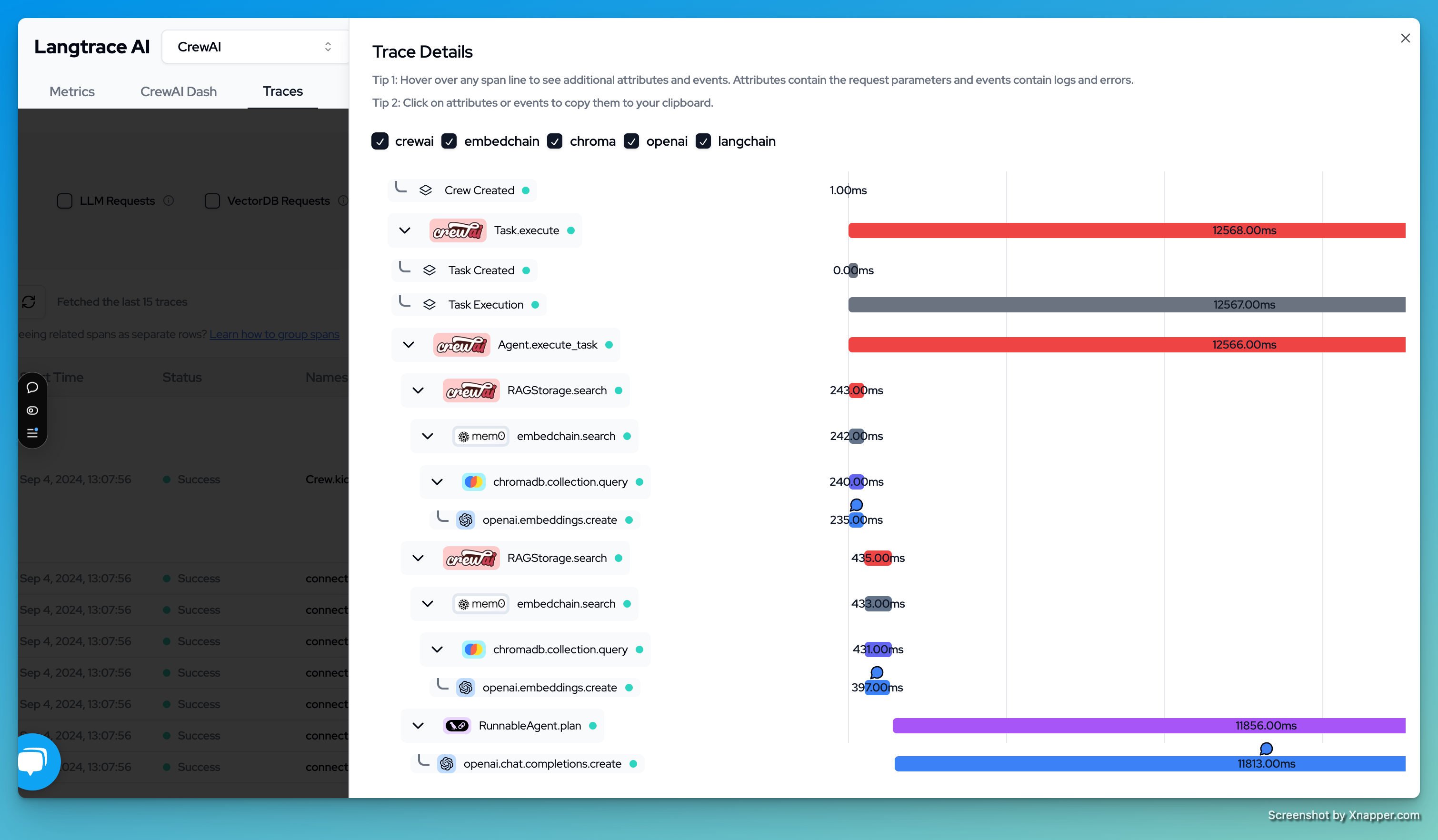
image

✨ Features

  • πŸ“Š Open Telemetry Support: Built on OTEL standards for comprehensive tracing
  • πŸ”„ Real-time Monitoring: Track LLM API calls, vector operations, and framework usage
  • 🎯 Performance Insights: Analyze latency, costs, and usage patterns
  • πŸ” Debug Tools: Trace and debug your LLM application workflows
  • πŸ“ˆ Analytics: Get detailed metrics and visualizations
  • 🏠 Self-hosting Option: Deploy on your own infrastructure

πŸš€ Quick Start

# For TypeScript/JavaScript
npm i @langtrase/typescript-sdk

# For Python
pip install langtrace-python-sdk

Initialize in your code:

// TypeScript
import * as Langtrace from '@langtrase/typescript-sdk'
Langtrace.init({ api_key: '<your_api_key>' }) // Get your API key at langtrace.ai
# Python
from langtrace_python_sdk import langtrace
langtrace.init(api_key='<your_api_key>') # Get your API key at langtrace.ai

For detailed setup instructions, see Getting Started.

πŸ“Š Open Telemetry Support

The traces generated by Langtrace adhere to Open Telemetry Standards(OTEL). We are developing semantic conventions for the traces generated by this project. You can checkout the current definitions in this repository. Note: This is an ongoing development and we encourage you to get involved and welcome your feedback.


πŸ“¦ SDK Repositories


πŸš€ Getting Started

Langtrace Cloud ☁️

To use the managed SaaS version of Langtrace, follow the steps below:

  1. Sign up by going to this link.
  2. Create a new Project after signing up. Projects are containers for storing traces and metrics generated by your application. If you have only one application, creating 1 project will do.
  3. Generate an API key by going inside the project.
  4. In your application, install the Langtrace SDK and initialize it with the API key you generated in the step 3.
  5. The code for installing and setting up the SDK is shown below:

If your application is built using typescript/javascript

npm i @langtrase/typescript-sdk
import * as Langtrace from '@langtrase/typescript-sdk' // Must precede any llm module imports
Langtrace.init({ api_key: <your_api_key> })

OR

import * as Langtrace from "@langtrase/typescript-sdk"; // Must precede any llm module imports
LangTrace.init(); // LANGTRACE_API_KEY as an ENVIRONMENT variable

If your application is built using python

pip install langtrace-python-sdk
from langtrace_python_sdk import langtrace
langtrace.init(api_key=<your_api_key>)

OR

from langtrace_python_sdk import langtrace
langtrace.init() # LANGTRACE_API_KEY as an ENVIRONMENT variable

🏠 Langtrace self hosted

To run the Langtrace locally, you have to run three services:

  • Next.js app
  • Postgres database
  • Clickhouse database

[!IMPORTANT] Checkout our documentation for various deployment options and configurations.

Requirements:

  • Docker
  • Docker Compose
The .env file

Feel free to modify the .env file to suit your needs.

Starting the servers
docker compose up

The application will be available at http://localhost:3000.

Take down the setup

To delete containers and volumes

docker compose down -v

-v flag is used to delete volumes

Telemetry

Langtrace does NOT collect any Telemetry if you are self hosting the OSS client. None of your data leaves your servers.


πŸ”— Supported Integrations

Langtrace automatically captures traces from the following vendors and frameworks:

LLM Providers

Provider TypeScript SDK Python SDK
OpenAI βœ… βœ…
Anthropic βœ… βœ…
Azure OpenAI βœ… βœ…
Cohere βœ… βœ…
DeepSeek βœ… βœ…
xAI βœ… βœ…
Groq βœ… βœ…
Perplexity βœ… βœ…
Gemini βœ… βœ…
AWS Bedrock βœ… βœ…
Mistral ❌ βœ…

LLM Frameworks

Framework TypeScript SDK Python SDK
Langchain ❌ βœ…
LlamaIndex βœ… βœ…
Langgraph ❌ βœ…
LiteLLM ❌ βœ…
DSPy ❌ βœ…
CrewAI ❌ βœ…
Ollama ❌ βœ…
VertexAI βœ… βœ…
Vercel AI βœ… ❌
GuardrailsAI ❌ βœ…
Arch ❌ βœ…
Graphlit ❌ βœ…
Agno ❌ βœ…
Phidata ❌ βœ…
Cleanlab ❌ βœ…

Vector Databases

Database TypeScript SDK Python SDK
Pinecone βœ… βœ…
ChromaDB βœ… βœ…
QDrant βœ… βœ…
Weaviate βœ… βœ…
PGVector βœ… βœ… (SQLAlchemy)
MongoDB ❌ βœ…
Milvus ❌ βœ…

πŸ“ Langtrace System Architecture

image


πŸ’‘ Feature Requests and Issues


🀝 Contributions

We welcome contributions to this project. To get started, fork this repository and start developing. To get involved, join our Slack workspace.


🌟 Langtrace Star History

Langtrace Star History Chart


πŸ”’Security

To report security vulnerabilities, email us at . You can read more on security here.


πŸ“œ License

  • Langtrace application(this repository) is licensed under the AGPL 3.0 License. You can read about this license here.
  • Langtrace SDKs are licensed under the Apache 2.0 License. You can read about this license [here](https://www.apache.org/licenses/LICEN

readme truncated β€” read the full docs on github

Frequently asked questions

Is langtrace free to use?

langtrace is open source under the AGPL-3.0 licence. There is no licence fee and no seat count β€” you can self-host it or, where the project offers one, pay a vendor for a managed version instead.

What does langtrace do?

Langtrace πŸ” is an open-source, Open Telemetry based end-to-end observability tool for LLM applications, providing real-time tracing, evaluations and metrics f

What is langtrace written in?

langtrace is primarily written in TypeScript. Its source is publicly available at https://github.com/Scale3-Labs/langtrace, and it has 1,231 GitHub stars.






