



Website · Community · Docs · CLI Docs · Try Kodus Cloud · Self-Host Guide
🌐 English · Português (BR) · Español · 日本語 · 简体中文 · Français
Why Teams Choose Kodus
- Model Agnostic: Use Claude, GPT-5, Gemini, Llama, GLM, Kimi or any OpenAI-compatible endpoint.
- Zero Markup on LLM Costs: You pay model providers directly. No hidden multipliers.
- Learns from Your Context: Kody adapts to your architecture, standards, and workflow.
- You Set the Rules: Define custom review rules in plain language.
- Privacy & Security: Source code is not used to train models, data is encrypted in transit and at rest, and self-hosted runners are supported. Self-hosted instances send one anonymous heartbeat per day (aggregated counters only — no code, names, or identifiers); opt out with
KODUS_TELEMETRY_DISABLED=true. See Anonymous Telemetry. - Native Git Workflow: Works directly in PRs with GitHub, GitLab, Bitbucket, and Azure Repos.
- CLI + CI/CD Ready: Run reviews locally and in pipelines.
- Operational Impact: Track technical debt and delivery metrics while keeping review quality high.
Product Highlights
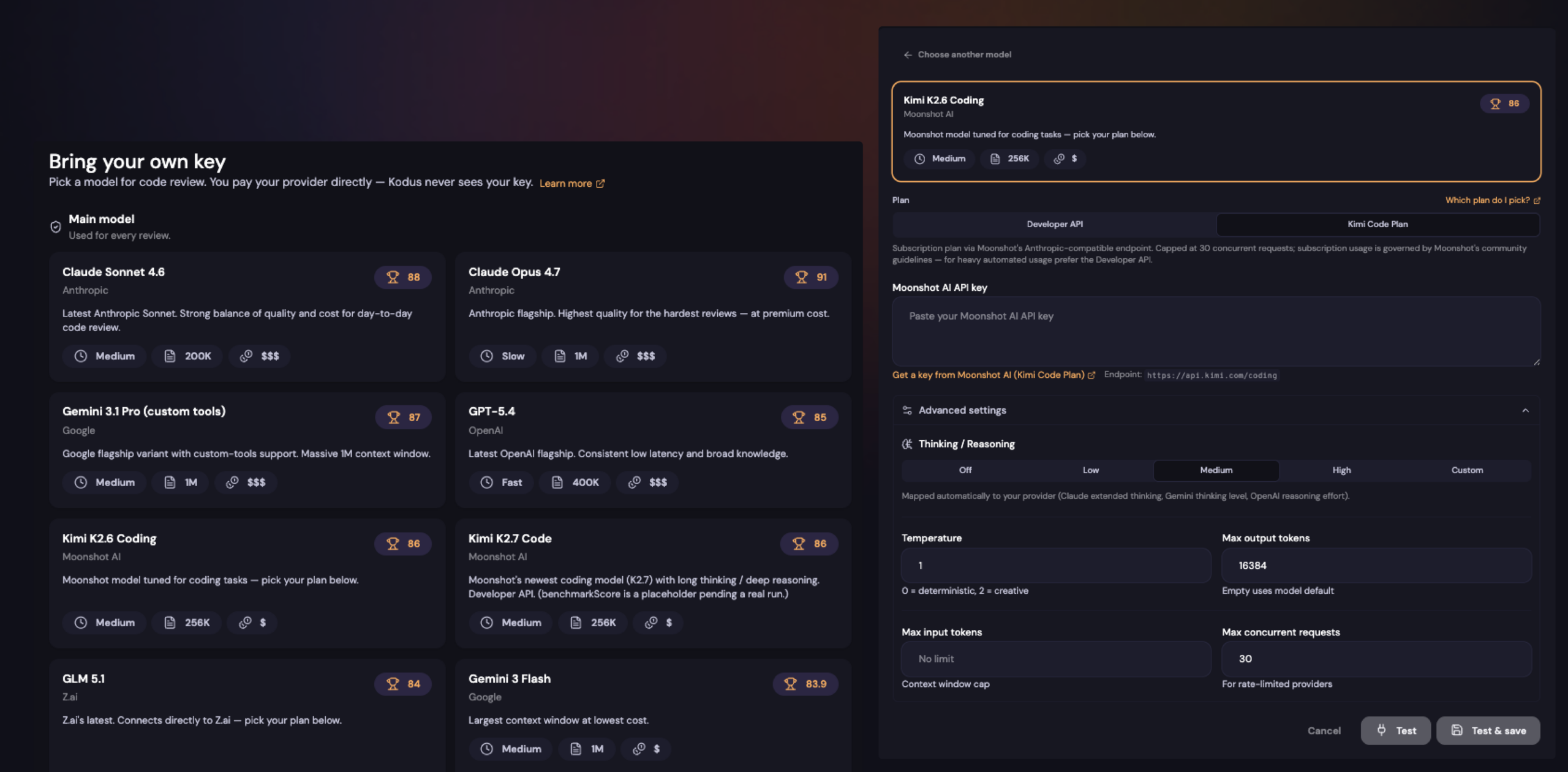
🔑 Bring Your Own Key
Connect your own provider credentials and choose the models behind Kodus reviews: OpenAI, Anthropic, Google Gemini, Vertex AI, Novita, or any OpenAI-compatible endpoint. Keep billing and usage under your own provider account, without hidden LLM markups.
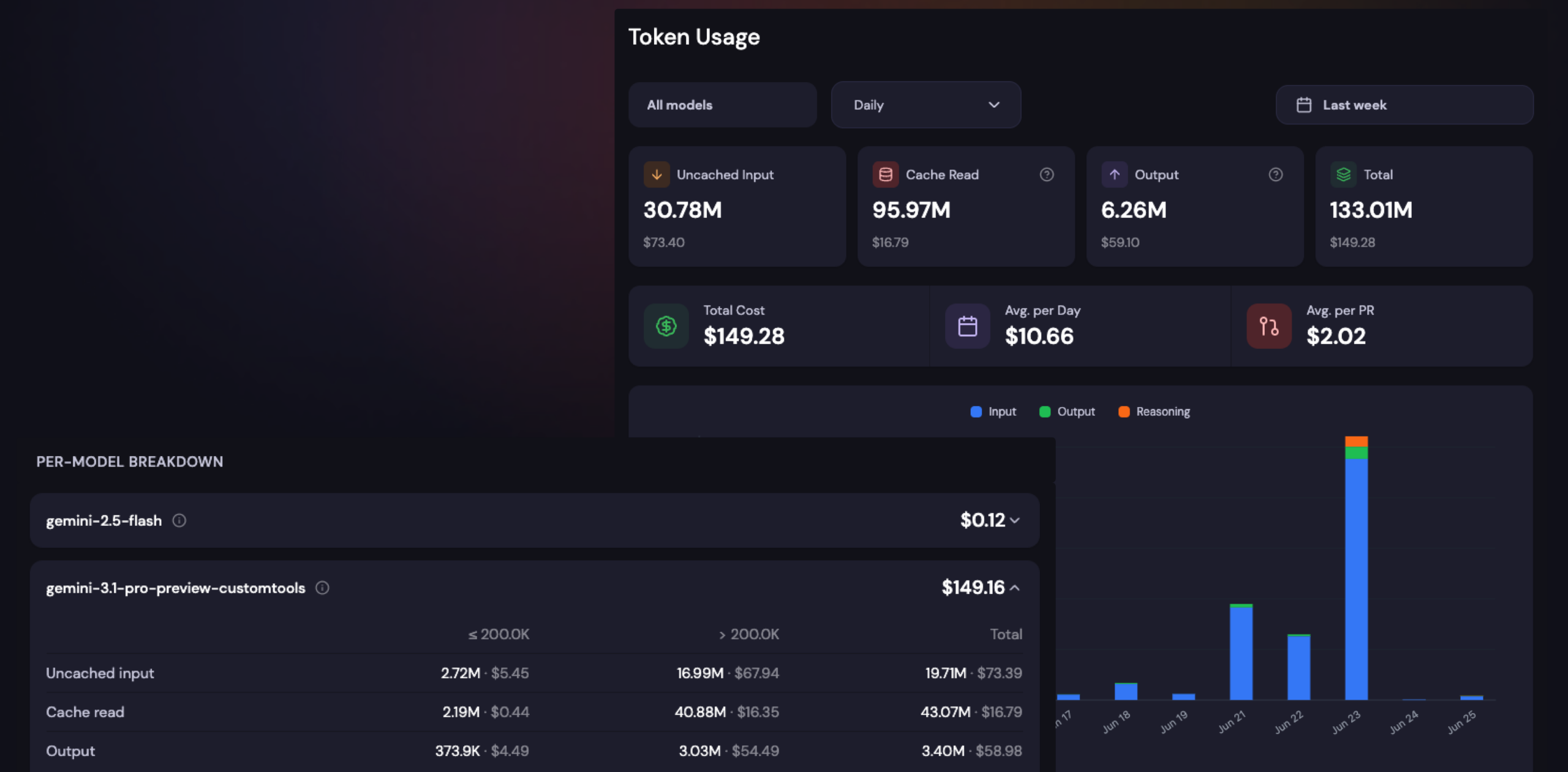
📈 Token Usage
Track token consumption across AI code reviews, understand cost drivers, and keep model spend predictable as adoption grows.
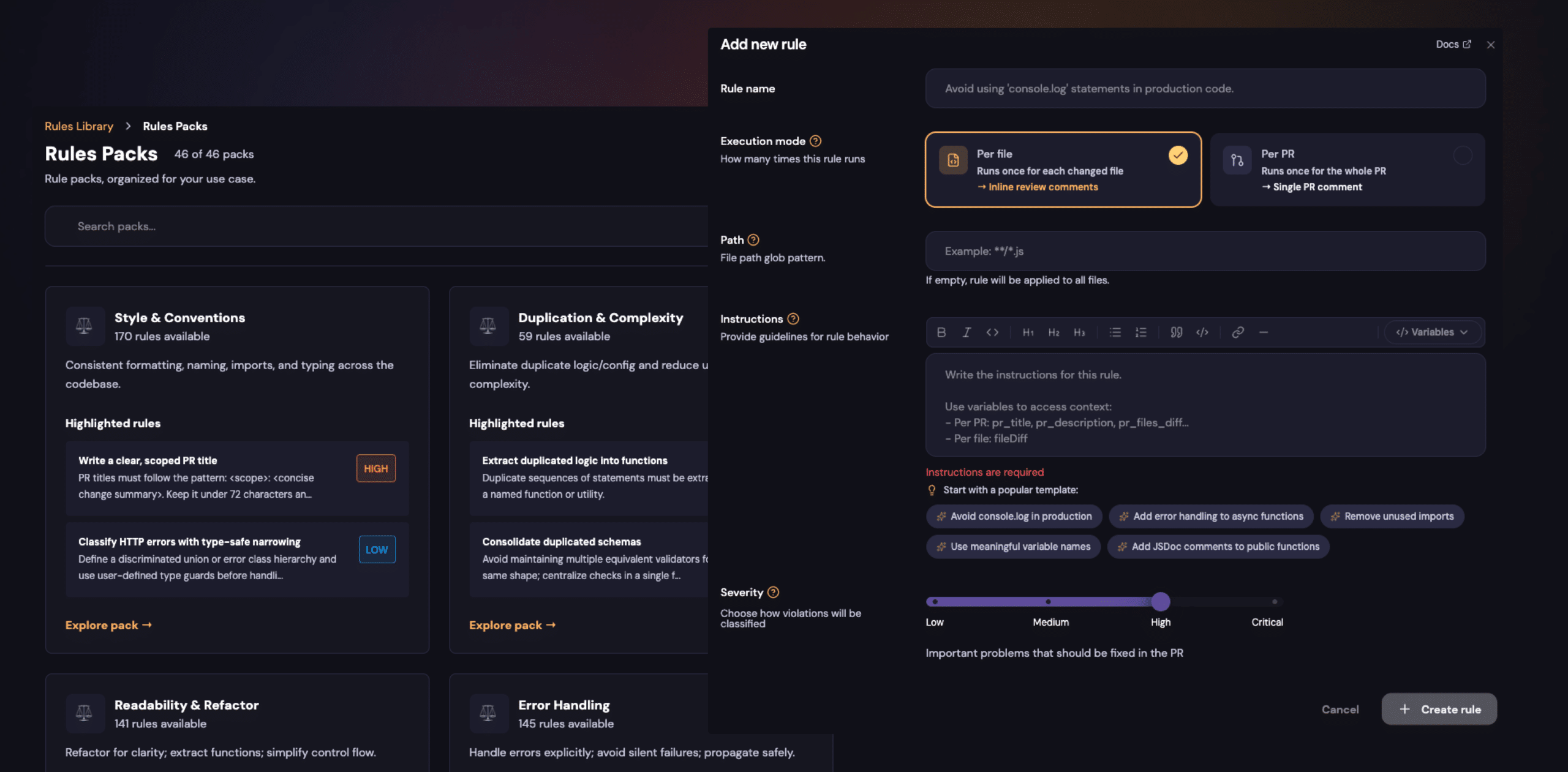
⚙️ Kody Rules
Kody Rules let teams define review instructions in plain language and apply them across organizations, repositories, paths, or specific review scopes. Kody uses those rules as context when reviewing pull requests, helping enforce architecture decisions, security expectations, testing practices, and repository-specific conventions without relying on reviewers to repeat the same feedback manually.
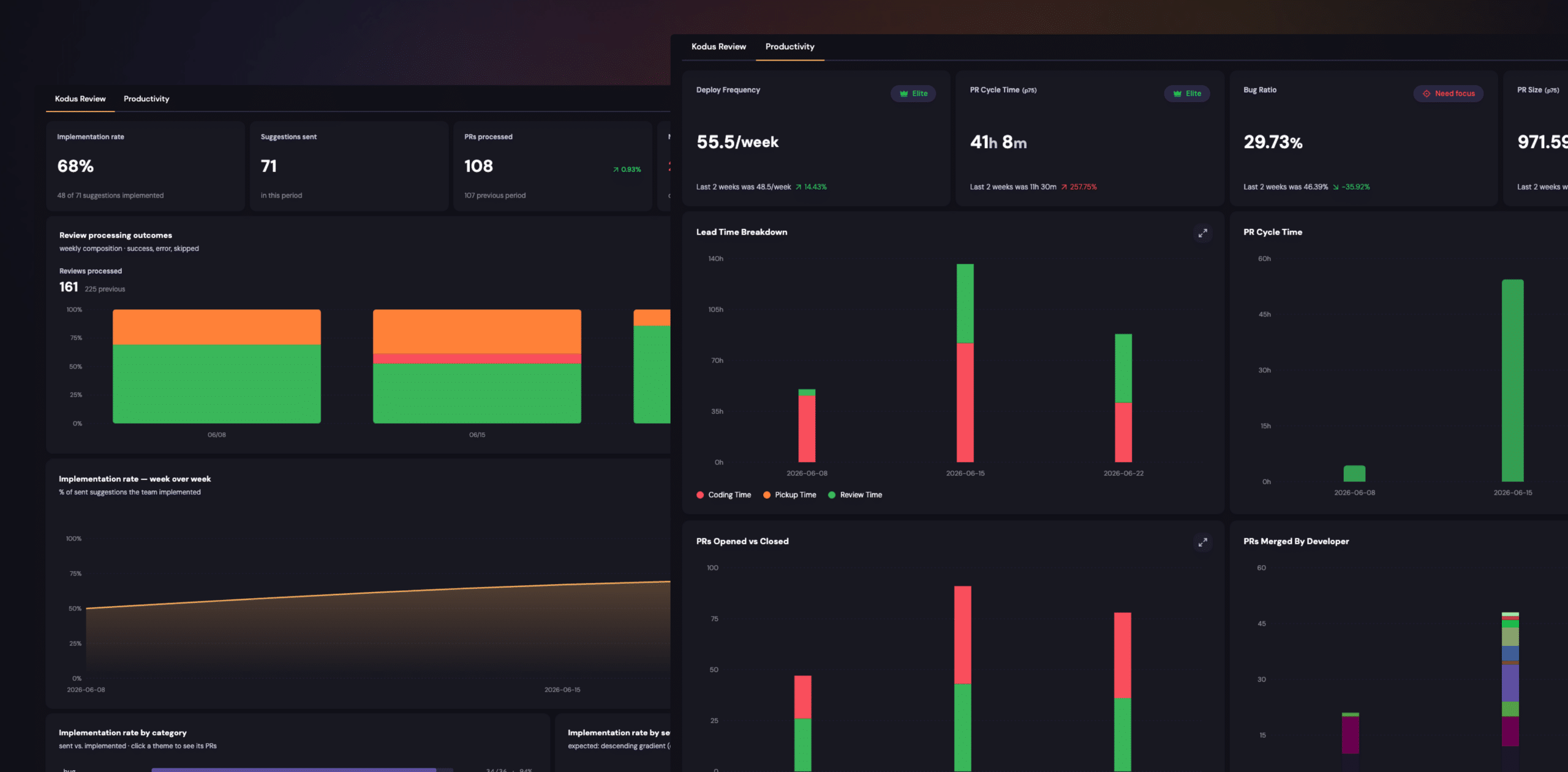
📊 Cockpit
Cockpit helps teams measure Kodus review effectiveness, Kody Rule health, repository health, and delivery metrics across the engineering workflow.
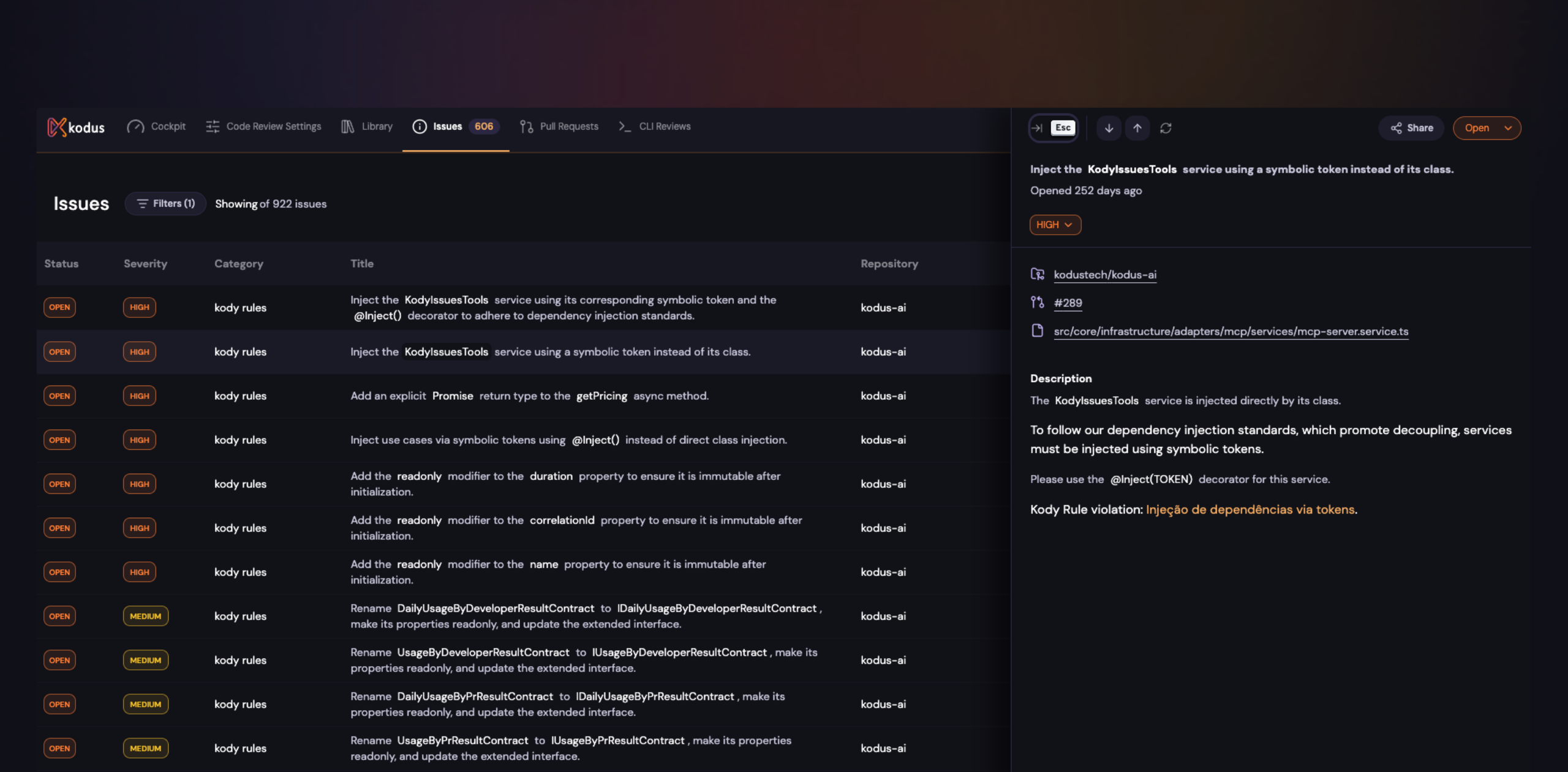
🧩 Kody Issues
Automatically track unimplemented suggestions from closed pull requests, manage them by status, severity, category, and repository, and let Kody resolve them when the fix appears in a future PR.
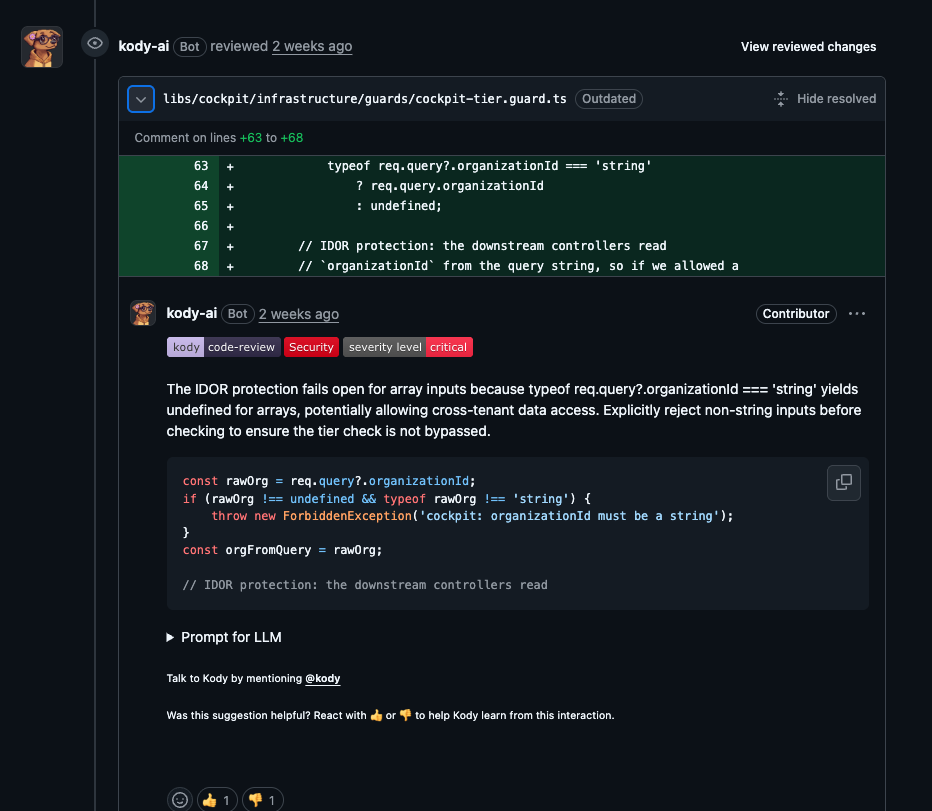
🔎 See Kody reviewing a real pull request
Kody does more than summarize diffs. It reviews code with context, flags risks by severity, and suggests concrete fixes directly in the pull request.
 />
/>
In this example, Kody catches a critical IDOR risk where an organizationId query parameter could bypass tenant protection when passed as an array, then suggests an explicit runtime validation before the code is merged.
Get Started
Choose the workflow that matches how you want to use Kodus.
|
Try Kodus Cloud
Start reviewing pull requests without managing infrastructure. Create a free account · View pricing |
Self-host Kodus
Deploy Kodus on your own infrastructure with control over data, models, and runtime configuration. Installation guide |
|
Use the CLI
Run AI code reviews from your terminal against a working tree, staged diff, branch, or commit. kodus review
kodus review --staged
kodus review --prompt-only
CLI overview · Command reference · CI/CD |
Contribute Locally
Run the Kodus monorepo locally for development across the API, worker, webhooks service, web app, and local infrastructure. git clone https://github.com/kodustech/kodus-ai.git
cd kodus-ai
yarn setup
Local quickstart |
Monorepo Structure
Kodus is a monorepo with multiple applications and shared domain libraries.
kodus-ai/
├── apps/
│   ├── api/          # NestJS API
│   ├── web/          # Next.js dashboard
│   ├── worker/       # Review execution and queue consumers
│   └── webhooks/     # Git provider webhook ingestion
├── libs/             # Shared NestJS domain modules (incl. libs/llm — LLM/BYOK layer)
└── scripts/          # Dev, deploy, benchmark, and automation scripts
| Path | Purpose |
|---|---|
apps/api |
Main NestJS API for authentication, organizations, teams, Kody Rules, integrations, permissions, and code review orchestration. |
apps/web |
Next.js web application for the Kodus dashboard. |
apps/worker |
Background service for code review execution, queue processing, suggestion checks, automation jobs, and monitoring tasks. |
apps/webhooks |
Webhook ingestion service for GitHub, GitLab, Azure Repos, Bitbucket, and Forgejo events. |
libs |
Shared NestJS domain modules used across Kodus applications. |
libs/llm |
In-repo LLM/BYOK abstraction layer for model providers. |
For full setup instructions, follow the Local Quickstart.
Open Source vs. Teams vs. Enterprise
| Feature | 
Community |