Prepare unstructured data for AI Agents






🔗 Website | 📄 Docs | 🏠 Self-Host | 🖥️ Dashboard
Overview
Knowhere is a document parsing and retrieval system that turns complex, dirty files into persistent, navigable memory for AI agents—especially across local and offline document collections.
It ingests unstructured documents and produces persistent, navigable memory: parsing, hierarchy reconstruction, multi-modal structuring, and graph construction in a single pipeline. Every result stays connected to its document, section, source pages, and related assets, making the output a natural fit for Agentic RAG, vector-based RAG, or any LLM workflow.
Knowhere 2.0 supports complementary Vision and Text tracks. Text-native documents retain precise extracted structure, while complex PDFs and PowerPoint files can be understood directly as pages by frontier vision models. Both tracks converge into the same memory schema, hierarchy, retrieval engine, and citation model.
[!NOTE] Get started in seconds with Knowhere Cloud. Avoid the complexity of self-deployment. Use our managed API at knowhereto.ai and enjoy $5 in free credits upon registration.
📢 News
- September 8, 2026: 🧭 Introducing agent-native Retrieval 2.0. MapNav has evolved from a fixed navigation workflow into a corpus-native foundation for agents. Knowhere provides a unified schema, hierarchy-aware tools, and resolvable evidence references; the agent decides how to search, traverse, read, and cite. The same foundation powers built-in retrieval and external agents through MCP.
- September 2026: 👁️ Introducing dual-track Document Parsing 2.0. Vision Page and Text Track now converge into one hierarchy-native memory schema for retrieval, understanding, and citation.
- June 1, 2026: 📚 Knowhere now supports ultra-long PDFs and atlas-style documents. The parsing pipeline can process long-form PDFs with hundreds of pages (for example, 300, 500, or more) and route technical atlases or drawing collections through a dedicated layout-aware parser.
- May 7, 2026: 🚀 Knowhere is now Open Source! We have open-sourced our entire stack for document ingestion, parsing, and agentic RAG. You can now self-host the full platform using knowhere-self-hosted. Check out our Contribution Guide to get involved!
Vision + Text: Document Parsing 2.0
Traditional OCR and Document Intelligence pipelines try to extract every element before a model can understand the document. On dirty PDFs and slide decks, mistakes in reading order, layout, tables, or hidden text layers can accumulate into unreliable model context.
Knowhere does not make perfect element-by-element extraction a prerequisite for retrieval. The Text Track preserves precise text and native structure where they are reliable. The Vision Track uses frontier vision models to understand a page or slide as a whole, so visually complex content can still be recalled and understood without first reconstructing every element.
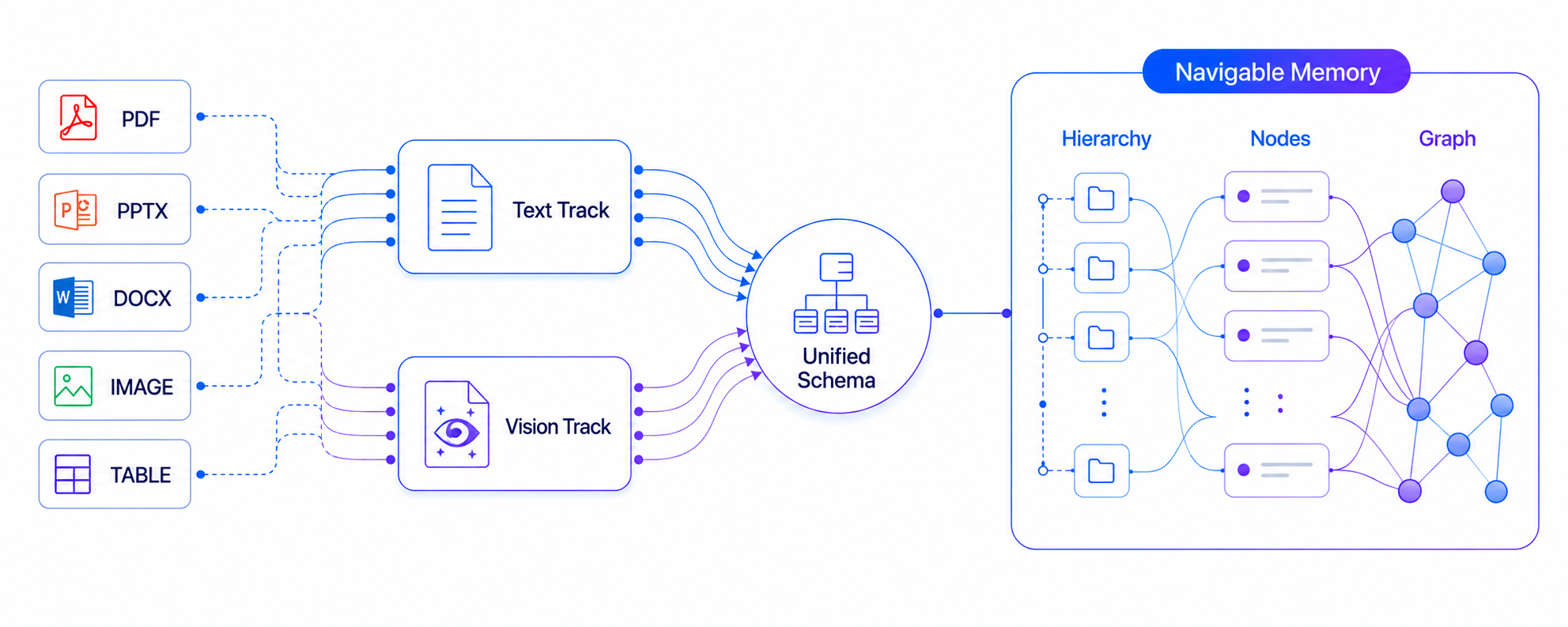
- Two tracks, one contract: Both parsing paths produce the same chunk and metadata schema, so downstream storage, hierarchy, graph construction, and retrieval remain format-independent.
- Recall without brittle reconstruction: Pages can be indexed through summaries, entities, source text, and hierarchy even when OCR or layout extraction cannot reliably recover every component.
- One navigable memory: Text sections and vision-understood pages become compatible hierarchy nodes with source evidence, linked assets, and cross-document relationships.
PDF and .pptx uploads through the V2 Jobs API use the Vision Track; other supported formats use the Text Track. The tracks differ in how they understand the source, not in how agents consume the resulting memory.
How it Works
Knowhere runs in two steps: build memory from documents, then let agents retrieve from it.
Step 1: Parse and Build Memory
- Route: Select the Vision or Text track according to the document format and API generation.
- Understand: Preserve native text structure where it is reliable, or understand complex pages holistically with a vision model.
- Normalize: Convert both tracks into the same hierarchy-native chunk and metadata schema.
- Build Memory: Store navigation trees, linked assets, citations, and cross-document relationships as agent-ready context.
Step 2: Agentic Retrieval
Knowhere provides the document-memory substrate; the agent decides how to explore it.
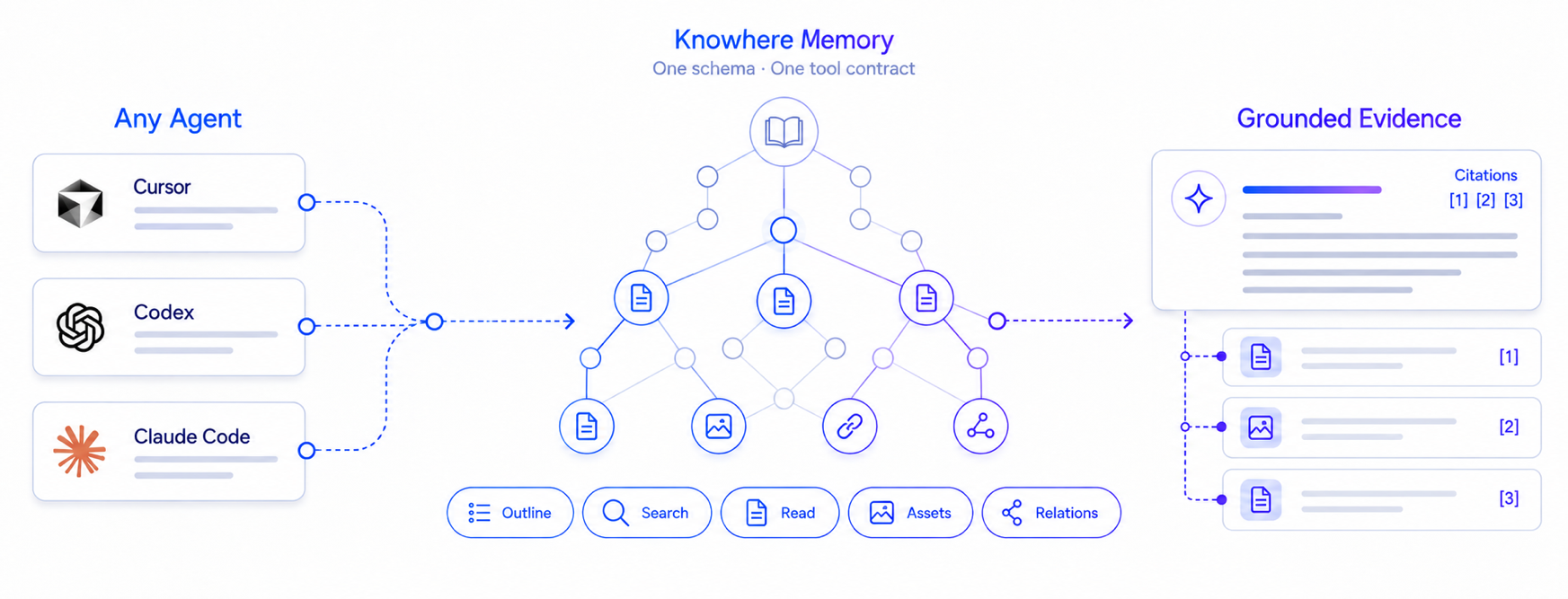
- Provide the substrate: Knowhere exposes one corpus schema and tools for document outlines, structural filters, exact search, fuzzy recall, full reading, assets, and cross-document relationships.
- Let the agent explore: Instead of forcing every query through a fixed navigation pipeline, the agent chooses which tools to call, in what order, and how deeply to traverse.
- Stay agent-neutral: The same corpus and evidence contract works across built-in agents, MCP clients, models, and orchestration frameworks. Whichever agent explores the memory, Knowhere resolves its references into traceable documents, sections, pages, and linked assets.
FAQ
Q: What is Knowhere's relationship with MinerU?
A: MinerU remains the default raw PDF extractor for Knowhere's V1 chunk-based pipeline. PDF and PowerPoint uploads through the V2 API use Vision Page instead: Knowhere renders the source pages, combines their visual interpretation with document profiling and TOC structure, and assembles page-grounded hierarchy nodes. MinerU is still useful, but V2 no longer treats parser-generated Markdown as the only source of truth.
Q: What LLM / VLM dependencies does Knowhere have?
A: We recommend deepseek-v4-flash-vision-exp as a unified model for both Text and Vision workloads. It accepts text and image input, so the same model can handle summarization, hierarchy reasoning, page understanding, and asset descriptions. The model is currently experimental, and Knowhere remains model-agnostic: you can use another model—or separate Text and Vision models—from OpenAI, Qwen, GLM, Volcengine, or any compatible provider.
Q: How is Agentic Retrieval different from traditional RAG?
A: Traditional RAG does a flat vector lookup and returns isolated snippets. Knowhere's agents navigate the document's section tree and cross-document graph, drilling into the most relevant regions the way a human reader would, returning traceable, well-contextualized evidence.
Q: Does it handle images and tables?
A: Yes. Knowhere extracts images and tables, runs them through VLM-assisted summarization and feature extraction, and links them back to their source section nodes. Vision Page also retains rendered page citations, so agents can re