




kepler.gl | Website | Demo App | Docs

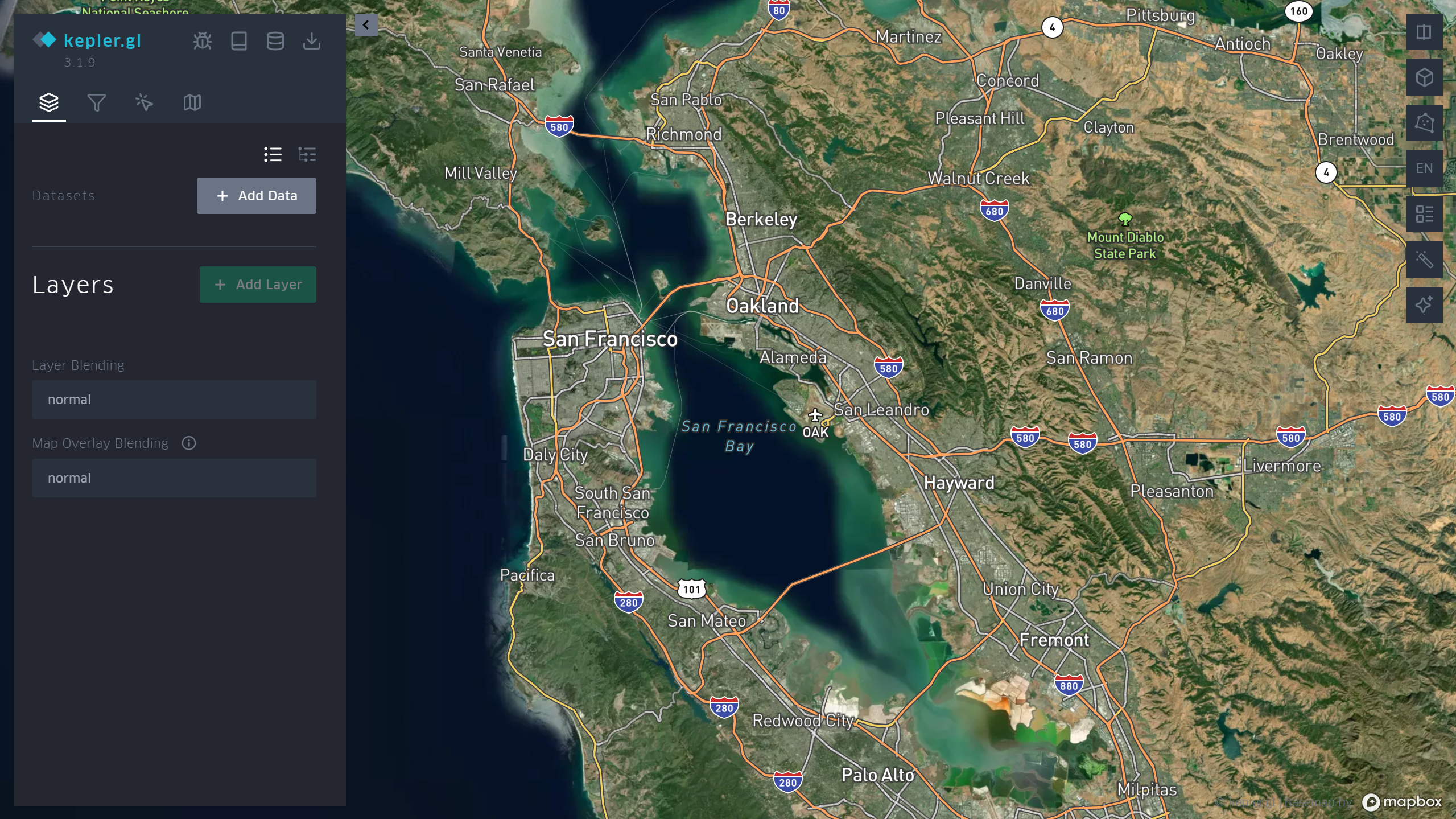
[Kepler.gl][web] is a data-agnostic, high-performance web-based application for visual exploration of large-scale geolocation data sets. Built on top of MapLibre GL and deck.gl, kepler.gl can render millions of points representing thousands of trips and perform spatial aggregations on the fly.
Kepler.gl is also a React component that uses Redux to manage its state and data flow. It can be embedded into other React-Redux applications and is highly customizable. For information on how to embed kepler.gl in your app take a look at the documentation.
Links
- [Website][web]
- [Demo][demo-app]
- [Examples][examples]
- [Get Started][get-started]
- [App User Guide][user-guide]
- [Jupyter Widget User Guide][user-guide-jupyter]
- [Documentation][docs]
- [Stack Overflow][stack]
- [Contribution Guidelines][contributing]
- [Api Reference][api-reference]
- [Roadmap][roadmap]
Env
For developing this repository, use Node 20.19.3 (see .nvmrc): run nvm install and nvm use. Newer Node versions can make yarn install / yarn bootstrap try to compile the gl dev dependency from source; if that fails, see Troubleshooting: gl package install.
When using kepler.gl as a dependency in your own app, use Node 20.19.3 or a supported LTS; older Node versions are not supported or tested.
Install kepler.gl modules
Kepler.gl consists of different modules. Each module can be added to the project like this:
npm install --save @kepler.gl/components
// or
yarn add @kepler.gl/components
kepler.gl is built upon [mapbox][mapbox]. You will need a [Mapbox Access Token][mapbox-token] to use it.
If you don't use a module bundler, it's also fine. Kepler.gl npm package includes precompiled production UMD builds in the umd folder. You can add the script tag to your html file as it follows (latest version of Kepler.gl):
<script src="https://unpkg.com/kepler.gl/umd/keplergl.min.js" />
or if you would like, you can load a specific version:
<script src="https://unpkg.com/[email protected]/umd/keplergl.min.js" />
Develop kepler.gl
Take a look at the [development guide][developers] to develop kepler.gl locally.
The SQLRooms demo tests a collapsible application
shell and modular panel layout using @kepler.gl/sqlrooms. Run
it with yarn start:sqlrooms (port 8083), alongside the original
main demo with yarn start (port 8080). The website continues
to serve the original app at /demo.
Basic Usage
Here are the basic steps to import kepler.gl into your app. You also take a look at the examples folder. Each example in the folder can be installed and run locally.
1. Mount reducer
Kepler.gl uses Redux to manage its internal state, along with a built-in task middleware to handle async side effects.
You need to add taskMiddleware to your store. The easiest way is via enhanceReduxMiddleware from @kepler.gl/reducers:
import {createStore, combineReducers, applyMiddleware, compose} from 'redux';
import keplerGlReducer, {enhanceReduxMiddleware} from '@kepler.gl/reducers';

const initialState = {};
const reducers = combineReducers({
  // <-- mount kepler.gl reducer in your app
  keplerGl: keplerGlReducer,

  // Your other reducers here
  app: appReducer
});

// using createStore
export default createStore(
  reducer,
  initialState,
  applyMiddleware(
    enhanceReduxMiddleware([
      /* Add other middlewares here */
    ])
  )
);
Or if use enhancer:
// using enhancers
const initialState = {};
const middlewares = enhanceReduxMiddleware([
  // Add other middlewares here
]);
const enhancers = [applyMiddleware(...middlewares)];

export default createStore(reducer, initialState, compose(...enhancers));
If you mount kepler.gl reducer in another address instead of keplerGl, or the kepler.gl reducer is not
mounted at root of your state, you will need to specify the path to it when you mount the component
with the getState prop.
Read more about [Reducers][reducers].
2. Mount Component
import KeplerGl from '@kepler.gl/components';

const Map = props => (
  <KeplerGl id="foo" width={width} mapboxApiAccessToken={token} height={height} />
);
Props
| Prop Name | Type | Default Value | Description |
|---|---|---|---|
id |
String | map |
The unique identifier for the KeplerGl instance. Required when multiple KeplerGl instances exist. It maps to the state in the reducer (e.g. component with id foo can be found instate.keplerGl.foo). |
mapboxApiAccessToken |
String | undefined |
API token for Mapbox, used for rendering base maps. Create a free token at Mapbox. |
getState |
Function | state => state.keplerGl |
Function that specifies the path to the root KeplerGl state in the reducer. |
width |
Number | 800 |
The width of the KeplerGl UI in pixels. |
height |
Number | 800 |
The height of the KeplerGl UI in pixels. |
appName |
String | Kepler.Gl |
The app name displayed in the side panel header. |
version |
String | v1.0 |
The version displayed in the side panel header. |
onSaveMap |
Function | undefined |
A function called when the "Save Map URL" in side panel header is clicked. |