
Kelivo
An open-source LLM client for mobile and desktop.
Use every major model in one app, give it a workspace to get real work done, and keep your data on your own device.







Website · User Guide · Download · Report an Issue
English · 简体中文
💡 Overview
Kelivo is a cross-platform LLM client built with Flutter for Android, iOS, macOS, Windows and Linux. Connect your own API keys or sign in with a supported subscription, and switch between OpenAI, Gemini, Claude, DeepSeek, OpenRouter and any OpenAI-compatible service without switching apps.
Kelivo goes beyond chat. Models can search the web, call MCP servers, follow skills and remember what matters to you. Bind a conversation to a workspace and the model can read and edit files and run commands: inside a Linux sandbox on your phone, or in a native shell on your computer.
Conversations, settings and files are stored locally. Kelivo has no account system of its own; back up to WebDAV or S3-compatible storage whenever you choose.
💖 Sponsors
| siliconflow.cn | Thanks to siliconflow.cn for providing free models in cooperation with us. |
 随想AI中转 |
感谢随想AI中转对本项目的赞助!随想AI中转 是一家可靠高效的 API 中继服务提供商,提供 Claude、Codex、Gemini 等的中继服务。注重隐私的中转站·无数据倒卖·无模型掺水,隐私,透明,极速售后。新账户注册每日签到就送 0.5 元测试额度,充值额度 1:1,无需订阅,按量付费。多线路冗余、跨区域容灾、自动故障切换,长链路 SSE 不中断。99.9% 可用性,关键调用从不掉队。 |
|
MaruCode 是一家偶尔做做慈善的小破站 API,自营号池,主要提供 Codex、Claude Code、GPT Image 等主流模型,支持 Websocket 协议,明码标价(Codex 0.25x, CC 1.5x),透明汇率(1:1),新用户注册送 2 刀。生图工作台🖼️ |
If Kelivo is useful to you, you can also support the project on WeChat.

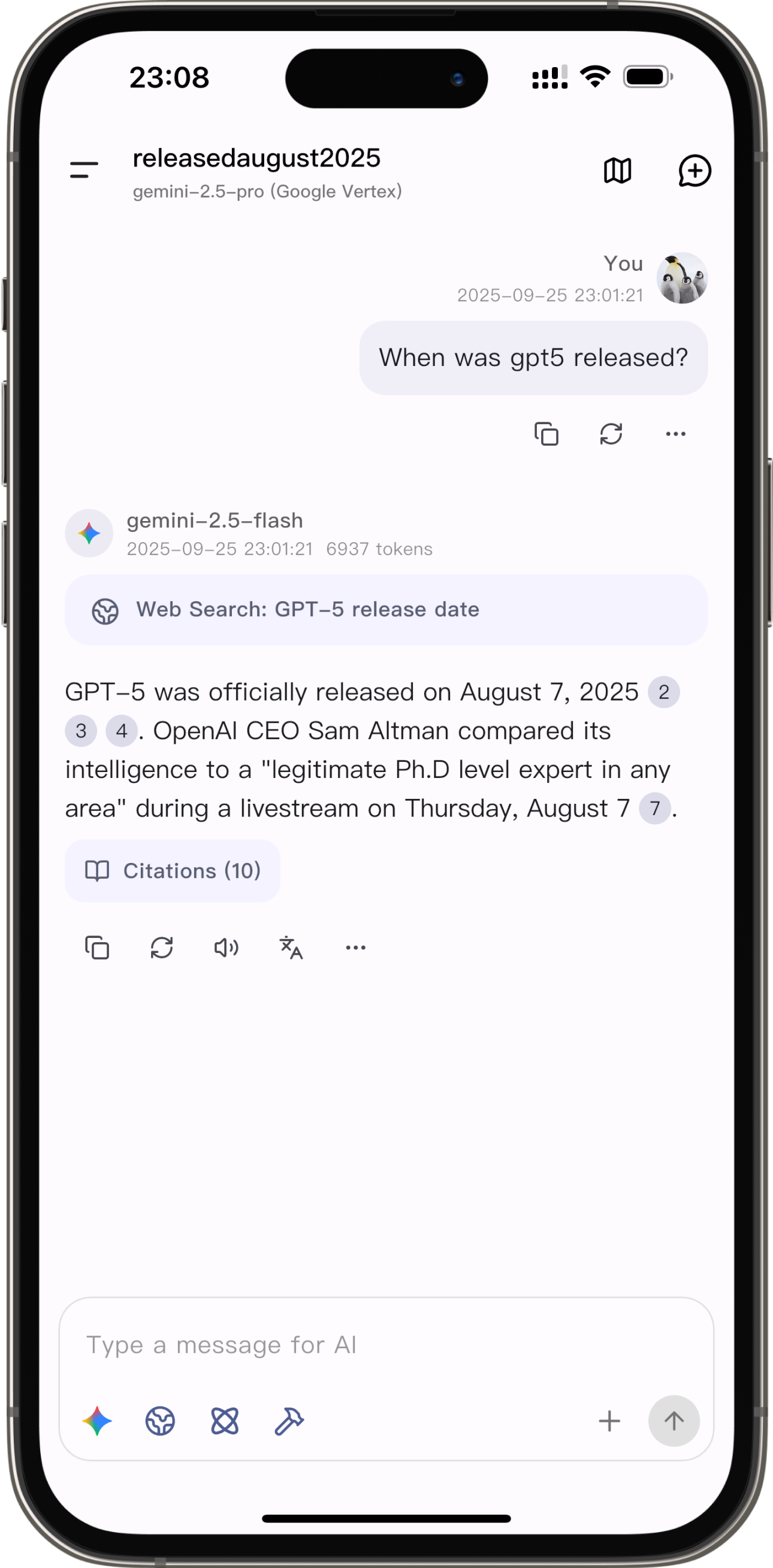
📸 Screenshots
🚀 Download
| Platform | Get Kelivo | Package | Requirements |
|---|---|---|---|
| iOS / iPadOS | App Store · TestFlight (beta) | App Store, or unsigned IPA in Releases | iOS 15.0 or later |
| Android | GitHub Releases | APK (arm64-v8a, armeabi-v7a, x86_64) |
Android 7.0 or later |
| macOS | GitHub Releases | DMG | macOS 11.0 or later, Apple silicon or Intel |
| Windows | GitHub Releases | Installer (setup.exe) or portable ZIP |
Windows 10 or 11 |
| Linux | GitHub Releases | AppImage, DEB, RPM, tar.gz | x86_64 |
| HarmonyOS | kelivo-ohos | Maintained in a separate repository | — |
The download page on the website lists the same builds.
🧭 Getting Started
- Add a model provider. Open Settings → Providers, enter an API key for a preset provider or add your own endpoint, then fetch its model list. To use a ChatGPT, Grok or Kimi Code account instead, sign in from the Accounts tab under Add Provider.
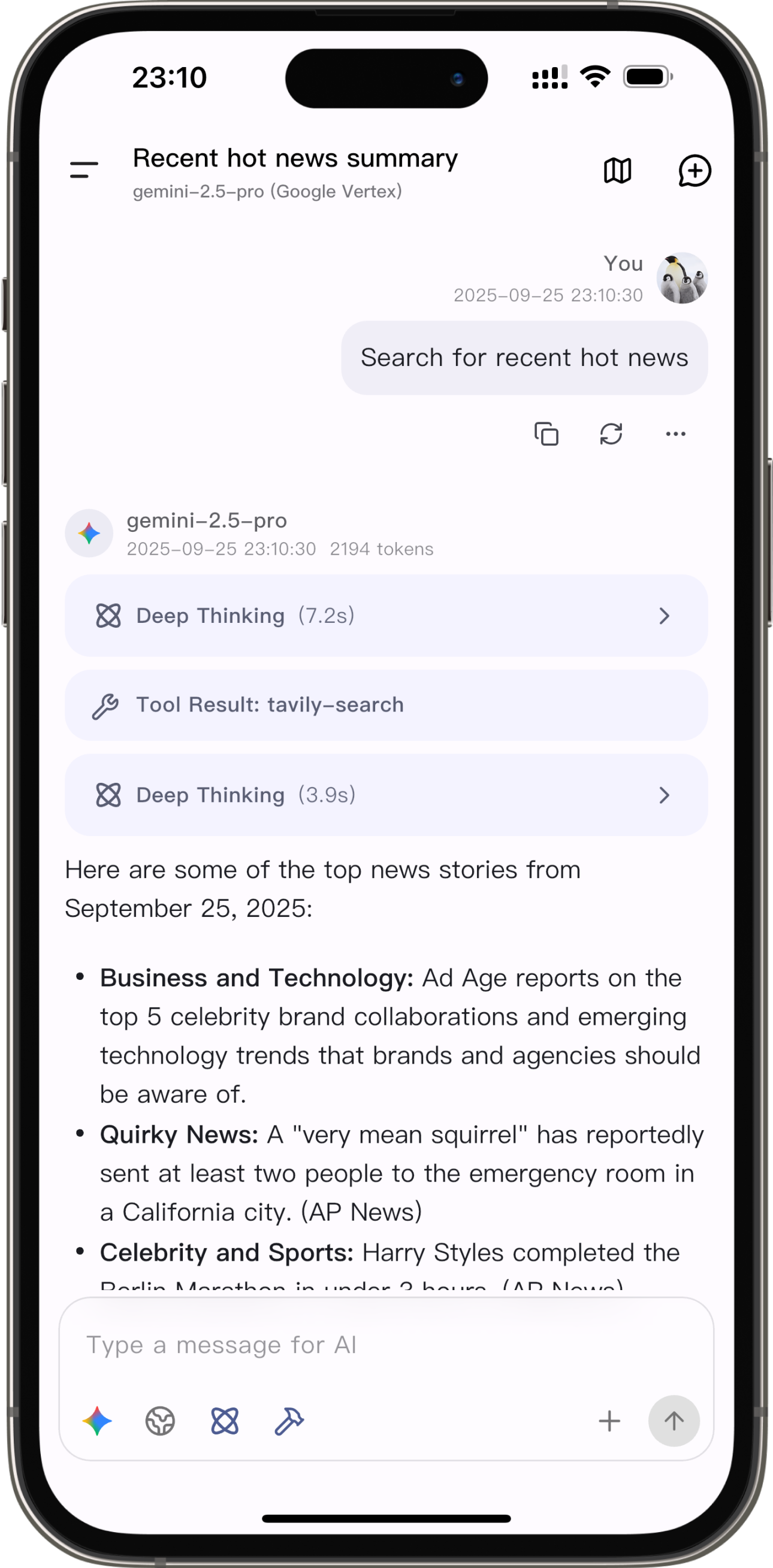
- Start a conversation. Select a model from the input bar. Turn on web search, MCP servers, tools or reasoning for the current chat from the same bar.
- Let the model work with files (optional). Open Settings → Workspace & environment and create a workspace, then bind it to a conversation from the chat. On Android and iOS, install the Linux environment on the same page first; the iOS environment is bundled with the app, so nothing is downloaded.
The User Guide (Chinese) covers providers, memory, world books and more.
✨ Features
🧠 Models and Providers
- Native protocols: OpenAI Chat Completions and Responses API, Google Gemini and Vertex AI, and Anthropic Claude, plus any OpenAI-compatible endpoint, including self-hosted models.
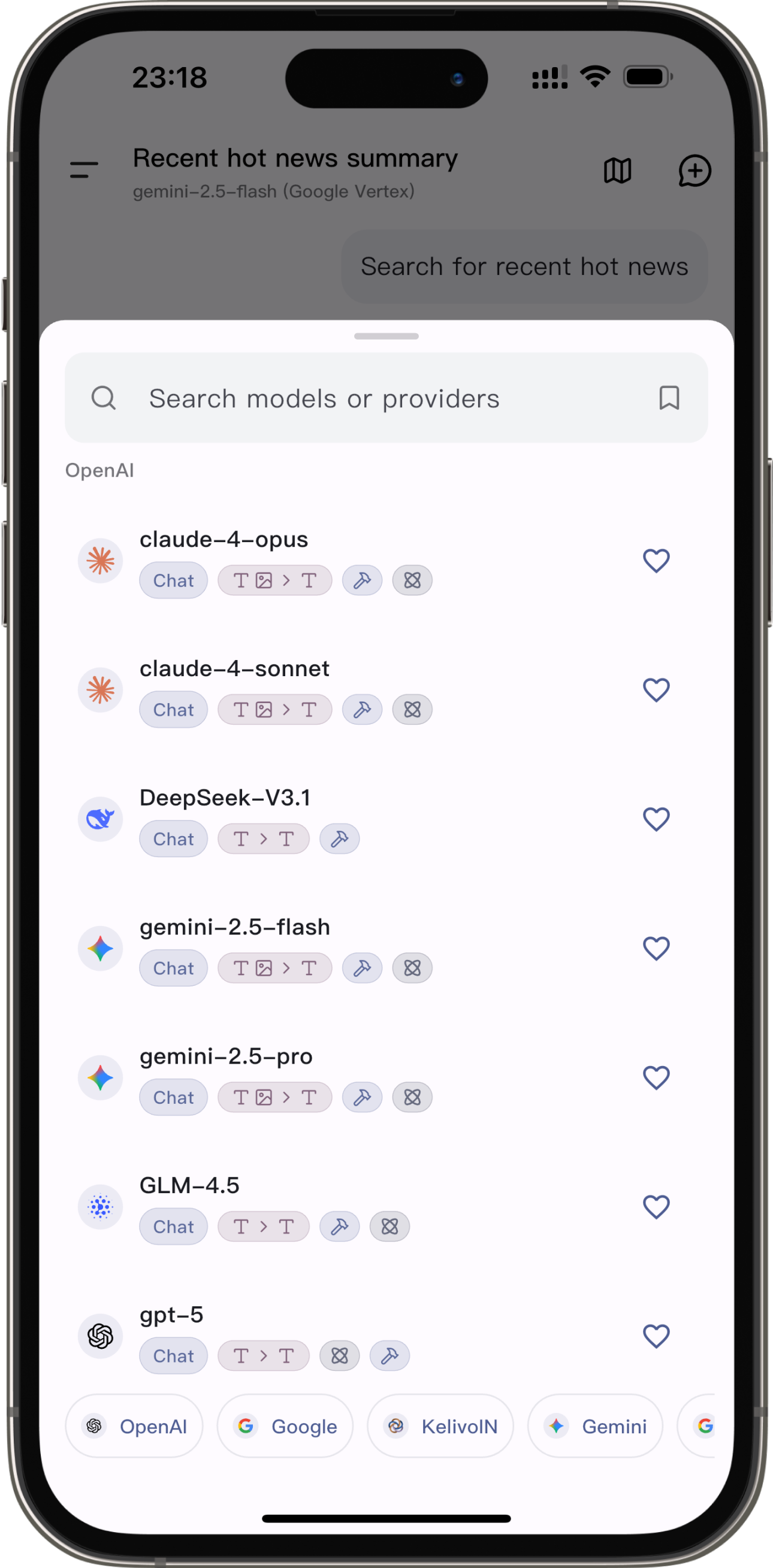
- Built-in presets for OpenAI, Gemini, Claude, DeepSeek, OpenRouter, SiliconFlow, Alibaba Cloud, Zhipu AI, xAI, ByteDance and more.
- Account sign-in: use a ChatGPT (Codex), Grok or Kimi Code account directly. Kelivo syncs the available models and shows your usage limits.
- Model capabilities: set input and output modalities, tool use and reasoning per model. Choose a reasoning level from off to maximum, or set a custom token budget.
- Provider-side tools, where supported: native web search, URL context, code execution, code interpreter and image generation.
- Multiple API keys per provider, with round-robin, priority, least-used or random load balancing and automatic error tracking.
- Request control: custom headers and request body at the provider, model or assistant level; HTTP, HTTPS or SOCKS5 proxy per provider; Claude prompt caching; balance lookup; automatic retry with exponential backoff.
- Organization and sharing: group providers, and share or import provider configurations as a QR code or text.
🤖 Agent and Workspaces
- Workspaces: bind a conversation to a workspace to give the model seven tools:
shell,read_file,write_file,edit_file,list_dir,globandgrep. Command output streams live, file edits appear as diffs, and shell commands can require approval, which you grant per command or for the whole session. - A Linux sandbox on your phone: Android runs Ubuntu, Debian or Alpine Linux through PRoot, or a rootfs image you import. iOS includes Alpine Linux based on iSH, so nothing needs to be downloaded. Install Python, Node.js, Git, SSH and other common tools from the app, and choose the fastest apt/apk, pip and npm mirrors after a speed test.
- Native on desktop: on macOS, Windows and Linux, tools run in your system shell, in an app-managed folder or a folder you link from your computer.
- Files and terminal: browse workspace files with previews for Markdown, HTML, CSV, images and text. Mobile has an in-app terminal; on desktop, open the workspace in your system terminal. On mobile, you can also mount up to 10 external folders into the sandbox, read-only or read-write.
- Environment variables shared by a