Kandev
Manage and run tasks in parallel. Orchestrate agents. Review changes. Ship value.
Features | Workflows | Run as a Service | Mobile Access | Debug Logs | Roadmap | Contributing | Architecture | Discord
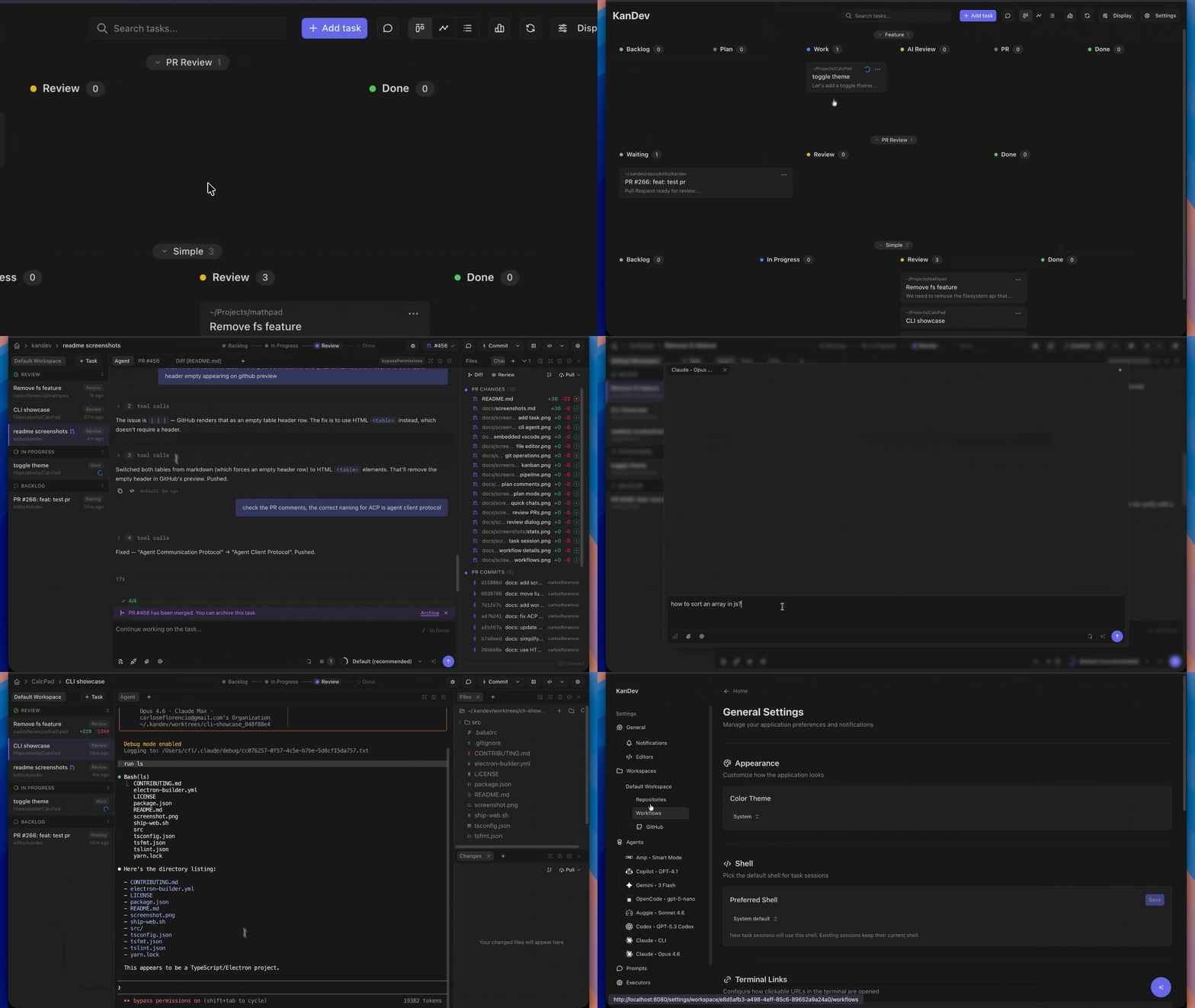
What
Kandev is a powerful tool for power users who want deeper control over how AI agents work: customize workflows, agent profiles, runtimes, prompts, and review gates to match your process.
Organize work across kanban and pipeline views with opinionated workflows and execute multiple tasks in parallel. Assign agents from any provider, and review their output in an integrated workspace - file editor, file tree, terminal, browser preview, and git changes in one place. Terminal agent TUIs are great for running agents, but reviewing and iterating on changes there doesn't scale.
Run it locally or self-host it on your own infrastructure. Use the mobile remote-access guide to connect through Tailscale, Cloudflare Tunnel, or another private VPN.
Open source, multi-provider, no telemetry, not tied to any cloud.
Distribution
Kandev is distributed as a native Go binary for each supported platform. The compiled web frontend is embedded in that binary. The binary serves the web UI and API, so the application server does not need Node.js, a separate web server, or a frontend build at runtime.
Homebrew, Scoop, release archives, and the desktop app run this native binary
directly. The npm/npx package adds a small Node.js platform selector, so Node.js
is required to launch Kandev through npm/npx but not by the application server.
Release bundles also include agentctl helpers for task environments.
Vision
Humans stay in control. Define tasks, build agentic workflows with gates, review every change, decide what ships.
- Review-first - Humans support production systems. We need to understand (yet) and trust the code that gets deployed.
- Your workflow - Every team is different, and not every developer uses AI the same way. Define workflows once, share them across the team, and give everyone a consistent process for working with agents - regardless of experience level.
- Remote agents - Running multiple agents on a large codebase can quickly saturate a local machine. The goal is a single control plane: offload execution to servers, orchestrate from anywhere, including your phone.
Features
- Multi-agent support - Claude Code, Codex, GitHub Copilot, Gemini CLI, Amp, Auggie, OpenCode, Cursor, Devin, Qwen, Factory Droid, iFlow, Kilocode, Pi, Kimi, AWS Kiro, Qoder, Trae, Oh My Pi, Grok, Hermes, Antigravity
- Parallel task execution – start and manage multiple tasks from different sources simultaneously, boosting productivity with AI agents
- Integrated workspace - Built-in terminal, code editor with LSP, git changes panel, embedded vscode and chat in one IDE-like view
- Kanban task management - Drag-and-drop boards, columns, and workflow automation
- Agentic workflows - Multi-step pipelines that mix-and-match agents per step - for example, Claude Code Opus to design a plan, GitHub Copilot Sonnet to implement it, and Codex GPT 5.4 to review the changes. See docs/workflow-tips.md
- Automations - Trigger agent tasks on schedules or webhooks, with configurable run destinations, context, and concurrency
- Sub-tasks - Agents can spawn sub-tasks that resume from the parent task's session. Useful for splitting a task that has grown too big, or producing several PRs from the same starting point.
- CLI passthrough - Drop into raw agent CLI mode for direct terminal interaction with agents that support it, leveraging their full native TUI
- Workspace isolation - Git worktrees prevent concurrent agents from conflicting
- Multi-repository tasks - Span a single task across multiple repositories, with one worktree per repo, per-repo branches, per-repo PRs, and per-repo grouping in the Changes panel and review dialog
- Flexible runtimes - Run agents as local processes, in isolated Docker containers, on remote servers via SSH, or in cloud executors like sprites.dev
- Runtime settings - Executor profiles, secrets, custom prompts, utility agents, and resource metrics are configurable from Settings
- Task-agent MCP - Agents can create subtasks, target sibling repos, attach extra branches for multiple PRs, message other tasks, read conversations, and inspect related tasks
- External MCP - Manage Kandev from outside coding agents over streamable HTTP or SSE, with copyable config snippets for popular agent CLIs
- Plugin marketplace and management - Browse, install, update, enable, disable, and configure plugins from Settings, including MCP Explorer and the Bitbucket plugin
- Workflow portability - Export and import workflows as portable YAML across workspaces or Kandev installs
- Session management - Resume and review agent conversations
- Shareable task snapshots - Publish redacted task conversation snapshots as secret GitHub Gists, with preview and revoke controls
- Stats - Track your productivity with stats on the completed tasks, agent turns, etc
See docs/features.md for the full feature inventory, including settings, secrets, custom prompts, and MCP task capabilities.
In progress: Office mode
We're working on Office mode, a feature-flagged autonomy layer for persistent agent teams. The direction is agent instances with roles and permissions, dashboards, inbox/approvals, routines, task delegation, skills, memory, cost tracking, budgets, and workspace config sync. We'll document Office as a supported feature after it is live.
Integrations




Connect Kandev to GitHub, GitLab, Jira, Linear, Sentry, and Azure DevOps to pull issues into the kanban, link tasks to PRs, and surface review activity inline. Bitbucket support is available through the Bitbucket plugin.
Supported ACP Agents
| Agent | Package / command |
|---|---|
| Claude Code | @agentclientprotocol/claude-agent-acp |
| Codex | @agentclientprotocol/codex-acp |
| GitHub Copilot | @github/copilot |
| Gemini CLI | @google/gemini-cli |
| Amp | amp-acp |
| Auggie | @augmentcode/auggie |
| OpenCode | opencode-ai |
| Cursor | cursor-agent (requires Cursor Pro) |
| Devin | devin (install Devin CLI from Devin Desktop or standalone installer) |
| Qwen | @qwen-code/qwen-code |
| Factory Droid | droid |
| iFlow (beta) | @iflow-ai/iflow-cli |
| Kilocode | @kilocode/cli |
| Pi | ACP adapter: pi-acp; CLI passthrough: pi |
| Kimi | kimi (install Kimi CLI from Moonshot AI) |
| Kiro | kiro-cli-chat (install Kiro CLI from AWS) |
| Qoder | qodercli (install Qoder CLI) |
| Trae | traecli (install Trae IDE CLI) |
| Oh My Pi | omp (install @oh-my-pi/pi-coding-agent with Bun) |
| Grok | grok (install @xai-official/grok with npm) |
| Hermes | hermes (install with the official Hermes installer) |
| Antigravity | agy_acp_server.par / .exe (no automated install; download from the ACP registry, extract both archive entries into one directory, and put that directory on PATH) |
All agents communic