K-Dense BYOK






🎥 Webinar recording: Getting Started with K-Dense BYOK
An online walkthrough of installing Kady and running your first research task, with live Q&A.
Your own AI research assistant, running on your computer, powered by the accounts and API keys you choose.
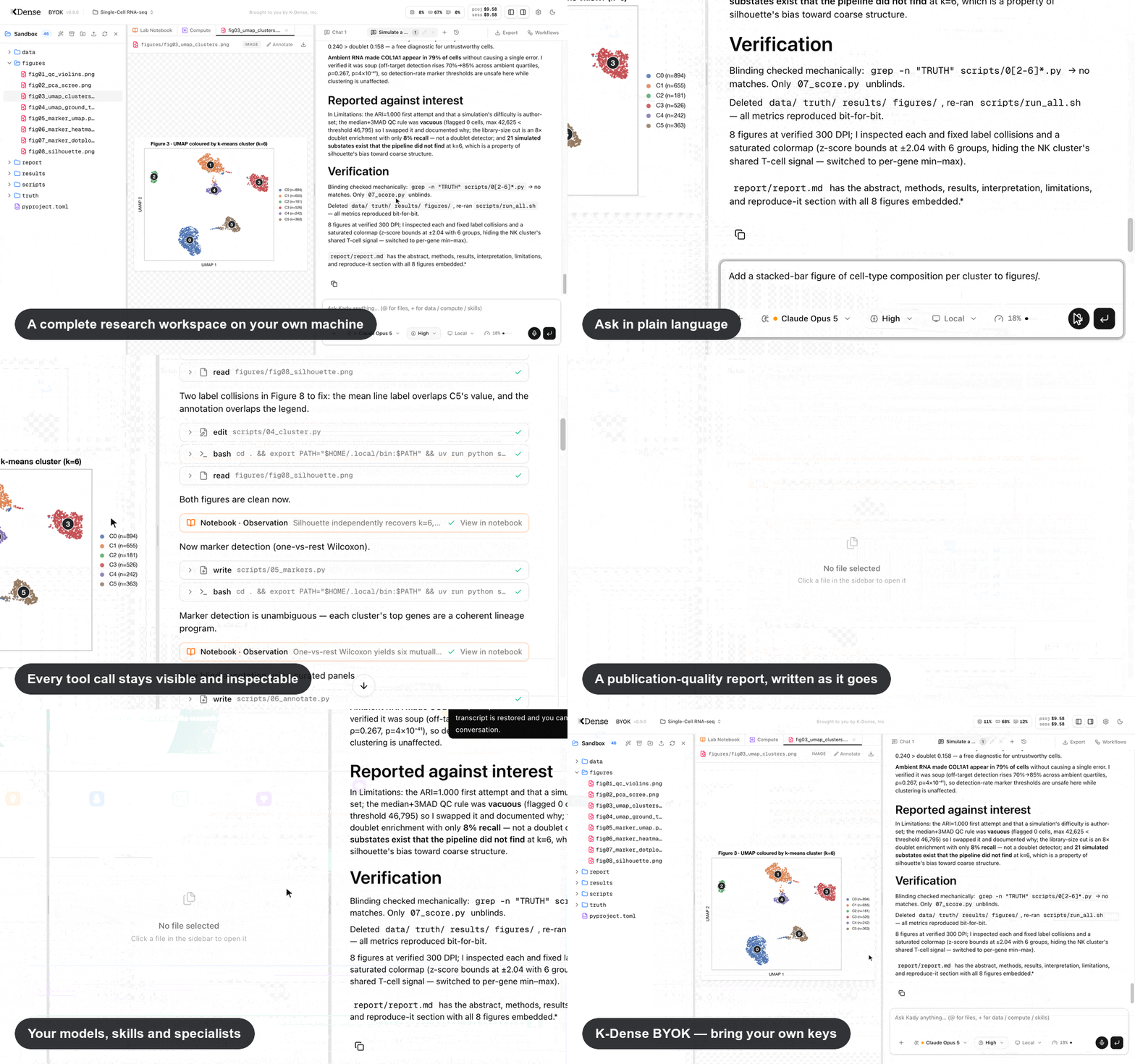
K-Dense BYOK (Bring Your Own Keys) is a free, open-source app that gives you Kady — an AI research assistant for scientists in any field. Describe a task in plain language — analyze this dataset, review my manuscript, search the literature, build this figure — and Kady works through it in a complete research workspace. It can inspect your files, write and run analysis code, search and read sources, create figures and reports, and keep a living record of what it did.
Three things to know up front:
- No coding experience required. You describe what you want; Kady writes and runs the code and shows you its progress as it works.
- Your workspace stays on your computer. Projects, conversations, notebooks, and results live in ordinary folders on your machine; K-Dense does not host or store them. When you use a hosted AI model, the material needed for that request is sent directly to the provider you selected under that provider's privacy terms. Use a local Ollama model when data must not leave your machine.
- The app itself is free; provider charges and limits remain yours. Use prepaid OpenRouter, connect a supported AI subscription, or run free local models. Kady tracks paid OpenRouter usage and Anthropic OAuth's documented metered extra usage against project spending caps. ChatGPT, Copilot, and xAI subscription usage is tracked separately because those providers manage quotas and overages; a subscription login does not imply unlimited or free usage.
Beta: K-Dense BYOK is currently in beta. Many features and improvements are on the way. Star us on GitHub to stay in the loop, and follow K-Dense on X, LinkedIn, YouTube, and Reddit for release notes and tutorials.
🎬 Prefer to watch first? The Future of Research is Open: Introducing K-Dense BYOK walks through what the app does and how to get set up. More walkthroughs in Tutorial videos.
CompBioBench
As of September 11, 2026, K-Dense BYOK holds #2 on the public CompBioBench v1 leaderboard.
CompBioBench is a Genentech benchmark of 100 computational-biology tasks. Each task has one exact-match answer. The gold answers stay on the leaderboard, so an independent grader scores every run.
We ran the same K-Dense BYOK harness four times through OpenRouter. Each run used one model and one isolated project per question.
| Run | Model | Reasoning | Accuracy | Rank (Sept 11, 2026) |
|---|---|---|---|---|
| r4 | GPT-6 Astra | xhigh | 98% | #2 |
| r3 | Gemini 3.8 Flash | xhigh | 94% | #7 |
| r2 | GPT-5.6 SOL | xhigh | 92% | #11 |
| r1 | DeepSeek V4 Pro | high | 81% | — |
Ranks will move as new submissions arrive. For agreement, failures, and cost on the first three runs, see K-Dense BYOK on CompBioBench.
Internal benchmark
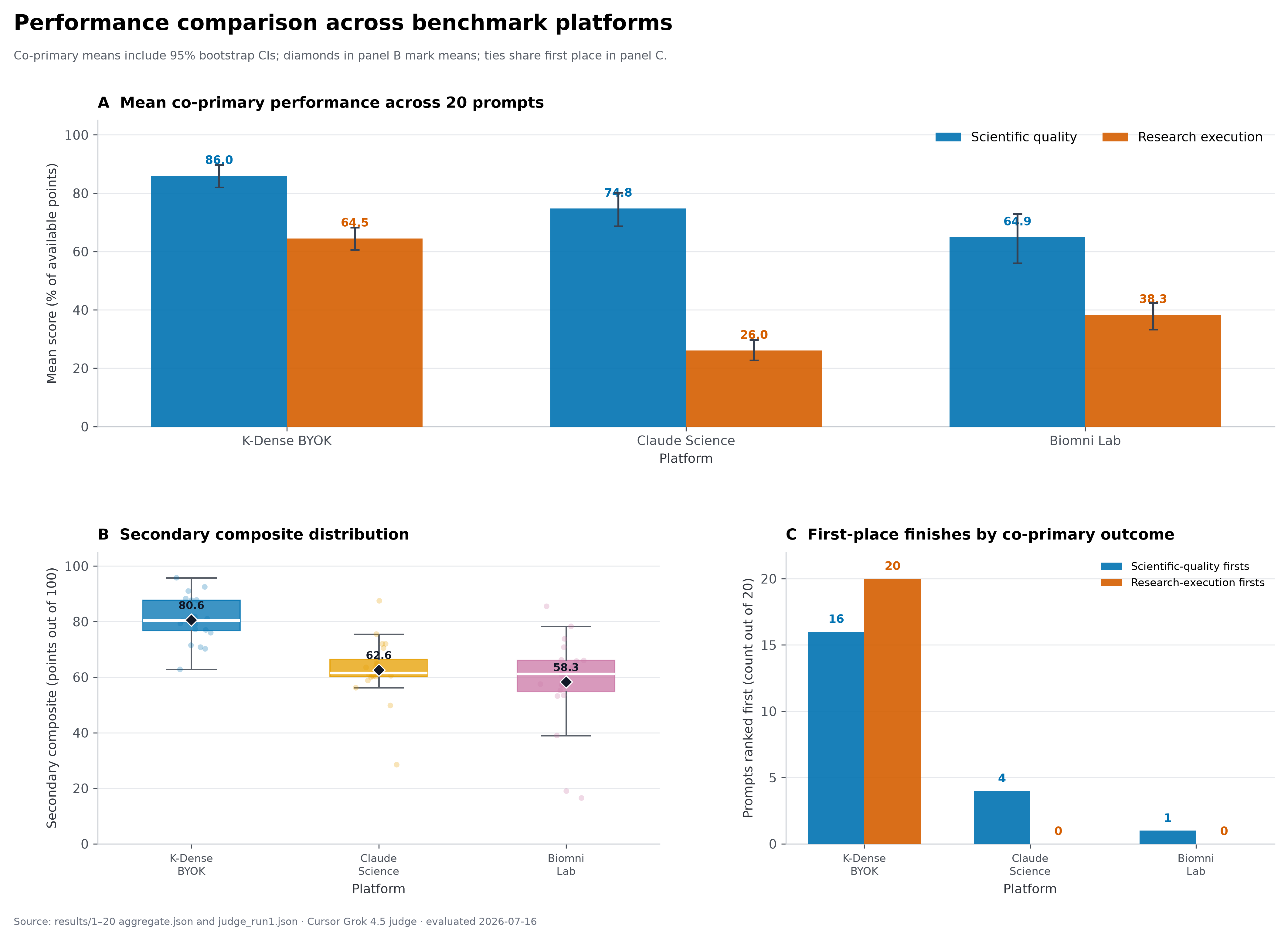
This figure compares K-Dense BYOK, Claude Science, and Biomni Lab across scientific quality and research execution in a 20-prompt benchmark. For these runs, K-Dense BYOK was configured to use Claude Opus 4.8 with the xHigh reasoning level. The benchmark was designed, run, and evaluated internally by K-Dense rather than an independent third party, so the results should be interpreted as an internal evaluation under the tested setup, not as a universal measure of platform performance.
Related reading on how we evaluate: K-Dense Web vs. Claude Science walks through the same 20-task comparison for our hosted platform, and Introducing K-Bench 01 covers our broader benchmark of nine frontier models on 178 real scientific tasks.
What can it do?
Kady is designed to carry out research work, not only answer questions. You remain the scientist in charge: you can watch each step, inspect the code and files it creates, redirect it while it works, and stop a run at any time.
From a research question to usable results
- Analyze real datasets. Ask Kady to clean data, check quality, choose and run statistical methods, compare groups, fit models, or generate publication-ready figures. It writes and runs the code inside the project, so the scripts, intermediate files, tables, figures, and reports remain available for inspection and reuse.
- Review evidence and documents. Kady can search the web and read web pages, PDFs, GitHub repositories, and YouTube videos. It can compare papers, extract methods, audit a manuscript, summarize evidence, or follow links to supporting material. Web search works without an additional account; optional search-provider keys improve capacity.
- Work with text, data, and images. Type or dictate a request, upload files through the project browser, attach project files to a conversation, or paste/drop images directly into a message for a vision-capable model to inspect.
- Ask before it assumes. If a study design, comparison, output format, or other requirement is ambiguous, Kady can pause and show a short in-chat question form — including multiple choice, free text, and image input — rather than silently guessing.
- Keep working while it works. Add up to five follow-up messages to a running conversation, steer the current analysis, or continue in another chat or project.
A scientific toolkit built in
- 149 scientific skills cover genomics, proteomics, bioinformatics, drug discovery, chemistry, materials science, clinical research, and more. Kady activates the relevant procedures automatically, and you can browse or disable them in Settings.
- 326 guided workflow templates across 22 disciplines turn common analyses into fill-in-the-blank starting points. Choose a workflow, supply the study details, and launch it into the active chat.
- 229 scientific and financial data resources across 18 categories give Kady guidance for finding information in biomedical, chemical, scholarly, market, earth-science, climate, and space databases. Some resources require their own free key.
- 21 scientific specialists can take focused assignments such as statistical review, citation checking, peer review, data analysis, or literature synthesis. Kady can delegate independent work in parallel and combine the findings, or you can call a specialist by name. Learn more.
- A Living Lab Notebook records the reasoning trail. As Kady and its specialists work, they can log hypotheses, methods, observations, decisions, confidence, code, and linked artifacts. You can connect evidence to hypotheses, pin and comment on entries, add your own notes, view one chat or the whole project, export Markdown/JSON/a bundle with artifa