Jean
A desktop AI assistant for managing multiple projects, worktrees, and chat sessions with Claude CLI, Codex CLI, Cursor CLI, OpenCode, PI, Command Code, Grok, and Kimi Code.
Tauri v2 · React 19 · Rust · TypeScript · Tailwind CSS v4 · shadcn/ui v4 · Zustand v5 · TanStack Query · Pierre Diffs · xterm.js
About the Project
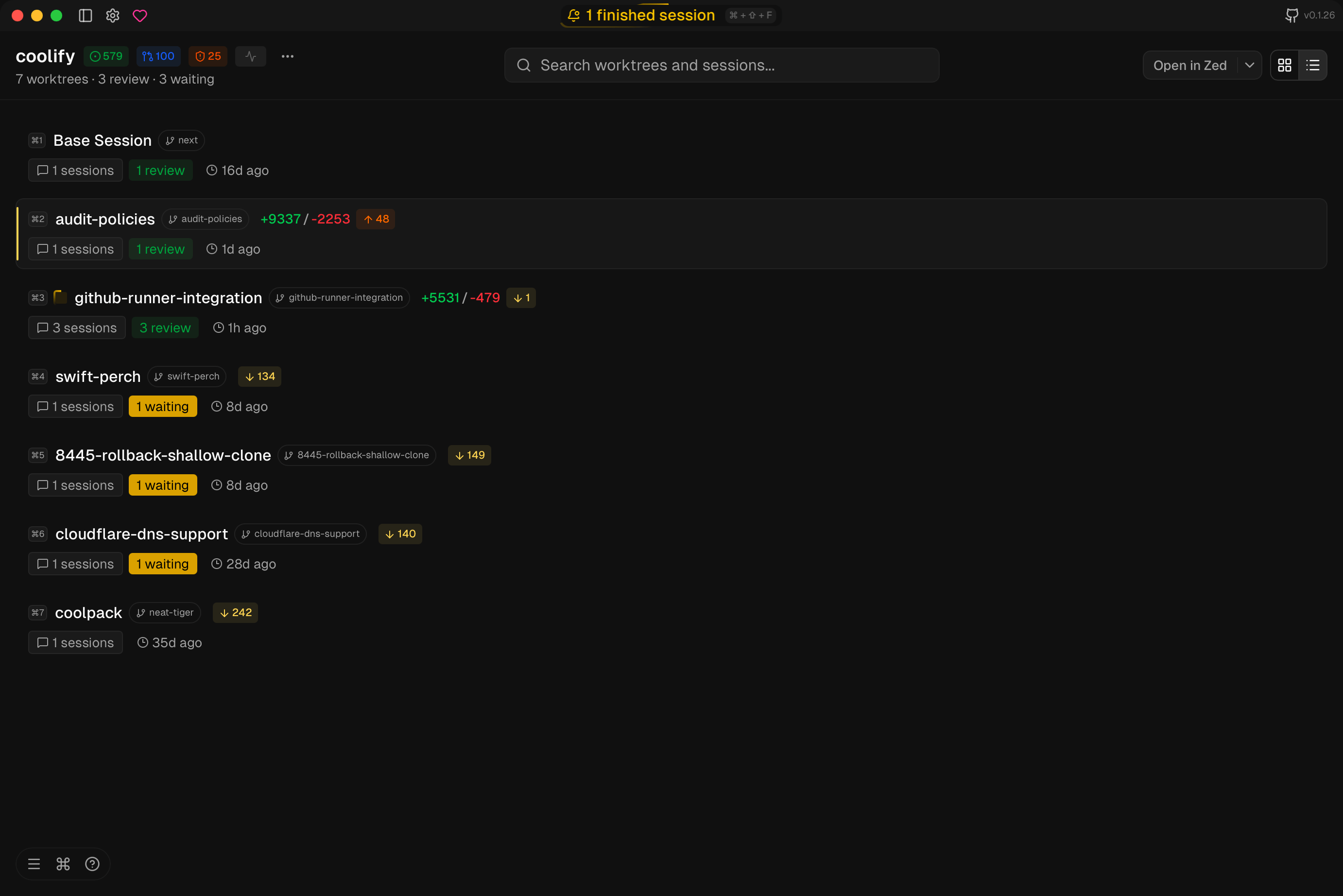
Jean is an opinionated native desktop app built with Tauri that gives you a powerful interface for working with Claude CLI, Codex CLI, Cursor CLI, OpenCode, PI, Command Code, Grok, and Kimi Code across multiple projects. It has strong opinions about how AI-assisted development should work - managing git worktrees, chat sessions, terminals, GitHub and Linear integrations in one cohesive workflow.
No vendor lock-in. Everything runs locally on your machine with your own CLI installations.
For more information, take a look at jean.build.
Screenshots
 |
 |
 |
 |
 |
 |
 |
 |
Features
- Project & Worktree Management - Multi-project support, linked projects for cross-project context, git worktree automation (create, archive, restore, delete), custom project avatars
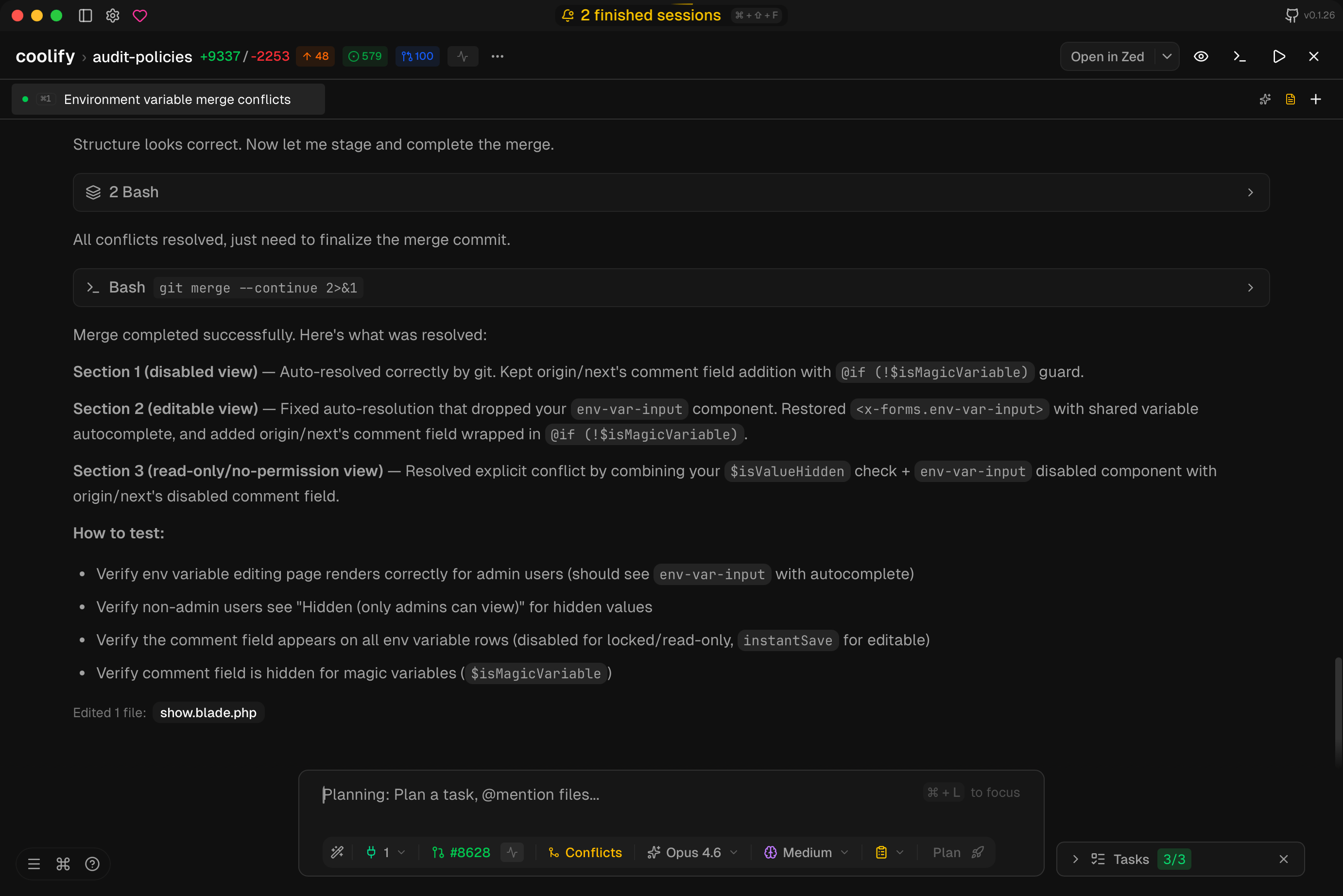
- Session Management - Multiple sessions per worktree, execution modes (Plan, Build, Yolo) with plan approval flows, session recap/digest, saved contexts with AI summarization, archiving with retention settings, recovery, auto-naming, canvas views
- AI Chat (Claude, Codex, Cursor, OpenCode, PI, Command Code, Grok, Kimi) - Model selection and thinking/effort levels with per-mode overrides, MCP server support, multi-agent collaboration, file picker & image attachments, chat search, notification sounds, custom system prompts, custom CLI profiles
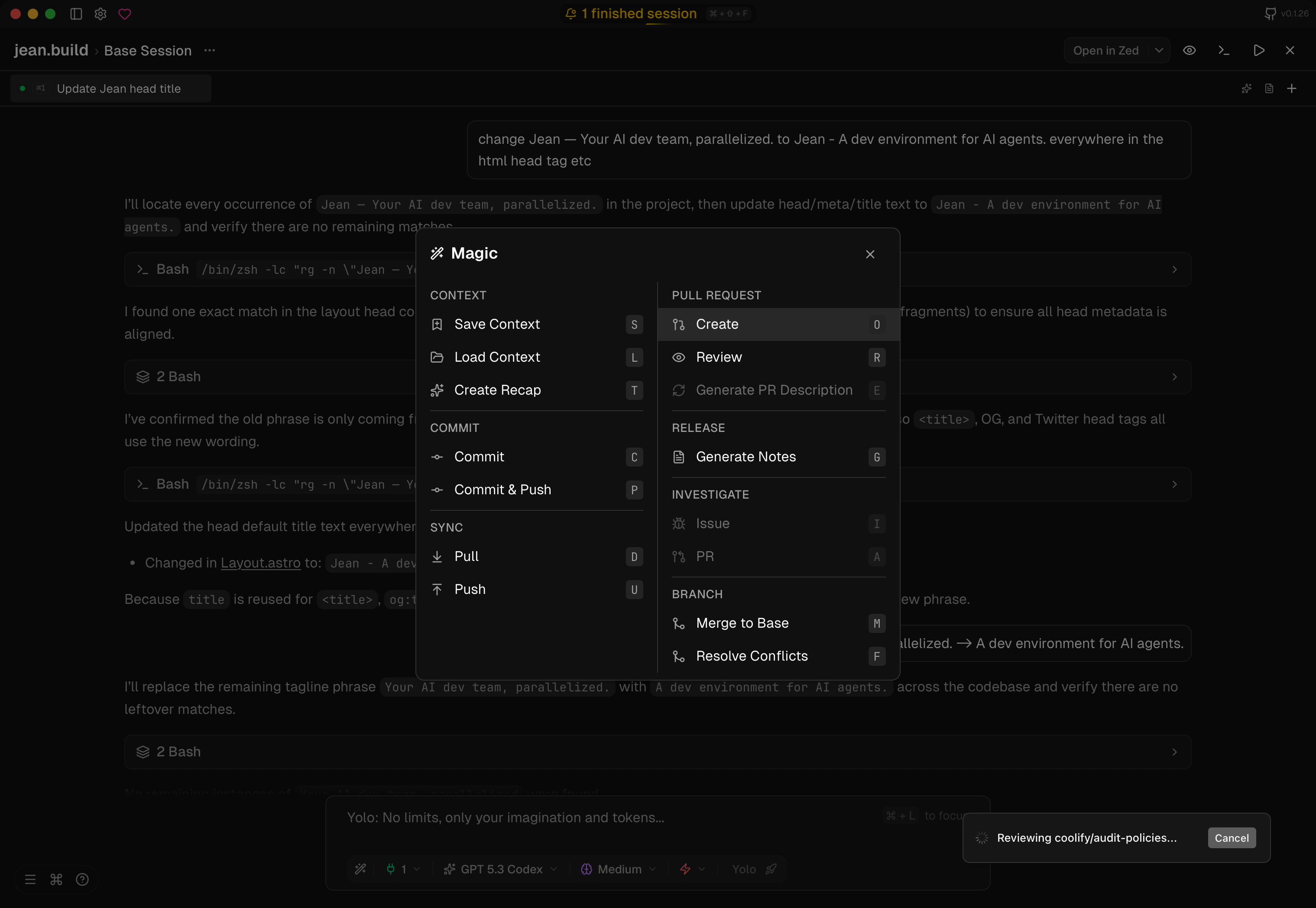
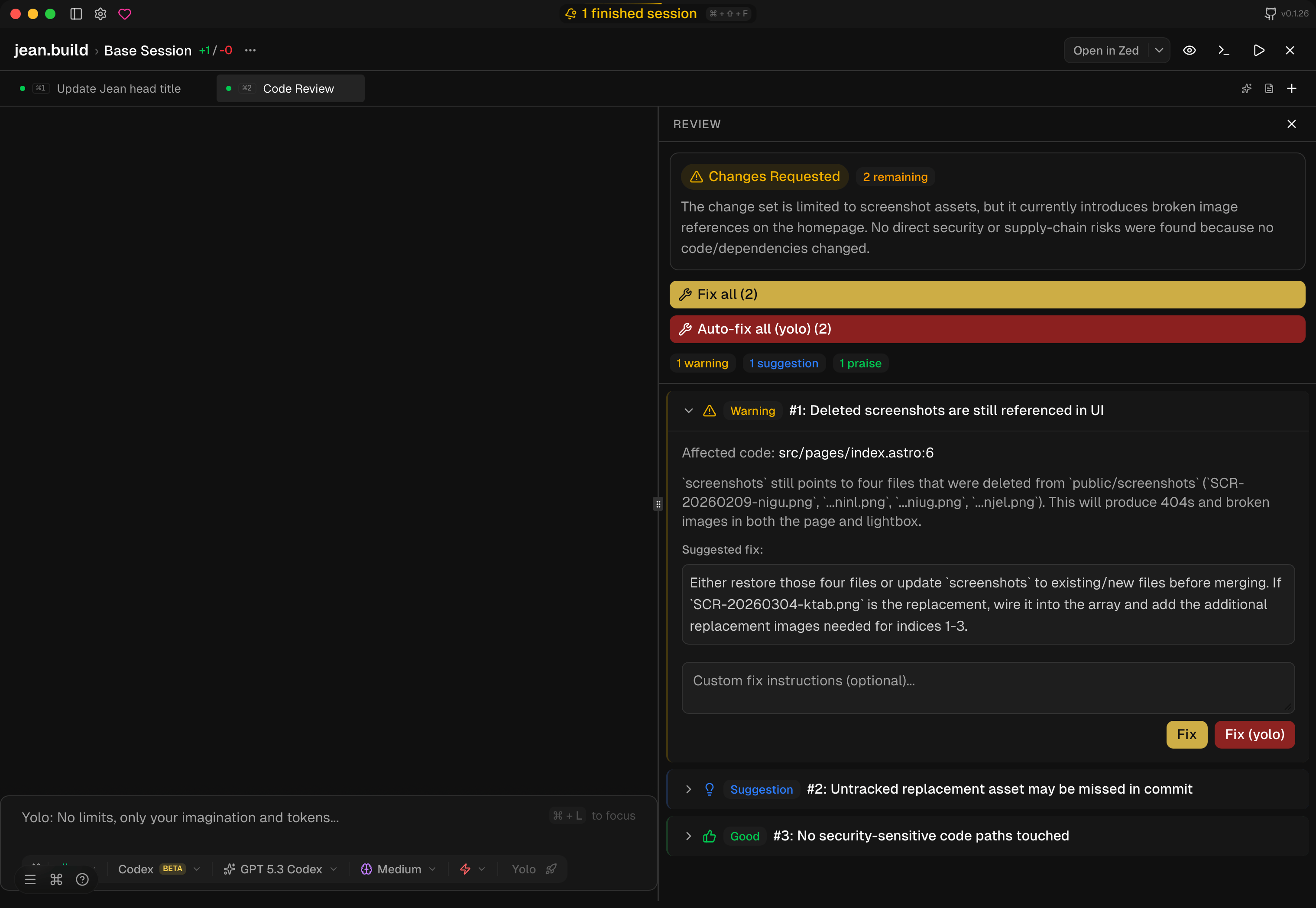
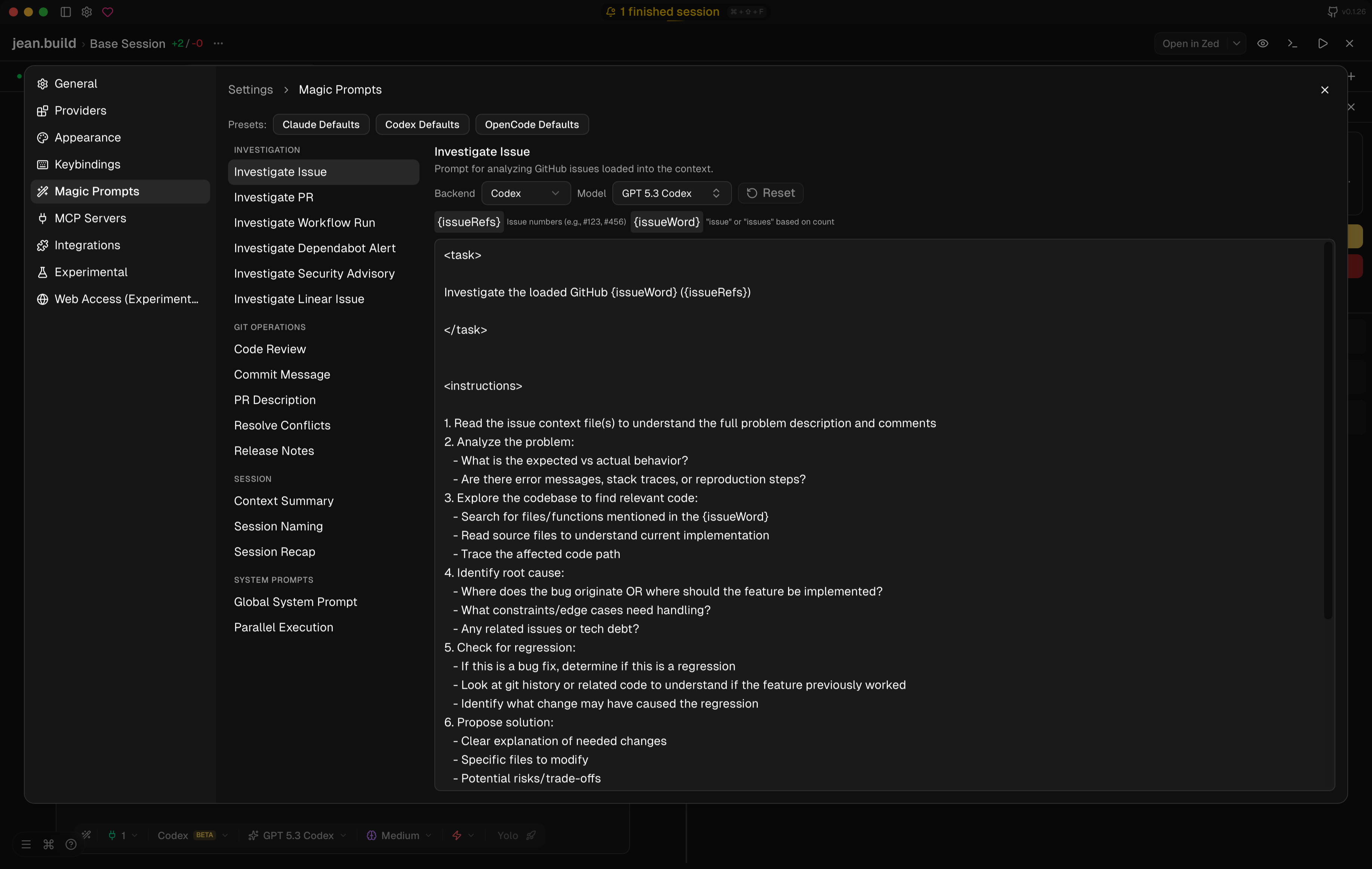
- Magic Commands - Investigate issues/PRs/workflows, code review with finding tracking, AI commit messages, PR content generation, merge conflict resolution, release notes generation, customizable per-prompt model/backend/effort selection
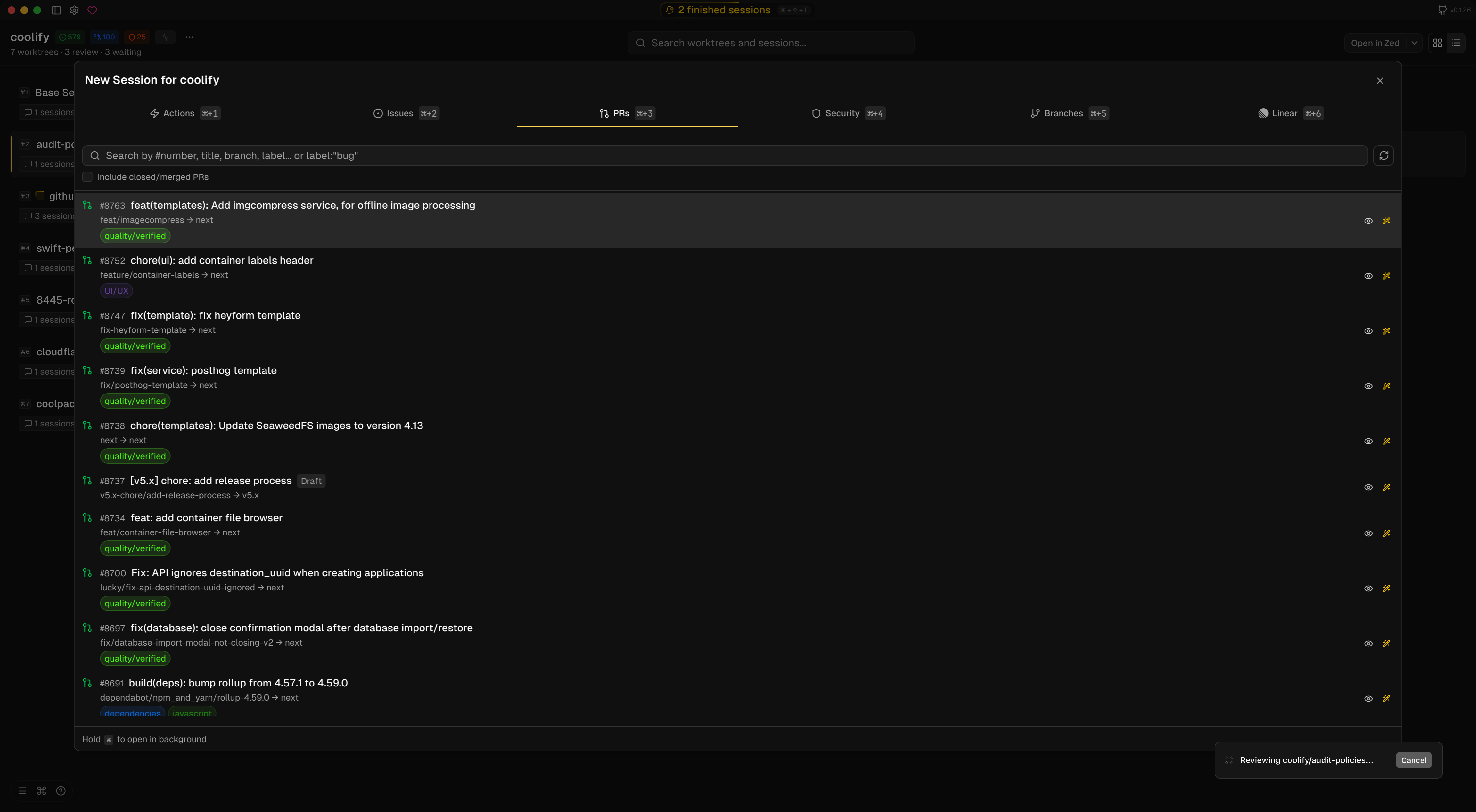
- GitHub Integration - Dashboard with Issues, PRs, Security Alerts, and Advisories tabs, Dependabot investigation, checkout PRs as worktrees, auto-archive on PR merge, workflow investigation
- Linear Integration - Issue investigation, context loading, per-project API key and team configuration
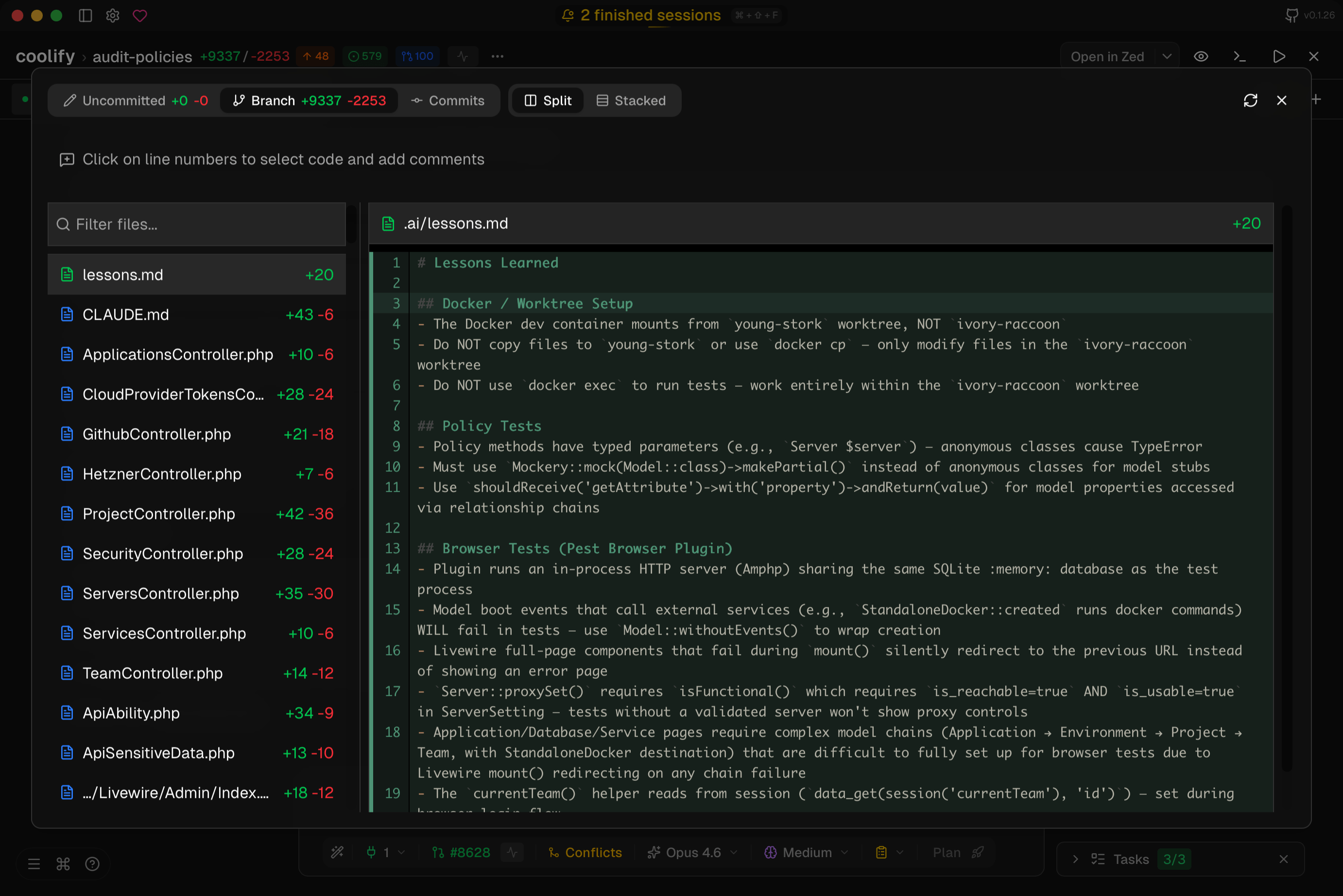
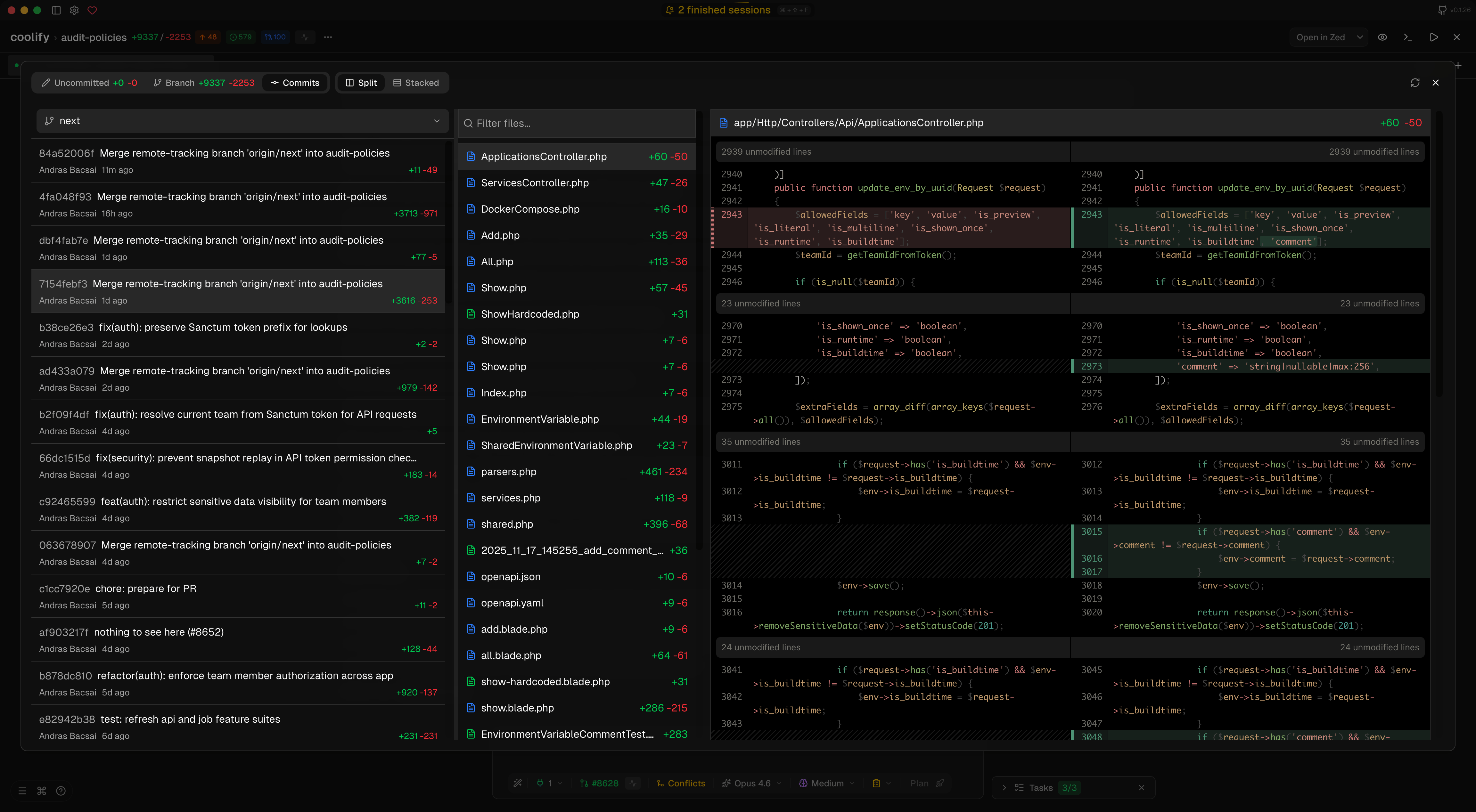
- Developer Tools - Multi-dock terminal (floating, left, right, bottom), command palette, open in editor (Zed, VS Code, VSCodium, Cursor, Xcode, IntelliJ), git operations (status, stash, revert, fetch/merge with conflict detection), diff viewer (unified & side-by-side), file tree with preview, debug panel with token usage tracking
- Web Access - Every Jean instance (desktop or headless server) can expose the full UI over HTTP/WebSocket with token auth so you can use it from a browser on your network
- Customization - Themes (light/dark/system), custom fonts, customizable AI prompts, configurable keybindings, mobile swipe gestures
Installation
Download the latest version from the GitHub Releases page or visit jean.build.
Homebrew (macOS)
brew tap coollabsio/jean
brew install --cask jean
Building from Source
Prerequisites:
- Node.js
- Rust
- Windows only: In the Visual Studio Installer, ensure the "Desktop development with C++" workload is selected, which includes:
- MSVC C++ build tools
- Windows SDK (provides
kernel32.liband other system libraries required by Rust)
See CONTRIBUTING.md for full development setup and guidelines.
Platform Support
- macOS: Tested
- Windows: Not fully tested
- Linux: Community tested (Arch Linux + Hyprland/Wayland)
Web Access
Every Jean instance can run Web Access: an embedded HTTP + WebSocket server that serves the same UI in a browser. That applies to both:
| Mode | How you get Web Access |
|---|---|
| Native desktop (macOS / Windows / Linux) | Settings → Web Access - enable the HTTP server, set port/bind address, copy the token URL |
Headless server (jean-server) |
Always on - the process is the Web Access endpoint |
Use it to open Jean from another machine on your LAN, a phone/tablet browser, or a remote host. Token authentication is on by default; keep it enabled for any non-localhost bind.
Network access (recommended: Tailscale)
Web Access binds a normal TCP port (default 3456). For access beyond the local machine, prefer a private mesh VPN rather than exposing the port to the public internet:
- Tailscale (recommended) - prefer
jean-server --host 127.0.0.1plustailscale serve --bg 3456so the browser gets real HTTPS (clipboard and other secure-context APIs work). Binding the Tailscale IP directly (--host tailscale) is HTTP-only and browsers will treat it as an insecure origin. - Other options: WireGuard, ZeroTier, SSH tunnel, or a reverse proxy with TLS
in front of
127.0.0.1
Keep token auth enabled, use a long random token
(openssl rand -base64 32), and avoid binding 0.0.0.0 on untrusted networks
unless you also terminate TLS and restrict who can reach the port.
Desktop app
- Open Settings → Web Access
- Enable HTTP server (optionally turn on Auto-start)
- Set Port and Bind address (
127.0.0.1for local only, LAN IP,0.0.0.0, or your Tailscale IP) - Open the shown URL (includes
?token=...) in a browser, or share it with devices that can reach that host
The native app can also connect to a remote Jean Web Access server (title bar server icon → Add remote) while keeping the desktop shell.
Headless server (jean-server)
Run Jean as a standalone Linux server with browser Web Access - no desktop window, GTK, or WebView required. Linux amd64 and arm64 only (glibc + OpenSSL 3; Ubuntu 22.04+ / Debian 12+ recommended).
Install (release binary + systemd)
Interactive install (prompts for bind interface + port when a TTY is available):
curl -fsSL https://raw.githubusercontent.com/coollabsio/jean/main/scripts/install-jean-server.sh | sudo bash
Non-interactive (defaults to 127.0.0.1:3456, or pass --host / --port):
curl -fsSL https://raw.githubusercontent.com/coollabsio/jean/main/scripts/install-jean-server.sh | sudo bash -s -- -y
Or from a clone:
sudo ./scripts/install-jean-server.sh --host 127.0.0.1 --port 3456 -y
The installer downloads the latest release, installs the binary, writes an env
file (host/port/token), and registers a systemd service. Re-run to upgrade;
existing tokens are preserved unless you pass --token.
Common options:
# Public bind with an explicit token
sudo ./scripts/install-jean-server.sh \
  --host 0.0.0.0 \
  --port 3456 \
  --token "$(openssl rand -base64 32)" \
  -y

# Tailscale-only bind (auto-detect Tailscale IPv4) - recommended for remote use
sudo ./scripts/install-jean-server.sh --host tailscale -y

# Current user only (user systemd unit)
./scripts/install-jean-server.sh --user-install --host 127.0.0.1 -y
Run manually
jean-server --host 127.0.0.1 --port 3456
# or with an explicit token:
jean-server --host 127.0.0.1 --port 3456 --token "$JEAN_TOKEN"
--host accepts localhost, presets (tailscale, lan, 0.0.0.0, …), or
any IP/hostname to bind only that interface. Docker images are also published
as ghcr.io/coollabsio/jean-server.
See docs/headless-server.md for systemd details, reverse proxies, updates, native remote connections (including Install via SSH from user + IP), and security notes.
Contributing
See CONTRIBUTING.md for development setup and guidelines.
Core Maintainer
| Andras Bacsai |
|---|