
Icinga is a free, open source monitoring & observability project written in C++ and released under GPL-3.0. It has 2,237 GitHub stars, 616 forks and 496 open issues, and was last pushed 33 hours ago. On this registry it ranks #80 of 97 tracked projects in Monitoring & Observability, with 5 head-to-head comparisons available.

What is Icinga?

What it is

Icinga is an open source monitoring system for complex IT infrastructure. It checks the availability of network resources, notifies users of outages, and generates performance data for reporting. The project sits in the Infrastructure & Operations / Monitoring & Observability ecosystem, and Icinga 2 is the monitoring server component of the broader Icinga stack.

The concrete problem it addresses is visibility into large, multi-location environments where availability, performance, and alerting must be tracked across distributed systems. Icinga 2 is scalable and extensible, and it requires Icinga Web 2 on top in the Icinga stack. Configuration can be managed through Icinga Director, configuration management tools, or plain text in the Icinga DSL.

Key capabilities

  • It checks the availability of network resources across large, complex environments.
  • It generates performance data for reporting.
  • It notifies users of outages.
  • It supports distributed monitoring and cluster deployment patterns, as indicated by the repository topics and installation documentation.
  • It provides a REST API, as stated in the GitHub description.
  • It uses the Icinga DSL configuration language, manageable with Icinga Director, configuration management tools, or plain text files.
  • Repository topics list Elastic, Graphite, Graylog, InfluxDB, and OpenTSDB, indicating integration or compatibility with those named systems.

Who uses it and how

  • Operations teams use Icinga 2 as the monitoring server within an Icinga stack that also includes Icinga Web 2.
  • Teams monitoring multiple locations use distributed monitoring and cluster patterns described in the topics and documentation.
  • Administrators manage configuration through Icinga Director, configuration management tools, or plain-text Icinga DSL files.
  • Operators extend the core server with Icinga modules once the Icinga server and web components are running in a distributed environment.
  • Reporting workflows use the performance data and metrics generated by the monitoring system.

Getting started

Install Icinga 2 server and Icinga Web 2 using the documented installation steps, then configure the monitoring server through Icinga Director, configuration management tools, or plain text in the Icinga DSL.

When to use it — and when not to

Use Icinga when an organization needs an open source, self-hosted monitoring core for large or distributed environments and can operate Icinga 2 together with Icinga Web 2. Choose another approach if an organization does not want to manage configuration through the Icinga DSL, Icinga Director, or configuration management tools, or if it needs to avoid the GPLv3+ license applied from v2.16.0 onwards. The provided metadata lists 496 open issues and 0 contributors, so prospective users should verify current community and support status.

project readme (upstream, from github) — read inline

Github Tag

Icinga 2

Icinga Logo

Table of Contents
  1. About
  2. Installation
  3. Documentation
  4. Support
  5. License
  6. Contributing

About

Icinga is a monitoring system which checks the availability of your network resources, notifies users of outages, and generates performance data for reporting.

Scalable and extensible, Icinga can monitor large, complex environments across multiple locations.

Icinga 2 is the monitoring server and requires Icinga Web 2 on top in your Icinga Stack. The configuration can be easily managed with either the Icinga Director, config management tools or plain text within the Icinga DSL.
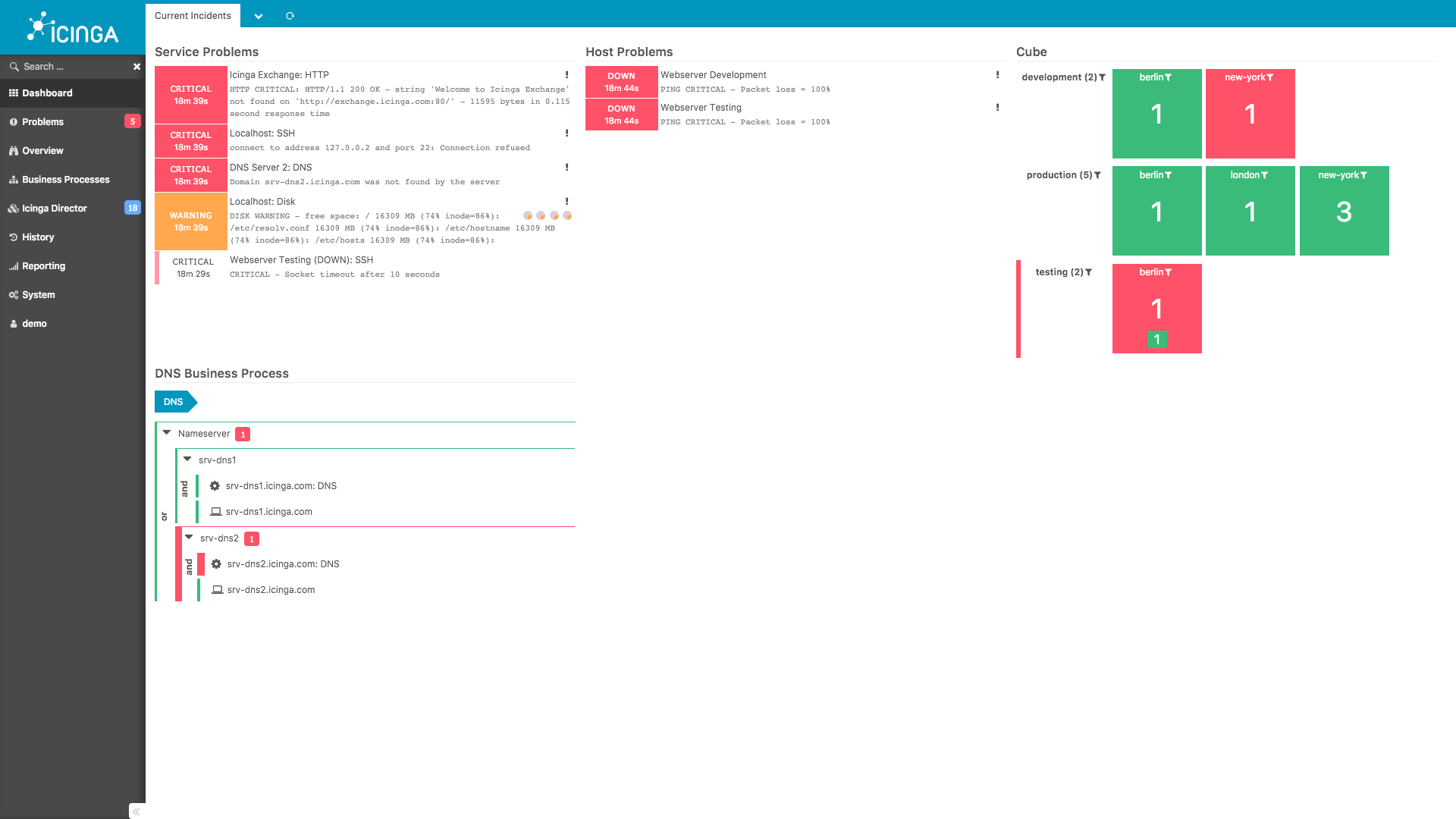
Icinga Dashboard

Installation

Once Icinga Server and Web are running in your distributed environment, make sure to check out the many Icinga modules for even better monitoring.

Documentation

The documentation is available on icinga.com/docs.

Support

Check the project website for status updates. Join the community channels for questions or ask an Icinga partner for professional support.

License

Icinga 2 and the Icinga 2 documentation are licensed under the terms of the GNU General Public License Version 3 or later, you will find a copy of this license in the LICENSE.md file included in the source package.

In addition, as a special exception, the copyright holders give permission to link the code of portions of this program with the OpenSSL library under certain conditions as described in each individual source file, and distribute linked combinations including the two.

You must obey the GNU General Public License in all respects for all of the code used other than OpenSSL. If you modify file(s) with this exception, you may extend this exception to your version of the file(s), but you are not obligated to do so. If you do not wish to do so, delete this exception statement from your version. If you delete this exception statement from all source files in the program, then also delete it here.

Note

Historically, Icinga 2 has been licensed under the GNU General Public License Version 2 or later. However, due to newly introduced dependencies licensed under the Apache License 2.0 (which is not compatible with GPLv2), we have decided to upgrade the license of Icinga 2 to GPLv3+, effective from version v2.16.0 onwards. All versions prior to v2.16.0 and all existing source code files remain licensed under GPLv2+ (see the license information in those files).

Also, the OpenSSL linking exception is only relevant for OpenSSL 1.x. OpenSSL >= 3.0 is licensed under the Apache License version 2.0, which is compatible with GPLv3 and no longer requires an exception.

Contributing

There are many ways to contribute to Icinga -- whether it be sending patches, testing, reporting bugs, or reviewing and updating the documentation. Every contribution is appreciated!

Please continue reading in the contributing chapter.

If you are a packager, please read the development chapter for more details.

Security Issues

For reporting security issues please visit this page.

Frequently asked questions

Is Icinga free to use?

Icinga is open source under the GPL-3.0 licence. There is no licence fee and no seat count — you can self-host it or, where the project offers one, pay a vendor for a managed version instead.

What does Icinga do?

Open source monitoring for complex IT infrastructure

What is Icinga written in?

Icinga is primarily written in C++. Its source is publicly available at https://github.com/icinga/icinga2, and it has 2,237 GitHub stars.