What it is
Hyvor Relay is an open-source email API aimed at developers, written primarily in PHP with Symfony for the API backend and Go for the email workers, webhook handlers, DNS server, and incoming SMTP server. The frontend is built with SvelteKit and the Hyvor Design System, and PostgreSQL serves both as the database and as the queue. It lives in the PHP and Go ecosystems, is licensed under AGPL-3.0, and is positioned as a cloud and self-hosted alternative to SES, Mailgun, and SendGrid.
The concrete problem it solves is sending transactional and distributional email through your own infrastructure rather than renting deliverability from a paid provider. Hyvor Relay speaks SMTP to deliver mail, exposes a simple API for sending, and adds the operational machinery that raw SMTP lacks: queue isolation, greylisting, retry handling, bounce processing, feedback loops, and suppression management. For teams that want the control of running their own mail stack without building every deliverability safeguard from scratch, it packages those concerns into one deployable system.
Key capabilities
- Self-hosted deployment through Docker Compose or Docker Swarm, with the option of the hosted service at relay.hyvor.com.
- An email API for sending messages, backed by SMTP delivery over infrastructure you control.
- Send logs and full SMTP conversations for sent emails, retained for up to 30 days.
- Multi-tenancy with scoped access, aimed at organizations and agencies, plus multiple isolated projects inside each tenant.
- Two main queues that separate transactional from distributional email to protect IP reputation.
- Automatic greylisting and retry handling, bounce handling, feedback loop integration, and suppression management for bounces and unsubscribes.
- DNS automation through a built-in DNS server, so records do not have to be maintained by hand, alongside webhooks for email events.
- Observability through Prometheus metrics, Grafana dashboards, and logs, plus horizontal scaling by adding servers and IP addresses.
- Health checks that monitor performance and deliverability.
Who uses it and how
- Development teams that already run their own mail infrastructure and want the API, queueing, and bounce logic handled by a single self-hosted service.
- Agencies and larger organizations that need multi-tenancy, using scoped access to separate client work under one deployment.
- Product teams splitting transactional mail from bulk distribution, using the two queues so that marketing sends do not damage the reputation of the IPs carrying password resets and receipts.
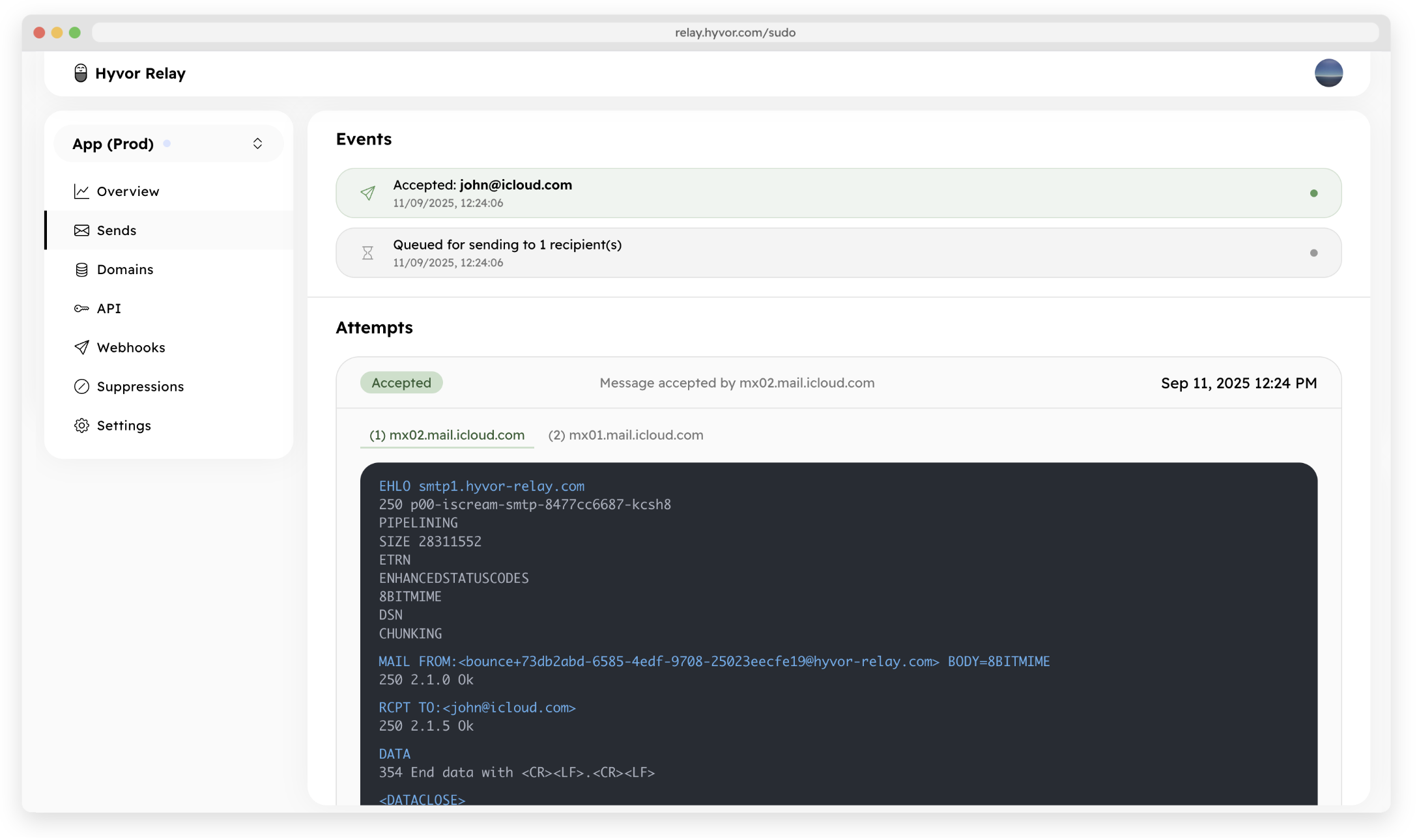
- Operators who need auditability, reviewing send logs and SMTP conversations in the console when a message is delayed or rejected.
- SRE-style workflows that scrape Prometheus metrics and watch Grafana dashboards to track deliverability and queue health.
Getting started
Deploy with Docker Compose or Docker Swarm following the self-hosting documentation, or contribute against the HYVOR development environment by running ./run relay to start Hyvor Relay at https://relay.hyvor.localhost. A hosted cloud option is available at relay.hyvor.com.
When to use it — and when not to
It is the reasonable pick when the goal is to replace a paid API such as SES, Mailgun, or SendGrid while keeping delivery on your own infrastructure, though the AGPL-3.0 terms mean organizations wanting a commercial license or unwilling to comply with those terms should look at the enterprise licensing path. A self-hoster must operate PostgreSQL, which backs both the database and the queue, plus the SMTP sending path, DNS delegation, and the Prometheus and Grafana stack if observability is wanted. The project is young, with a recent first push and no listed contributors yet, so expect a smaller community and more rough edges than
project readme (upstream, from github) — read inline
Hyvor Relay
Hyvor Relay is a self-hosted, open-source email API for developers. It uses SMTP to send
emails using your own infrastructure. It is designed to be simple to self-host, easy to manage and observe, and powerful
enough to send millions of daily emails.

Email API for Developers
|
Self-Hosting Docs
|
Product Docs
Features
- Self-Hosted: Docker compose or swarm-based deployment.
- Health Checks: Multiple health checks to ensure best performance and deliverability.
- Email API: Send emails using a simple API.
- Logs & SMTP Conversations: View send logs and SMTP conversations of sent emails up to 30 days.
- Multi-Tenancy: Support for multiple tenants with scoped access (useful for organizations and agencies).
- Project Management: Support for multiple isolated projects within a tenant.
- Queues: Two main queues to isolate transactional and distributional emails and IP reputation.
- Greylisting & Retries Handling: Automatically manage greylisting and retries.
- Bounce Handling: Automatically handle bounced emails.
- Feedback Loops: Integrate with feedback loops to manage spam complaints.
- Suppressions: Automatically manage email suppressions (bounces, unsubscribes, etc.).
- DNS Automation: Delegate DNS to the in-built DNS server. No need to manage DNS records manually.
- Webhooks: Receive HTTP callbacks for email events.
- Easy scaling: Add more servers and IP addresses as needed.
- Observability: Prometheus metrics, Grafana dashboards, and logs for monitoring.
Screenshots
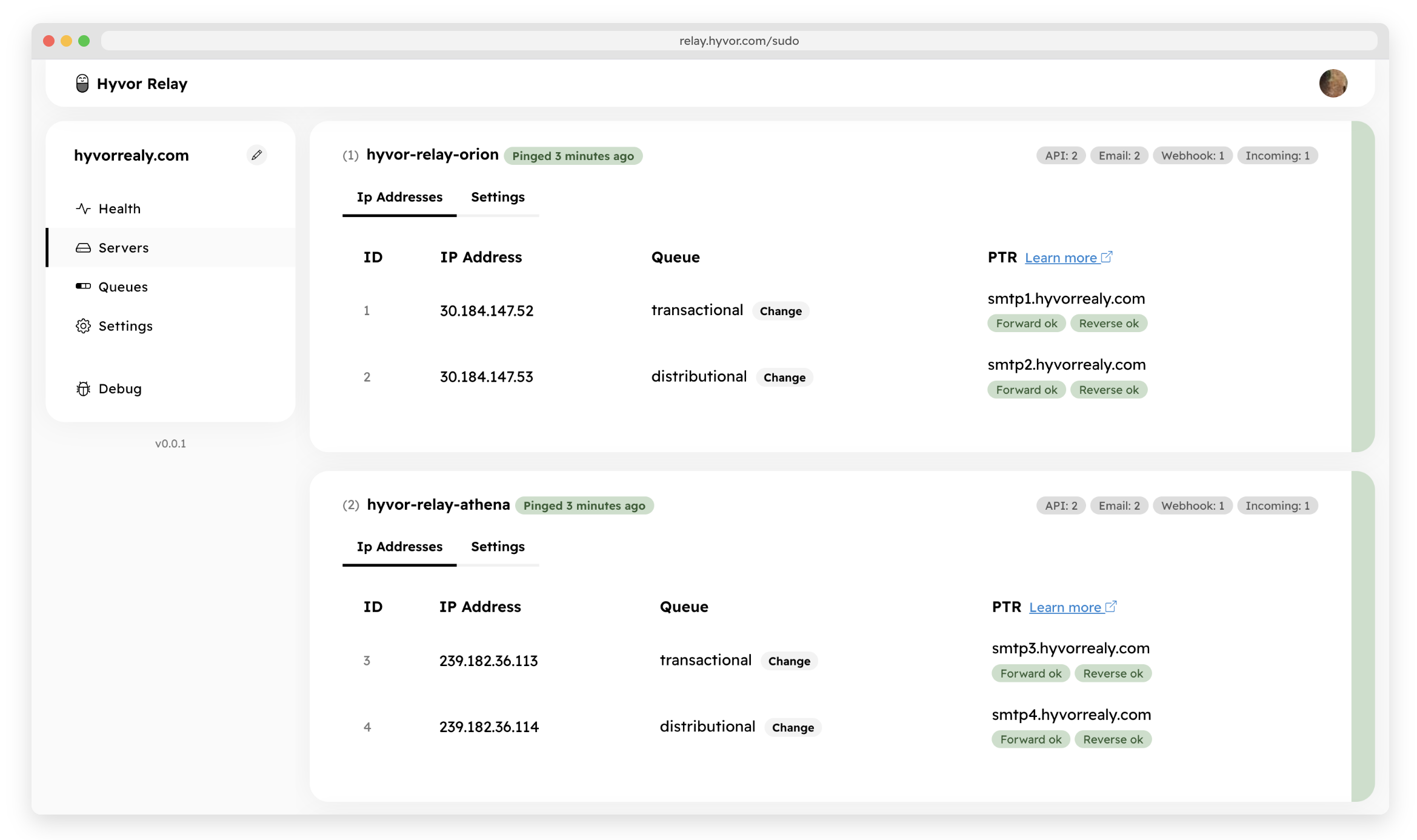
The sudo dashboard for admins:
The console for users (viewing send logs and SMTP conversations):
Architecture
- PHP + Symfony for the API backend.
- Go for email workers, webhook handlers, DNS server, and the incoming SMTP server.
- SvelteKit and Hyvor Design System for the frontend.
- PGSQL is used for the database as well as for the queue.
Roadmap & Community
Contributing
Visit hyvor/dev to set up the HYVOR development environment. Then, run ./run relay to
start Hyvor Relay at https://relay.hyvor.localhost.
Directory structure:
/backend: Symfony API backend/frontend: SvelteKit frontend/worker: Go services (single binary)
See CONTRIBUTING.md for contribution guidelines.
License
Hyvor Relay is licensed under the AGPL-3.0 License. We also offer enterprise licenses for organizations that require a commercial license or do not wish to comply with the AGPLv3 terms. See Self-Hosting License FAQ for more information.

Copyright © HYVOR. HYVOR name and logo are trademarks of HYVOR, SARL.