What it is
Hyvor Blogs is an open-source, self-hosted blogging platform maintained by HYVOR and written primarily in PHP under the AGPL-3.0 license. It is built for speed and simplicity while remaining flexible enough to support anything from a straightforward personal blog to more complex publishing workflows. The project ships as a full application rather than a library: a console and editor frontend built with SvelteKit and the Hyvor Design System, an API backend built on PHP and Symfony, and PostgreSQL serving both as the database and as the queue backend. It lives in the PHP and Symfony ecosystem, with a SvelteKit frontend, and sits in the self-hosted CMS and blogging category alongside the topics blogging, blogging-platform, and cms.
The concrete problem it solves is ownership and consolidation of a publishing stack. Rather than combining a hosted blog service, a separate SEO plugin, a comments or membership add-on, and an authentication provider, operators get one installation that handles multiple blogs, custom domains per blog, built-in sitemaps and Open Graph metadata, Atom feeds, role-based users, and redirects in a single deployment. Authentication is delegated to any OIDC provider such as Authentik or Keycloak, so an existing identity system can be reused instead of introducing another credential store. Content can be imported from WordPress or a sitemap and exported at any time, which limits lock-in, and an AGPL-licensed codebase means the platform can be inspected, modified, and extended directly.
Key capabilities
- Self-hosted deployment driven by Docker Compose, with self-hosting instructions published in the project documentation.
- Multi-blog hosting from a single installation, including custom domains per blog and customizable URL routes with managed redirects.
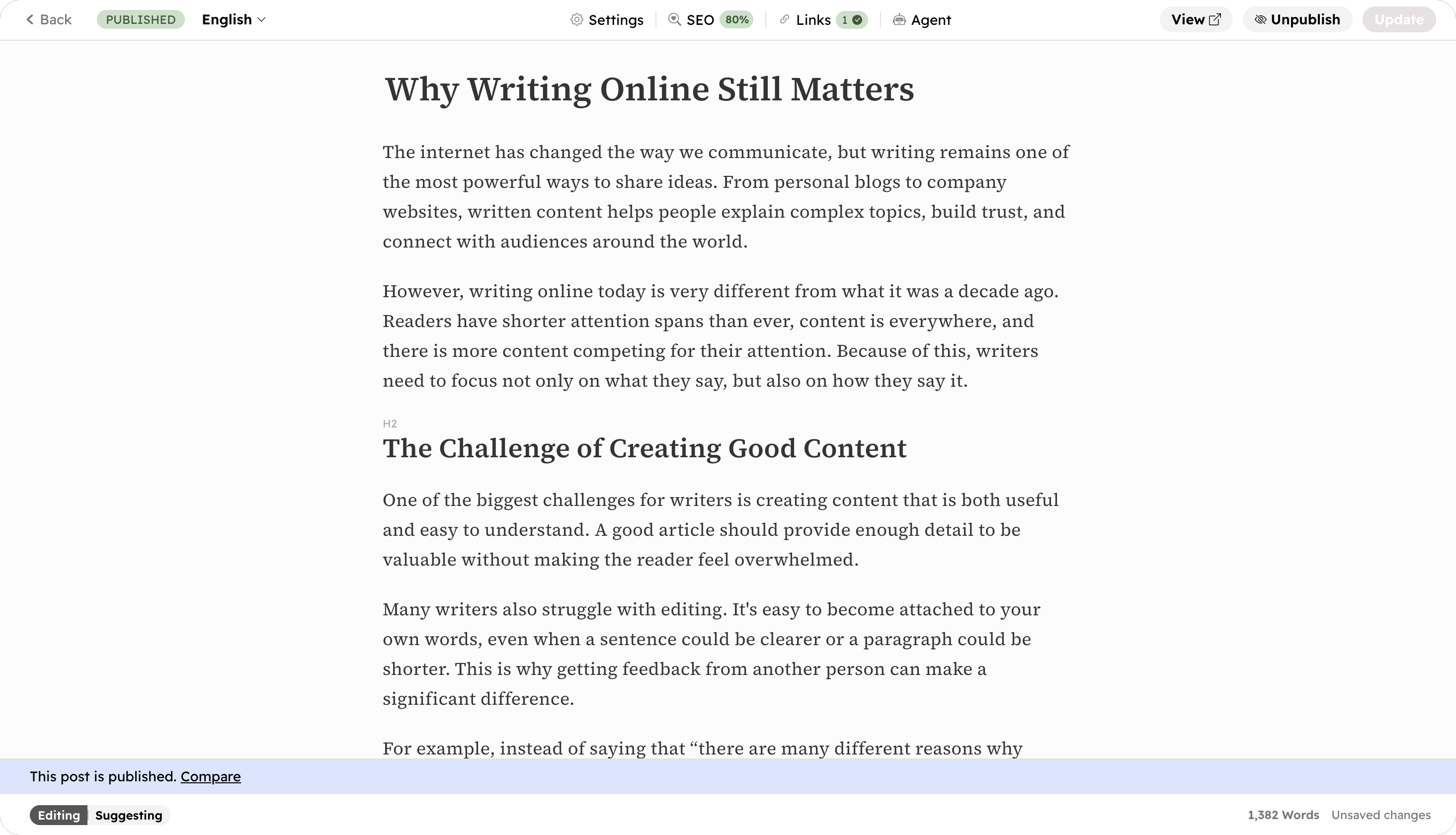
- Block-based rich text editor supporting images, videos, code blocks, and Markdown, with a suggestion mode for proposed changes.
- Theme system with a template language plus CSS and JavaScript for full customization of each blog.
- Built-in SEO output covering sitemaps, Open Graph tags, and canonical URLs, alongside automatically generated Atom feeds.
- OIDC single sign-on with providers such as Authentik and Keycloak, plus per-blog role-based access control for authors and editors.
- Console API for automations, Data API for headless usage, Delivery API for sub-directory hosting, and HTTP webhooks for post, tag, and member events.
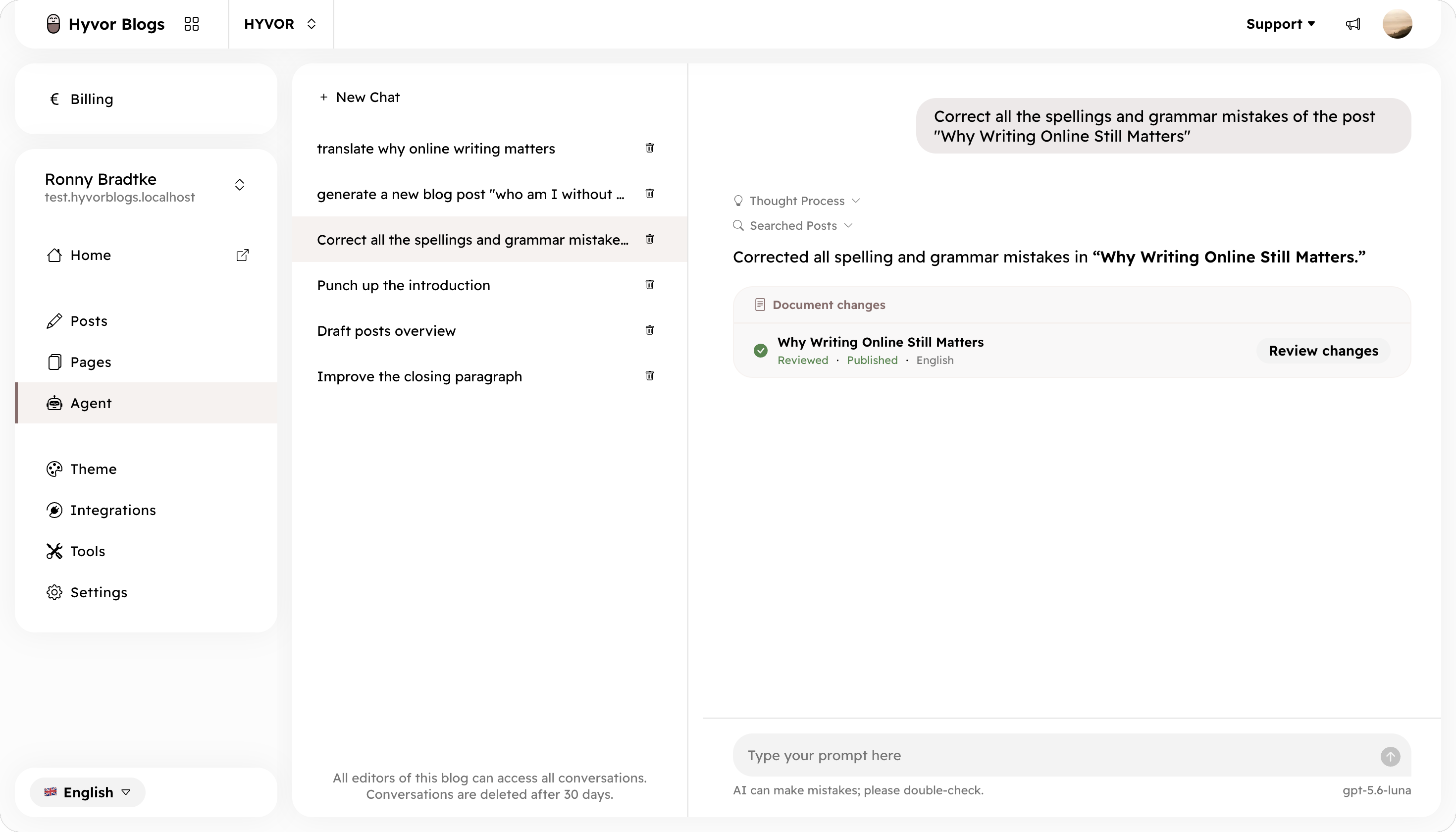
- AI agent that reviews posts and suggests improvements, and internationalization supported from the ground up without plugins.
Who uses it and how
- Individuals and small teams hosting one or more personal or project blogs on their own infrastructure behind a Docker Compose stack.
- Organizations with an existing OIDC identity provider that want blog authentication to flow through the same single sign-on system they already operate.
- Development teams running Hyvor Blogs headlessly, consuming content through the Data API while serving a separately built frontend.
- Publishers hosting blogs in a sub-directory of a larger site, using the Delivery API for that arrangement.
- Migrators leaving WordPress or another platform,
project readme (upstream, from github) — read inline
Hyvor Blogs
Hyvor Blogs is a self-hosted, open-source blogging platform designed to make creating and managing a blog simple. It’s built for speed and simplicity, while remaining flexible enough to support everything from straightforward personal blogs to more complex publishing workflows.

Open-Source Blogging Platform
|
Self-Hosting Docs
|
Product Docs
Features
- Self-Hosted: Docker Compose-based deployment.
- Multi-blog: Manage multiple blogs with a single installation.
- OIDC SSO: Use any OIDC provider for authentication (Authentik, Keycloak, etc.)
- Rich Editor: Block-based editor with images, videos, code blocks, and more, with Markdown support.
- Themes: Fully customizable themes with template language, CSS, and JavaScript.
- Custom Domains: Serve each blog on its own custom domain.
- Internationalization: Multi-language support from ground up, no plugins required.
- Users & Roles: Manage authors and editors per blog with role-based access control.
- SEO: Built-in sitemaps, Open Graph, and canonical URL support.
- RSS: Automatically generated RSS (Atom) feeds for each blog.
- API: Console API for automations, Data API for headless usage, and Delivery API for sub-directory hosting.
- Webhooks: HTTP callbacks for post, tag, and member events.
- AI Agent: AI agent that reviews posts and suggests improvements.
- Real-Time Collaboration: Multiple authors editing together with a suggestion mode for proposed changes.
- Import & Export: Import from WordPress or a sitemap, and export your content anytime.
- Redirects & Routes: Manage redirects and customize URL routes.
Screenshots
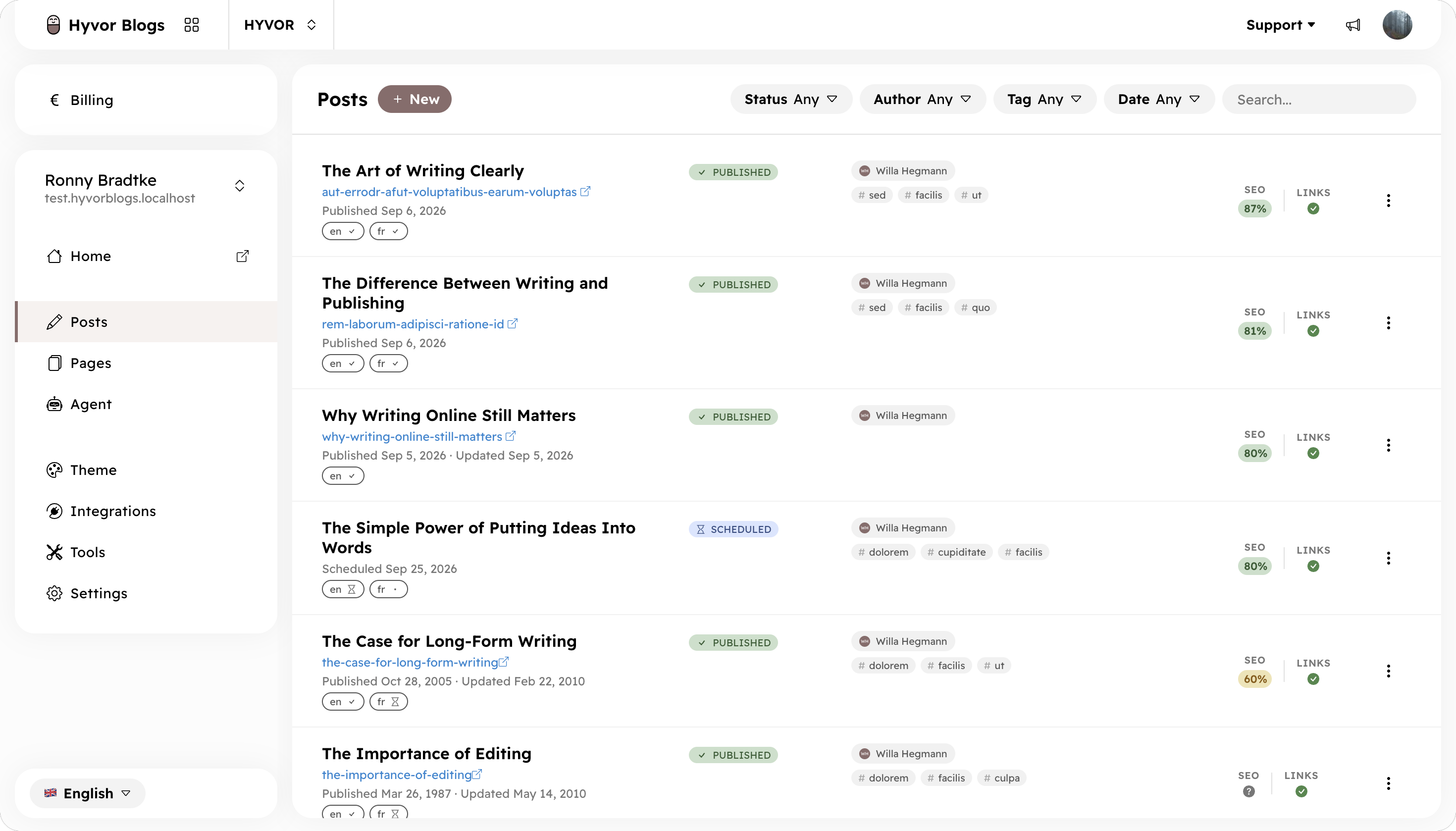
Console:
Rich-text Editor:
AI Agent:
Architecture
- PHP + Symfony for the API backend.
- SvelteKit with Hyvor Design System for the frontend.
- PostgreSQL as the database and queue backend.
Self-Hosting
See the self-hosting documentation for instructions on how to
deploy Hyvor Blogs using Docker Compose.
Development
See DEV.md for instructions on setting up a local development environment.
Community
License
Hyvor Blogs is licensed under the GNU Affero General Public License v3.0. We also offer enterprise licenses for organizations that require a commercial license or do not wish to comply with the AGPLv3 terms. See Self-Hosting License FAQ for more information.

Copyright © HYVOR. HYVOR name and logo are trademarks of HYVOR, SARL.