

Composable Open-Source Payments Infrastructure






📁 Table of Contents
What Can I Do with Hyperswitch?
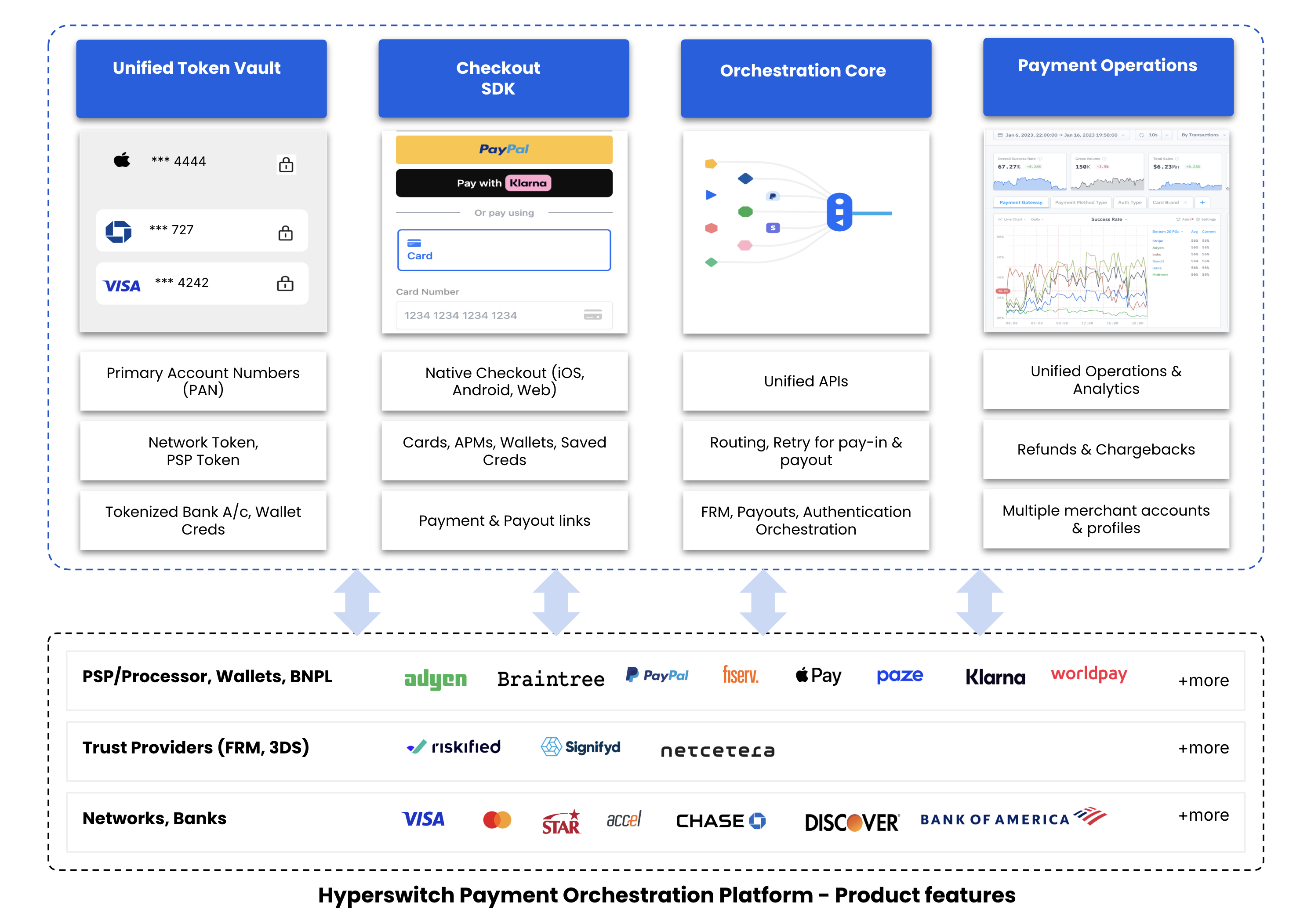
Hyperswitch offers a modular, open-source payments infrastructure designed for flexibility and control. Apart from our Payment Suite offering, this solution allows businesses to pick and integrate only the modules they need on top of their existing payment stack — without unnecessary complexity or vendor lock-in.
Each module is independent and purpose-built to optimize different aspects of payment processing.
Learn More About The Payment Modules
Cost Observability
Advanced observability tools to audit, monitor, and optimize your payment costs. Detect hidden fees, downgrades, and penalties with self-serve dashboards and actionable insights.
Read moreRevenue Recovery
Combat passive churn with intelligent retry strategies tuned by card bin, region, method, and more. Offers fine-grained control over retry algorithms, penalty budgets, and recovery transparency.
Read moreVault
A PCI-compliant vault service to store cards, tokens, wallets, and bank credentials. Provides a unified, secure, and reusable store of customer-linked payment methods. Also supports bring-your-own-vault to connect existing providers including VGS and TokenEx without re-tokenizing or migrating stored cards.
Read moreIntelligent Routing
Route each transaction across Stripe, Adyen, Braintree, Worldpay, Checkout.com, and 120+ others to the PSP with the highest predicted auth rate. Reduce retries, avoid downtime, and minimize latency while maximizing first attempt success. Read moreReconciliation
Automate 2-way and 3-way reconciliation with backdated support, staggered scheduling, and customizable outputs. Reduces manual ops effort and increases audit confidence.
Read moreAlternate Payment Methods
Drop-in widgets for PayPal, Apple Pay, Google Pay, Samsung Pay, Pay by Bank, and BNPL providers like Klarna. Maximizes conversions with seamless one-click checkout.
Read more
Quickstart
Local Setup via Docker
# One-click local setup

git clone --depth 1 --branch latest https://github.com/juspay/hyperswitch

cd hyperswitch

scripts/setup.sh
This script:
- Detects Docker/Podman
- Offers multiple deployment profiles:
- Standard: App server + Control Center
- Full: Includes monitoring + schedulers
- Minimal: Standalone App server
- Provides access links when done
If you need further help, check out our video tutorial.
👉 After setup, configure a connector and test a payment.
Hosted Sandbox (No Setup Required)
Hyperswitch offers a fully hosted sandbox environment that requires no setup. You can explore the Control Center, configure payment connectors, and test payments directly from the UI.

What you can do in the Hosted Sandbox
- Access the full Control Center
- Configure payment connectors
- View logs, routing rules, and retry strategies
- Try payments directly from the UI
Cloud Deployment
You can deploy to AWS, GCP, or Azure using Helm Charts.
Cloud Deployment Instructions.
Architectural Overview
Why Hyperswitch?
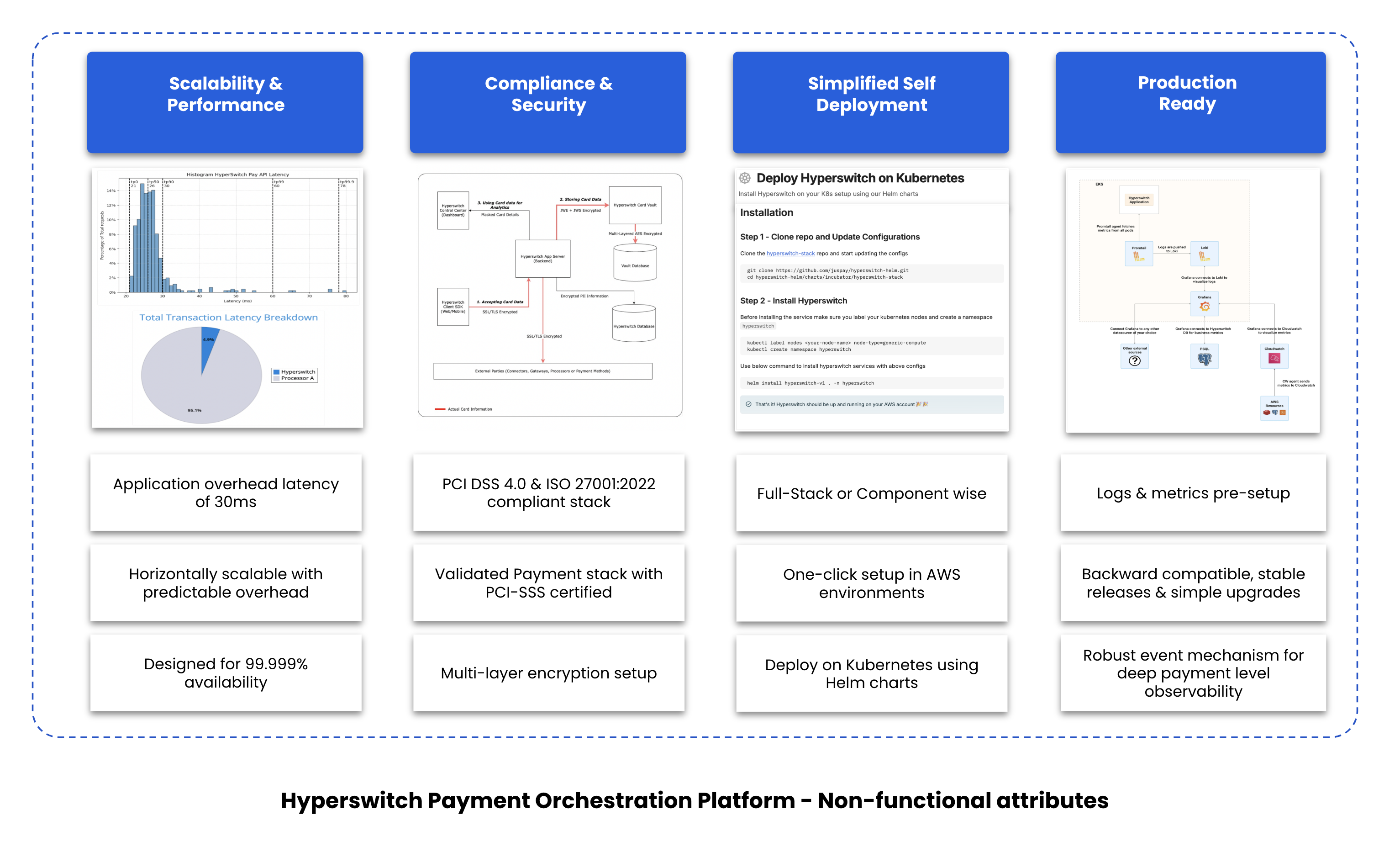
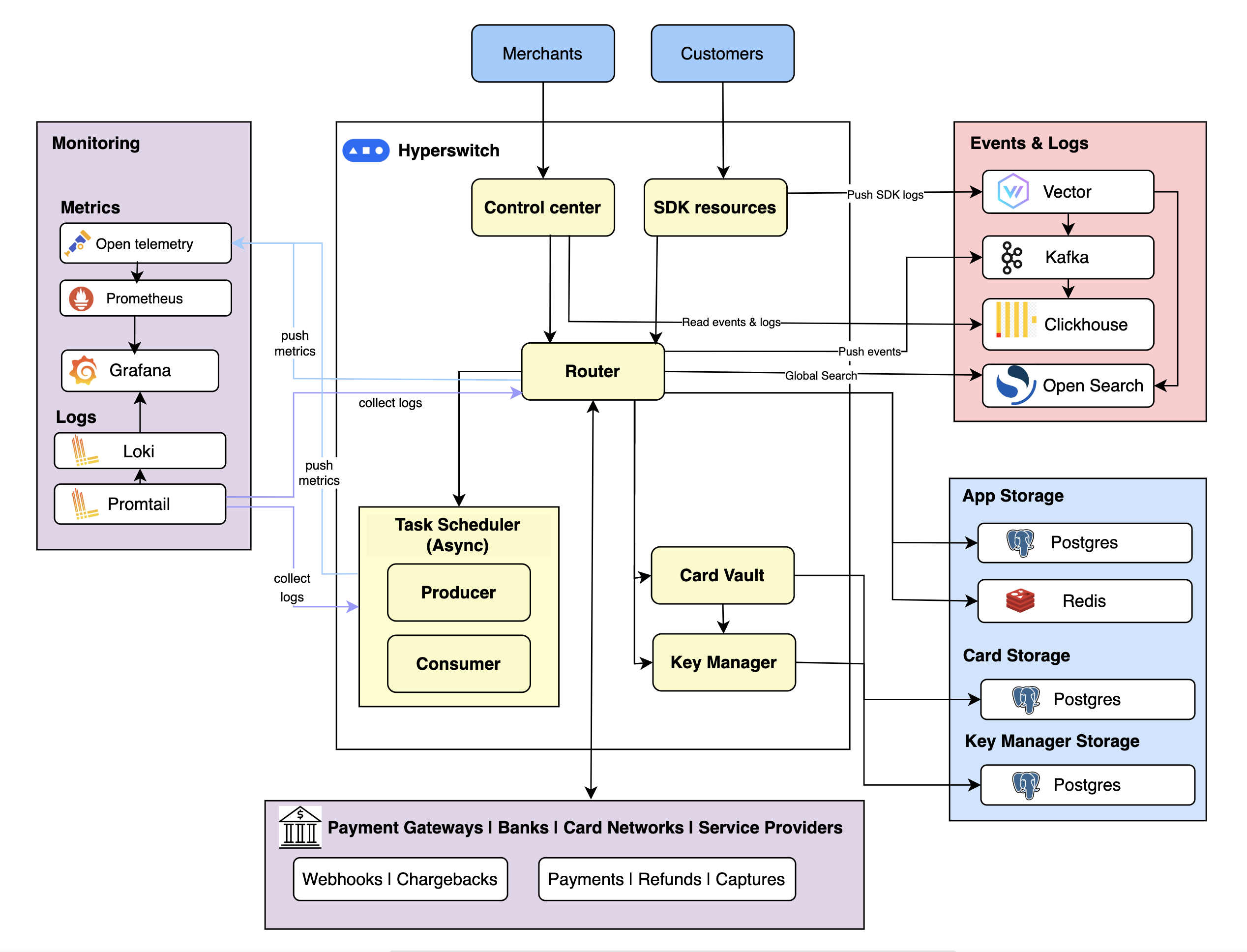
Hyperswitch is a commercial open-source payments stack purpose-built for scale, flexibility, and developer experience. Designed with a modular architecture, Hyperswitch lets you pick only the components you need—whether it’s routing, retries, vaulting, or observability—without vendor lock-in or bloated integrations.
Built in Rust for performance and reliability, Hyperswitch connects to Stripe, Adyen, Braintree, Worldpay, Checkout.com, Cybersource, and 120+ processors — exposing smart routing and retry logic, and provides a visual workflow builder in the Control Center. Whether you're integrating a full payment suite or augmenting an existing stack with a single module, Hyperswitch meets you where you are.
Common starting points: teams moving from a single Stripe/ Stripe connect or Braintree integration to multi-PSP routing, merchants replacing a payment gateway with direct acquirer connections to TSYS, JP Morgan Payments, or other acquirers, and merchants rearchitecting their payments platform through Hyperswitch while keeping their existing VGS, TokenEx or other existing vault intact.
“Linux for Payments” — Hyperswitch is a well-architected reference for teams who want to own their payments stack.
We believe in:
Embracing Payment Diversity: Innovation comes from enabling choice—across payment methods, processors, and flows.
Open Source by Default: Transparency drives trust and builds better, reusable software.
Community-Driven Development: Our roadmap is shaped by real-world use cases and contributors.
Systems-Level Engineering: We hold ourselves to a high bar for reliability, security, and performance.
Maximizing Value Creation: For developers, customers, and partners alike.
Community-Driven, Enterprise-Tested: Hyperswitch is built in the open with real-world feedback from developers and contributors, and maintained by Juspay, the team powering payment infrastructure for 400+ leading enter