
Hoppscotch
Open Source API Development Ecosystem



Built with ❤︎ by contributors
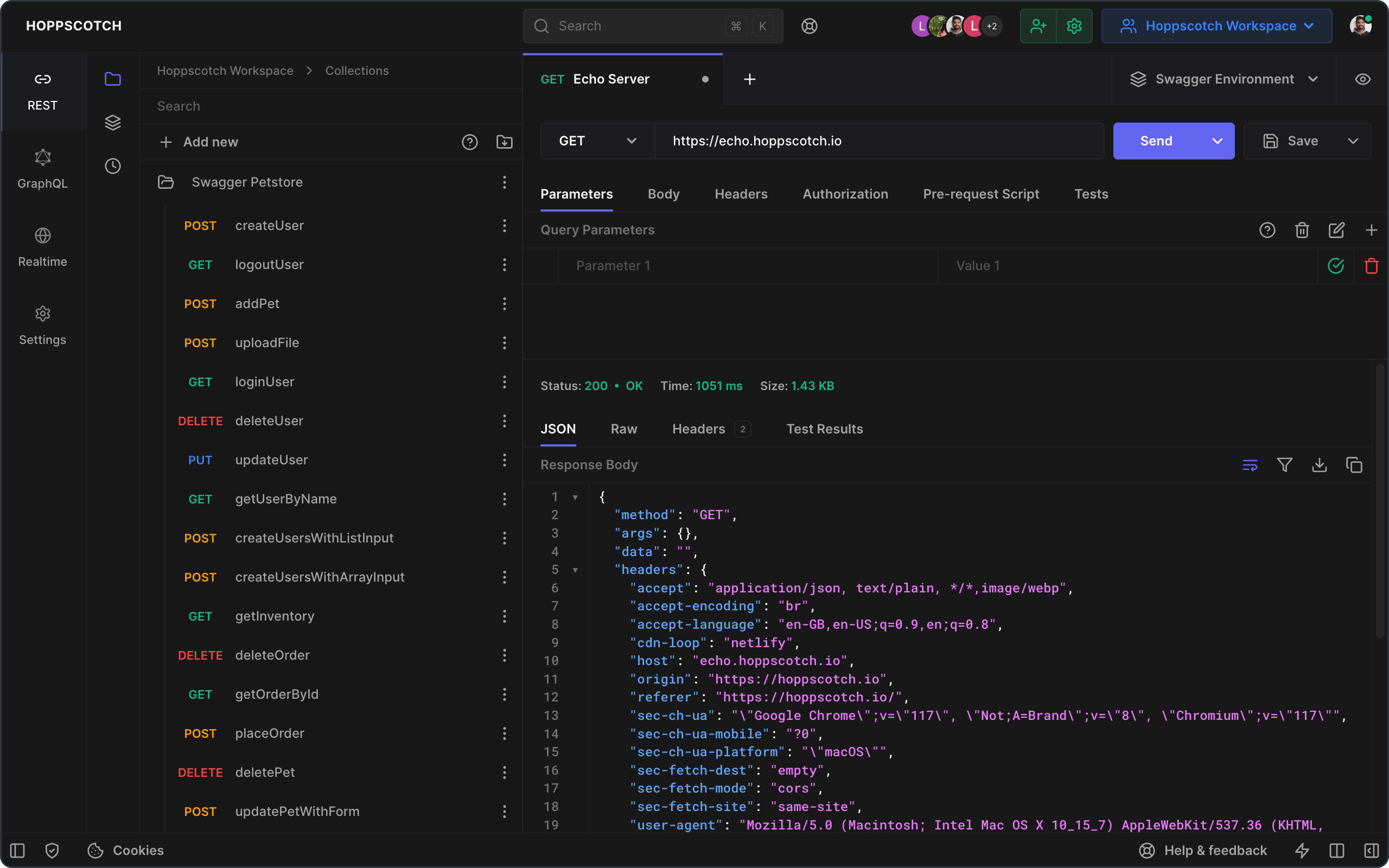
We highly recommend you take a look at the Hoppscotch Documentation to learn more about the app.
Support



Features
❤️ Lightweight: Crafted with minimalistic UI design.
⚡️ Fast: Send requests and get responses in real time.
🗄️ HTTP Methods: Request methods define the type of action you are requesting to be performed.
GET- Requests retrieve resource informationPOST- The server creates a new entry in a databasePUT- Updates an existing resourcePATCH- Very similar toPUTbut makes a partial update on a resourceDELETE- Deletes resource or related componentHEAD- Retrieve response headers identical to those of a GET request, but without the response body.CONNECT- Establishes a tunnel to the server identified by the target resourceOPTIONS- Describe the communication options for the target resourceTRACE- Performs a message loop-back test along the path to the target resource- `` - Some APIs use custom request methods such as
LIST. Type in your custom methods.
🌈 Theming: Customizable combinations for background, foreground, and accent colors — customize now.
- Choose a theme: System preference, Light, Dark, and Black
- Choose accent colors: Green, Teal, Blue, Indigo, Purple, Yellow, Orange, Red, and Pink
- Distraction-free Zen mode
Customized themes are synced with your cloud/local session.
🔥 PWA: Install as a Progressive Web App on your device.
- Instant loading with Service Workers
- Offline support
- Low RAM/memory and CPU usage
- Add to Home Screen
- Desktop PWA
🚀 Request: Retrieve response from endpoint instantly.
- Choose
method - Enter
URL - Send
- Copy/share public "Share URL"
- Generate/copy request code snippets for 10+ languages and frameworks
- Import
cURL - Label requests
🔌 WebSocket: Establish full-duplex communication channels over a single TCP connection.
📡 Server-Sent Events: Receive a stream of updates from a server over an HTTP connection without resorting to polling.
🌩 Socket.IO: Send and Receive data with the SocketIO server.
🦟 MQTT: Subscribe and Publish to topics of an MQTT Broker.
🔮 GraphQL: GraphQL is a query language for APIs and a runtime for fulfilling those queries with your existing data.
- Set endpoint and get schema
- Multi-column docs
- Set custom request headers
- Query schema
- Get query response
🔐 Authorization: Allows to identify the end-user.
- None
- Basic
- Bearer Token
- OAuth 2.0
- OIDC Access Token/PKCE
📢 Headers: Describes the format the body of your request is being sent in.
📫 Parameters: Use request parameters to set varying parts in simulated requests.
📃 Request Body: Used to send and receive data via the REST API.
- Set
Content Type - FormData, JSON, and many more
- Toggle between key-value and RAW input parameter list
📮 Response: Contains the status line, headers, and the message/response body.
- Copy the response to the clipboard
- Download the response as a file
- View response headers
- View raw and preview HTML, image, JSON, and XML responses
⏰ History: Request entries are synced with your cloud/local session storage.
📁 Collections: Keep your API requests organized with collections and folders. Reuse them with a single click.
- Unlimited collections, folders, and requests
- Nested folders
- Export and import as a file or GitHub gist
Collections are synced with your cloud/local session storage.
📜 Pre-Request Scripts: Snippets of code associated with a request that is executed before the request is sent.
- Set environment variables
- Include timestamp in the request headers
- Send a random alphanumeric string in the URL parameters
- Any JavaScript functions
👨👩👧👦 Teams: Helps you collaborate across your teams to design, develop, and test APIs faster.
- Create unlimited teams
- Create unlimited shared collections
- Create unlimited team members
- Role-based access control
- Cloud sync
- Multiple devices
👥 Workspaces: Organize your personal and team collections environments into workspaces. Easily switch between workspaces to manage multiple projects.
- Create unlimited workspaces
- Switch between personal and team workspaces
⌨️ Keyboard Shortcuts: Optimized for efficiency.
🌐 Proxy: Enable Proxy Mode from Settings to access blocked APIs.
- Hide your IP address
- Fixes
CORS(Cross-Origin Resource Sharing) issues - Access APIs served in non-HTTPS (
http://) endpoints - Use your Proxy URL
Official proxy server is hosted by Hoppscotch - GitHub - Privacy Policy.
🌎 i18n: Experience the app in your language.
Help us to translate Hoppscotch. Please read TRANSLATIONS for details on our CODE OF CONDUCT and the process for submitting pull requests to us.
☁️ Auth + Sync: Sign in and sync your data in real-time across all your devices.
Sign in with:
- GitHub
- Microsoft
- SSO (Single Sign-On)[^EE]
🔄 Synchronize your data: Handoff to continue tasks on your other devices.
- Workspaces
- History
- Collections
- Environments
- Settings
✅ Post-Request Tests: Write tests associated with a request that is executed after the request's response.
- Check the status code as an integer
- Filter response headers
- Parse the response data
- Set environment variables
- Write JavaScript code
🌱 Environments: Environment variables allow you to store and reuse values in your requests and scripts.
- Unlimited environments and variables
- Initialize through the pre-request script
- Export as / import from GitHub gist
Use-cases
- By storing a value in a variable, you can reference it throughout your request section
- If you need to update the value, you only have to change it in one place
- Using variables increases your ability to work efficiently and minimizes the likelihood of error
🚚 Bulk Edit: Edit key-value pairs in bulk.
- Entries are separated by newline
- Keys and values are separated by
: - Prepend
#to any row you want to add but keep disabled
🎛️ Admin dashboard: Manage your team and invite members.
- Insights
- Manage users
- Manage teams
📦 Add-ons: Official add-ons for hoppscotch.
- Hoppscotch CLI - Command-line interface for Hoppscotch.
- Proxy - A simple proxy server created for