HolmesGPT — The CNCF SRE Agent
Installation |
Docs |

Open-source AI agent for investigating production incidents and finding root causes. Works with any stack — Kubernetes, VMs, cloud providers, databases, and SaaS platforms. We are a Cloud Native Computing Foundation sandbox project. Originally created by Robusta.Dev, with major contributions from Microsoft.
New: Operator Mode — Find Problems 24/7 in the Background
Most AI agents are great at troubleshooting problems, but still need a human to notice something is wrong and trigger an investigation. Operator mode fixes that — HolmesGPT runs in the background 24/7, spots problems before your customers notice, and messages you in Slack with the fix. Connect the GitHub integration and it can even open PRs to fix what it finds.
While the operator itself runs in Kubernetes, health checks can query any data source Holmes is connected to — VMs, cloud services, databases, SaaS platforms, and more.
- Deployment verification — Deploy a health check alongside your app to verify the new version is healthy
- Scheduled health checks — Continuously monitor services and catch regressions automatically
Features
- Petabyte-scale data: Server-side filtering, JSON tree traversal, and tool output transformers keep large payloads out of context windows
- Memory-safe execution: Per-tool memory limits, streaming large results to disk, and automatic output budgeting prevent OOM kills when querying large observability datasets
- Deep integrations: Prometheus, Grafana, Datadog, Kubernetes, and many more—plus any REST API
- Bidirectional alert integrations: Fetch alerts from AlertManager, PagerDuty, OpsGenie, or Jira—and write findings back
- Any LLM provider: OpenAI, Anthropic, Azure, Bedrock, Gemini, and more
- No Kubernetes required: Works with any infrastructure — VMs, bare metal, cloud services, or containers
How it Works
HolmesGPT uses an agentic loop to query live observability data from multiple sources and identify root causes.
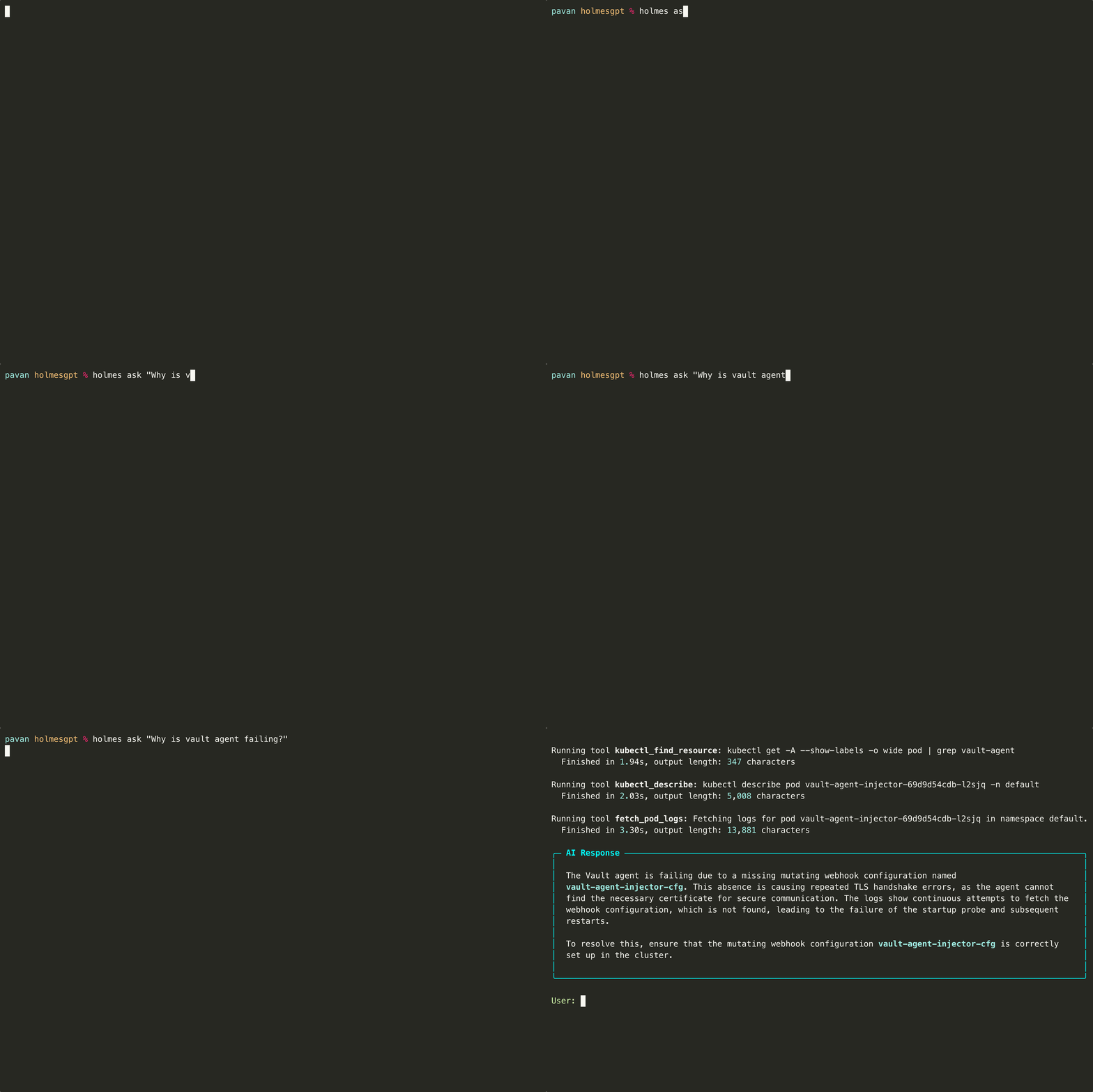
🔗 Data Sources
HolmesGPT integrates with popular observability and cloud platforms. The following data sources ("toolsets") are built-in. Add your own.
| Data Source | Notes |
|---|---|
 AKS AKS |
Azure Kubernetes Service cluster and node health diagnostics |
 Atlassian Rovo Atlassian Rovo |
Jira issues and Confluence pages via Atlassian's hosted server (MCP) |
 ArgoCD ArgoCD |
Get status, history and manifests and more of apps, projects and clusters |
 AWS AWS |
RDS events, instances, slow query logs, and more (MCP) |
 Azure Azure |
Azure resources and diagnostics (MCP) |
 Confluence Confluence |
Private runbooks and documentation |
| Confluence (MCP) |
Private runbooks and documentation (MCP) |
 Coralogix Coralogix |
Retrieve logs for any resource |
 Crossplane Crossplane |
Troubleshoot Crossplane providers, compositions, claims, and managed resources |
 Datadog Datadog |
Query logs, metrics, and traces |
 Docker Docker |
Get images, logs, events, history and more |
 Elasticsearch / OpenSearch Elasticsearch / OpenSearch |
Query logs, cluster health, shard and index diagnostics |
 GCP GCP |
Google Cloud Platform resources (MCP) |
 GitHub GitHub |
Repositories, issues, and pull requests (MCP) |
 GitLab GitLab |
Projects, merge requests, issues, and CI/CD pipelines (MCP) |
 Jenkins (MCP) Jenkins (MCP) |
Build status, pipeline logs, and job history (MCP) |
 Grafana Grafana |
Query and analyze dashboard configurations and panels |
 Helm Helm |
Release status, chart metadata, and values |
 Internet Internet |
Public runbooks, community docs, etc. |
 Kafka Kafka |
Fetch metadata, list consumers and topics or find lagging consumer groups |
 Kubernetes Kubernetes |
Pod logs, K8s events, and resource status (kubectl describe) |
| Kubernetes Remediation (MCP) |
Apply fixes like scaling, rollbacks, and resource edits (MCP) |
[ Loki](https://holmesgpt.dev/data-sourc Loki](https://holmesgpt.dev/data-sourc |