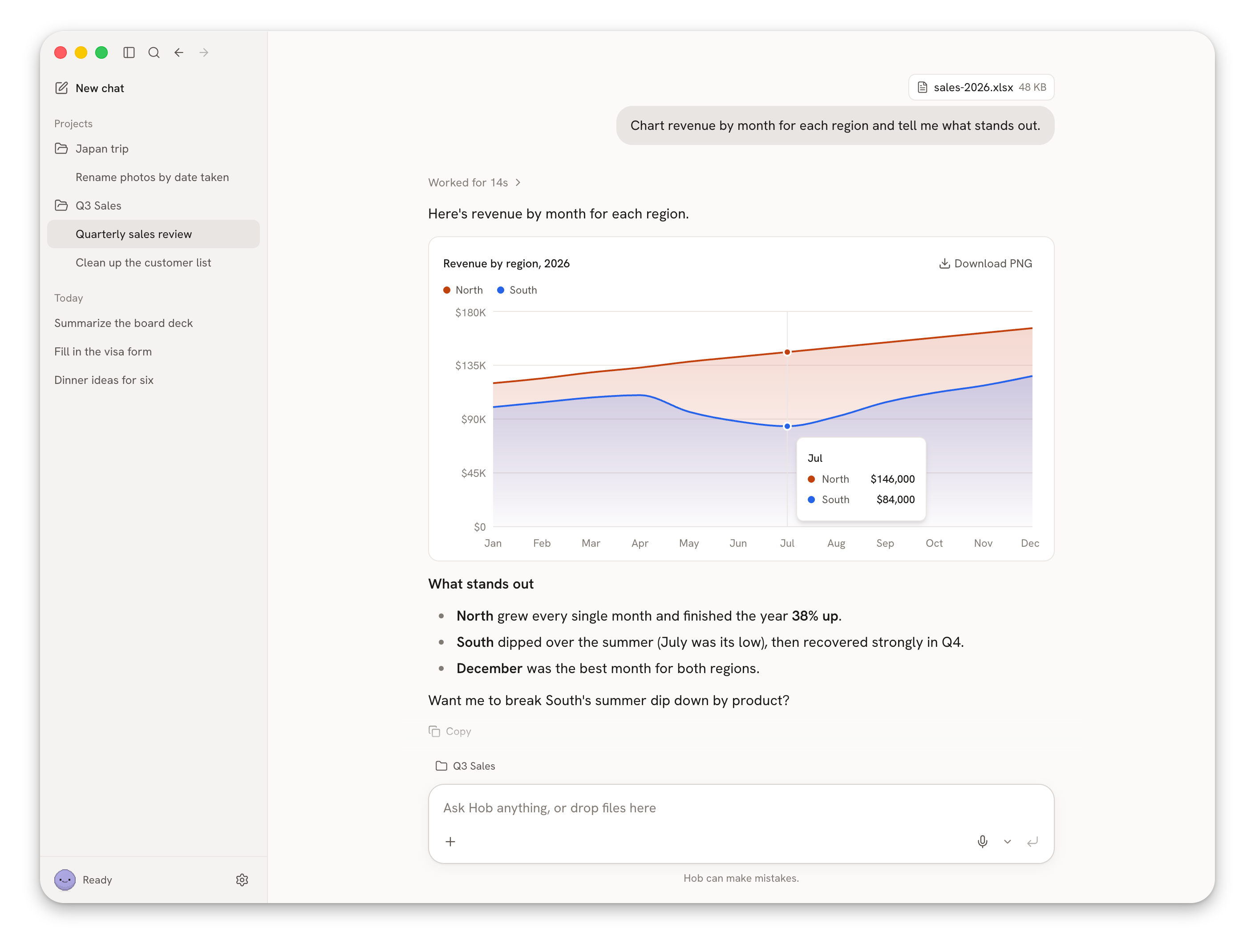
Hob is a free, MIT-licensed desktop application for Mac, Windows and Linux that gives people an easier way to run open-weight AI models such as Gemma and gpt-oss locally on their own computer, built for anyone who wants a private, offline-capable alternative to Claude and ChatGPT without having to assemble a local model stack themselves.
What it is
Hob is an Electron desktop application written in TypeScript that puts a local AI assistant on the user's own machine. Rather than sending prompts to a hosted service, it runs open-weight models through a local inference stack (the project's topics name llama-cpp) and presents the result as an ordinary desktop app for macOS, Windows and Linux. It is made by Frigade and released under the MIT licence, with source on GitHub and a homepage at hob.chat.
The concrete problem it solves is the setup burden that normally sits between a user and a local model. Running open-weight models yourself usually means choosing a runtime, finding a model that your hardware can actually handle, downloading weights, and wiring it all into something you can talk to. Hob removes that work: it picks the best frontier open-weight model that fits your computer and sets everything up for you. The specific thing it replaces is a subscription chat assistant — it is explicitly positioned as a free, open-source alternative to Claude and ChatGPT, with the added properties that it is private and works offline.
Key capabilities
- Runs open-weight models locally, with Gemma and gpt-oss named as the model families it works with.
- Automatically selects the best frontier open-weight model that fits the machine it is installed on, and configures it without manual setup.
- Operates offline, so prompts and documents do not need to leave the computer.
- Ships as a desktop application for Mac, Windows and Linux, built on Electron with a TypeScript codebase.
- Handles document work directly, including filling out PDFs and working through documents.
- Is positioned as an AI assistant and AI agent rather than a bare model runner.
- Is distributed under the MIT licence, with downloads and help available from hob.chat.
Who uses it and how
- Individuals who want a private assistant on a personal laptop and are unwilling to send their prompts to a hosted provider.
- People working in low-connectivity or offline environments, where a cloud-dependent chat assistant is simply not usable.
- Users who deal in documents and PDFs and want the model to work over that material on the same machine where the files live.
- Users who want local models but do not want to choose a runtime, pick a quantisation or manage weights themselves — the app makes that decision for the hardware.
- Cross-platform households and small teams that mix Macs, Windows machines and Linux, since the same application is offered for all three.
Getting started
Download the application for Mac, Windows or Linux from hob.chat; the README points to that site as the entry point rather than to a package manager or container image.
How it compares
Claude and ChatGPT are hosted assistants reached over the network, while Hob is an MIT-licensed application that runs the model on the user's own hardware. That difference carries through to data ownership and cost: with Hob the documents and prompts stay on the local machine and there is no subscription, whereas the hosted products it names as alternatives are services the user connects out to. The trade-off is that Hob's capability is bounded by what the local computer can run.
When to use it — and when not to
Choose Hob if you want a local, private assistant and would rather the application choose and configure a model for you than tune a runtime by hand. Avoid it if you need a documented hardware compatibility list or a detailed model catalogue before installing — the README is brief, and beyond Gemma and gpt-oss it does not enumerate supported models or state system requirements. It is also a small project (roughly 512 stars and 41 forks), so users who need a large support community or formal vendor backing should weigh that before adopting it.