Hermes Browser Extension
Browser-native side panel for Hermes Agent — connect active web context through a local gateway, Hermes Cloud, or a self-hosted remote gateway.
Created by Jon Komet (
@abundantbeing). Community extension for Hermes Agent by Nous Research.

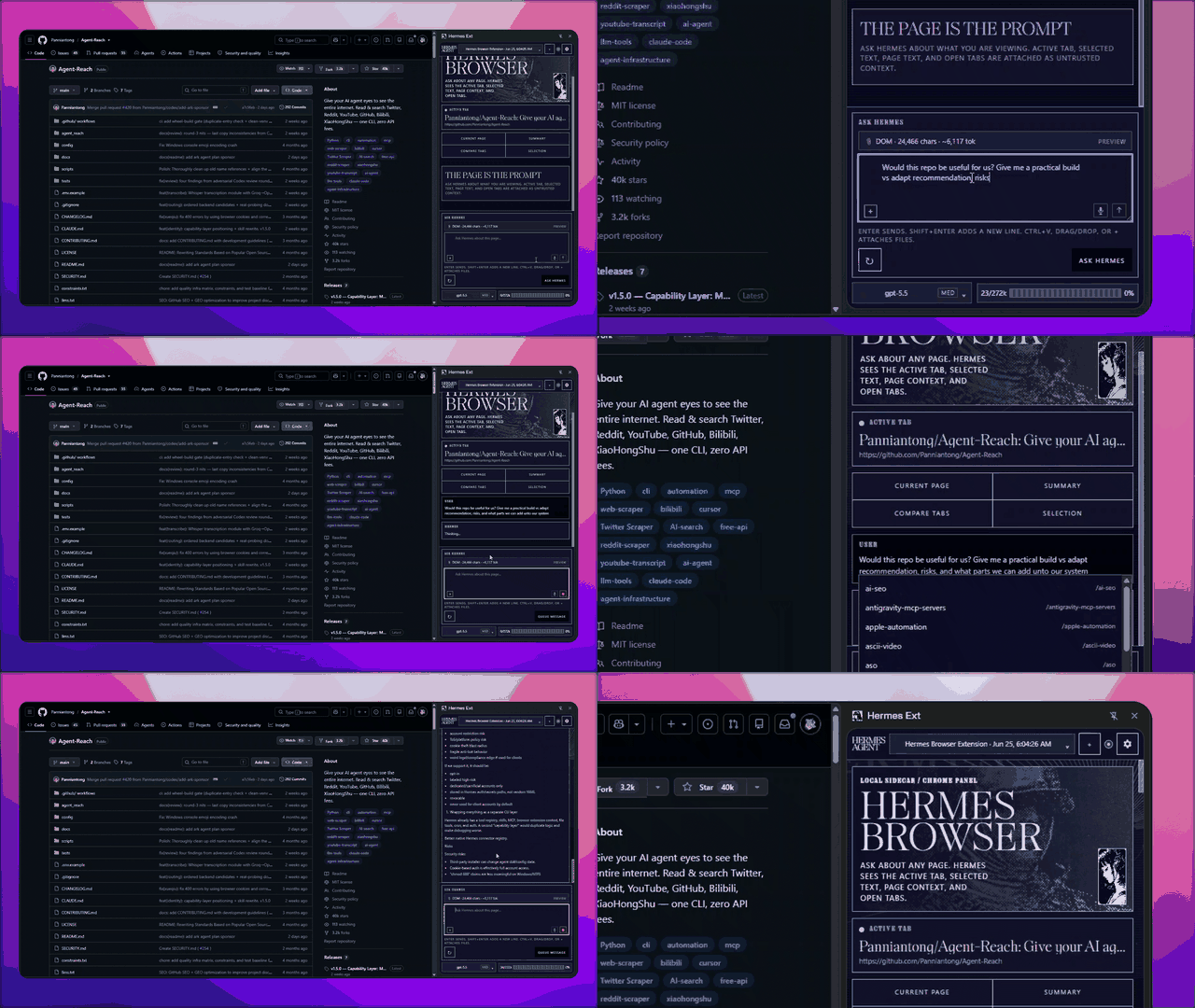
Public v0.3.2 · Load unpacked · Local / Hermes Cloud / Remote · Full Hermes runtime tools
Not on the Chrome Web Store yet.
What it is
Hermes Browser Extension is not a browser chatbot. It is a Chrome/Edge/Chromium side panel for the real Hermes Agent runtime. Choose a local gateway, attach to a signed-in Hermes Cloud agent tab, or connect to a self-hosted remote API/dashboard. Local and remote API connections can use the models, tools, skills, sessions, memory, and MCP servers already configured in Hermes; Cloud and dashboard-ticket connections are intentionally Chat-only.
This repo is specifically for the Hermes Browser Extension: the Chrome/Edge/Chromium side-panel integration for Hermes Agent.
New in v0.3.2: Hermes Bot Mode, Multi-Agent Threads and Intelligent Tab Scoping
v0.3.2 introduces Hermes Bot Mode, bringing your full Hermes multi-agent roster directly into the browser side panel:
- Instant Multi-Agent Switching: Seamlessly toggle between default and named agent profiles with lazy model hydration and Desktop dashboard discovery from known candidates, cached URLs, and open dashboard tabs.
- Desktop Names, Avatars, and Last Activity: Bot Mode uses authenticated Desktop
profiles.listmetadata for display names, avatars, last-activity stamps, and existing Bot Chat identity instead of internal profile ids or public health-name lists. - Existing Bot Chat Resume: Opening a bot resumes that profile's existing hidden Bot Chat. Lookup failures stay fail-closed so the extension does not mint a duplicate chat.
- Group Chats & Collaborative Threads: Synced multi-agent room projections, room-level thread tracking, and synchronized conversation histories without blank chat states.
- Truthful Page-Only Scoping & Zero Token Bloat: By default, only the active browser tab is included (
1/Ntabs in prompt) and sent in the prompt envelope. All other open tabs remain strictly excluded, preventing context bloat and token waste. - Interactive Multi-Tab In/Out Controls: Click any tab to toggle it
INorOUTon demand, with a full-width Page only reset action and side-by-side Include all tabs and AI Triage Tabs controls. - Multi-Keyword Tab Search: Fast whitespace-token search filtering across tab titles and URLs with an active match count badge and keyboard navigation (
Enterto toggle,Escapeto clear). - AI Tab Triage (
/sort-tabs): Automated tab clustering by topic or project, duplicate domain/URL detection, and an actionable checklist of tabs recommended for closure.
Live browser control
v0.3.0 added an opt-in MV3 controller for leased browser tabs, explicit approval gates for consequential or privileged actions, local HTML/PDF/localhost document access after approval, scoped artifact transfer, and reviewed workflow-to-skill drafts. Control remains bound to the exact controller, tab lease, frame, and document generation, and a Browser-bound request never falls back to an isolated browser backend.
The release also keeps Hermes Assist, Hermes Web Alpha, session-scoped model routing, and the Browser Context Protocol introduced in v0.2.0.
Page comments
Comment on page in the attach menu uses the existing red element picker. Click a target, write a note, and queue pins without filling the composer. Queued comments sit beside Ask Hermes until you send; the chat shows a compact summary while Hermes still receives the annotated targets, notes, and crops. Closing the side panel or pressing Esc cancels pick and comment chrome. The on-page comment card follows the active extension theme and can be dragged.
Chat transcript
Hermes-managed session images (cache/@image:/MEDIA: paths) hydrate when you reopen a chat. Unsent composer text and attachments come back after you close and reopen the side panel in the same browser session. If Hermes spawns subagents, a live SUBAGENTS stack appears above the composer so you can watch, steer, or stop them. If the Browser socket goes quiet while Hermes is still working, the panel reconnects to the live turn instead of showing a dashboard timeout.
Hermes Assist
Hermes Assist adds a compact, site-aware drafting panel beside supported text composers. It recognizes 31 writing environments and adapts its primary action to the surface—such as Draft a reply, Draft a post, or Draft a message—while preserving useful site-specific actions.
Every model-backed action runs through the connected Hermes Agent. When the gateway advertises per-session model locking, Hermes Assist sends the exact selected provider/model and fails closed if Hermes does not acknowledge it. Released gateways without that contract use the active model configured in Hermes Agent and receive no unsupported override fields. Results are reviewed before use. Safe plain-text composers can apply a draft only after an explicit user action; framework-owned structured editors default to preview/copy. Hermes Assist never clicks Send/Post/Submit, navigates, purchases, or operates the page autonomously.
Private surfaces use per-site context controls and conservative defaults. Browser context remains bounded, redacted, labeled as untrusted, and visible to the user before it is sent.
Visual tour
| Side panel | Theme settings | Local agents |
|---|---|---|
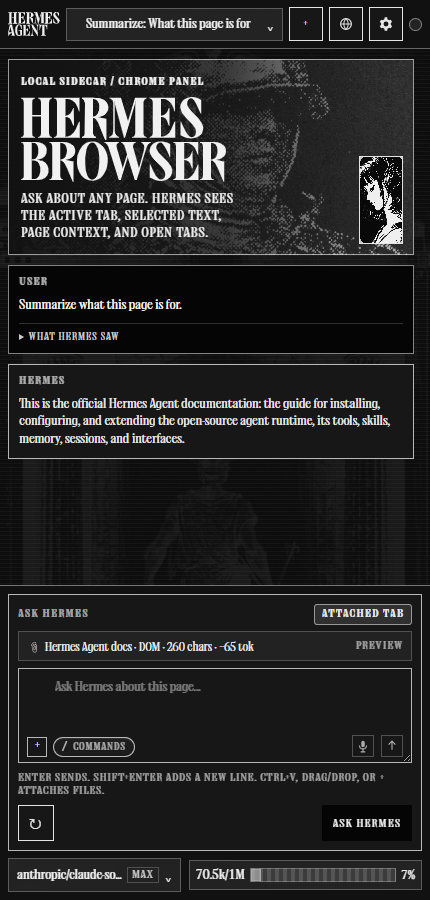 |
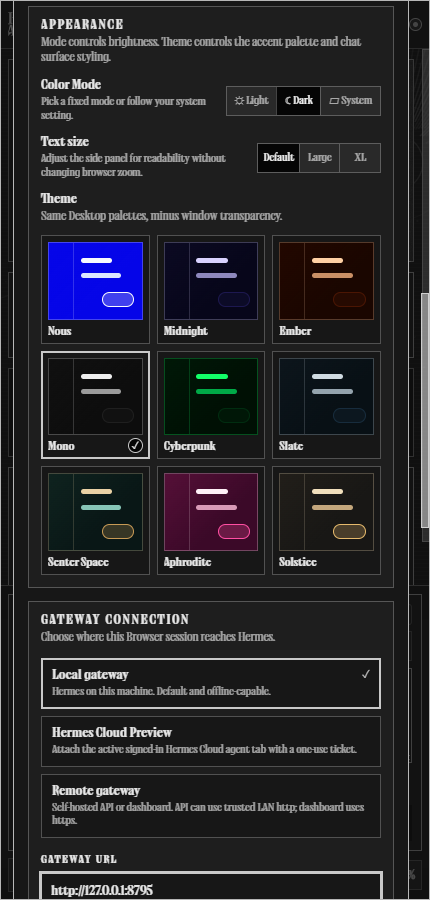 |
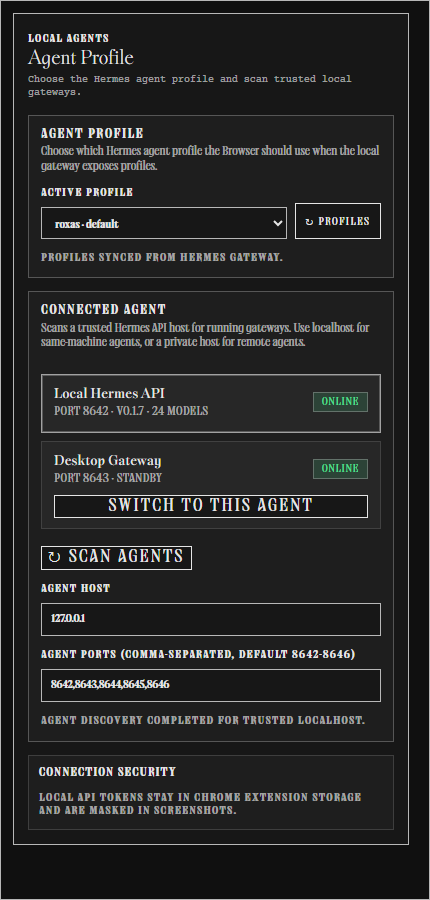 |
| Browser behavior | Page-only context | Hermes compatibility |
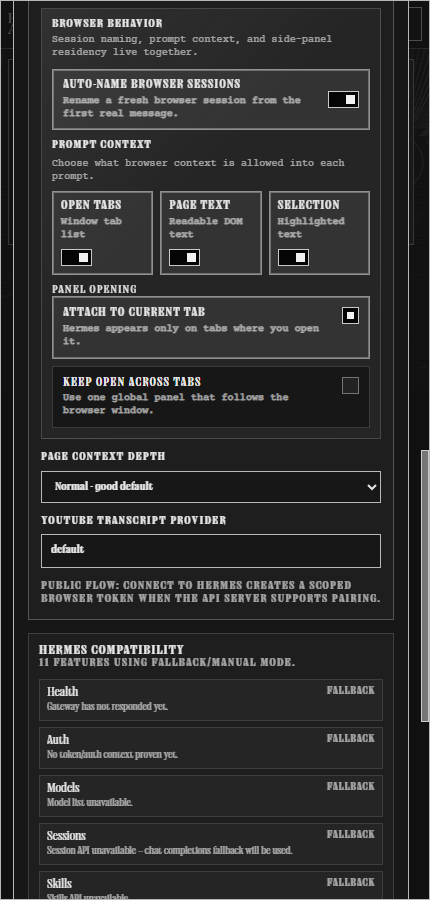 |
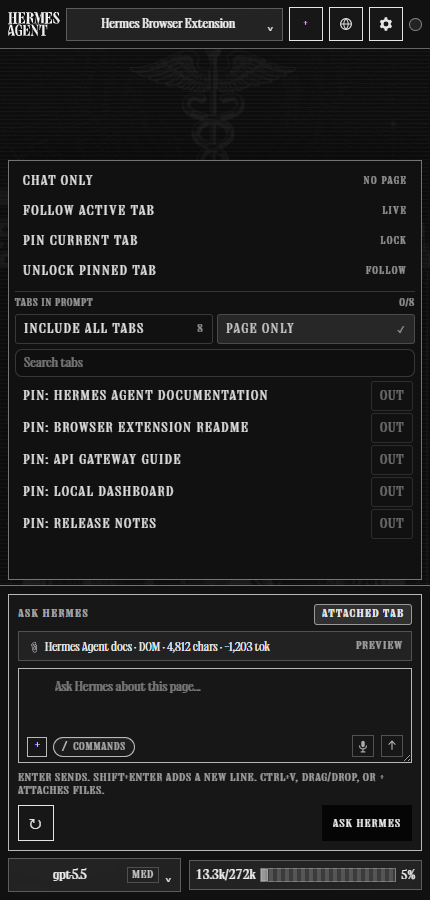 |
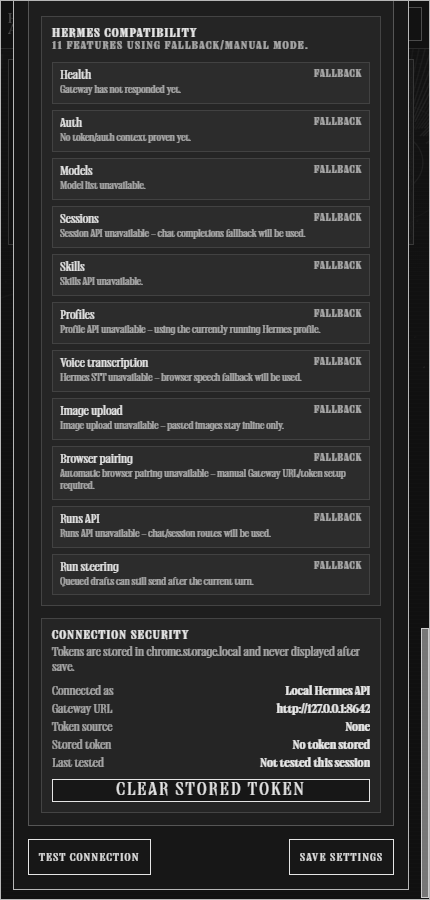 |
Hermes Web
Open the extension's full view for canonical Hermes sessions, model/runtime control, rich messages, generated media, and accurate session context telemetry in a browser-native workspace.
Hermes Web Alpha currently uses token-backed Local or Remote API connections. Hermes Cloud Preview and ticketed remote-dashboard transports remain Chat-only in the side panel; live full-view dashboard handoff is not shipped yet.
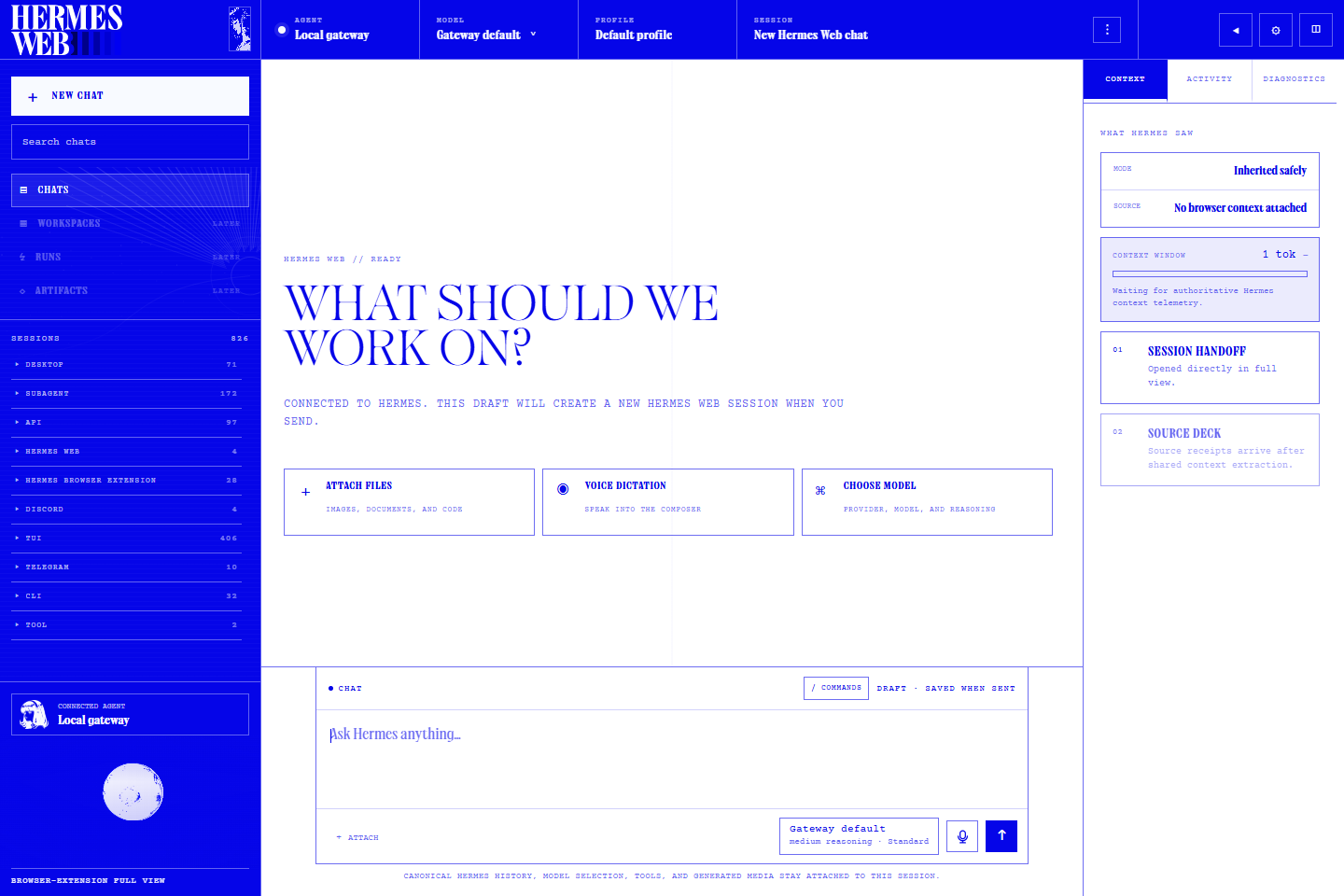
Start a fresh canonical Hermes Web session
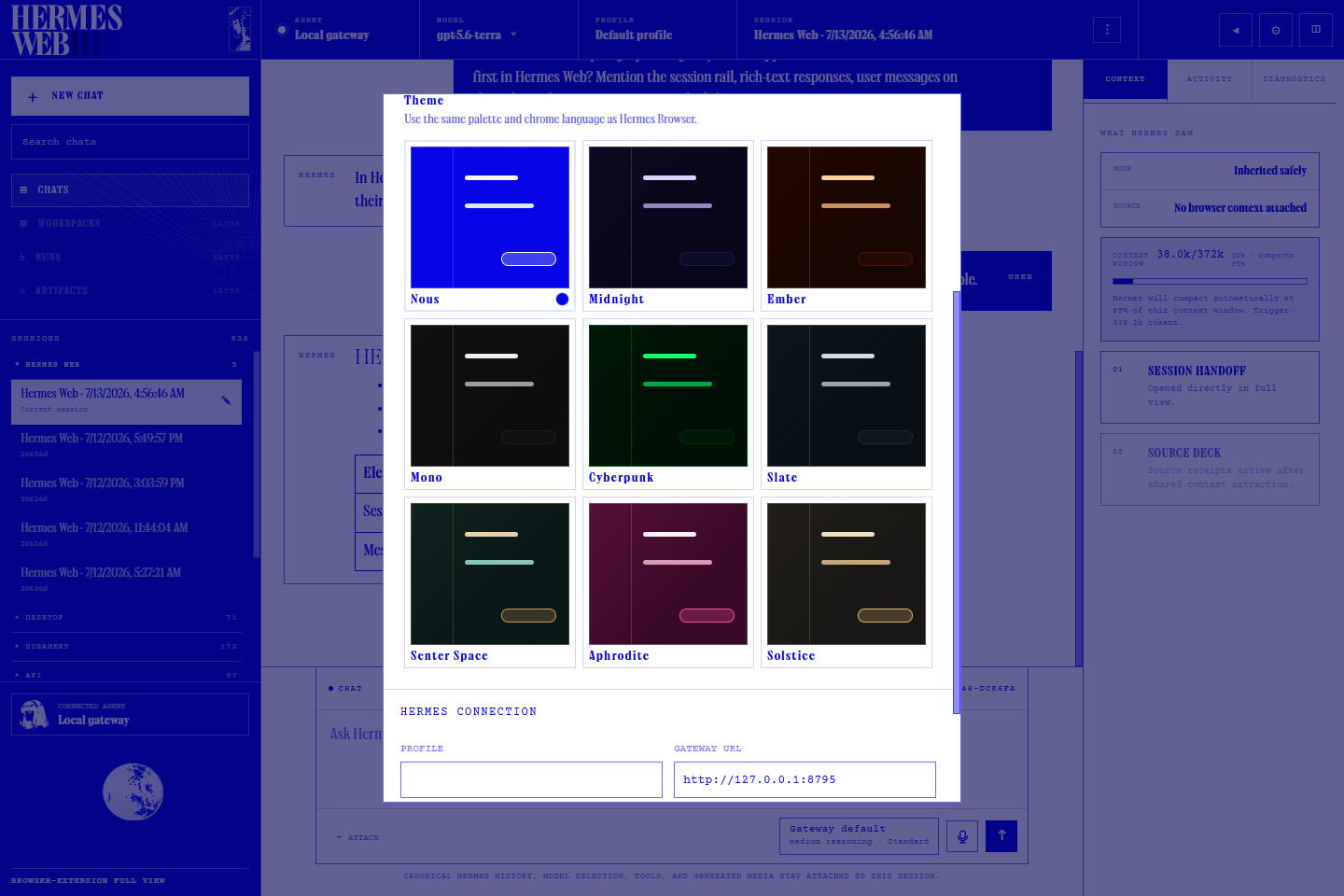
Choose from nine themes with Light and Dark modes
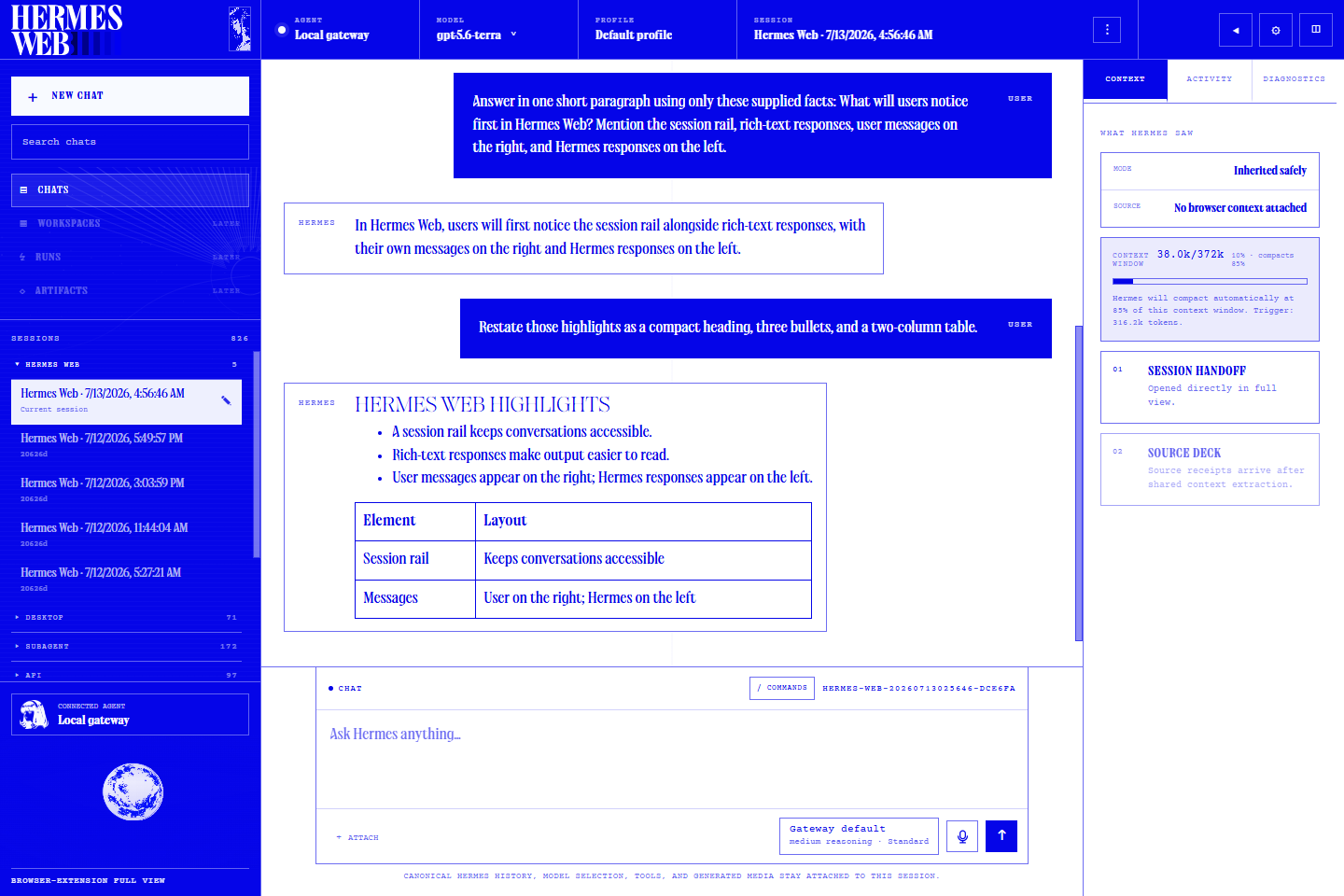
Read rich Hermes responses while canonical history stays attached
Highlights
- Adds Hermes Web Alpha, a full-page browser workspace for canonical Hermes sessions with a session rail, user-right/Hermes-left messages, safe rich Markdown, model/runtime controls, tools, skills, attachments, voice, active-run steering, generated media, and a context/activity/diagnostics inspector.
- Chrome/Edge/Chromium MV3 side panel powered by the Side Panel API.
- Matches Hermes Desktop's three connection choices: **Local ga