
GrowthBook is a free, open source application security project written in TypeScript and released under a custom open-source licence. It has 8,376 GitHub stars, 849 forks and 793 open issues, and was last pushed 4 hours ago. On this registry it ranks #3 of 16 tracked projects in Application Security, with 5 head-to-head comparisons available. It gained 32 stars over the last 6 tracked days.

What is GrowthBook?

GrowthBook is an open-source platform for feature flags, A/B experimentation, and product analytics that product, data, and platform teams can either consume through a hosted cloud account or run entirely on their own infrastructure.

What it is

GrowthBook is a TypeScript codebase that combines feature flagging, experimentation, and product analytics in one application. It ships with a hosted option at app.growthbook.io and a self-hosted deployment that runs from a Docker Compose file in the repository, serving the UI on port 3000. The project describes itself as an open core product: the bulk of the code sits under the permissive MIT license, while several directories fall under the separate GrowthBook Enterprise License. Around it sits an ecosystem of client libraries, documentation, warehouse connectors, and an API surface for automation.

The problem it targets is stated directly in its own philosophy section: the top one percent of companies spend thousands of hours building experimentation, feature flagging, and analytics platforms in-house, while the rest either pay for expensive third-party SaaS tools or assemble unmaintained open-source libraries. GrowthBook replaces that SaaS bill and that patchwork with a single deployable platform whose experimentation statistics and metric definitions are computed against the customer's own data warehouse. It lives in the product experimentation and continuous delivery toolchain, alongside the data stack rather than beside it.

Key capabilities

  • Feature flags with advanced targeting, gradual rollouts, and experiments attached to the same flag.
  • 24 SDKs, including React, Python, Android (Kotlin), and iOS (Swift).
  • Experiment statistics engine implementing CUPED, Sequential testing, Bayesian analysis, Post-Stratification, Bandits, and SRM checks.
  • Warehouse-native querying of 11 data sources, including BigQuery, Snowflake, and Databricks.
  • Flexible SQL-backed metric definitions covering conversion rates, ratios, and quantiles.
  • Built-in Product Analytics suite for dashboards, plus screenshots, custom meta fields, and Markdown documentation on entities.
  • Webhooks, a full REST API, and an MCP server for creating features, starting experiments, and cleaning up stale flags.

Who uses it and how

  • Teams that want experimentation on their own infrastructure self-host with docker compose up -d, pulling a prebuilt public Docker image that needs no registry credentials.
  • Data organisations running warehouse-native setups point GrowthBook at BigQuery, Snowflake, Databricks, or ClickHouse and keep metric logic in SQL they control.
  • Product engineering teams instrument React, Python, Kotlin, and Swift clients through the 24 published SDKs, then roll out changes gradually by flag.
  • Platform and data engineering groups automate the lifecycle through the REST API, webhooks, and the MCP server instead of the web UI.
  • Smaller teams start on a free GrowthBook Cloud account before deciding whether to move to self-hosting.

Getting started

Clone https://github.com/growthbook/growthbook.git, run docker compose up -d, and visit http://localhost:3000; building the image from the repository Dockerfile instead requires a one-time docker login dhi.io because its hardened base images come from Docker's dhi.io registry. A free GrowthBook Cloud account is the alternative for teams that do not want to operate the stack.

How it compares

This entry names no directly comparable tools, so GrowthBook stands alone in this registry. Its README frames the competitive choice in categories rather than products: an in-house platform the company builds itself, an expensive third-party SaaS tool, or a set of unmaintained open-source libraries.

When to use it — and when not to

Self-hosting means operating the full Docker Compose stack and, for warehouse-native experiments, maintaining a live connection and metric definitions in a data source such as BigQuery, Snowflake, or Databricks; teams without a warehouse or without Docker capacity should use the hosted cloud option or look elsewhere. The licence field reads NOASSERTION because the repository is open core, so anyone planning commercial use should read the LICENSE file carefully before assuming MIT terms apply throughout. The project also carries 793 open issues, which suggests a large and active backlog worth weighing against how quickly a given team needs fixes.

project readme (upstream, from github) — read inline

GrowthBook

Open Source Feature Flags, Experimentation, and Product Analytics

Build Status Release Join us on Slack

Create a free GrowthBook Cloud account to get started quickly.

Or run it yourself with:

git clone https://github.com/growthbook/growthbook.git
cd growthbook
docker compose up -d

Then visit http://localhost:3000. View the full Self-Hosting Instructions for more details.

This pulls our prebuilt public Docker image and needs no registry credentials. If you instead build the image from the Dockerfile in this repo, its hardened base images come from Docker's dhi.io registry, which requires a one-time docker login dhi.io with any free Docker account — see Building from source.
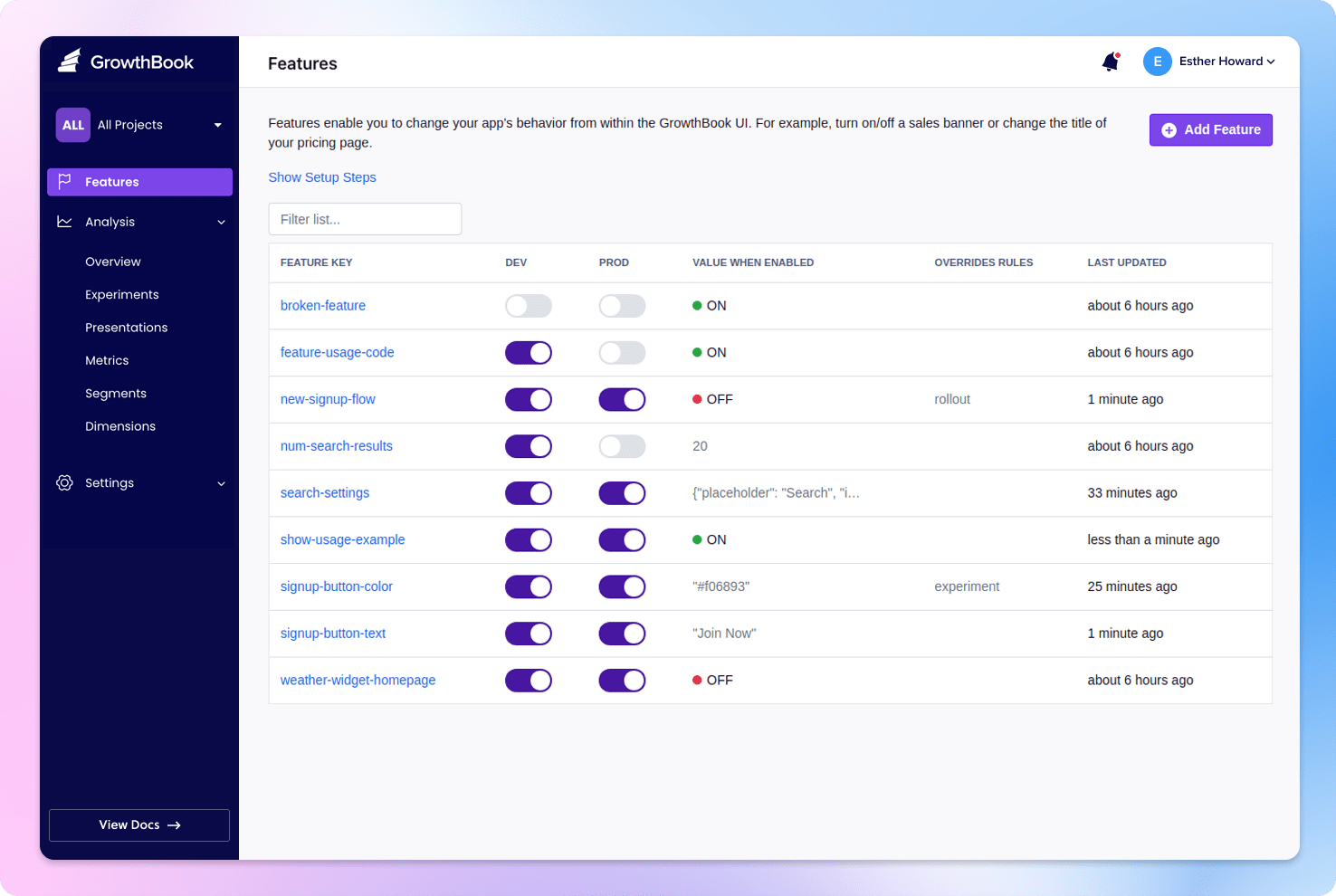
GrowthBook Screenshot

Our Philosophy

The top 1% of companies spend thousands of hours building their own in-house experimentation, feature flagging, and analytics platforms. The other 99% are left paying for expensive 3rd party SaaS tools or hacking together unmaintained open source libraries.

We want to give all companies the flexibility and power of a fully-featured in-house platform without needing to build it themselves.

Major Features

  • 🏁 Feature flags with advanced targeting, gradual rollouts, and experiments
  • 💻 24 SDKs including React, Python, Android, and iOS. View all
  • 🆎 World class experiment stats engine (CUPED, Sequential, Bayesian, Post-Strat, Bandits, SRM checks).
  • ❄️ Warehouse Native. Query 11 data sources including BigQuery, Snowflake, and Databricks. View all.
  • 🎯 Flexible SQL-backed metric definitions. Simple conversion rates, ratios, quantiles, and more.
  • 📊 Built-in Product Analytics suite to build dashboards and share with your team.
  • 📝 Document everything with screenshots, custom meta fields, and Markdown throughout.
  • 🔔 Webhooks and a full REST API for building integrations and custom workflows.
  • 🤖 MCP server to create features, start experiments, clean up stale flags, and more.

Documentation and Support

View the GrowthBook Docs for info on how to configure and use the platform.

Join our Slack community if you get stuck, want to chat, or are thinking of a new feature.

Or email us at [email protected] if Slack isn't your thing.

We're here to help - and to make GrowthBook even better!

Contributors

We ❤️ all contributions, big and small!

Read CONTRIBUTING.md for how to setup your local development environment.

If you want to, you can reach out via Slack or email and we'll set up a pair programming session to get you started.

License

GrowthBook is an Open Core product. The bulk of the code is under the permissive MIT license. There are several directories that are governed under a separate commercial license, the GrowthBook Enterprise License.

View the LICENSE file in this repository for the full text and details.
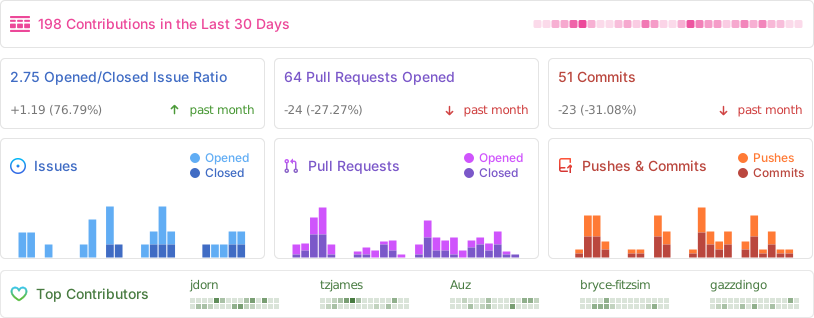
GrowthBook Repository Stats

Frequently asked questions

Is GrowthBook free to use?

GrowthBook is open source. There is no licence fee and no seat count — you can self-host it or, where the project offers one, pay a vendor for a managed version instead.

What does GrowthBook do?

Open-source A/B testing and feature flagging platform

What is GrowthBook written in?

GrowthBook is primarily written in TypeScript. Its source is publicly available at https://github.com/growthbook/growthbook, and it has 8,376 GitHub stars.