graphify is a free, open source ai development platforms project written in Python and released under Apache-2.0. It has 118,991 GitHub stars, 11,505 forks and 1,350 open issues, and was last pushed 27 hours ago. On this registry it ranks #5 of 61 tracked projects in AI Development Platforms, with 5 head-to-head comparisons available. It gained 991 stars over the last 3 tracked days.

What is graphify?

graphify is an Apache-2.0 Python CLI and /graphify skill that turns a whole project — code, docs, SQL schemas, configs, PDFs, images, and video — into a queryable knowledge graph, built for developers and AI-agent users in Claude Code, Cursor, Codex, and Gemini CLI who want to query a codebase instead of grepping through files.

What it is

graphify lives in the AI coding-assistant ecosystem as a skill plus a command-line tool. It runs inside Claude Code, Cursor, Codex, Gemini CLI, GitHub Copilot, and 15 or more other platforms. Code is parsed locally with tree-sitter AST, which is deterministic and uses no LLM, so nothing leaves the machine. A separate semantic pass handles docs, PDFs, images, and video or audio, and that pass calls a backend model or a configured API key. The result is a real graph, not an embedding index.

The concrete problem it solves is search by reading. Instead of grepping through files and reading them one by one, a user asks a question against graph.json, traces how two things connect, or explains a single concept. It also replaces the vector-store approach common to retrieval tooling: graphify states plainly that there are no embeddings and no vector store. The graph is traversed rather than approximated by similarity, and every edge is tagged EXTRACTED when it is explicit in the source, or INFERRED when graphify resolved it, so a reader can tell what was read directly from what was derived.

Key capabilities

  • /graphify . maps a project and writes three files into graphify-out/: graph.html, GRAPH_REPORT.md, and graph.json.
  • graphify query "" returns a scoped subgraph for a plain-language question; graphify path A B traces how any two things connect; graphify explain "" describes one concept.
  • Cross-file links such as calls, imports, inherits, and mixes_in are resolved across roughly 40 languages via tree-sitter AST.
  • God nodes surface the most-connected concepts, and communities split the graph into subsystems using Leiden, with LLM-free labels.
  • # NOTE: and # WHY: comments, plus ADR and RFC citations, become first-class nodes linked to the code.
  • Docs, PDFs, images, and video or audio map into the same graph as the code.
  • Local-first operation: code parsing is offline, and the semantic pass over docs and media contacts a backend only when one is configured.

Who uses it and how

  • Developers working in Claude Code, Cursor, Codex, or Gemini CLI install the skill once and then run /graphify . from inside the assistant.
  • Teams onboarding onto an unfamiliar repository use GRAPH_REPORT.md for key concepts, surprising connections, and suggested questions, then open graph.html to click, filter, and search the graph.
  • Engineers who need to justify a connection use the EXTRACTED and INFERRED tags to separate what the source states from what graphify resolved.
  • Projects where code should not leave the machine rely on the local tree-sitter parse and keep the semantic pass off.
  • Multi-language codebases use the cross-file link resolution across roughly 40 languages to connect call, import, inheritance, and mixin relationships.

Getting started

Install the CLI with uv tool install graphifyy or pipx install graphifyy, then register the skill with the assistant by running graphify install. A hosted platform is also in early access at app.graphify.com ahead of the public v1 launch.

How it compares

No comparable or paid products are named in the facts for this entry, so graphify stands alone in this registry. Its distinguishing claim is structural rather than commercial: a traversable graph in place of a vector index, with each edge labelled as extracted or inferred.

When to use it — and when not to

A self-hoster who wants semantic coverage of docs, PDFs, images, and video must supply an assistant model or a configured API key, because the local path covers code only. The repository carries roughly 1,350 open issues, and the README excerpt is truncated mid-benchmark, so published benchmark figures are incomplete and should be verified before relying on them. Anyone who needs only simple text search, or who cannot configure a backend for non-code material, should not pick it.

project readme (upstream, from github) — read inline

Graphify

Graphify-Labs%2Fgraphify | Trendshift

Read this in other languages

🇺🇸 English | 🇨🇳 简体中文 | 🇯🇵 日本語 | 🇰🇷 한국어 | 🇩🇪 Deutsch | 🇫🇷 Français | 🇪🇸 Español | 🇮🇳 हिन्दी | 🇧🇷 Português | 🇷🇺 Русский | 🇸🇦 العربية | 🇮🇷 فارسی | 🇮🇹 Italiano | 🇵🇱 Polski | 🇳🇱 Nederlands | 🇹🇷 Türkçe | 🇺🇦 Українська | 🇻🇳 Tiếng Việt | 🇮🇩 Bahasa Indonesia | 🇸🇪 Svenska | 🇬🇷 Ελληνικά | 🇷🇴 Română | 🇨🇿 Čeština | 🇫🇮 Suomi | 🇩🇰 Dansk | 🇳🇴 Norsk | 🇭🇺 Magyar | 🇹🇭 ภาษาไทย | 🇺🇿 Oʻzbekcha | 🇹🇼 繁體中文 | 🇵🇭 Filipino | 🇮🇱 עברית

PyPI Downloads Discord YouTube LinkedIn YC S26

Early access to the graphify platform is open before the public v1 launch: app.graphify.com

Type /graphify in your AI coding assistant and it maps your entire project (code, docs, PDFs, images, videos) into a knowledge graph you can query instead of grepping through files.

  • Code maps for free, fully local. Code is parsed with tree-sitter AST: deterministic, no LLM, nothing leaves your machine. (Docs, PDFs, images and video use your assistant's model, or a configured API key, for a semantic pass.)
  • Every edge is explained. Each connection is tagged EXTRACTED (explicit in the source) or INFERRED (resolved by graphify), so you can tell what was read directly from what was inferred.
  • Not a vector index. No embeddings, no vector store: a real graph you traverse. Ask a question, trace the path between two things, or explain one concept.

Want this always-on, updating in the background across your code, docs, and meetings rather than only on demand? That is what we are building at graphify.com, and early access is open now at app.graphify.com.
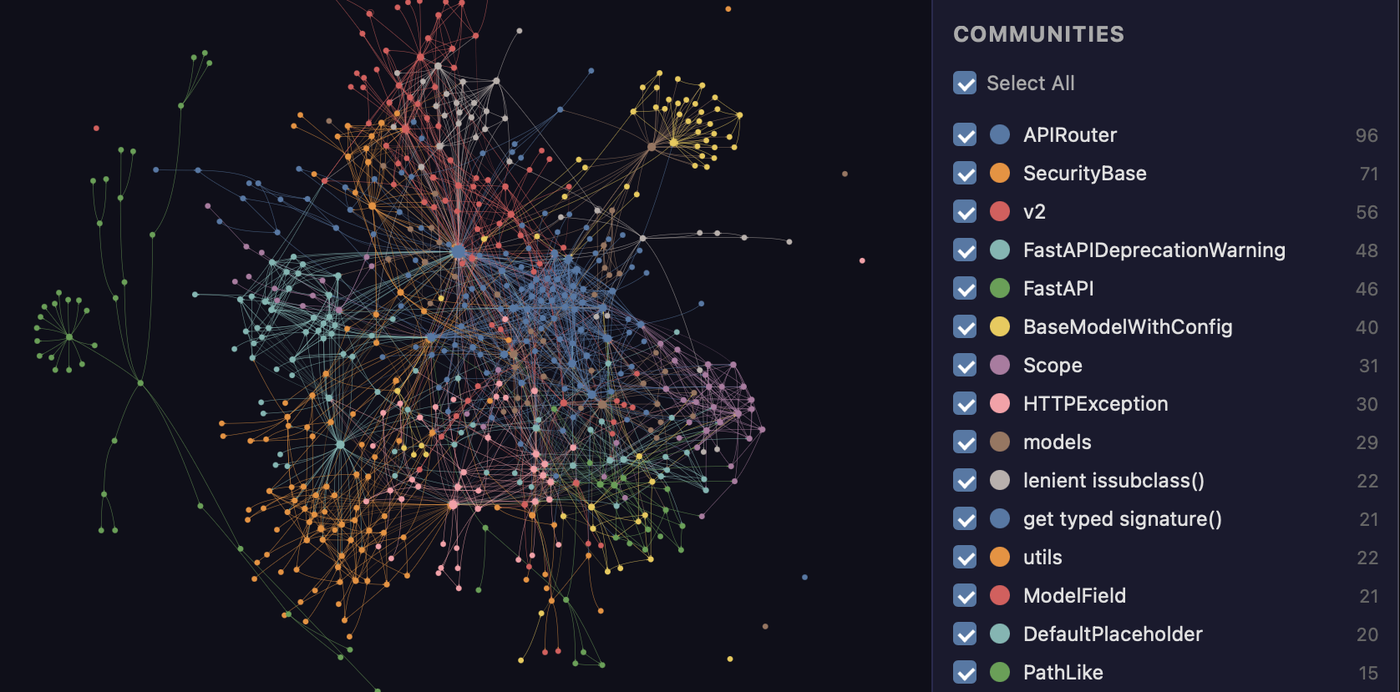
graphify's interactive graph.html showing the FastAPI codebase as a force-directed knowledge graph with a legend of detected communities

The FastAPI codebase mapped by graphify. Every node is a concept, colors are detected communities, and the whole thing is clickable in graph.html.

Get started (30 seconds):

uv tool install graphifyy      # install the CLI (or: pipx install graphifyy)
graphify install               # register the skill with your AI assistant

Then, in your AI assistant:

/graphify .

That's it. You get three files:

graphify-out/
├── graph.html       open in any browser — click nodes, filter, search
├── GRAPH_REPORT.md  the highlights: key concepts, surprising connections, suggested questions
└── graph.json       the full graph — query it anytime without re-reading your files

Works in Claude Code, Cursor, Codex, Gemini CLI, GitHub Copilot, and 15+ more — pick your platform.


See it in action
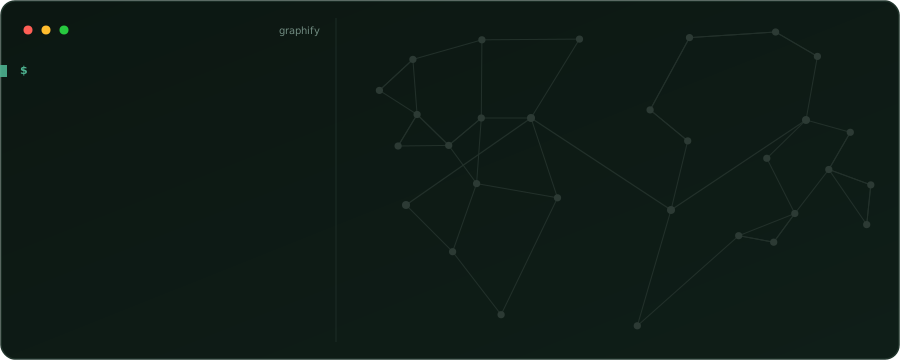
graphify path query: a terminal asks for the shortest path between FastAPI and ModelField, and the answer lights up hop by hop across the knowledge graph

Once the graph is built you query it instead of reading files. Real output, graphify run on the FastAPI codebase shown above:

$ graphify explain "APIRouter"
Node: APIRouter
  Source:    routing.py L2210
  Community: 2
  Degree:    47

Connections (47):
  --> RequestValidationError [uses] [INFERRED]
  --> Dependant [uses] [INFERRED]
  --> .get() [method] [EXTRACTED]
  <-- __init__.py [imports] [EXTRACTED]
  ...

$ graphify path "FastAPI" "ModelField"
Shortest path (3 hops):
  FastAPI --uses--> DefaultPlaceholder <--references-- get_request_handler() --references--> ModelField

Every edge carries a confidence tag (EXTRACTED = explicit in the source, INFERRED = derived by resolution), so you can tell what was read directly from what was inferred. graphify query "" returns a scoped subgraph for a plain-language question, and graphify path A B traces how any two things connect.


What it does

What you get out of the box:

Capability What you get
God nodes The most-connected concepts, so you see what everything flows through
Communities The graph split into subsystems (Leiden), with LLM-free labels
Cross-file links calls / imports / inherits / mixes_in resolved across ~40 languages via tree-sitter AST
Query, path, explain Ask a question, trace the path between two things, or explain one concept, all against graph.json
Rationale + doc refs # NOTE: / # WHY: comments and ADR/RFC citations become first-class nodes linked to the code
Beyond code Docs, PDFs, images, and video/audio all map into the same graph
Local-first Code is parsed locally with tree-sitter (no LLM, nothing leaves your machine); only the semantic pass over docs/media calls a backend, and only if you configure one

Benchmarks

Benchmark Metric graphify Field
LOCOMO (n=300) recall@10 0.497 mem0 0.048, supermemory 0.149
LOCOMO (n=300) QA accuracy 45.3% supermemory 49.7%, mem0 27.3%
LongMemEval-S (n=50) QA accuracy 76% tied with dense RAG
Graph build LLM credits 0 per-token for most systems

Every system ran on the same harness with the same model and budgets, scored by a judge blind-validated against a second judge (90.6% agreement, Cohen's kappa 0.81). Full per-system tables, the code-intelligence result, and reproduction commands: BENCHMARKS.md.


Prerequisites

Requirement Minimum Check Install
Python 3.10+ python --version python.org
uv (recommended)

readme truncated — read the full docs on github

Frequently asked questions

Is graphify free to use?

graphify is open source under the Apache-2.0 licence. There is no licence fee and no seat count — you can self-host it or, where the project offers one, pay a vendor for a managed version instead.

What does graphify do?

Turn any codebase, with its docs, SQL schemas, configs, and PDFs, into a queryable knowledge graph. A /graphify skill for Claude Code, Cursor, Codex, and Gemini

What is graphify written in?

graphify is primarily written in Python. Its source is publicly available at https://github.com/Graphify-Labs/graphify, and it has 118,991 GitHub stars.


