Generative AI for Beginners is Microsoft's free, MIT-licensed curriculum of 21 Jupyter Notebook lessons that teaches developers how to start building generative AI applications, aimed at newcomers who want a structured, self-paced path instead of scattered documentation.
What it is
Generative AI for Beginners is an open-source educational repository published under the microsoft organisation on GitHub and filed in this registry under AI & Machine Learning / AI Development Platforms. It is written primarily in Jupyter Notebook and released under the MIT licence, with 119,941 stars, 63,146 forks and 23 open issues at the time of listing. Its own tagline is "21 Lessons, Get Started Building with Generative AI," and its topic tags place it inside the generative AI ecosystem alongside ai, llms, language-model, gpt, chatgpt, dall-e, openai, azure, prompt-engineering and microsoft-for-beginners.
The concrete problem it solves is sequence and access. A developer who wants to build with large language models normally assembles an education from vendor blog posts, scattered tutorials, API references and conference talks, with no agreed order and no shared vocabulary. This repository replaces that by packaging a numbered lesson set into runnable notebooks, so the same material covers the concepts, the model families, and the practical prompt engineering work in one place. It also removes the language barrier from that path: the README ships translated copies of the curriculum under ./translations/, including Arabic, Bengali, Hindi, Japanese, Korean, Spanish, Swahili, Tamil and many more, and those translations are described as maintained through a GitHub Action that keeps them automated and always up to date.
Key capabilities
- 21 lessons that make up a complete introductory curriculum for building generative AI applications, delivered as Jupyter Notebook lesson files.
- Multi-language delivery through per-locale directories such as
./translations/hi/README.md, ./translations/ja/README.md and ./translations/sw/README.md, refreshed by a GitHub Action rather than by hand.
- Coverage of the major model families and vendors reflected in the topic tags:
openai, azure, gpt, chatgpt, dall-e, llms and language-model.
- Explicit prompt engineering material, indicated by the
prompt-engineering topic.
- Community support through a Microsoft Foundry Discord invite linked from the README.
- Contributor workflow signalled by the
PRs Welcome badge, the contributors badge, and the pull request and issue badge set.
- Permissive reuse under the MIT licence, with the licence file linked from the README badge row.
Who uses it and how
- Developers with no prior generative AI background who want a guided on-ramp, which is the audience the
microsoft-for-beginners topic and the tagline both target.
- Non-English-speaking engineers who follow the curriculum through a translated
translations//README.md rather than the English source.
- Teams standardising on Azure and OpenAI services who use the lessons to give engineers a shared baseline before they touch a real project.
- Instructors, study groups and internal training programmes that fork the repository and run the notebooks as course material, which the 63,146 forks suggest happens at scale.
- Contributors who file issues or open pull requests against the 23 open issues and the wider lesson set, supported by the
PRs Welcome badge.
Getting started
There is no package, container image or hosted product named in the README. The documented route is to clone or fork microsoft/Generative-AI-For-Beginners on GitHub and work through the Jupyter Notebook lessons directly, optionally reading a translated copy under ./translations/ and joining the linked Microsoft Foundry Discord for questions.
How it compares
This registry entry names no paid products that the project replaces, and it names no competing tool either, so it stands alone here rather than as a substitute for a specific commercial offering. Its only stated kinship is the microsoft-for-beginners topic, which places it in Microsoft's wider "For Beginners" curriculum series. Any assessment of cost, hosting or data ownership therefore rests on the single fact that it is MIT-licensed teaching material rather than a deployable service.
When to use it — and when not
Choose it when the goal is learning, since the MIT licence permits reuse, forking and internal adaptation without a commercial agreement. Do not choose it as a production dependency: it is a curriculum, not a library with an API surface, and the README excerpt names no runtime, install command or deployment artefact. Note also that the excerpt is dominated by badges and translation links, so anyone needing release history, supported model versions or maintenance commitments beyond the last push date of 2026-09-17 will need to read the lessons themselves.
project readme (upstream, from github) — read inline
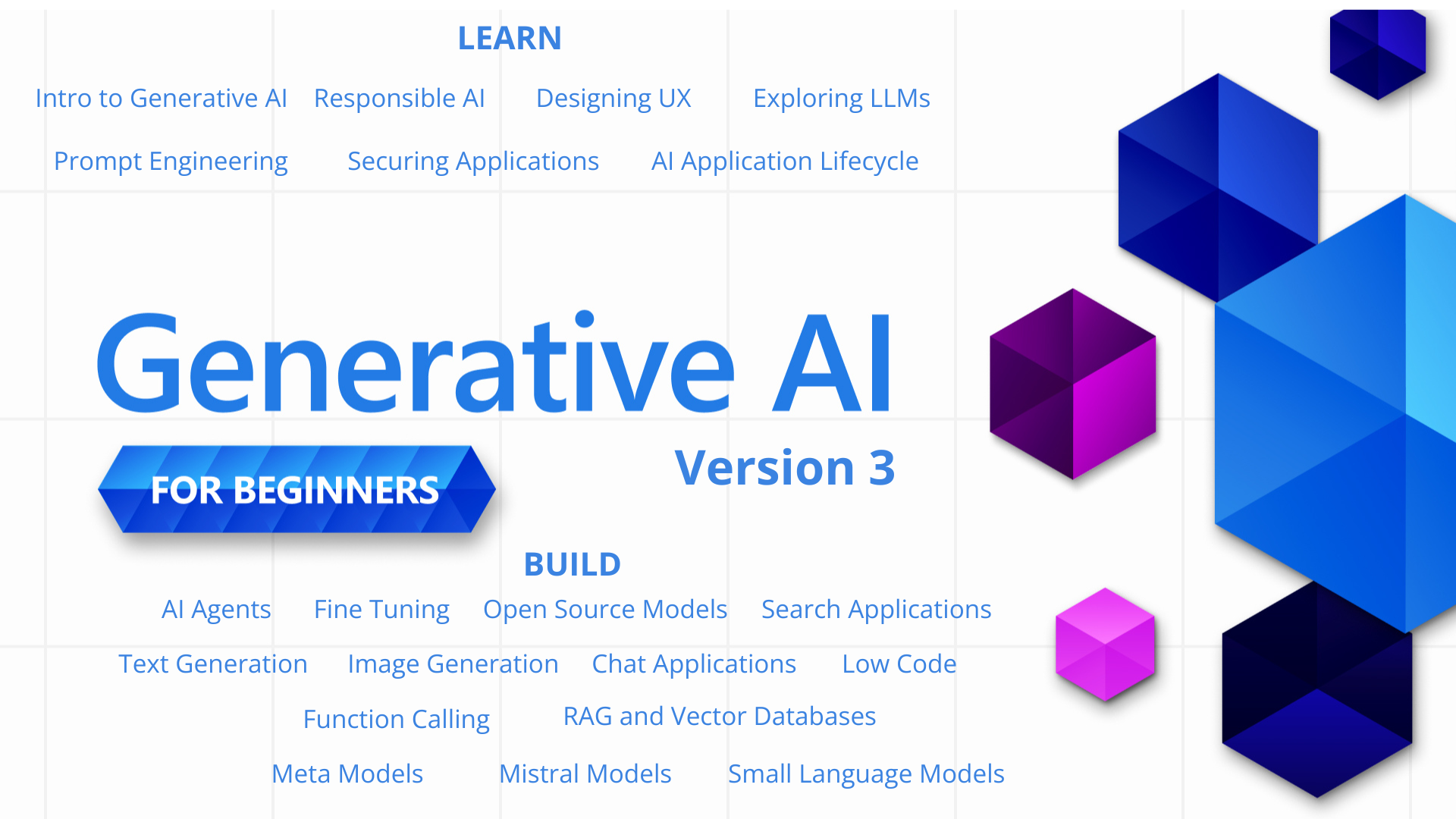
21 Lessons teaching everything you need to know to start building Generative AI applications







🌐 Multi-Language Support
Supported via GitHub Action (Automated & Always Up-to-Date)
Arabic | Bengali | Bulgarian | Burmese (Myanmar) | Chinese (Simplified) | Chinese (Traditional, Hong Kong) | Chinese (Traditional, Macau) | Chinese (Traditional, Taiwan) | Croatian | Czech | Danish | Dutch | Estonian | Finnish | French | German | Greek | Hebrew | Hindi | Hungarian | Indonesian | Italian | Japanese | Kannada | Khmer | Korean | Lithuanian | Malay | Malayalam | Marathi | Nepali | Nigerian Pidgin | Norwegian | Persian (Farsi) | Polish | Portuguese (Brazil) | Portuguese (Portugal) | Punjabi (Gurmukhi) | Romanian | Russian | Serbian (Cyrillic) | Slovak | Slovenian | Spanish | Swahili | Swedish | Tagalog (Filipino) | Tamil | Telugu | Thai | Turkish | Ukrainian | Urdu | Vietnamese
Prefer to Clone Locally?
This repository includes 50+ language translations which significantly increases the download size. To clone without translations, use sparse checkout:
Bash / macOS / Linux:
git clone --filter=blob:none --sparse https://github.com/microsoft/generative-ai-for-beginners.git
cd generative-ai-for-beginners
git sparse-checkout set --no-cone '/*' '!translations' '!translated_images'
CMD (Windows):
git clone --filter=blob:none --sparse https://github.com/microsoft/generative-ai-for-beginners.git
cd generative-ai-for-beginners
git sparse-checkout set --no-cone "/*" "!translations" "!translated_images"
This gives you everything you need to complete the course with a much faster download.
Generative AI for Beginners (Version 3) - A Course
Learn the fundamentals of building Generative AI applications with our 21-lesson comprehensive course by Microsoft Cloud Advocates.
🌱 Getting Started
This course has 21 lessons. Each lesson covers its own topic so start wherever you like!
Lessons are labeled either "Learn" lessons explaining a Generative AI concept or "Build" lessons that explain a concept and code examples in both Python and TypeScript when possible.
For .NET Developers checkout Generative AI for Beginners (.NET Edition)!
Each lesson also includes a "Keep Learning" section with additional learning tools.
What You Need
To run the code of this course, you can use either:
We have created a Course Setup lesson to help you with setting up your development environment.
Don't forget to star (🌟) this repo to find it easier later.
🧠 Ready to Deploy?
If you are looking for more advanced code samples, check out our collection of Generative AI Code Samples in both Python and TypeScript.
🗣️ Meet Other Learners, Get Support
Join our official Microsoft Foundry Discord server to meet and network with other learners taking this course and get support.
Ask questions or share product feedback in our Microsoft Foundry Developer Forum on Github.
🚀 Building a Startup?
Visit Microsoft for Startups to find out how to get started building with Azure credits today.
🙏 Want to help?
Do you have suggestions or found spelling or code errors? Raise an issue or Create a pull request
📂 Each lesson includes:
- A short video introduction to the topic
- A written lesson located in the README
- Python and TypeScript code samples supporting Azure OpenAI and OpenAI API
- Links to extra resources to continue your learning
🗃️ Lessons
| # | **Lesson Link