What it is
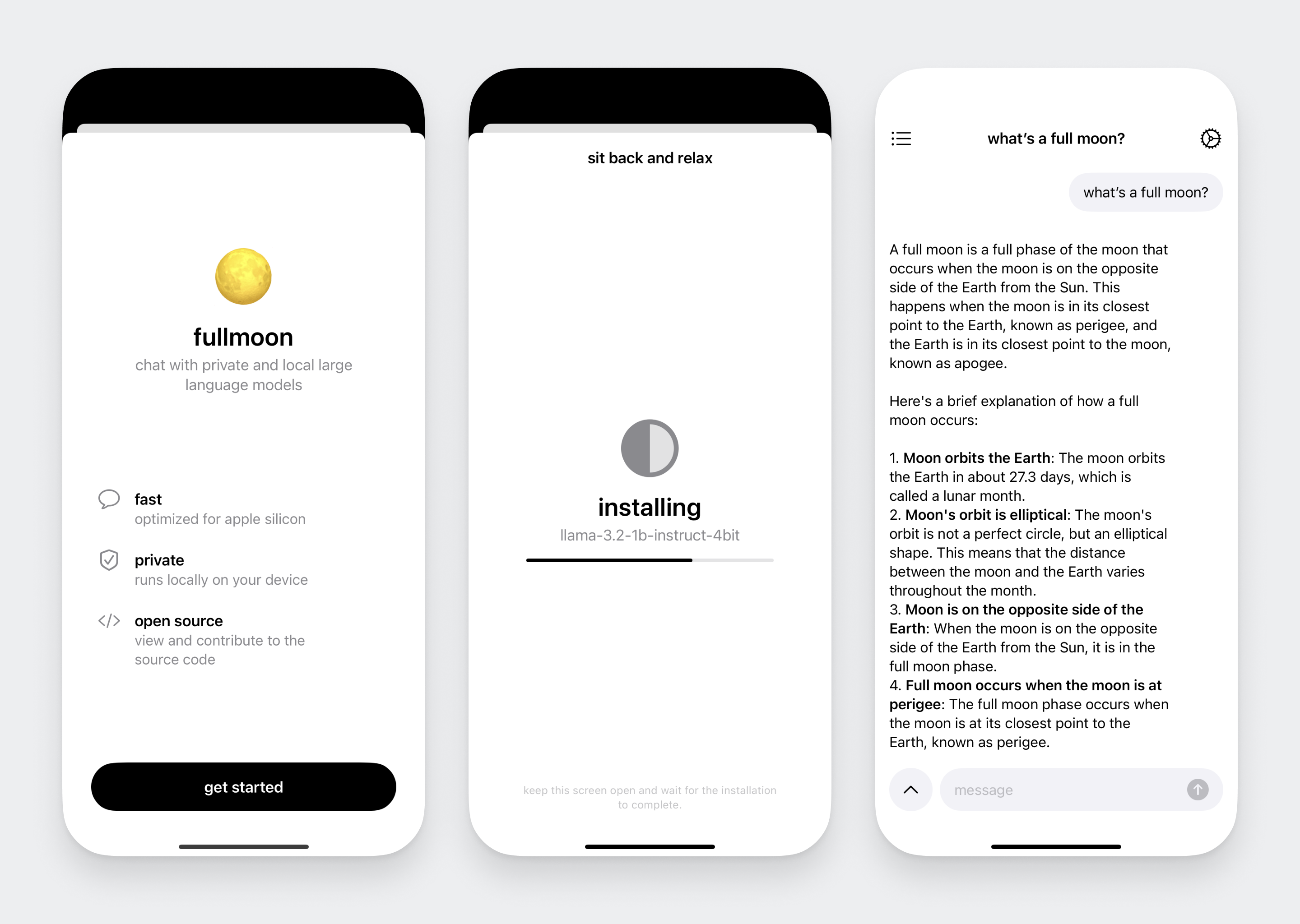
Fullmoon is an iOS application for chatting with local large language models, built in Swift and released under the MIT license. It is optimized for Apple silicon and runs across iPhone, iPad, and Mac, with chat history stored locally on the device and a customizable interface. The project lives in the Apple ecosystem and depends on MLX Swift, Apple's array framework for machine learning research on Apple silicon.
The concrete problem it addresses is privacy and offline access in LLM chat. Instead of sending prompts to a hosted service, Fullmoon runs the model on the user's own hardware, so conversations never leave the device. That matters for users who want to experiment with language models without an account, a network connection, or a third party retaining their prompts. It also gives Apple silicon owners a way to use the neural hardware they already paid for rather than renting inference.
Key capabilities
- Runs large language models locally on Apple silicon through MLX Swift.
- Supports Llama 3.2 1B and Llama 3.2 3B in 4-bit instruction-tuned form.
- Supports DeepSeek-R1-Distill-Qwen-1.5B in 4-bit form.
- Saves chat history locally rather than on a remote server.
- Provides a customizable app appearance.
- Ships as a single app for iPhone, iPad, and Mac.
Who uses it and how
- iPhone and iPad owners who want an on-device chat client without a cloud account.
- Mac users on Apple silicon who prefer local inference over a hosted API.
- Privacy-conscious users who need prompts and history to stay on the device.
- Developers and researchers evaluating small quantized models such as Llama 3.2 1B and 3B, or DeepSeek-R1-Distill-Qwen-1.5B, in a ready-made interface.
Getting started
The README does not document a package manager, Docker image, or command-line install path; it points to the project homepage at https://fullmoon.app. The app is an iOS application distributed for iPhone, iPad, and Mac.
When to use it — and when not to
Fullmoon suits users who want local, private chat on Apple hardware and are content with the small models it lists, since larger models are not part of the supported set. A self-hoster does not need to operate a database, object storage, or SMTP server, because history is kept on the device, but that also means there is no sync or server-side backup. The repository shows 45 open issues and no listed contributors, so users should expect a small maintenance surface and check the issue tracker before relying on it.