Formizee is an open-source, Apache-2.0 licensed forms platform for developers who need to build, publish and measure web forms, positioned as an alternative to hosted services such as Formspree, Formcarry and Formester.
What it is
Formizee is a developers forms platform distributed under the Apache-2.0 licence and published from a repository authored primarily in MDX. Its stack pairs a Next.js frontend with a Hono backend, a Libsql SQLite client accessed through Drizzle as the ORM, ClickHouse for analytics and metrics, Auth.js for authentication, tRPC for a typed API, and shadcn-ui components styled with Tailwind. The project describes itself as an all-in-one solution covering design, build and analytics, and lists topics including backend, email-sender, form-builder, forms, serverless and open-source alongside the names of the products it substitutes for.
The concrete problem it addresses is the form endpoint itself. Web forms are a common need, and the usual answer is to hand the submission flow to a third-party hosted service. Formizee replaces that arrangement — the README names formspree.io, formcarry.com and formester.com in its own GitHub description — with software that can be run on infrastructure the operator controls. The README states the motivation directly: forms should be simple, affordable and built on modern, reliable technology rather than left on outdated servers. A hosted instance is offered at formizee.com for anyone who does not want to run the stack, and a custom plan is available by contacting [email protected].
Key capabilities
- Form creation and management through a form-builder component surfaced in the dashboard and listed in the repository topics.
- Submission email delivery through an SMTP relay, handled by the email-sender portion of the stack and deployed on AWS SMTP relay in the maintainers' own configuration.
- Analytics and metrics stored in ClickHouse, with Tinybird used as the managed ClickHouse host.
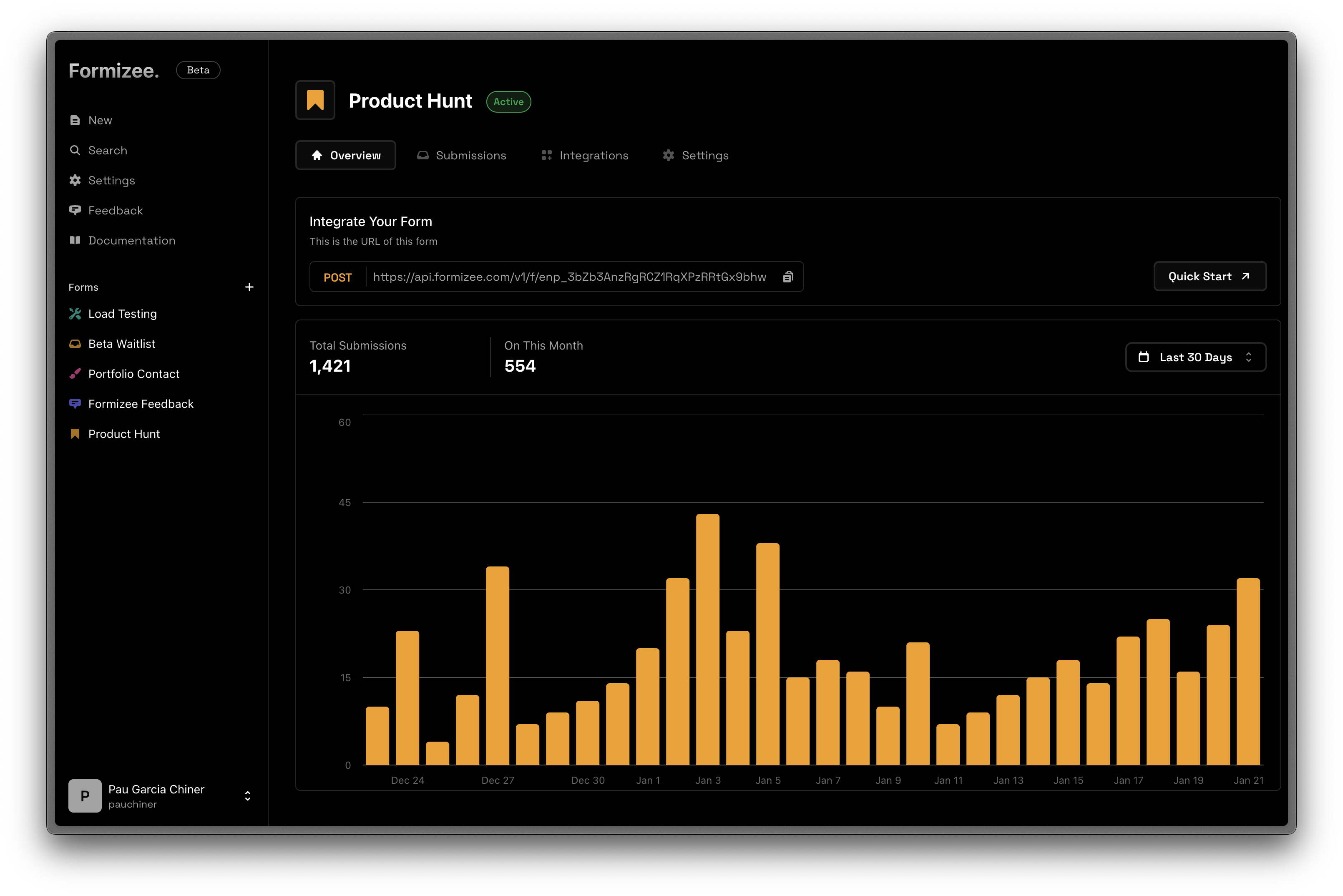
- A dashboard and web application built on Next.js with shadcn-ui components and Tailwind styling.
- A typed API layer using tRPC over a Hono backend framework.
- Persistence through a Libsql SQLite client and Drizzle ORM, with Turso used as the edge database and Cloudflare hosting the API and vault.
- Operational services wired into the reference deployment: BetterStack for the status page, Sentry for error logging and Stripe for payments.
Who uses it and how
- Developers who embed forms in their own sites and want submissions and emails routed through infrastructure they operate rather than a third-party form endpoint.
- Small teams willing to deploy the Next.js web and dashboard tier on Vercel and the API and vault tier on Cloudflare, matching the maintainers' documented hosting layout.
- Product and growth work that needs form submission metrics, which are collected in ClickHouse rather than a general-purpose application database.
- Contributors working on the codebase, who are asked to read CONTRIBUTING.md before starting any work.
- Organisations needing features beyond the standard offering, who are directed to email [email protected] about a custom plan.
Getting started
The README does not print an install command; it directs readers to the detailed local development guide at https://docs.formizee.com/contributing/getting-started and states that contributors should read CONTRIBUTING.md first. A hosted option is available at https://formizee.com for those who prefer not to run the stack locally.
How it compares
The GitHub description names three paid hosted products as the alternatives this project replaces: formspree.io, formcarry.com and formester.com. Formizee differs on licence and deployment, since it ships source under Apache-2.0 and can be self-hosted, while the three named alternatives are reached as third-party hosted services. That distinction matters most for data ownership, because submission content and delivery credentials stay on the operator's own database, SMTP relay and vault rather than a vendor's, and for the cost model, because the project can be run at infrastructure cost instead of as a subscription. The repository does not state pricing for the named alternatives, and no such figures should be assumed.
When to use it — and when not to
A self-hoster takes on the full surface of the reference architecture: the Next.js dashboard, the Hono API, a Libsql or Turso database, ClickHouse or Tinybird for analytics, an SMTP relay for delivery, Auth.js authentication, and optional Sentry and Stripe integrations — a meaningful operational load for what is often assumed to be a small form component. Teams without anyone to run that infrastructure, or non-technical users who expect a turnkey hosted product with no deployment step, should look elsewhere. The README is also thin: it contains no install command, no configuration reference and no environment variable list, deferring entirely to an external documentation site, and the project is small at 185 stars, 18 forks and a single open issue, with the most recent push in July 2025, so long-term maintenance support is not guaranteed by the facts here.
project readme (upstream, from github) — read inline


The Open-Source Form Platform.
Formizee is the modern approach to create forms.
Design, build and analytics all at an affordable price,
all-in-one solution
Discord
.
Website
·
Issues

Why I Built This?
Formizee was built because I’m passionate about open source and the beauty of software crafted with care.
To me, web forms are such a common need that they should be simple, affordable, and powered by modern, reliable technology—not left behind on outdated servers.
That’s why I’ve poured so much energy into making Formizee innovative, fast, and full of thoughtful features.
Tech Stack
Hosting Providers
Contributing
Please read through our contributing guide before starting any work.
Local Development
Follow our detailed guide to run Formizee locally.
Sponsors
If you want to appear here, sponsor this project!

Contact us
If you are interested in our custom plan or need special features, please
email us at [email protected]