What it is
Flarum is an open-source forum software project for building and running online community discussions on a website. It is positioned as a simple discussion platform with a fast interface and a PHP-based application, and it is distributed under the MIT License. It lives in the PHP web-application ecosystem, and its topics include forum, Laravel, and PHP.
The concrete problem it addresses is the need for a community operator to host a fast, responsive, and extensible discussion forum without adopting a cluttered or complex platform. Flarum is described as forum software for humans, with an interface that is intended to be consistent and intuitive across platforms out of the box. Its stated goal is to provide the features needed to run a successful community while keeping deployment simple and extensible.
Key capabilities
- Provides a forum-style discussion platform for a website, aimed at online communities.
- Uses PHP for the application foundation and Mithril for the JavaScript interface, as stated in the README.
- Offers a responsive design intended to work consistently across platforms without additional setup.
- Supports customization, extension, and integration through an Extension API.
- Presents itself as a simple architecture that avoids clutter, bloat, and complex dependencies.
- Supplies installation guidance through official documentation and community support channels.
- Is maintained as open-source software under the MIT License.
Who uses it and how
- Community operators install Flarum on a website to host discussions for their members.
- Self-hosters follow the installation guide and documentation to deploy the PHP application.
- Developers extend or integrate the forum through the Extension API to fit a specific community.
- Contributors work on the broader project through flarum/core, while the repository described here holds the skeleton application.
- Users seek support through the documentation, community forum, or Discord chat.
Getting started
The README directs users to the official installation guide and documentation to get started with Flarum. It does not mention a Docker image, package manager, hosted option, or specific database, storage, or SMTP requirements.
When to use it — and when not to
Use Flarum when a community wants open-source forum software in the PHP ecosystem and is prepared to read the installation guide and operate the application itself. Avoid it when a team expects the README to provide a one-command deployment path, hosted service details, or explicit infrastructure requirements, because those facts are not present. Also consider that most development happens in flarum/core rather than in the skeleton repository described here.
project readme (upstream, from github) — read inline




About Flarum
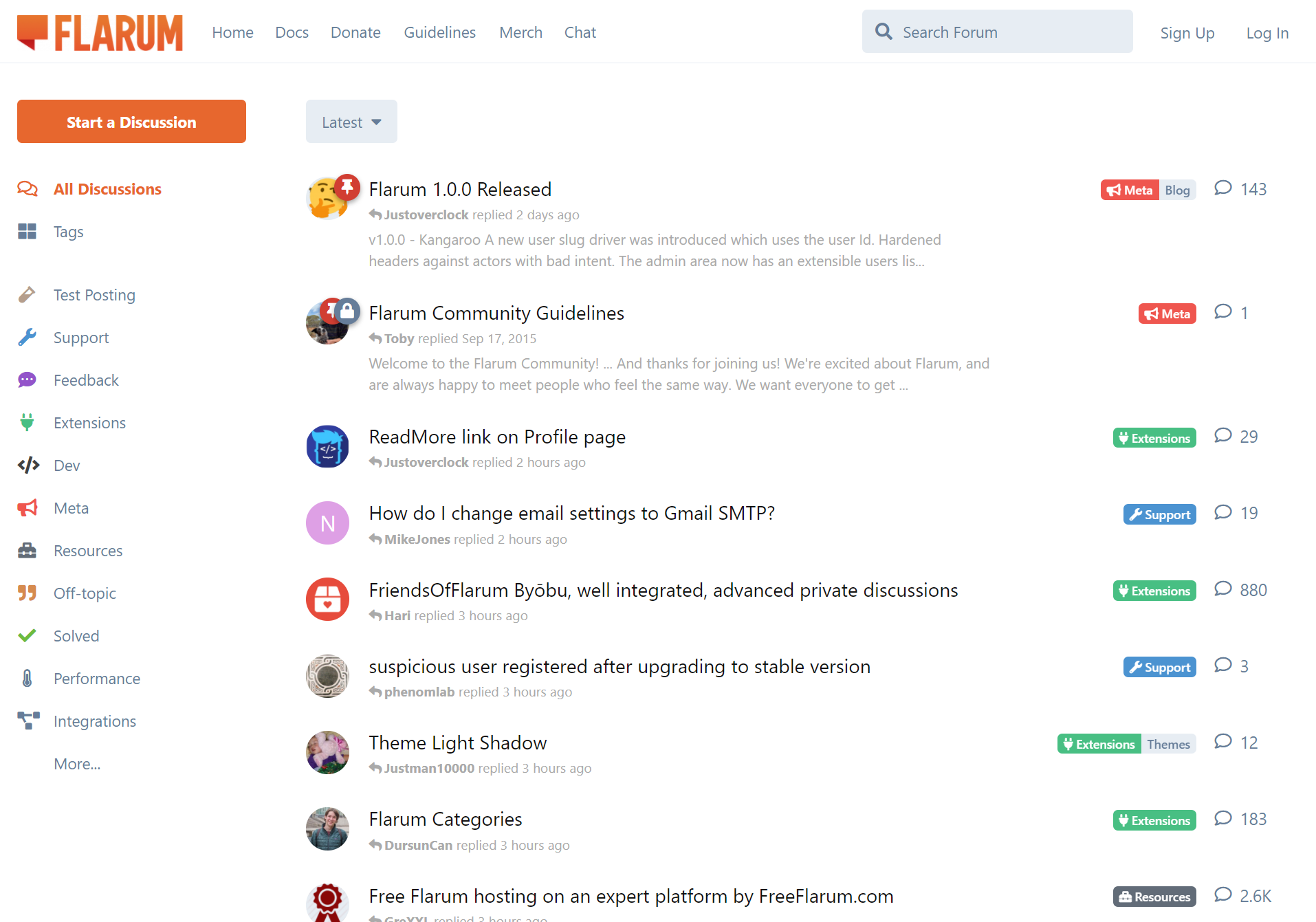
Flarum is a delightfully simple discussion platform for your website. It's fast and easy to use, with all the features you need to run a successful community. It is designed to be:
Fast and simple. No clutter, no bloat, no complex dependencies. Flarum is built with PHP so it’s quick and easy to deploy. The interface is powered by Mithril, a performant JavaScript framework with a tiny footprint.
Beautiful and responsive. This is forum software for humans. Flarum is carefully designed to be consistent and intuitive across platforms, out-of-the-box.
Powerful and extensible. Customize, extend, and integrate Flarum to suit your community. Flarum’s architecture is amazingly flexible, with a powerful Extension API.
Installation
Read the Installation guide to get started. For support, refer to the documentation, and ask questions on the community forum or Discord chat.
Contributing
Thank you for considering contributing to Flarum! Please read the Contributing guide to learn how you can help.
This repository only holds the Flarum skeleton application. Most development happens in flarum/core.
Security Vulnerabilities
If you discover a security vulnerability within Flarum, please follow our security policy so we can address it promptly.
License
Flarum is open-source software licensed under the MIT License.