




Actor model for Go. Build distributed systems without the distributed systems headache.
Goroutines and channels work great until your system grows. Then come the mutexes, the race conditions, the service discovery configs, the retry logic, the connection pool management. Ergo replaces all of that with one model: isolated processes that communicate through messages, supervised automatically, addressable across any cluster.
Inspired by Erlang/OTP. Zero external dependencies. Pure Go.
The core idea in 30 seconds
type Counter struct {
    act.Actor
    count int
}

type MessageInc struct{}

func (c *Counter) HandleMessage(from gen.PID, msg any) error {
    switch msg.(type) {
    case MessageInc:
        // safe without locks even with thousands of concurrent senders:
        // messages are processed one at a time
        c.count++
        c.Log().Info("count: %d", c.count)
    }
    return nil
}

func factory_Counter() gen.ProcessBehavior { return &Counter{} }

// Start a node and spawn the actor
node, _ := ergo.StartNode("mynode@localhost", gen.NodeOptions{})
pid, _ := node.Spawn(factory_Counter, gen.ProcessOptions{})

// Same API whether local or on another continent
node.Send(pid, MessageInc{})
node.Send(pid, MessageInc{})
No locks. No race conditions. Sequential message handling is the guarantee.
Why not just goroutines + channels?
| Goroutines + channels | Ergo | |
|---|---|---|
| Shared state | You manage with mutexes | No shared state by design |
| Failure recovery | Manual | Supervision trees restart automatically |
| Cross-node messaging | Build it yourself | Same API, transparent |
| Service discovery | External tool needed | Built in |
| Race conditions | Possible | Impossible within a process |
What you can build
Real-time backends. Each WebSocket connection becomes an addressable actor. Any node in your cluster can push to any specific client. No pub/sub intermediaries.
IoT platforms. One actor per device. Thousands of devices per node. Supervisors restart failed device actors automatically.
Multi-agent AI systems. Each agent is an isolated actor with a mailbox. Crash isolation, supervision, distributed addressability, and an MCP endpoint served by Observer that opens the running cluster to any AI assistant (Claude Code, Cursor, and other MCP-compatible clients). See AI Agents for patterns and diagnostics.
Financial and event-driven systems. Four priority queues per mailbox, guaranteed delivery, no dropped messages.
Distributed Pub/Sub across the cluster. Producer registers an event once; any process on any node subscribes. The framework delivers one network message per node, not per subscriber. 1M subscribers across 10 nodes cost 10 network messages, not 1M.
// Producer on any node
token, _ := producer.RegisterEvent("prices", gen.EventOptions{})
producer.SendEvent("prices", token, PriceUpdate{Asset: "BTC", Price: 95000})

// Subscriber on any other node, identical API
process.MonitorEvent(gen.Event{Name: "prices", Node: "producer@host"})

func (s *Sub) HandleEvent(event gen.MessageEvent) error {
    fmt.Println(event.Message.(PriceUpdate))
    return nil
}
Performance
- 25M+ messages/second locally
- ~5.8M messages/second over the network
- Distributed Pub/Sub: 2.9M msg/sec delivery to 1,000,000 subscribers across 10 nodes
Lock-free queues. Processes sleep when idle. No CPU wasted.
The numbers come from make bench, which measures four scenarios: one process
sending to one process, and one pair per CPU, each on a single node and across a
connection between two nodes. msg/sec is the rate messages are carried end to
end - the send loops included, not the rate Send is called at.
On an AMD Ryzen Threadripper 3970X (32 cores, 64 threads):
$ make bench
go test -run XXX -bench . -benchmem -benchtime 5s ./testing/benchmarks/...
goos: linux
goarch: amd64
pkg: ergo.services/ergo/testing/benchmarks/ping
cpu: QEMU Virtual CPU version 2.5+
BenchmarkLocal11-64        14633359     459.0 ns/op    2178526 msg/sec     58 B/op    2 allocs/op
BenchmarkLocalNN-64       143445265      39.08 ns/op  25591080 msg/sec     69 B/op    2 allocs/op
BenchmarkNetwork11-64       6348997     908.9 ns/op    1100193 msg/sec    776 B/op    6 allocs/op
BenchmarkNetworkNN-64      34500532     172.2 ns/op    5807413 msg/sec    150 B/op    6 allocs/op
PASS
On an Apple M4 Max (14 cores: 10 performance, 4 efficiency):
$ make bench
go test -run XXX -bench . -benchmem -benchtime 5s ./testing/benchmarks/...
goos: darwin
goarch: arm64
pkg: ergo.services/ergo/testing/benchmarks/ping
cpu: Apple M4 Max
BenchmarkLocal11-14        31014296     191.4 ns/op    5224960 msg/sec     58 B/op    2 allocs/op
BenchmarkLocalNN-14       100000000      64.97 ns/op  15390843 msg/sec     72 B/op    2 allocs/op
BenchmarkNetwork11-14      13759047     431.2 ns/op    2319322 msg/sec    262 B/op    6 allocs/op
BenchmarkNetworkNN-14      27716260     193.6 ns/op    5166431 msg/sec    137 B/op    6 allocs/op
PASS
The two machines answer two different questions. A single pair costs 191ns per message on the M4 Max against 459ns on the Threadripper - that is per-core speed. Aggregate throughput goes the other way: 25.6M msg/sec against 15.4M, because there are 64 threads to fill instead of 14. What does not move is the allocation count: 2 allocations per local message and 6 per message that crosses the network, on both machines.
The cpu: line of the Linux run reports the hypervisor's string; the hardware
underneath is the Threadripper.
Full benchmarks: benchmarks repository.
Observer
Observer is a real-time web UI for monitoring and inspecting Ergo nodes. It provides live visibility into every layer of the system:
- Processes - full process list with state, mailbox depth, latency, running time, wakeups, and uptime. Click any process to inspect its supervision tree, links, monitors, aliases, environment, and internal actor state
- Applications - running applications with their process trees, modes, and uptime
- Network - cluster topology, per-node connection details, traffic counters, and protocol info
- Events - registered events with producer, subscriber counts, and publication statistics
- Logs - live log stream with level filtering across the cluster
- Profiler - goroutine dump with grouping and stack traces, heap profile with allocation breakdown, and GC pressure charts
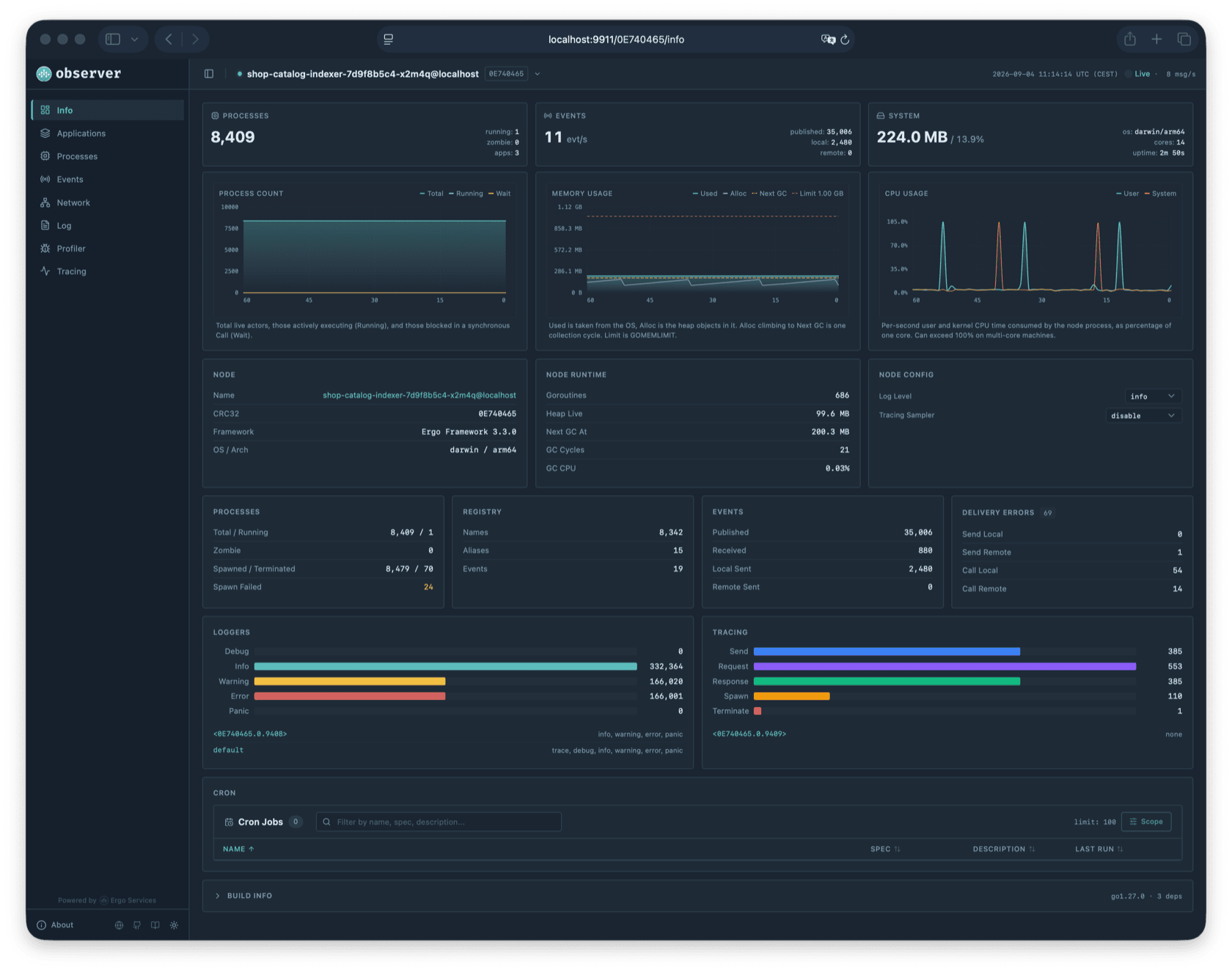
Add Observer to your node as an application:
import "ergo.services/application/observer"

options.Applications = []gen.ApplicationBehavior{
    observer.CreateApp(observer.Options{}),
}
To see it in action with a fully loaded cluster, see the observability example. For more information, visit the Observer documentation.
Features
Actor Model: isolated processes communicate through message passing, handling messages sequentially with four priority queues. Supports asynchronous messaging and synchronous request-response, with per-process mailbox latency measurement (
-tags=latency) for production diagnostics.Network Transparency: actors interact the same way whether local or remote. Uses EDF (Ergo Data Format), a custom binary serialization with type caching, pointer support, and message versioning for seamless upgrades. Includes connection pooling, compression, message fragmentation, and application-level keepalive for silent failure detection.
Supervision Trees: hierarchical fault recovery where supervisors monitor child processes