


Elementary Data is a free, open source data engineering & integration project written in HTML and released under Apache-2.0. It has 2,410 GitHub stars, 226 forks and 12 open issues, and was last pushed 17 hours ago. On this registry it ranks #22 of 39 tracked projects in Data Engineering & Integration, with 5 head-to-head comparisons available. It gained 4 stars over the last 6 tracked days.

What is Elementary Data?

What it is

Elementary Data is an open-source, dbt-native data observability tool for data and analytics engineers. It lives in the dbt and modern data warehouse ecosystem, and it is distributed as a CLI that works alongside the Elementary dbt package. The project is licensed under Apache-2.0, is written primarily in HTML, and is maintained by the Elementary team with a homepage at elementary-data.com and documentation at docs.elementary-data.com.

The concrete problem it solves is visibility into data pipelines that have already been built and tested. The CLI connects to a warehouse and reads the metadata, artifacts, and test results that the Elementary dbt package collects during dbt runs. From that material it generates a data observability report, surfaces anomalies and failed tests, sends alerts to Slack and Microsoft Teams, and tracks model and test performance trends over time. Instead of assembling a separate monitoring stack, teams get observability output derived from the dbt code and runs they already have.

Key capabilities

  • Anomaly detection tests that collect data quality metrics and detect anomalies as native dbt tests.
  • End-to-end data lineage enriched with the latest test results, for impact and root cause analysis of data issues.
  • A data quality dashboard that serves as a single interface for monitoring and test results.
  • Models performance monitoring that tracks model and job run results and performance over time.
  • Configuration-as-code, with Elementary configuration managed inside the dbt code.
  • Alerts with actionable messages, custom channels, and tagging of owners.
  • A dbt artifacts uploader that saves metadata and run results as part of dbt runs.

Who uses it and how

  • Analytics engineers who want data quality checks expressed as dbt tests rather than in a separate tool.
  • Data teams that need failed tests and anomalies routed to Slack or Microsoft Teams with owner tagging.
  • Teams performing root cause and impact analysis by combining lineage with the latest test results.
  • Organizations monitoring model and job performance trends across repeated dbt runs.
  • Teams that want a data catalog view of dataset descriptions, columns, and dataset health.

Getting started

The README points to the quickstart guide at docs.elementary-data.com/oss/quickstart, which covers installing and configuring the Elementary dbt package together with the CLI. The README does not name a Docker image, package manager, or other distribution channel.

When to use it — and when not to

Elementary OSS is the right fit when the goal is a dbt-native observability report with Slack and Teams alerts, and when configuration-as-code inside dbt is acceptable. Teams that need automated ML monitoring

project readme (upstream, from github) — read inline

Logo

License Downloads

Elementary OSS: dbt-native data observability

Docs » | Join the Elementary Community »

⭐️ Star the repo


Built by the Elementary team, helping you deliver trusted data in the AI era.

Elementary OSS is the open-source CLI for dbt-native data observability. It works with the Elementary dbt package to generate the basic Elementary observability report and send alerts to Slack and Microsoft Teams.

For teams that need data reliability at scale, we offer Elementary Cloud, a full Data & AI Control Plane with automated ML monitoring, column-level lineage from source to BI, a built-in catalog, and AI agents that scale reliability workflows for both engineers and business users.
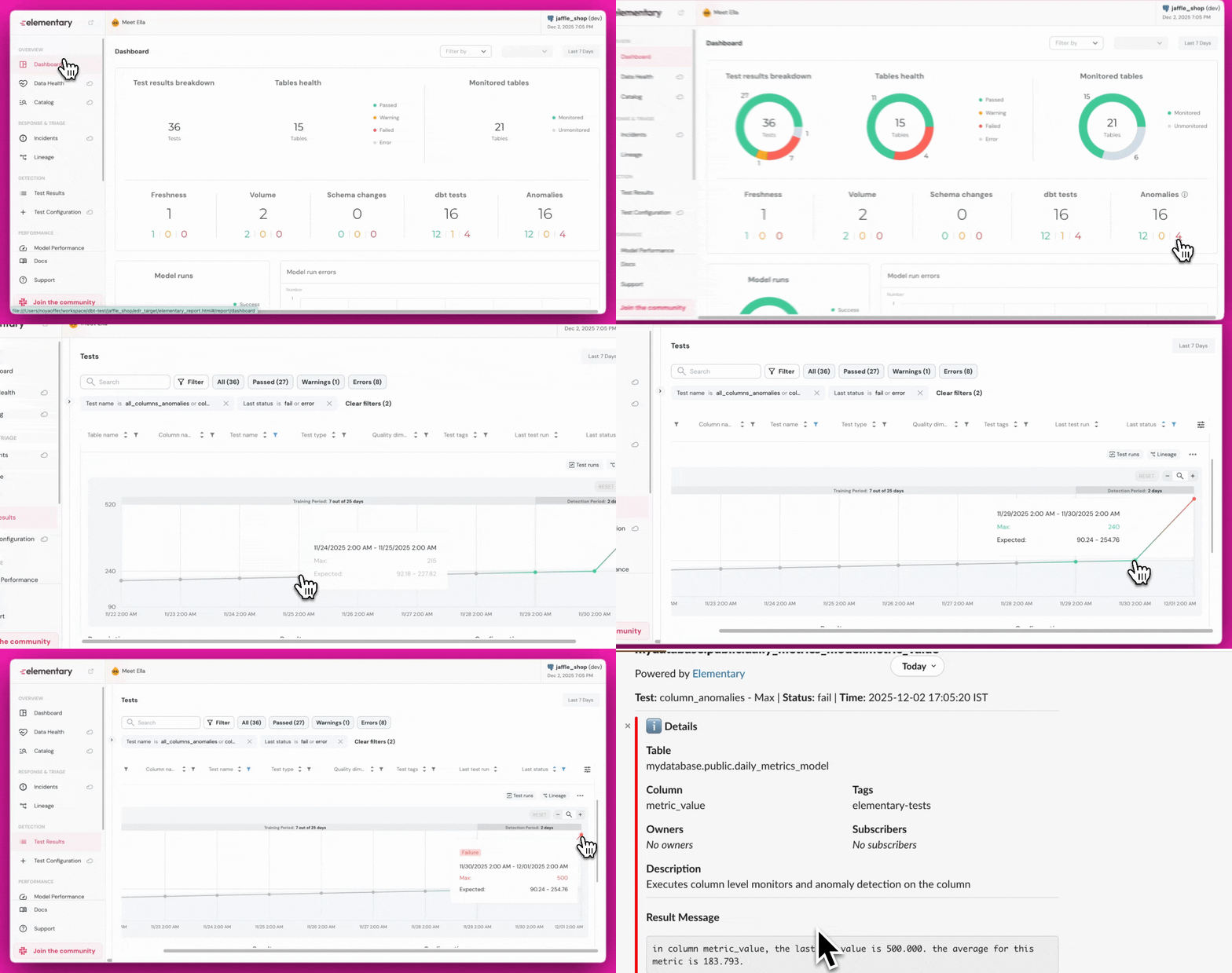
Demo

How It Works

Elementary OSS connects to your warehouse and reads the metadata, artifacts, and test results collected by the Elementary dbt package.
With this information, it can:

  • Generate a data observability report
  • Surface anomalies and failed tests
  • Send alerts to Slack and Teams
  • Track model and test performance trends

Quickstart

Follow the quickstart guide to install and configure the Elementary dbt package and CLI:

👉 https://docs.elementary-data.com/oss/quickstart

Features

  • Anomaly detection tests - Collect data quality metrics and detect anomalies, as native dbt tests.
  • Automated monitors - Out-of-the-box cloud monitors to detect freshness, volume and schema issues.
  • End-to-End Data Lineage - Enriched with the latest test results, for impact and root cause analysis of data issues. Elementary Cloud offers Column-Level-Lineage from ingestion to BI.
  • Data quality dashboard - Single interface for all your data monitoring and test results.
  • Models performance - Monitor models and jobs run results and performance over time.
  • Configuration-as-code - Elementary configuration is managed in your dbt code.
  • Alerts - Actionable alerts including custom channels and tagging of owners.
  • Data catalog - Explore your datasets information - descriptions, columns, datasets health, etc.
  • dbt artifacts uploader - Save metadata and run results as part of your dbt runs.
  • AI-Powered Data Tests & Unstructured Data Validations - Validate and monitor data using AI powered tests to validate both structured and unstructured data

Support

For additional information and help:

Elementary contributors: ✨

<img src="https://avatars.githubusercontent.com/u/4525500?v=4" width=

readme truncated — read the full docs on github

Frequently asked questions

Is Elementary Data free to use?

Elementary Data is open source under the Apache-2.0 licence. There is no licence fee and no seat count — you can self-host it or, where the project offers one, pay a vendor for a managed version instead.

What does Elementary Data do?

Data observability for modern data teams

What is Elementary Data written in?

Elementary Data is primarily written in HTML. Its source is publicly available at https://github.com/elementary-data/elementary, and it has 2,410 GitHub stars.