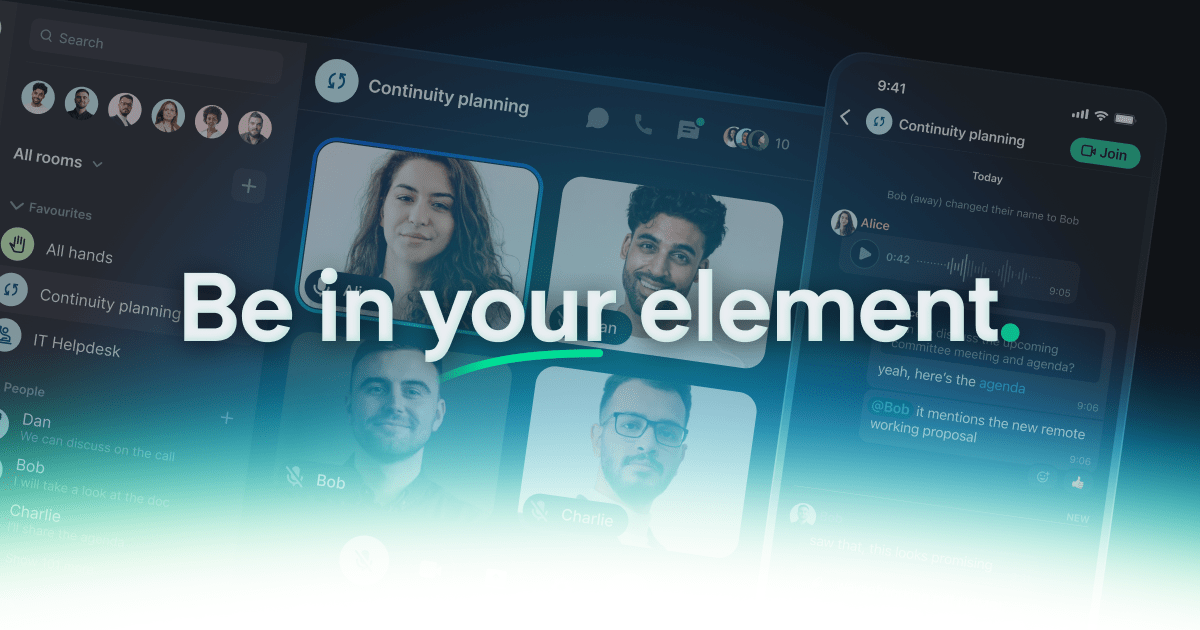




Element is a free, open source data security & privacy project written in TypeScript and released under AGPL-3.0. It has 13,461 GitHub stars, 2,759 forks and 3,779 open issues, and was last pushed 6 hours ago. On this registry it ranks #5 of 14 tracked projects in Data Security & Privacy, and is listed as an open source replacement for 2 paid products, with 5 head-to-head comparisons available. It gained 13 stars over the last 6 tracked days.

Element — Secure, decentralized messaging for teams and individuals

What is Element?

What it is

Element is a Matrix collaboration client for the web and desktop, and its tagline describes it as secure, decentralized messaging for teams and individuals. It is built with the Matrix JS SDK and lives in the Matrix ecosystem as an open alternative to Slack and Google Meet.

The project addresses the need for a browser-based and desktop-based Matrix client that teams and individuals can host, deploy, and operate without depending only on proprietary messaging or meeting products. Element Web is a TypeScript project under the AGPL-3.0 license, and it can be used through a hosted copy, a self-hosted installation, or an Electron desktop application.

Key capabilities

  • Element provides Matrix-based messaging and collaboration for web and desktop clients.
  • It is built on the Matrix JS SDK, connecting it to the broader Matrix ecosystem.
  • Element can run as a desktop application wrapped in Electron on macOS, Windows, and Linux.
  • It supports recent major desktop browsers, including the last two major versions of Chrome, Firefox, and Edge, and the last two versions of Safari.
  • It offers tiered compatibility for Firefox ESR, Chrome or Edge Extended Stable, and mobile web on Android, iOS, and iPadOS.
  • It can be self-hosted from the installation documentation, and the develop branch is continuously deployed for early access.

Who uses it and how

  • Teams and individuals use Element for Matrix-based messaging and collaboration in a browser or desktop app.
  • Users can start with the hosted copy for quick testing, or use the continuously deployed develop branch for early access.
  • Organizations can install Element Web as their own instance using the project's installation documentation.
  • Desktop users run the Electron-wrapped application on supported desktop operating systems, while mobile users can access mobile web, although the README recommends native element-x-android and element-x-ios apps for Android and iOS devices.

Getting started

The README points users to a hosted copy for quick testing, a continuously deployed develop branch for early access, and the Installing Element Web documentation for self-hosting. Element can also run as a desktop application wrapped in Electron, using a pre-built version or a self-built version.

When to use it — and when not to

Element is a good fit when a Matrix-based open alternative to Slack or Google Meet matches the organization's browser support needs and deployment model. It is less suitable when mobile web must be first-class or when Element Call and other sibling features must be guaranteed on best-effort browsers, because those environments are supported only on a best-effort or community basis. The provided facts do not specify required database, storage, SMTP, or other backing services, so self-hosters must consult the installation documentation before planning operations.

project readme (upstream, from github) — read inline

Chat Tests Static Analysis Localazy Quality Gate Status Coverage Vulnerabilities Bugs

Element

Element (formerly known as Vector and Riot) is a Matrix web & desktop client built using the Matrix JS SDK.

Supported Environments

Element has several tiers of support for different environments:

  • Supported
    • Definition:
      • Issues actively triaged, regressions block the release
    • Last 2 major versions of Chrome, Firefox, and Edge on desktop OSes
    • Last 2 versions of Safari
    • Latest release of official Element Desktop app on desktop OSes
    • Desktop OSes means macOS, Windows, and Linux versions for desktop devices that are actively supported by the OS vendor and receive security updates
  • Best effort
    • Definition:
      • Issues accepted, regressions do not block the release
      • The wider Element Products (including Element Call and the Enterprise Server Suite) do still not officially support these browsers.
      • The element web project and its contributors should keep the client functioning and gracefully degrade where other sibling features (E.g. Element Call) may not function.
    • Last major release of Firefox ESR and Chrome/Edge Extended Stable
  • Community Supported
    • Definition:
      • Issues accepted, regressions do not block the release
      • Community contributions are welcome to support these issues
    • Mobile web for current stable version of Chrome, Firefox, and Safari on Android, iOS, and iPadOS
  • Not supported
    • Definition: Issues only affecting unsupported environments are closed
    • Everything else

The period of support for these tiers should last until the releases specified above, plus 1 app release cycle(2 weeks). In the case of Firefox ESR this is extended further to allow it land in Debian Stable.

For accessing Element on an Android or iOS device, we currently recommend the native apps element-x-android and element-x-ios.

Getting Started

The easiest way to test Element is to just use the hosted copy at . The develop branch is continuously deployed to for those who like living dangerously.

To host your own instance of Element see Installing Element Web.

To install Element as a desktop application, see Running as a desktop app below.


Monorepo

This repository is a monorepo hosting Element Web and other related projects in various subdirectories. You can read more about the structure here.

Element Web

To learn more about Element Web click here

Running as a Desktop app

Element can also be run as a desktop app, wrapped in Electron. You can download a pre-built version from or, if you prefer, build it yourself.

To build it yourself, follow the instructions at .

Many thanks to @aviraldg for the initial work on the Electron integration.

The configuration docs show how to override the desktop app's default settings if desired.

Development

Please read through the following:

  1. Developer guide
  2. Code style
  3. Contribution guide

Translations

To add a new translation, head to the translating doc.

For a developer guide, see the translating dev doc.

Triaging issues

Issues are triaged by community members and the Web App Team, following the triage process.

We use issue labels to sort all incoming issues.

Copyright & License

Copyright (c) 2014-2017 OpenMarket Ltd Copyright (c) 2017 Vector Creations Ltd Copyright (c) 2017-2025 New Vector Ltd

This software is multi licensed by New Vector Ltd (Element). It can be used either:

(1) for free under the terms of the GNU Affero General Public License (as published by the Free Software Foundation, either version 3 of the License, or (at your option) any later version); OR

(2) for free under the terms of the GNU General Public License (as published by the Free Software Foundation, either version 3 of the License, or (at your option) any later version); OR

(3) under the terms of a paid-for Element Commercial License agreement between you and Element (the terms of which may vary depending on what you and Element have agreed to). Unless required by applicable law or agreed to in writing, software distributed under the Licenses is distributed on an "AS IS" BASIS, WITHOUT WARRANTIES OR CONDITIONS OF ANY KIND, either express or implied. See the Licenses for the specific language governing permissions and limitations under the Licenses.

Please contact [email protected] to purchase an Element commercial license for this software.

Frequently asked questions

Is Element free to use?

Element is open source under the AGPL-3.0 licence. There is no licence fee and no seat count — you can self-host it or, where the project offers one, pay a vendor for a managed version instead.

What does Element do?

Secure, decentralized messaging for teams and individuals

What is Element written in?

Element is primarily written in TypeScript. Its source is publicly available at https://github.com/element-hq/element-web, and it has 13,461 GitHub stars.

What is a good open source alternative to Google Meet?

Element is one of the open source options listed as an alternative to Google Meet, Slack. Compare licences, stars and activity side by side on the Element profile.