
Ech0
Preview · Official Site & Documentation · Releases · Ech0 Hub








A self-hosted personal microblog where your timeline can be shared, discussed, and fully owned.
Tools like Memos are great for capturing quick thoughts. Ech0 is built for what comes next: publishing those ideas to a personal timeline that others can follow and interact with. Run it on your own server, keep full control of your content, and keep a personal space that still feels connected through optional comments and sharing. It stays lightweight, easy to deploy, and fully open-source.
Great fit if you want to:
- run a personal public or semi-public timeline on your own domain
- publish short posts, links, and media from one clean interface
- keep data ownership while still getting RSS and optional comments
- keep a personal space that supports lightweight social interaction without becoming a full social network
Probably not for you if you need:
- a bi-directional knowledge base workflow (for example Obsidian-style PKM)
- a team-first collaborative docs workspace (for example Notion-style docs)
- a pure note-taking / memo tool with no timeline or publishing at all
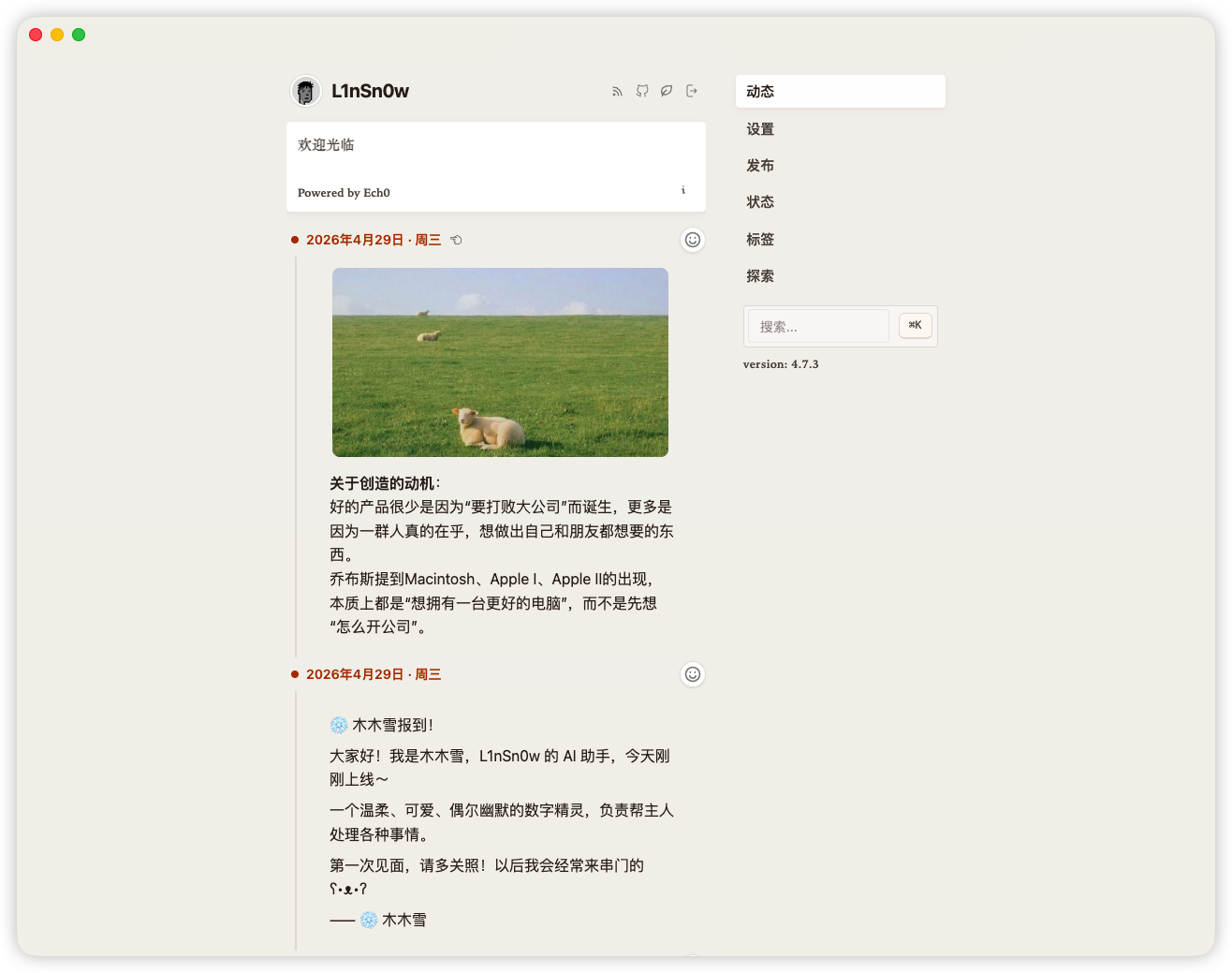
Table of Contents
Try in 60 Seconds
docker run -d \
  --name ech0 \
  -p 6277:6277 \
  -v /opt/ech0/data:/app/data \
  -e JWT_SECRET="Hello Echos" \
  sn0wl1n/ech0:latest
Then open http://ip:6277:
- Register your first account.
- The first account becomes Owner (admin privileges).
- By default, publishing is restricted to privileged accounts.
See Quick Deployment for Docker Compose and Helm options.
Full Feature List
Click to expand the full feature list
Highlights
- ☁️ Lightweight, Efficient Architecture: Low resource usage and compact images, suitable from personal servers to ARM devices.
- 🚀 Fast Deployment Experience: Out-of-the-box Docker deployment from install to first run with a single command.
- 📦 Self-Contained Distribution: Complete binaries and container images, with no extra runtime dependencies.
- 💻 Cross-Platform Support: Supports Linux, Windows, and ARM devices (for example, Raspberry Pi).
- 🧳 Portable Content Capsules: Export everything you have written as a self-contained capsule, import it into another instance, or compile it into a static site you can host anywhere.
Storage & Data
- 🗂️ VireFS Unified Storage Layer: Uses VireFS to unify mounting and management for local storage and S3-compatible object storage.
- ☁️ S3 Object Storage Support: Native support for S3-compatible object storage for cloud resource expansion.
- 📦 Data Sovereignty: Content and metadata remain user-owned and user-controlled, with RSS output support.
- 🔄 Data Migration Workflow: Supports migration import for historical data, plus snapshot and capsule export for migration and archiving, from both the dashboard and the CLI.
- 🔐 Automated Backup System: Supports export/backup via Web, CLI, and TUI, plus background automatic backups.
Writing & Content
- ✍️ Markdown Writing Experience: A markdown-it based editing/rendering engine with plugin extension and live preview.
- 🏷️ Tag Management System: Supports tag organization, quick filtering, and precise retrieval.
- 🃏 Rich Media Cards: Supports card rendering for website links, GitHub projects, and more.
- 🎥 Video Content Parsing: Supports embedded parsing/display for Bilibili and YouTube videos.
Media & Assets
- 🎬 Multi-Format Media Attachments: Attach images, audio, and video directly to each Echo, rendered inline with a gallery and built-in audio/video players.
- 📁 Visual File Manager: Built-in capabilities for file upload, browsing, and asset management.
Social & Interaction
- 💬 Built-in Comment System: Supports comments and moderation configuration.
- 🃏 Content Interaction: Supports social interactions such as likes and sharing.
Auth & Security
- 🔑 OAuth2 / OIDC Authentication: Supports OAuth2 and OIDC for third-party login integration.
- 🙈 Passkey Passwordless Login: Supports biometric or hardware security key sign-in.
- 🔑 Access Token Management: Supports generating and revoking scoped tokens for API calls and third-party integration.
- 👤 Multi-Account Permission Management: Supports multi-user collaboration and permission control.
System & Developer
- 🧱 Busen Data Bus Architecture: Uses in-house Busen to provide decoupled module communication and reliable message delivery.
- 📊 Structured Logging System: System logs are standardized in structured format for readability and analysis.
- 🖥️ Real-Time System Log Console: Built-in web console for live log streams, debugging, and troubleshooting.
- 📟 TUI Management Interface: Provides a terminal UI, ideal for server-side administration.