Dumpify






Improve productivity and debuggability by adding .Dump() extension methods to Console Applications.
Dump any object in a structured and colorful way into the Console, Trace, Debug events or your own custom output.
How to Install
The library is published as a Nuget
Either run dotnet add package Dumpify, Install-Package Dumpify or use Visual Studio's NuGet Package Manager
Overview Video
An overview video hosted on the Open at Microsoft show
Features
- Dump any object in a structured, colorful way to Console, Debug, Trace or any other custom output
- Support Properties, Fields and non-public members
- Support max nesting levels
- Support circular dependencies and references
- Support styling and customizations
- Highly Configurable
- Support for different output targets: Console, Trace, Debug, Text, Custom
- Fast!
Examples:
Anonymous types
new { Name = "Dumpify", Description = "Dump any object to Console" }.Dump();

Support nesting and circular references
var moaid = new Person { FirstName = "Moaid", LastName = "Hathot", Profession = Profession.Software };
var haneeni = new Person { FirstName = "Haneeni", LastName = "Shibli", Profession = Profession.Health };

moaid.Spouse = haneeni;
haneeni.Spouse = moaid;

moaid.Dump();
//You can define max depth as well, e.g `moaid.Dump(maxDepth: 2)`

Support for Arrays, Dictionaries and Collections
var arr = new[] { 1, 2, 3, 4 }.Dump();

var arr2d = new int[,] { {1, 2}, {3, 4} }.Dump();

new Dictionary<string, string>
{
   ["Moaid"] = "Hathot",
   ["Haneeni"] = "Shibli",
   ["Eren"] = "Yeager",
   ["Mikasa"] = "Ackerman",
}.Dump();

You can ensure that arrays, dictionaries and collections don't output too much by allowing results to be truncated. Do this by setting the MaxCollectionCount property in the TruncationConfig.
int[] arr = [1, 2, 3, 4, 5, 6, 7, 8, 9, 10];

// Outputs only the first 5 elements with a truncation marker
arr.Dump(truncationConfig: new TruncationConfig { MaxCollectionCount = 5 });
// Shows: 1, 2, 3, 4, 5, [... 5 more]

// You can also truncate from the tail (last N elements)
arr.Dump(truncationConfig: new TruncationConfig { MaxCollectionCount = 5, Mode = TruncationMode.Tail });
// Shows: [... 5 more], 6, 7, 8, 9, 10

// Or show both head and tail with truncation in the middle
arr.Dump(truncationConfig: new TruncationConfig { MaxCollectionCount = 6, Mode = TruncationMode.HeadAndTail });
// Shows: 1, 2, 3, [... 4 more], 9, 10
You can turn on or off fields and private members
public class AdditionValue
{
    private readonly int _a;
    private readonly int _b;

    public AdditionValue(int a, int b)
    {
        _a = a;
        _b = b;
    }

    private int Value => _a + _b;
}


new AdditionValue(1, 2).Dump(members: new MembersConfig { IncludeFields = true, IncludeNonPublicMembers = true });

You can provide a custom filter to determine if members should be included or not
public class Person
{
    public string Name { get; set; }

    [JsonIgnore]
    public string SensitiveData { get; set; }
}

// Filter by attribute - exclude members with [JsonIgnore]
new Person()
{
    Name = "Moaid",
    SensitiveData = "We don't want this to show up"
}.Dump(members: new MembersConfig { MemberFilter = ctx => !ctx.Member.Info.CustomAttributes.Any(a => a.AttributeType == typeof(JsonIgnoreAttribute)) });

// Filter by value - exclude null or empty values (NEW!)
new Person()
{
    Name = "Moaid",
    SensitiveData = null
}.Dump(members: new MembersConfig { MemberFilter = ctx => ctx.Value is not null });

// Filter by depth - only show top-level properties (NEW!)
myNestedObject.Dump(members: new MembersConfig { MemberFilter = ctx => ctx.Depth == 0 });
The MemberFilter receives a MemberFilterContext which provides:
ctx.Member- Access to member metadata (Name, Type, Attributes)ctx.Value- The actual value of the member (lazily evaluated)ctx.Source- The parent object containing the memberctx.Depth- The current nesting depth during rendering
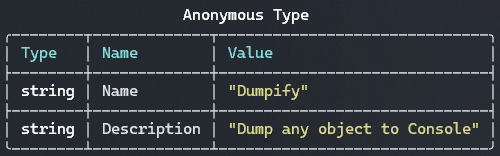
### You can turn on or off row separators and a type column
```csharp
//globally
DumpConfig.Default.TableConfig.ShowMemberTypes = true;
DumpConfig.Default.TableConfig.ShowRowSeparators = true;

new { Name = "Dumpify", Description = "Dump any object to Console" }.Dump();

//or Per dump
new { Name = "Dumpify", Description = "Dump any object to Console" }.Dump(tableConfig: new TableConfig { ShowRowSeparators = true, ShowMemberTypes = true });
Customize table border style
If tables look garbled in your terminal (VS Code, Windows Terminal, etc.), you can change the border style:
// Use ASCII borders for maximum compatibility
DumpConfig.Default.TableConfig.BorderStyle = TableBorderStyle.Ascii;

// Or use Square borders (simpler Unicode characters)
DumpConfig.Default.TableConfig.BorderStyle = TableBorderStyle.Square;

// Available styles: Rounded (default), Square, Ascii, None, Heavy, Double, Minimal, Markdown
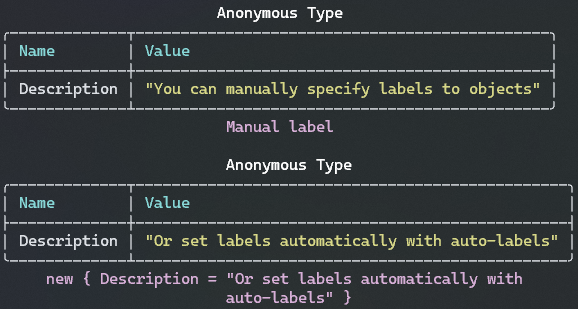
You can set custom labels or auto-labels
new { Description = "You can manually specify labels to objects" }.Dump("Manual label");

//Set auto-label globally for all dumps if a custom label wasn't provider
DumpConfig.Default.UseAutoLabels = true;
new { Description = "Or set labels automatically with auto-labels" }.Dump();
You can customize colors
var package = new { Name = "Dumpify", Description = "Dump any object to Console" };
package.Dump(colors: ColorConfig.NoColors);
package.Dump(colors: new ColorConfig { PropertyValueColor = new DumpColor(Color.RoyalBlue)});

You can turn on or off type names, headers, lables and much more
var moaid = new Person { FirstName = "Moaid", LastName = "Hathot", Profession = Profession.Software };
var haneeni = new Person { FirstName = "Haneeni", LastName = "Shibli", Profession = Profession.Health };
moaid.Spouse = haneeni;
haneeni.Spouse = moaid;

moaid.Dump(typeNames: new TypeNamingConfig { ShowTypeNames = false }, tableConfig: new TableConfig { ShowTableHeaders = false });

There are multiple output options (Console, Trace, Debug, Text) or provide your own
var package = new { Name = "Dumpify", Description = "Dump any object to Console" };
package.Dump(); //Similar to `package.DumpConsole()` and `package.Dump(output: Outputs.Console))`
package.DumpDebug(); //Dump to Visual Studio's Debug source
package.DumpTrace(); //Dump to Trace
var text = package.DumpText(); //The table in a text format

using var writer = new StringWriter();
package.Dump(output: new DumpOutput(writer)); //Custom output
Custom Type Handlers
You can register custom handlers to control how specif