Pipelines you own. Author and deploy to your servers or cloud.
Duckle is an open-source ETL platform for teams who want their pipelines running on their own infrastructure. Author on a canvas, in Python or in SQL, then ship the same file to your own server or cloud account: duckle-runner serve runs it headless on a schedule, in Docker or on a box you own, with a web console, roles and an audit trail. Every pipeline is one file in git, so it outlives whoever wrote it. It compiles to SQL on DuckDB and uses every core you give the box, so a bigger instance is a faster pipeline: 96 million rows out of Postgres to Parquet in 39.9s. No vendor cloud. No per-row billing. No lock-in.
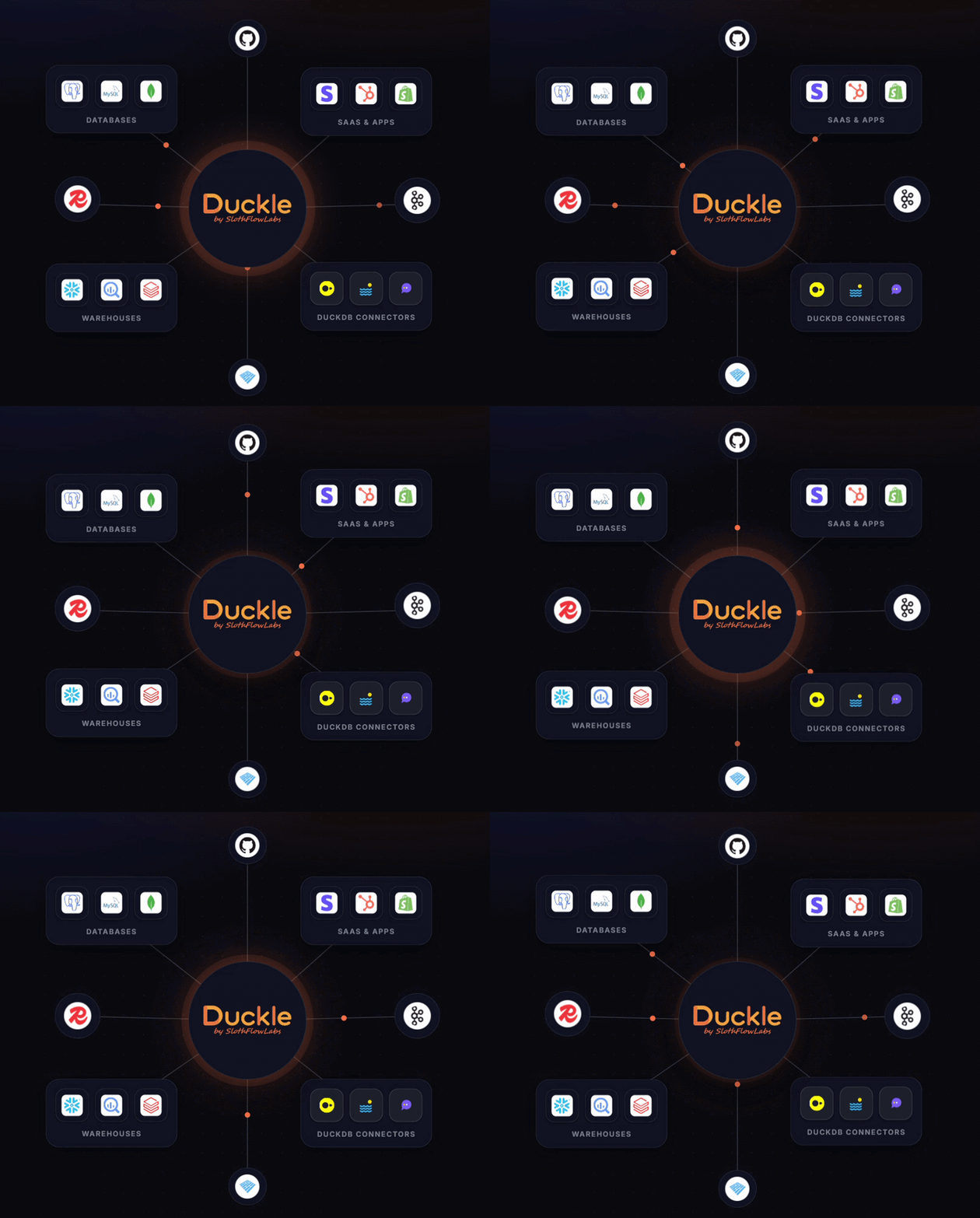
Duckle is an independent open-source project by SlothFlowLabs. It builds on the DuckDB engine but is not part of, affiliated with, or endorsed by DuckDB Labs or MotherDuck.






Star Duckle if it looks useful. It genuinely helps other data engineers find the project.
Quick links
Get started |
Use the product |
Reference |
Resources |
What is Duckle?
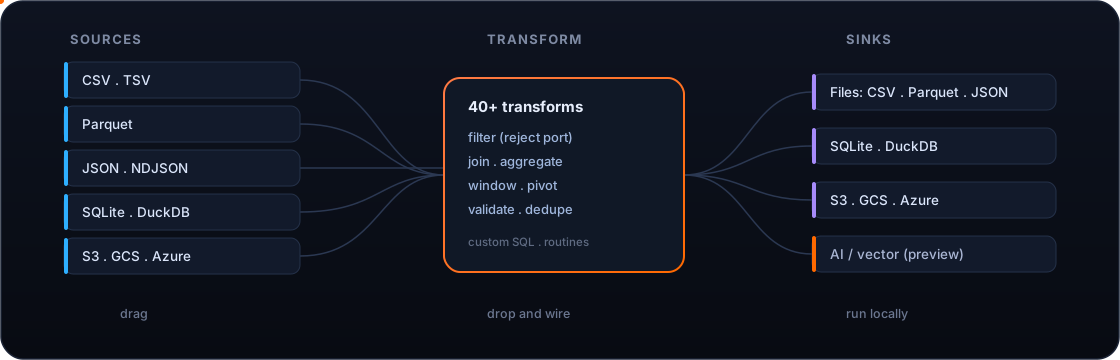
An open-source ETL platform you run on your own infrastructure. Drag sources, transforms, validators and sinks onto a canvas, wire them together, and press Run. Duckle compiles the graph to SQL and executes it on a real columnar engine, with live previews, the generated SQL visible on every node, and no hidden state.
You build a pipeline on a laptop and deploy that same file to a server, where it runs on a schedule under a web console with roles, alerts and an audit log. Nothing is rewritten in between, and nothing is metered.
In short: a free, open-source, single-engine alternative to hosted, per-row-priced ETL platforms like Fivetran and Airbyte - one pipeline for ingest, transform, and load that runs anywhere, and can also run dbt on DuckDB inside the same tool.
Three things set it apart:
- An AI assistant that ships in the box. Describe the pipeline you want in English; Duckie writes the JSON and drops it onto the canvas. The model runs wherever Duckle does - no API key, no telemetry, no vendor round-trip. Point it at your own OpenAI-compatible endpoint instead if you would rather it did not run in-process.
- 400+ components ready at install time. Files, lakehouses, SQL databases, warehouses, NoSQL, vector DBs, streaming brokers, SaaS REST/GraphQL APIs, even FTP and IMAP - working today, not coming-soon.
- A self-contained binary you can audit. 73 to 110 MB depending on your platform. Engines install on first launch. Workspaces are plain files in a folder you choose. Diff them, branch them, ship them.
Why Duckle is different
| Visual, never opaque | The canvas compiles to SQL you can read, and every node has a live preview tab. No black box. |
| An assistant with no API key | Runs in-process by default, or against your own OpenAI-compatible endpoint. Your prompts and your data stay inside your infrastructure either way. |
| Single-file binary, no bundled DB | 73 to 110 MB depending on platform (it embeds the headless runner + MCP server). DuckDB downloads on first launch with a guided step. AI engine is opt-in. |
| Native speed | Execution runs through DuckDB: vectorized, columnar, local. A clean-and-export job that crawls in a spreadsheet finishes in milliseconds. |
| Git-friendly by design | Pipelines, connections, contexts, and routines persist as plain files in a folder you pick. Diff them, branch them, review them. |
| 400+ components ready today | Files, databases, warehouses, lakehouses, object stores, SaaS APIs, NoSQL, streaming brokers, vector DBs, FTP, IMAP, SMTP. Each is covered by tests. |
| Honest about scope | Single-machine and embedded by design. Built to make local and small-team data work fast, not to replace a distributed warehouse. |
| 60 UI languages | Topbar, palette, chat assistant, properties panel, and common dialogs ship localized. English, Spanish, Chinese (Simplified + Traditional), Hindi, Arabic, Portuguese (Brazil), Bengali, Russian, Japanese, Punjabi, German, Korean, French, Vietnamese, Telugu, Marathi, Turkish, Tamil, Urdu, Persian, Polish, Italian, Ukrainian, Indonesian, Thai, Du |