dreamfactory is a free, open source api development & testing project written in Shell and released under Apache-2.0. It has 1,788 GitHub stars, 354 forks and 1 open issues, and was last pushed 1 months ago. On this registry it ranks #120 of 178 tracked projects in API Development & Testing, with 5 head-to-head comparisons available.

What is dreamfactory?

DreamFactory is a secure, self-hosted enterprise data access platform that generates governed REST and MCP APIs for the databases and file storage an organization already runs, built for enterprise development teams that need role-based API access without writing backend code.

What it is

DreamFactory is an open-source, self-hosted data access platform built on the Laravel framework and written primarily in PHP and Shell. It is distributed under the Apache-2.0 licence and lives in the PHP/Laravel ecosystem, sitting under the Developer Tools / API Development & Testing category. The platform connects to a data source, introspects its schema, and generates a complete REST API with full CRUD operations, relationship handling, stored procedure access, and OpenAPI/Swagger documentation — all in minutes. Alongside REST, it exposes an MCP server so that enterprise applications and on-premises LLMs can reach the same data through governed endpoints with role-based access and identity passthrough.

The concrete problem it solves is the hand-written CRUD layer. A team with an existing MySQL, PostgreSQL, SQL Server, or MongoDB database would normally build controllers, serializers, validation, pagination, and documentation by hand before any frontend, mobile app, or AI model can read the data. DreamFactory replaces that hand-coded CRUD API with auto-generated, documented endpoints, and it wraps legacy SQL Server stored procedures, Oracle databases, and mainframe data in modern REST APIs instead of forcing a rewrite.

Key capabilities

  • Automatic REST API creation for SQL and NoSQL databases, requiring no application code.
  • OpenAPI/Swagger documentation generated automatically for every endpoint.
  • Stored procedure and function support, exposing database logic as API endpoints.
  • Related data retrieval, server-side filtering, sorting, and pagination, plus bulk insert, update, and delete on every endpoint.
  • Role-based access control (RBAC) with granular permissions per table, endpoint, and HTTP verb, together with API key management, rate limiting, audit logging, SSO via SAML 2.0, OAuth 2.0, OpenID Connect, Azure AD, and LDAP/Active Directory, and field-level data masking.
  • Server-side scripting in PHP, Python, or Node.js, including pre- and post-process event scripts, webhook and event broadcasting, and custom service creation.
  • An MCP server that gives ChatGPT, Claude, or local LLMs governed access to enterprise data.

Who uses it and how

  • API-first development teams generating REST APIs for existing databases without writing backend code.
  • Organizations modernizing legacy systems by wrapping SQL Server stored procedures, Oracle databases, and mainframe data in REST APIs.
  • Teams connecting ChatGPT, Claude, or local LLMs to enterprise data through MCP or REST APIs with governed access controls.
  • Mobile and web application teams that need secure, role-based data access for frontend clients.
  • Data integration teams combining multiple databases and services behind a single API gateway.

Getting started

DreamFactory installs on Linux, Windows, Docker, or Kubernetes. The project publishes a Docker repository at dreamfactorysoftware/df-docker and a Helm chart at dreamfactorysoftware/df-helm for Kubernetes deployments.

How it compares

The supplied facts name no paid products that DreamFactory replaces and no comparable tools in this registry, so no licence, self-hosting, data-ownership, or cost comparison can be drawn here. The repository does carry a commercial licences section alongside its Apache-2.0 project licence, which indicates that some commercial arrangements exist outside the open-source core.

When to use it — and when not to

A self-hoster operates the platform itself, provisions and secures connections to every underlying database, and configures the identity provider (Azure AD, LDAP, or another SSO source) plus roles, API keys, and audit logging — so teams wanting a managed service with no operational surface should look elsewhere. It is also a poor fit when no governance layer is needed, such as a small static site with one read-only endpoint. The facts show a modest footprint — 1,788 stars, 354 forks, and a Shell language label that understates the Laravel/PHP stack — and a commercial licences section that suggests checking which capabilities sit outside the Apache-2.0 core before committing.

project readme (upstream, from github) — read inline

DreamFactory

DreamFactory is a self-hosted platform providing governed API access to any data source for enterprise apps and local LLMs.

DocumentationGetting Started GuideContributeCommunity Support

GitHub License Docker Pulls GitHub Release Date

Twitter Follow

Install on Windows    Install on Linux

Deploy with Helm    Deploy with Docker


Table of Contents


What is DreamFactory?

DreamFactory is a secure, self-hosted enterprise data access platform that provides governed API access to any data source, connecting enterprise applications and on-prem LLMs with role-based access and identity passthrough.

DreamFactory is built on the Laravel framework and serves as a governed AI data access layer between your applications and data sources. Whether you're building internal tools, mobile apps, or connecting AI models to enterprise data, DreamFactory provides a single, secure AI data gateway.

Use Cases

  • API-first development — Generate REST APIs for existing databases without writing backend code
  • AI and LLM data access — Connect ChatGPT, Claude, or local LLMs to enterprise data via MCP or REST APIs with governed access controls
  • Legacy database modernization — Wrap SQL Server stored procedures, Oracle databases, and mainframe data in modern REST APIs
  • Microservices backend — Replace hand-coded CRUD APIs with auto-generated, documented endpoints
  • Mobile and web app backend — Provide secure, role-based data access for frontend applications
  • Data integration — Combine multiple databases and services behind a single API gateway

How It Works

DreamFactory connects to your database, introspects the schema, and generates a complete REST API with full CRUD operations, relationship handling, stored procedure access, and OpenAPI/Swagger documentation — all in minutes.
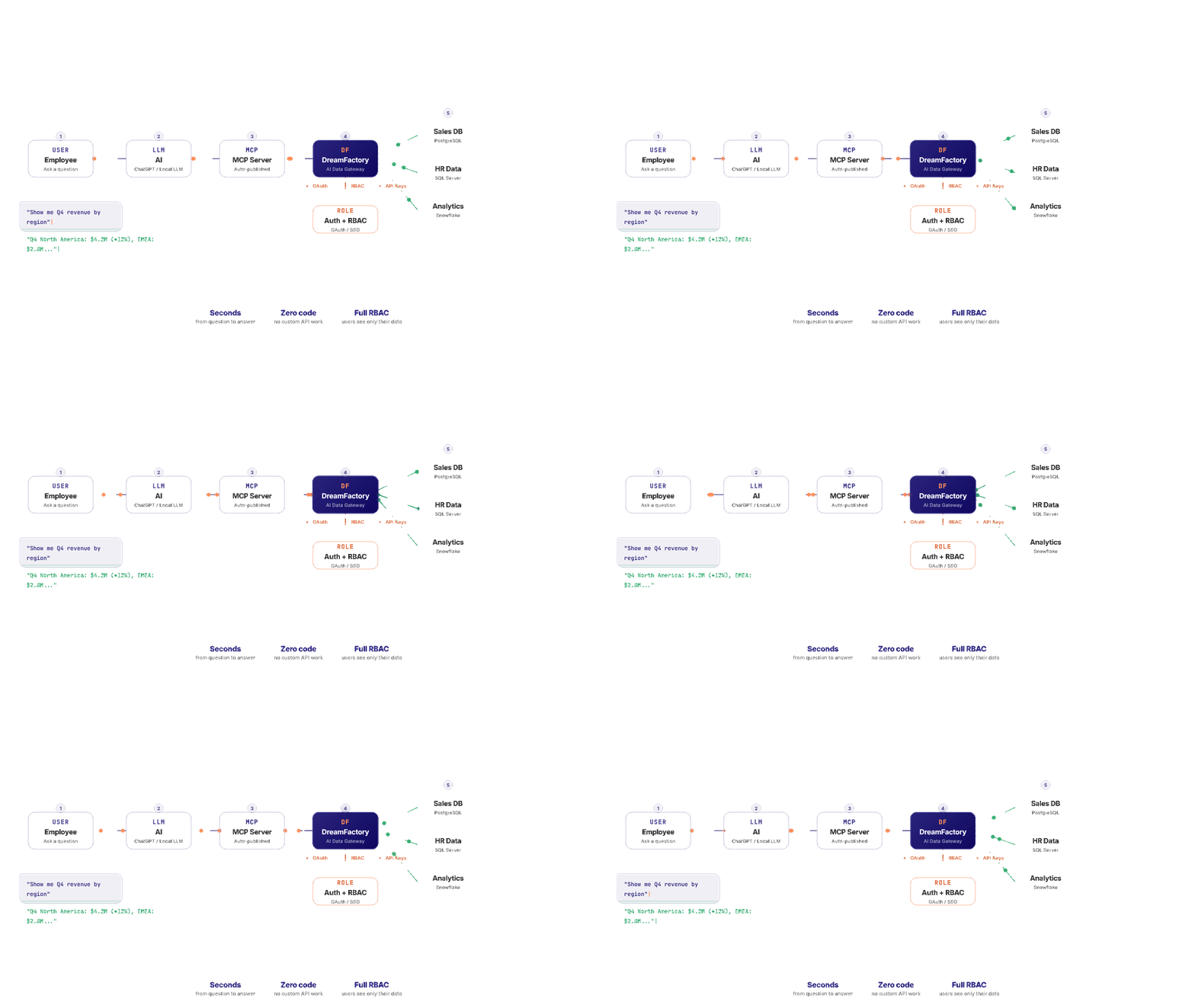
DreamFactory MCP Data Flow

See how DreamFactory connects AI models, applications, databases, and file storage services through governed MCP and REST API endpoints.

Quick Start:

  1. Install DreamFactory on Linux, Windows, Docker, or Kubernetes
  2. Connect a database (MySQL, PostgreSQL, SQL Server, MongoDB, etc.)
  3. DreamFactory auto-generates a REST API with full OpenAPI documentation
  4. Configure roles, API keys, and access controls
  5. Call your APIs from any application, script, or AI model

Key Features

API Generation

  • Automatic REST API creation for SQL and NoSQL databases — no code required
  • OpenAPI/Swagger documentation generated automatically for every endpoint
  • Stored procedure and function support — expose database logic as API endpoints
  • Related data retrieval — fetch parent/child records in a single API call
  • Server-side filtering, sorting, and pagination built into every endpoint
  • Bulk insert, update, and delete operations for high-throughput data access

Security and Access Control

  • Role-based access control (RBAC) — granular permissions per table, endpoint, and HTTP verb
  • API key management — issue, revoke, and rate-limit API keys per application
  • SSO authentication — SAML 2.0, OAuth 2.0, OpenID Connect, Azure AD, LDAP/Active Directory
  • API rate limiting — throttle requests per user, role, or service
  • Audit logging — track every API call with user, timestamp, and payload
  • Data masking and field-level security — control which columns are visible per role

Extensibility

  • Server-side scripting — customize API behavior with PHP, Python, or Node.js at any endpoint
  • Pre- and post-process event scripts — transform requests and responses
  • Custom service creation — build and register your own API services
  • Webhook and event broadcasting — trigger external workflows on data changes

MCP Server (Model Context Protocol)

  • Built-in MCP server for connecting AI models (ChatGPT, Claude, local LLMs) to your databases
  • Governed AI data access — AI queries go through DreamFactory's RBAC and audit logging
  • Deterministic database queries — AI uses structured API calls, not raw SQL generation
    • Tool definitions — expose database tables and stored procedures as MCP tools

Administration

  • Web-based admin console — manage services, roles, users, and API keys from a browser
  • Multi-tenant support — host multiple isolated API environments on a single instance
  • Database schema management — create, modify, and manage tables via API or admin UI
  • API usage dashboards — monitor request volume, errors, and performance

Supported Data Sources

DreamFactory connects to a wide range of databases and services out of the box.

SQL Databases

Database Connector Package Features
MySQL / MariaDB df-mysqldb Full CRUD, stored procedures, views, relationships
PostgreSQL df-sqldb Full CRUD, stored procedures, views, relationships
SQL Server df-sqlsrv Full CRUD, stored procedures, views, relationships
Oracle df-oracledb Full CRUD, stored procedures, views, relationships
SQLite df-sqldb Full CRUD, views
IBM Db2 df-ibmdb2 Full CRUD, stored procedures
SAP SQL Anywhere df-sqlanywhere Full CRUD, stored procedures
Firebird df-firebird Full CRUD, stored procedures
Snowflake df-snowflake Full CRUD, views
Apache Spark / Databricks df-spark Full CRUD, Spark SQL

NoSQL Databases

Database Connector Package
MongoDB df-mongodb
Apache Cassandra df-cassandra
Couchbase [df-co

readme truncated — read the full docs on github

Frequently asked questions

Is dreamfactory free to use?

dreamfactory is open source under the Apache-2.0 licence. There is no licence fee and no seat count — you can self-host it or, where the project offers one, pay a vendor for a managed version instead.

What does dreamfactory do?

DreamFactory is a secure, self-hosted enterprise data access platform that provides governed API access to any data source, connecting enterprise applications a

What is dreamfactory written in?

dreamfactory is primarily written in Shell. Its source is publicly available at https://github.com/dreamfactorysoftware/dreamfactory, and it has 1,788 GitHub stars.



