Dograh is a free, open source automation project written in Python and released under BSD-2-Clause. It has 5,688 GitHub stars, 1,414 forks and 77 open issues, and was last pushed 10 hours ago. On this registry it ranks #26 of 54 tracked projects in Automation, with 5 head-to-head comparisons available. It gained 51 stars over the last 6 tracked days.

What is Dograh?

Dograh is a self-hostable, open-source voice AI platform under the BSD 2-Clause licence that lets teams build production voice agents with a visual workflow builder while keeping every line of source code, model choice, and call data on infrastructure they control.

What it is

Dograh is an open-source voice AI platform written in Python, published as a self-hosted alternative to the proprietary voice-agent products Vapi and Retell. It runs as a full stack deployed with Docker, driven by a browser-based visual workflow builder for designing inbound and outbound voice agents. The project lives in the conversational AI and telephony ecosystem: it integrates with speech-to-speech pipelines, or with separate LLM, speech-to-text, and text-to-speech providers, and it ships an MCP server so coding agents such as Claude Code and Codex can design and edit agents directly inside a Dograh workspace. It also supports telephony providers including Twilio, Vonage, and Telnyx, alongside an Asterisk ARI topic in its repository.

The concrete problem it solves is vendor lock-in and the closed nature of hosted voice-agent services. Teams evaluating Vapi or Retell get per-minute SaaS pricing, proprietary code, and call data resident in someone else's cloud, with customization limited to what the vendor's integrations expose. Dograh replaces that arrangement with a platform the operator hosts, where the LLM, TTS, and STT layers are interchangeable and the source itself is modifiable. Data residency is a property of the deployment rather than a contractual promise, and there is no per-minute tariff attached to the self-hosted path.

Key capabilities

  • Visual workflow builder for agent design, starting from an Inbound or Outbound bot template and a short use-case description.
  • BYOK across two architectures: end-to-end speech-to-speech, or a composable LLM / STT / TTS stack, with any provider or Dograh's bundled stack.
  • Auto-generated API keys and a built-in LLM, TTS, and STT stack, so no external API keys are required to get a first agent running.
  • In-browser testing through Test Audio for live voice conversations and Test Chat for text iteration, including editing or replaying user turns so the agent regenerates replies and node transitions from that point.
  • MCP server integration, letting Claude Code and Codex work inside the workspace; installable via /plugin marketplace add dograh-hq/dograh-plugins and /plugin install dograh@dograh.
  • Telephony support for outbound and inbound calling through providers such as Twilio, Vonage, and Telnyx, with Asterisk ARI listed among the project's topics.
  • Deployment as a Docker Compose stack, downloadable as docker-compose.yaml with a start_docker.sh launcher script.

Who uses it and how

  • Teams that must keep call recordings, transcripts, and prompts inside their own infrastructure for data residency or compliance reasons, deploying the Compose stack rather than consuming a hosted API.
  • Startups and small product teams qualifying leads or screening submissions with an inbound or outbound agent, for example a bot named "Lead Qualification" that screens insurance form submissions for purchase intent.
  • Engineering organisations that want source-level control, modifying the Python codebase and swapping LLM, STT, or TTS providers without waiting on a vendor roadmap.
  • Developers using AI coding assistants, who install the Dograh setup skill into Claude Code or Codex and let the agent detect the OS, choose the deploy path, run the setup scripts, and verify the result.
  • Operators running on-premise voice agents where the on-prem constraint rules out SaaS-only platforms entirely.

Getting started

Download docker-compose.yaml from the Dograh repository, fetch start_docker.sh, make it executable, and run it; then open http://localhost:3010 to create the first voice assistant. A hosted option is also available at https://app.dograh.com, and remote-server deployment is documented at docs.dograh.com.

How it compares

Against Vapi and Retell, both proprietary and SaaS-only, Dograh is BSD 2-Clause licensed and self-hostable, so the code is modifiable at source level rather than configurable within fixed integrations. Pricing differs in kind: Dograh self-hosted is free with a usage-based cloud option, while Vapi and Retell charge per minute. Data residency and vendor lock-in follow from that: on Dograh the operator's infrastructure holds the data and there is no lock-in, whereas on both competitors the data sits in their cloud.

When to use it — and when not to

A self-hoster must run and maintain the Docker Compose stack, including the bundled model stack, and should expect a two-to-three minute first startup while images download. Telemetry is collected by default and must be disabled explicitly by setting ENABLE_TELEMETRY=false before running the startup script, which is a real consideration for privacy-sensitive deployments. Teams that want a fully managed service with no operational surface, or that cannot run Docker at all, should look elsewhere.

project readme (upstream, from github) — read inline

Dograh AI

Dograh: #1 Product of the Day on Product Hunt

The open-source, self-hostable alternative to Vapi & Retell — build production voice agents with a visual workflow builder, test them in minutes, and let AI coding assistants help design and edit them through MCP.


Try the Cloud   Self-host in 60s   Join Slack

📖 Docs  ·  📜 BSD 2-Clause  ·  🌐 中文  ·  🌐 日本語
  • 100% open source, self-hostable — no vendor lock-in, unlike Vapi or Retell
  • Full control & transparency — every line of code is open, with flexible LLM / TTS / STT integration
  • Maintained by YC alumni and exit founders, committed to keeping voice AI open

Dograh - #1 Product of the Day | Product Hunt   Dograh - #1 Product of the Week | Product Hunt
Dograh - #1 Product of the Month | Product Hunt   Dograh - #1 Product of the Month, Developer Tools | Product Hunt
dograh-hq%2Fdograh | Trendshift

🎥 Featured

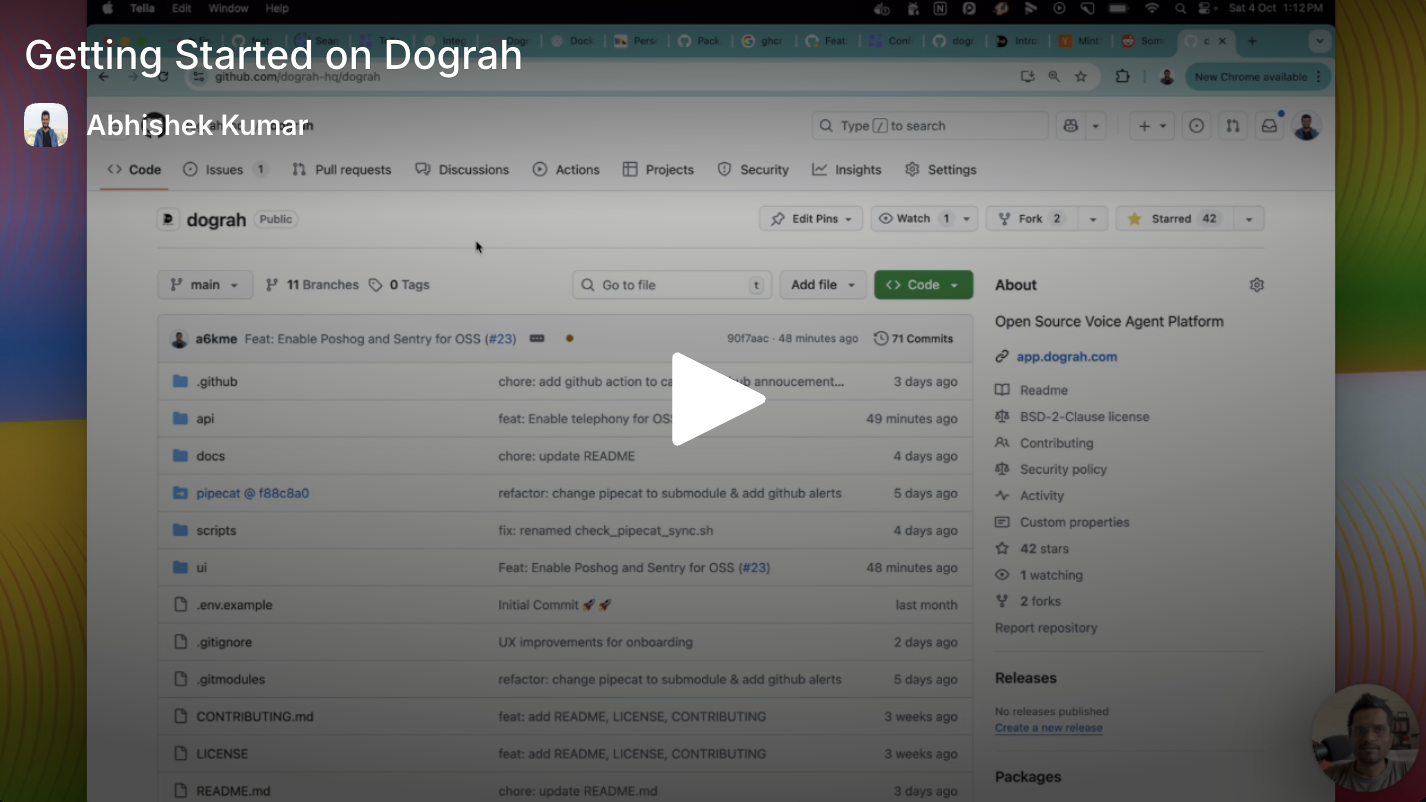
Dograh featured by Better Stack
Featured by Better Stack — a hands-on look at Dograh
📺 Prefer a 2-minute product walkthrough? Click here.
⚖️ Dograh vs Vapi vs Retell

An honest comparison on the axes that matter most to teams evaluating voice AI platforms.

Dograh Vapi Retell
License BSD 2-Clause (open source) Proprietary Proprietary
Self-hostable ✅ Yes — one Docker command ❌ SaaS only ❌ SaaS only
Pricing Free (self-host) · usage-based (cloud) Per-minute SaaS Per-minute SaaS
Bring your own LLM / STT / TTS ✅ Any provider, or use Dograh's stack Configurable within their integrations Configurable within their integrations
Source-level customization ✅ Every line is yours to modify ❌ Closed source ❌ Closed source
Data residency Your infra, your rules Their cloud Their cloud
Vendor lock-in None Full Full

🚀 Get Started

Download and setup Dograh on your Local Machine

Note We collect anonymous usage data to improve the product. You can opt out by setting ENABLE_TELEMETRY=false before running the startup script.

Note If you wish to run the platform on a remote server instead, checkout our Documentation

curl -o docker-compose.yaml https://raw.githubusercontent.com/dograh-hq/dograh/main/docker-compose.yaml && curl -o start_docker.sh https://raw.githubusercontent.com/dograh-hq/dograh/main/scripts/start_docker.sh && chmod +x start_docker.sh && ./start_docker.sh

⚡ Prefer an AI agent to set it up for you? If you use Claude Code or Codex, install the official Dograh setup skill and let your agent handle installation, configuration, and troubleshooting — it detects your OS, picks the right deploy path, runs Dograh's own setup scripts, and verifies the result.

# In Claude Code
/plugin marketplace add dograh-hq/dograh-plugins
/plugin install dograh@dograh

Then start a new session and ask it to "set up Dograh" (or run /dograh-setup). Codex is supported too — see the plugin repo.

Note First startup may take 2-3 minutes to download all images. Once running, open http://localhost:3010 to create your first AI voice assistant! For common issues and solutions, see 🔧 Troubleshooting.

🎙️ Your First Voice Bot

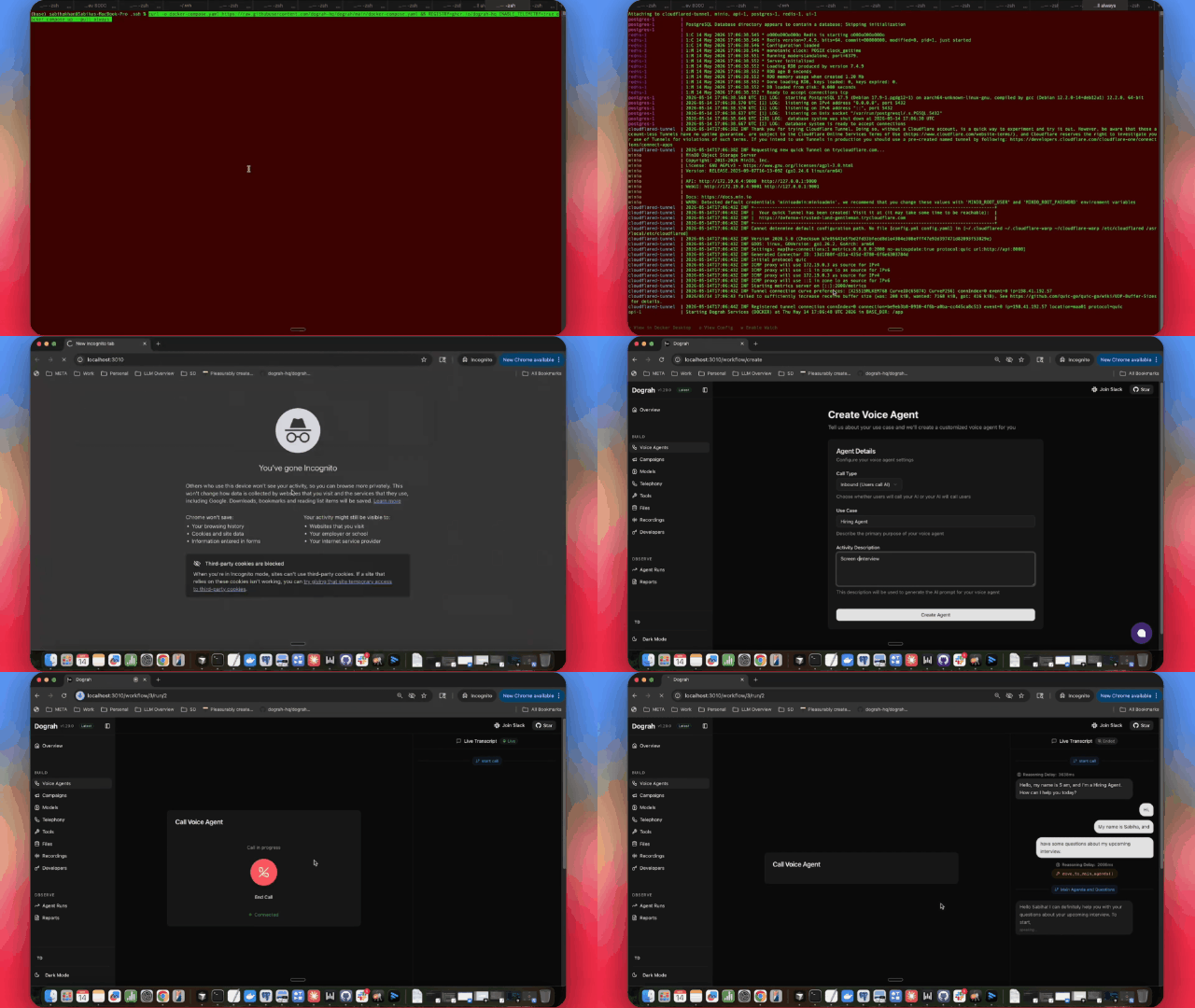
  1. Open http://localhost:3010 in your browser.
  2. Pick Inbound or Outbound, name your bot (e.g. Lead Qualification), and describe the use case in 5–10 words (e.g. Screen insurance form submissions for purchase intent).
  3. Click Test Agent.
  4. Use Test Audio to talk to your agent in the browser, or Test Chat to iterate faster in text. In Test Chat, you can edit or replay user turns and Dograh will regenerate the agent's replies and node transitions from that point.

🔑 No API keys needed. Dograh ships with auto-generated keys and its own LLM / TTS / STT stack. Connect your own keys for LLM, TTS, STT, or Telephony (e.g. Twilio, Vonage, Telnyx) anytime.

Featured On & Community Validation: Dograh was named #1 Product of the Day on Product Hunt.

Build Agents with MCP

Dograh ships with an MCP server, so coding agents can work directly inside your Dograh workspace.

Connect Codex, Claude Code, Cursor, or any MCP client to inspect existing agents, search Dograh docs, fetch node schemas, create new workflows, and save draft edits from natural language.

When asking your coding agent to build a voice agent, share a short script for the use case instead of only a one-line prompt. Include the agent persona, call flow, rules, objection handling, success criteria, and a sample conversation if you have one.

See the MCP guide to connect your assistant.

Features

Voice Agent Builder

  • Visual workflow builder with start nodes, agent nodes, global instructions, tools, transitions, and end-call outcomes
  • Test Agent panel with Test Audio for browser voice testing and Test Chat for fast prompt iteration
  • QA node, knowledge bases, webhooks, embeds, and tool calling for production workflows

Voice & Telephony

  • Built-in telephony integrations including Twilio, Vonage, Telnyx, Plivo, Vobiz, Cloudonix, and Asterisk ARI
  • Human handoff with call transfer on supported telephony providers
  • Bring your own LLM, TTS, STT, and telephony providers; store artifacts in

readme truncated — read the full docs on github

Frequently asked questions

Is Dograh free to use?

Dograh is open source under the BSD-2-Clause licence. There is no licence fee and no seat count — you can self-host it or, where the project offers one, pay a vendor for a managed version instead.

What does Dograh do?

Self-hostable voice agent platform with full model control

What is Dograh written in?

Dograh is primarily written in Python. Its source is publicly available at https://github.com/dograh-hq/dograh, and it has 5,688 GitHub stars.