Homebridge Docker



Official Docker image for Homebridge - Emulate the iOS HomeKit API on your network
📢 Important Update
We have migrated the official Homebridge Docker image from oznu/homebridge to homebridge/homebridge.
Please update your configurations to use the new image location for the latest updates and features.
🚀 Quick Start
Prerequisites
- Docker Engine with networking access
- Host network mode support (required for HomeKit)
⚠️ Compatibility Note: This image does not work with Docker Desktop for Mac or Windows due to networking limitations (details).
📦 Available Images
This is a multi-architecture image supporting x86_64, ARM32v7 (Raspberry Pi), and ARM64v8 platforms. Images are available with Ubuntu 24.04 (default) and Ubuntu 22.04 (for Synology compatibility) base images.
| Image Tag | Architectures | Base Image | Release Type | Description |
|---|---|---|---|---|
latest, ubuntu |
amd64, arm32v7, arm64v8 | Ubuntu 24.04 | Stable | Production-ready with latest stable releases |
legacy |
amd64, arm32v7, arm64v8 | Ubuntu 24.04 | Legacy | Production-ready with Homebridge 1.x stable releases |
synology |
amd64, arm32v7, arm64v8 | Ubuntu 22.04 | Stable | Production-ready with latest stable releases |
beta |
amd64, arm32v7, arm64v8 | Ubuntu 24.04 | Beta | Pre-release with beta versions for testing |
alpha |
amd64, arm32v7, arm64v8 | Ubuntu 24.04 | Alpha | Early access with alpha versions for development |
🛠️ Installation
Using Docker Compose (Recommended)
Create a docker-compose.yml file:
services:
  homebridge:
    image: homebridge/homebridge:latest
    restart: always
    network_mode: host
    hostname: docker-desktop  # Optional: Set container hostname
    volumes:
      - ./volumes/homebridge:/homebridge
    environment:
      - TZ=America/Toronto  # Optional: Set your timezone
      - ENABLE_AVAHI=1      # Optional: Enable/disable Avahi (1=enabled, 0=disabled)
    logging:
      driver: json-file
      options:
        max-size: '10m'
        max-file: '1'
    healthcheck:
      test: ["CMD-SHELL", "curl --fail http://localhost:8581 || exit 1"]
      interval: 60s
      retries: 5
      start_period: 300s
      timeout: 2s
Start the container:
docker compose up -d
Using Docker CLI
docker run \
  --net=host \
  --name=homebridge \
  -e TZ=America/Toronto \
  -v $(pwd)/homebridge:/homebridge \
  homebridge/homebridge:latest
⚙️ Configuration
Required Parameters
| Parameter | Docker Compose | Docker CLI | Description |
|---|---|---|---|
| Network Mode | network_mode: host |
--net=host |
Required - Enables host networking for HomeKit discovery |
| Volume Mount | volumes: |
-v /path:/homebridge |
Required - Persistent storage for config and plugins |
Optional Parameters
| Parameter | Docker Compose | Docker CLI | Default | Description |
|---|---|---|---|---|
| Hostname | hostname: homebridge |
--hostname=homebridge |
Container ID | Set custom hostname for the container |
| Timezone | environment:- TZ=America/Toronto |
-e TZ=America/Toronto |
UTC |
Set timezone (list) |
| Avahi mDNS | environment:- ENABLE_AVAHI=1 |
-e ENABLE_AVAHI=1 |
1 |
Set to 0 to disable Avahi mDNS service |
Note: When running with
ENABLE_AVAHI=0, you can mount the host's mDNS service to enable mDNS usage in the container:volumes: - ./volumes/homebridge:/homebridge - /var/run/dbus:/var/run/dbus # Mount host D-Bus socket - /var/run/avahi-daemon/socket:/var/run/avahi-daemon/socket # Mount host Avahi socket
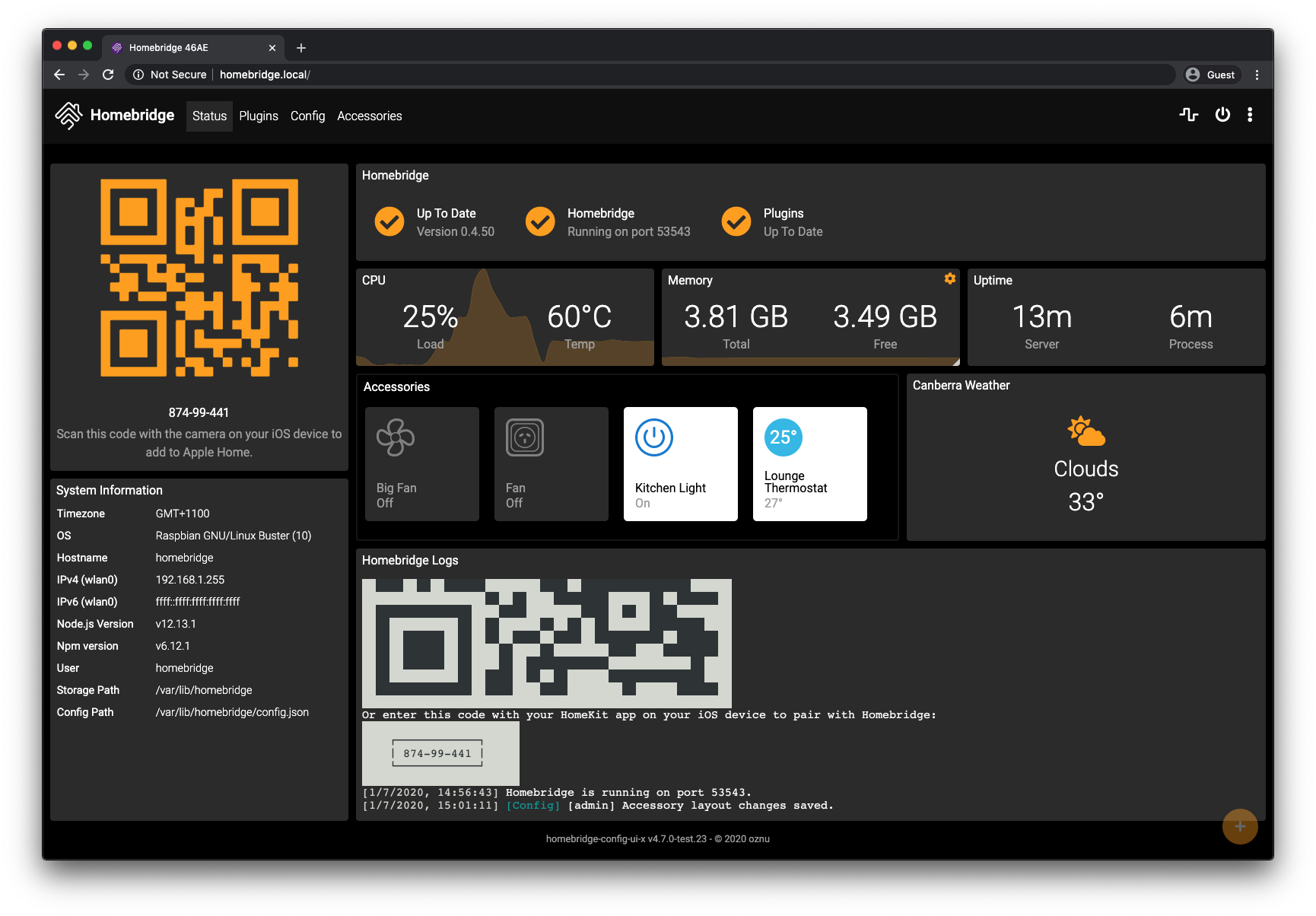
🖥️ Homebridge UI
Access the Homebridge UI at http://:8581
The UI allows you to:
- ✅ Install, update, and remove plugins
- ✅ Edit Homebridge configuration
- ✅ View logs and restart Homebridge
- ✅ Manage accessories and bridges
🔧 Custom Startup Script
For advanced customization, use the Startup Script feature in the UI (Settings → Startup & Environment).

The startup.sh script:
- Runs on every container start
- Persists across container recreations
- Can install packages, copy files, or execute custom commands
Example:
#!/bin/sh

# Install custom Node.js packages
npm install -g some-custom-package

# Install Python dependencies
pip3 install some-python-library

# Copy configuration from host
cp /homebridge/custom-config.json /etc/custom-config.json

📚 Step-by-Step Guides
- Running Homebridge with Docker on Linux
- Running Homebridge on Synology NAS
- Running Homebridge on Unraid
🔄 Updates
Manual Updates
Pull the latest image and recreate your container:
docker compose pull
docker compose up -d
Automated Updates
⚠️ Not Recommended: Automated updates using tools like Watchtower are strongly discouraged and done at your own risk
In-Container Updates
Since the 2025-06-25 release, updates to
- Homebridge core
- Homebridge UI
- Node.js runtime
will be overwritten if the container is updated.
🎥 FFmpeg Support
This image includes FFmpeg with libfdk-aac audio support for camera streaming and video processing.
✅ Container Validation
This repository includes automated validation to ensure container builds work correctly.
Manual Validation
To validate a specific release:
- Go to Actions
- Select "Validate Docker Container"
- Click "Run workflow"
- Choose the release tag:
latest- Stable releasebeta- Beta pre-releasealpha- Alpha early release
The validation workflow will:
- ✅ Start the container and verify it runs
- ✅ Check Homebridge UI accessibility on port 8581
- ✅ Verify Homebridge service starts with version detection
- ✅ Validate container health checks
- ✅ Extract and validate the Docker manifest
🐛 Troubleshooting
1. FFmpeg Issues
FFmpeg with libfdk-aac audio support is included in this image. No additional installation required.
2. Container Won't Start on Older Raspbian
If you see errors like:
Node.js[445]: ../src/util.cc:188:double node::GetCurrentTimeInMicroseconds(): Assertion `(0) == (uv_gettimeofday(&tv))' failed.
s6-svscan: warning: unable to iopause: Operation not permitted
Your host OS needs to be updated. See #434 and #441 for solutions.
3. Get Help on Discord
Join the Official Homebridge Discord and ask in the #docker channel.
📄 License
Copyright (C) 2024 homebridge
Copyright (C) 2017-2022 oznu
This program is free software: you can redistribute it and/or modify it under the terms of the GNU General Public License as published by the Free Software Foundation, either version 3 of the License, or (at your option) any later version.
This program is distributed in the hope that it will be useful, but WITHOUT ANY WARRANTY; without even the implied warranty of MERCHANTABILITY or FITNESS FOR A PARTICULAR PURPOSE. See the GNU General Public License for more details.
Made with ❤️ by the Homebridge community