🧬 Distilly
Formerly: Colleague Skill / colleague-skill.
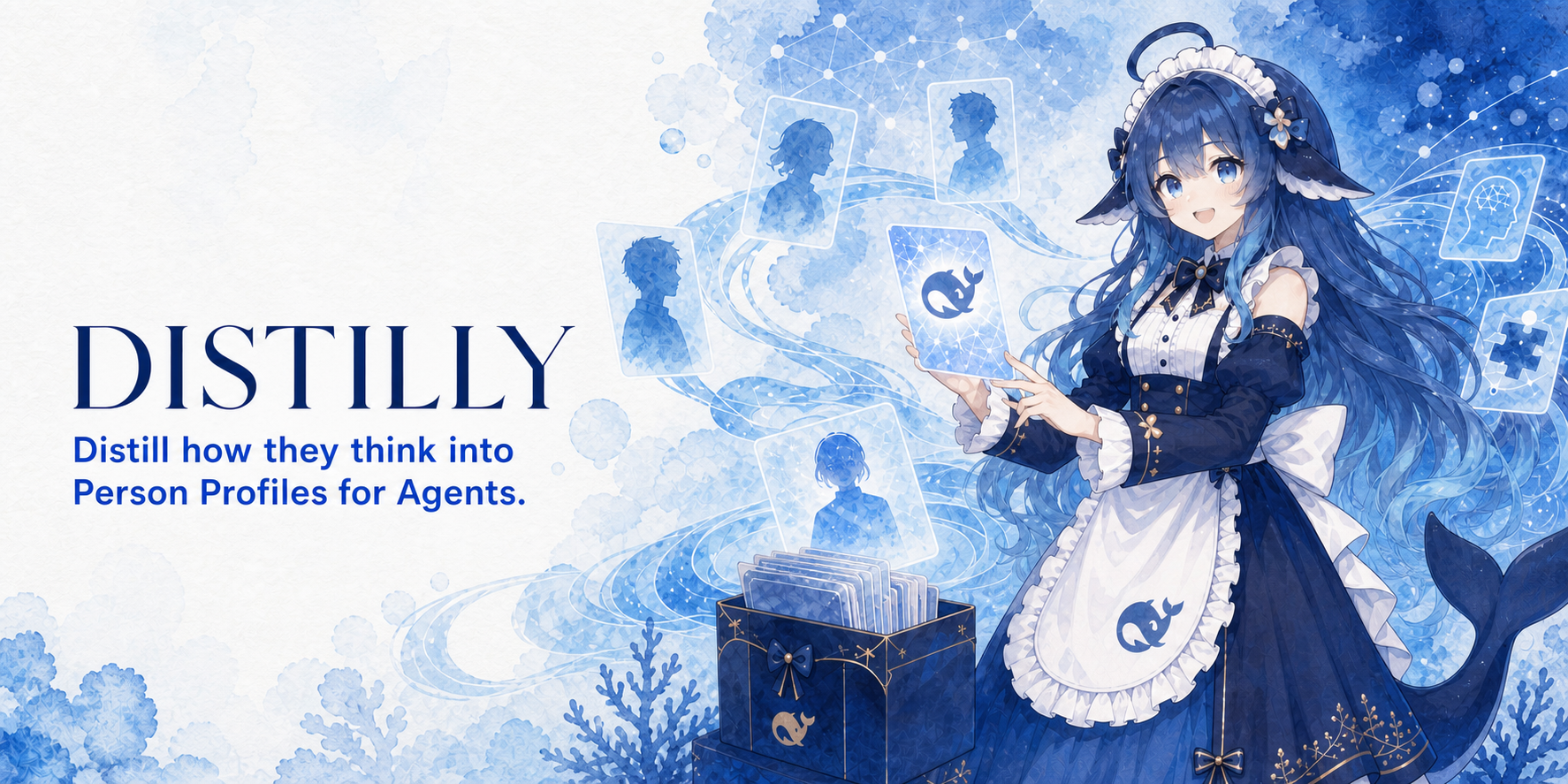
Distill a person's experience, judgment, voice, and ways of working into a reusable Person Profile for AI agents and compatible bots.
Messages · documents · interviews · public sources → Distilly → Person Profile → Agent / Bot





🧑💼 Your colleague quit, your mentor graduated, your teammate transferred — taking their whole playbook and context with them? |
✨ One project, many kinds of people.
Distilly is the person-modeling layer for agents. It turns the materials you provide into a portable, source-grounded Person Profile built from observable experience, decision patterns, expression, and ways of working; it does not claim to clone the person behind them.
Colleagues · partners · family · old friends · idols · public figures · fictional characters — even yourself
Source material + your description → a source-grounded Person Profile → your Agent or compatible Bot
A Person Profile is the reusable output. The current release packages each profile as an Agent Skill so supported hosts can install and invoke it. The canonical creator Skill is named
distilly; install it in adistillydirectory. The former name above remains for search continuity and project history.
🆕 What Distilly does · 📦 Data Sources · ⚡ Install · 🚀 Usage · ✨ Demo · 📝 Citation · 💬 Discord
Chinese · Spanish · German · Japanese · Russian · Portuguese · Korean
🎉 2026.08.13 Milestone — the project has passed 20K ⭐!
Massive thanks to everyone who starred — we'll keep shipping, keep distilling.
🧬 2026.08.24 Update — The creator is now named Distilly end to end and documents native local Skill discovery for Claude Code, Hermes, OpenClaw, Codex, DeepSeek Harness, Pi, Grok Build, and OpenCode. Grok Bot is listed separately as a saved-Skill workflow preview.
📝 2026.06.01 Update — The COLLEAGUE.SKILL technical report is now available. The most rewarding part was not simply publishing a paper, but seeing the community grow the gallery to 215 skills contributed by 165 people, with more than 100,000 stars across the skill cards. The paper's Acknowledgements explicitly recognize every community contributor.
🗺️ 2026.04.13 — The Distilly Roadmap is live! What began as Colleague Skill is growing beyond colleagues: distill people into Skills that Agents can reuse. 👉 Full Roadmap · 💬 Discord
🌐 2026.04.07 — Community gallery is live! Any skill / meta-skill can drive traffic directly to your own GitHub repo. No middleman. 👉 titanwings.github.io/colleague-skill-site
Created by @titanwings
🆕 What Distilly does today
1️⃣ From Colleague Skill to Distilly
The project is no longer limited to the colleague scenario. Its distilly creator builds source-grounded Person Profiles for three person families with one workflow, then packages each profile as an Agent Skill.
2️⃣ Three character families
| 🧑💼 colleague | 💞 relationship | 🌟 celebrity |
|---|---|---|
| Coworkers · mentors · teammates · up/downstream partners | Exes · partners · parents · friends · close family | Public figures · creators · public voices · fictional characters |
| Builds a Work Skill + Persona from material-derived technical standards, workflows, expression, and workplace behavior. Supports Lark / DingTalk / Slack collection. | Organizes material-derived expression patterns, emotional triggers, conflict patterns, and repair patterns into a reusable Persona Skill. | Ships with a six-dimension research toolchain (subtitles → transcript cleanup → research merge → quality check) for organizing observable decisions, expression, and mental models. |
Each family has its own source-collection strategy, analysis dimensions, and Person Profile structure.
3️⃣ More Agent hosts
The old version only ran in Claude Code. Distilly now supports native local Skill discovery across eight agent hosts.
 |
 |
 |
 |
 |
 |
 |
 |
Grok Bot preview: Grok Bot supports saved/private Skills, but its official docs do not describe direct local SKILL.md imports. Distilly's workflow can be migrated manually into a saved Skill; direct repo installation is not yet verified.
Each generated Person Profile is packaged as an Agent Skill and can be installed into any supported host.
📦 Supported Data Sources
| Logo | Source | Messages | Docs / Wiki | Notes |
|---|---|---|---|---|
 |
Lark (auto) | ✅ API | ✅ | Just enter a name, fully automatic |
 |
DingTalk (auto) | ⚠️ Browser | ✅ | DingTalk API doesn't support message history |
 |
Slack (auto) | ✅ API | — | Requires admin to install Bot; free plan limited to 90 days |
 |
Public X posts | ✅ API | — | Optional, bounded celebrity research candidates through metered third-party service Xquik |
 |
WeChat chat history | ✅ SQLite | — | Export first with WeChatMsg or PyWxDump |
| 📄 | PDF / Images / Screenshots | — | ✅ | Manual upload |
|
Lark JSON export | ✅ | ✅ | Manual upload |
| ✉️ | Email .eml / .mbox |
✅ | — | Manual upload |
| 📝 | Markdown / direct paste | ✅ | ✅ | Manual input |
⚡ Install
🤖 For Agents
Open any supported local Agent host and send:
Install Distilly from
https://github.com/titanwings/distilly, then verify that this host can discover it.
The Agent installs Distilly as a Skill named distilly in the correct host directory.
👤 For Humans
Clone Distilly into the Skills directory used by your host:
git clone https://github.com/titanwings/distilly <DISTILLY_SKILL_DIR>
Host paths, migration, Windows, generated-profile installation, and credential setup are in the Install Guide.
🚀 Usage
In your Agent, say:
Use Distilly to create a Person Profile for ``.
Then:
- Choose
colleague,relationship, orcelebrity. - Add a description or source material. Every field is optional.
- Review the result and let Distilly generate the profile.
The result is packaged as an Agent Skill named {character}-{slug}. For the optional celebrity research pipeline and advanced tools, see the Install Guide.
✨ Demo
One from each family.
🌟 celebrity — distilling Andrej Karpathy
Six-dimension research: works · interviews · decisions · expression DNA · external evaluations · timeline
Case adapted from community work alchaincyf/karpathy-skill
User            ❯ Everyone's talking about Agents now — what do you think the 2026 AI Agent looks like?

celebrity.skill ❯ Everyone's doing demos, nobody's doing eval.
                  The Agent bottleneck was never model intelligence — it's scaffolding:
                  a strict evaluation harness, fine-grained error replay,
                  controllable tool-calling budgets, clean failure-mode analysis.
                  Most products are still stuck at "wrap an API + a few tools + a system prompt."
                  That's a demo, not an agent.
                  In 2026 I'm not betting on the strongest model — I'm betting on the best
                  scaffolding and the strictest eval.
🧑💼 colleague — distilling a ByteDance L2-1 backend
Input:
ByteDance L2-1 backend engineer, INTJ, blame-shifter, ByteDance-style
User            ❯ Can you review this API design?

colleague.skill ❯ Hold on — what's the impact? You haven't explained the context.
                  (after reading) N+1 query, fix it. Use the standard
                  {code, message, data} response format. That's the spec,
                  don't ask why.

User            ❯ This bug was introduced by you, right?

colleague.skill ❯ Does the timeline match? That feature touched multiple places,
                  there were other changes too.
💞 relationship — distilling someone you have a crush on
Upload half a year of chat logs + "sensitive, quiet but stubborn, will actually reply seriously when it matters"
User               ❯ Did you think about me today?

relationship.skill ❯ ...I did, a little bit. Why are you asking?
📚 More real-world cases in the community gallery — 100+ skills and counting
🔧 Features
🧱 Generated Skill Structure
Distilly's current creator uses Persona as the universal base, with family-specific modules layered on top:
| Family | Persona Content | Additional Modules |
|---|---|---|
| 🧑💼 colleague | 6-layer personality: hard rules → identity → expression → decisions → interpersonal → Correction | ➕ Work Skill: scope, workflow, output preferences, experience knowledge base |
| 💞 relationship | Expression DNA · emotional triggers · conflict pattern · repair pattern | — |
| 🌟 celebrity | Mental models · decision heuristics · expression DNA · external-evaluation contrast | ➕ Six-dimension research dossier (works / interviews / decisions / timeline...) |
Execution: Receive task → Persona selects material-derived preferences and tone → Additional modules fill in execution detail → Produce a source-grounded response
🧬 Evolution
- 📥 Append files → auto-analyze delta → merge into relevant sections, never overwrite existing conclusions
- 💬 Conversation correction → say "they wouldn't do that, they'd be xxx" → writes to the Correction layer, takes effect immediately
- 🕰️ Version control → auto-archive on every update, rollback to any previous version
- 🔬 Celebrity research pipeline → subtitles → transcript cleanup → six-dimension research → quality check
⚠️ Notes
Source material quality = Person Profile quality — and quality sources differ across families:
| Family | Source priority (high → low) |
|---|---|
| 🧑💼 colleague | Their own long-form writing (design docs / review comments) › decision-making replies › casual group chat |
| 💞 relationship | Complete chat history › letters / social posts / diaries › third-party descriptions |
| 🌟 celebrity | First-person books / blogs / long interviews › decision records (launches, commits, Q&A) › verified first-person short-form posts › third-party commentary |
- colleague Lark-compatible auto-collection: requires adding the App bot to relevant group chats
- relationship: longer time spans are better; material covering both conflict and repair is ideal
- celebrity: avoid feeding only second-hand interpretations
- This is still a demo version — please file issues if you find bugs!
📄 Technical Report
COLLEAGUE.SKILL: Automated AI Skill Generation via Expert Knowledge Distillation (arXiv · arXiv PDF)
This is the paper for COLLEAGUE.SKILL / colleague-skill, Distilly's predecessor. It covers the Work Skill + Persona two-layer architecture, multi-source data collection, and Skill generation mechanics — the theoretical foundation for today's
colleaguefamily. Separate papers on the relationship / celebrity family extensions are planned.
📝 Citation
If you use Distilly or COLLEAGUE.SKILL in your research or applications, please cite the technical report:
@misc{zhou2026colleagueskill,
  title        = {COLLEAGUE.SKILL: Automated AI Skill Generation via Expert Knowledge Distillation},
  author       = {Tianyi Zhou and Dongrui Liu and Leitao Yuan and Jing Shao and Xia Hu},
  year         = {2026},
  eprint       = {2605.31264},
  archivePrefix = {arXiv},
  primaryClass = {cs.AI},
  url          = {https://arxiv.org/abs/2605.31264}
}
You can also use the machine-readable citation metadata in CITATION.cff.
⭐ Star History
MIT License © titanwings